Transit-Oriented Development (TOD)/Joint Development for Buffalo - - PowerPoint PPT Presentation
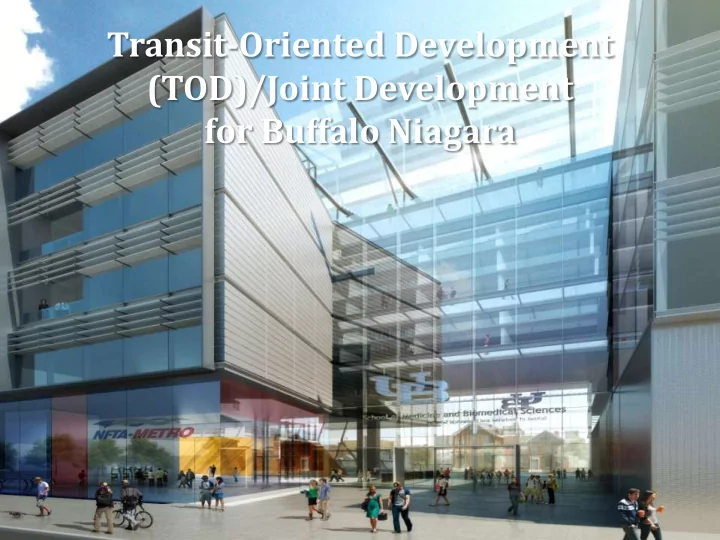
Transit-Oriented Development (TOD)/Joint Development for Buffalo Niagara TOD/Joint Development for Buffalo Niagara Transit-Oriented Development (TOD) Compact, mixed-use development near transit facilities and high-quality walking
Transit-Oriented Development (TOD) – Compact, mixed-use development near transit facilities and high-quality walking
- environments. TOD leverages transit infrastructure to promote
economic development and cater to shifting demands and lifestyle preferences. Joint Development – A form of TOD that is often project specific, taking place on, above, or adjacent to transit agency property, which the transit agency owns or leases or will acquire in whole
- r in part with FTA funds. FTA supports joint development
through its planning and capital assistance programs and allowing property previously acquired with FTA assistance to be used for joint development.
TOD/Joint Development for Buffalo Niagara
Benefits of TOD for Buffalo Niagara
- Less land consumed for development
- Catalyst for urban core redevelopment
- Increased physical activity
- Increase in property and sales taxes
- Fewer vehicle miles traveled
- Reduced air pollution
- Lower dependency on fossil fuels
- Reduced greenhouse gas emissions
- A more resilient transit agency
TOD/Joint Development for Buffalo Niagara
Benefits of TOD for NFTA
- Increased link between transit and development
- Strengthens core routes
- Facilitates linkages between core and secondary routes
- Can focus ridership on more efficient, higher service light rail
- Increased access for all populations
- Increased ridership
- Increases transit formula funding
- Increase in revenue sources and overall revenue for NFTA
- Improve scoring for Capital Investment Grant Program (i.e.
New Starts, Small Starts)
TOD/Joint Development for Buffalo Niagara
Increased Revenue for NFTA
- 1. Joint Development Revenue
- Air Rights Revenue
- Land Lease
- 2. Value Capture
- Bonding for Capital Improvements on Future Increase in
Property Tax Revenue
- Capturing Portion of Tax Revenue for Transit Improvements
- 3. Other Revenue Enhancements
- Ridership Gains
- Share/Reduced New Capital Costs
TOD/Joint Development for Buffalo Niagara
Improve Scoring for CIG Program
- Provides up to 50 percent of capital costs for new light rail, bus rapid
transit or system capacity improvements
- “Economic Development” scoring criteria is based on “breakpoints” in
the following categories
- Transit-Supportive Corridor Policies
- Supportive Zoning Near Transit
- Tools to Implement Transit-Supportive Plans and Policies
- Performance of Transit-Supportive Plans and Policies
- Potential Impact of Transit Project on Regional Development
- Plans and Policies to Maintain or Increase Affordable Housing in
Corridor
TOD/Joint Development for Buffalo Niagara
Transit Options Amherst-Buffalo
- Provide a fast, reliable, safe and
convenient transit ride in the corridor
- Link established and emerging
activity centers
- Support economic development
- pportunities
- Better serve transit-dependent
population
Requires a Coordinated, Collaborative, Regional Approach Leaders/Stakeholders include:
- GBNRTC
- Niagara Frontier Transportation Authority
- Municipalities (i.e. cities, villages, towns and counties)
- New York State
- Economic Development Entities (i.e. ECIDA)
- Community Development Agencies (i.e. LISC/National Equity
Fund)
- Housing Agencies (i.e. Belmont Housing Resources)
- Private Developers
- Transit Advocates
TOD/Joint Development for Buffalo Niagara
Requires a Coordinated, Collaborative, Regional Approach
The mismatch between leadership on transit investments and land development is a significant challenge in effectuating transit-
- riented development
* From FTA Report No. 0052 – Planning for Transit-Supportive Development: A Practitioner’s Guide
TOD/Joint Development for Buffalo Niagara
Transit Investments Land Development Federal Transit Administration Significant None New York State Significant Some GBNRTC Significant Little NFTA Significant Little Erie County Some Some Cities, Towns and Villages Little Significant Private Developers Little Significant
Federal Transit Administration TOD Planning Pilot Program Funding Opportunity
- $19.98 million available nationwide to transit projects sponsors (i.e. NFTA) for comprehensive
planning work that addresses barriers to TOD implementation in proposed CIG grant program corridors (i.e. TO Amherst-Buffalo)
- Strategies and work plans to support TOD
- Financing strategies for development around stations
- TOD focused zoning codes
- Tool development and implementation to encourage TOD including land banking, value
capture and development financing
- Analysis and implementation strategy to promote multimodal access to transit stations and
improve connectivity of disadvantaged populations to essential services
- Requires partnership with at least one local land use entity (i.e. Town of Amherst, City of Buffalo)
- Response due November 3
- Targeted to mature CIG project proposals
TOD/Joint Development for Buffalo Niagara
TOD/Joint Development Funding Opportunities
- Western New York Power Proceeds Allocation Board
- Economic development incentives for private (i.e. for-
profit, non-profit) sector
- Can used to fund infrastructure and transportation projects
that are adopted in regional transportation plans
- Better Buffalo Fund – Transit-Oriented Development Funding
- Up to $2 million in gap financing for projects within ¼ mile
- f transit stops on Bailey Avenue, Grant Street, Main
Street, Niagara Street and Utica Street in Buffalo
- Applications due December 1, 2014