Transit Oriented Development BART Board 2020 Workshop Transit - - PowerPoint PPT Presentation

transit oriented development
SMART_READER_LITE
LIVE PREVIEW

Transit Oriented Development BART Board 2020 Workshop Transit - - PowerPoint PPT Presentation

Rendering of Lake Merritt TOD Source: Strada, EBALDC Transit Oriented Development BART Board 2020 Workshop Transit Oriented Development: Discussion Objectives Update on: AB 2923 implementation progress and engagement plan AB


slide-1
SLIDE 1

Transit‐Oriented Development

BART Board 2020 Workshop

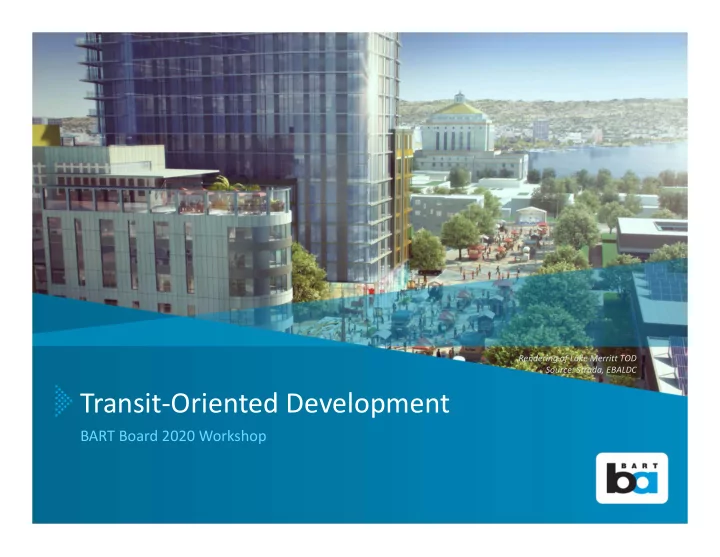
Rendering of Lake Merritt TOD Source: Strada, EBALDC
slide-2
SLIDE 2

1

Transit‐Oriented Development: Discussion Objectives

  • Update on:
  • AB 2923 implementation progress

and engagement plan

  • AB 2923 Guidance Document
  • 10‐Year TOD Work Plan
  • Discuss future TOD financial Return

expectations for affordable housing

slide-3
SLIDE 3

2

AB 2923 Outreach to Date

  • April/May 2019: 22 meetings with

affected jurisdictions

  • Jan & Jun 2019: BART Board
  • July 2019: stakeholder work session w/

50+ attendees

  • BART Title VI/LEP Committees
  • 5 City Council meetings
  • Mayors conferences
  • Email updates to 2,000‐person

stakeholder list

  • SPUR Urban Infrastructure Council

Presentation

  • EBHO Regional Policy Committee
  • Ongoing work with 3 Case Study

jurisdictions

  • 2 webinars
  • www.bart.gov/AB2923

AB 2923 Outreach

Public Local Elected Officials & Staff Regional Advocates BART Board & Committees Developers

Community Groups

slide-4
SLIDE 4

3

AB 2923 Upcoming Deliverables

Guidance Document: Responds to questions raised in

  • utreach on law. Limited to areas covered in language of

bill. 10‐Year Work Plan: Defines when and where BART plans to advance TOD in law timeline Other Upcoming Deliverables (required by law):

  • Parking replacement policy
  • Transportation demand management strategy
  • Anti‐displacement strategy in partnership with local

jurisdictions

  • Outreach to Communities of Concern
  • Biannual report to CA Housing & Community Development

Department

slide-5
SLIDE 5

4

AB 2923 Upcoming Deliverables: Relationship of 10‐Year Work Plan and Guidance Document

Guidance Document 10‐Year Work Plan Scope AB2923‐Affected Properties Only All developable BART property Primary Audience Local Jurisdictions All stakeholders with interest in BART’s TOD program Intent Clarify parts of AB2923 language, especially related to zoning Articulate BART’s intentions related to development Reach Only clarifies what is in

  • law. Jurisdictions still

have leeway with how they intend to conform Specific direction from BART on its expectations around development

slide-6
SLIDE 6

5

AB 2923 Upcoming Outreach

www.bart.gov/AB2923 Stakeholder Workshop: Friday Feb 21 Local jurisdiction staff, regional stakeholders, housing advocates, community‐based organizations Webinars: 1st Week in March Email sent to 1,600+ subscribers of TOD email list Meetings w/Communities of Concern Planning for Late February‐ April 2020

slide-7
SLIDE 7

AB 2923 Guidance Document

slide-8
SLIDE 8

7

AB 2923 Guidance Document

  • Clarifies grey areas of the law
  • Top 3 Questions:

1. What does the allowable building height and floor area ratio mean (e.g. is it a minimum limit)? 2. How will BART determine if local zoning conforms with law? 3. How will BART patron parking be incorporated?

  • Guidance Document outline

Available for public comment until March 16

slide-9
SLIDE 9

8

AB 2923 Background

Setting initial standards

  • Per June 2019 Board discussion, 2017 TOD Guidelines will

become TOD Zoning Standards on July 1, 2020

Local jurisdiction rezoning

  • Local jurisdiction rezones by June 30, 2022 or zoning

defaults to TOD Zoning Standards

  • BART to determine conformance with Zoning Standards

Until 2029 when bill sunsets

  • BART Board can adopt TOD Zoning Standards any time

(with CEQA documentation)

  • Local jurisdiction has 2 years to rezone from that point
slide-10
SLIDE 10

9

2017 TOD Guidelines (Basis for Zoning Standards)

slide-11
SLIDE 11

10

AB 2923 Guidance: Case Studies (Ha Hayw ywar ard, North Berkeley, Pittsburg Center)

Consider: What BART owns, what is developable

slide-12
SLIDE 12

11

AB 2923 Guidance: Case Studies (Ha Hayw ywar ard, North Berkeley, Pittsburg Center)

Consider: What has the City zoned for today?

slide-13
SLIDE 13

12

AB 2923 Guidance: Case Studies (Ha Hayw ywar ard, North Berkeley, Pittsburg Center)

Consider: does zoning conform? What needs to change?

slide-14
SLIDE 14

13

AB 2923 Guidance: Case Studies Early Findings

  • Density, Height, Floor‐Area‐Ratio (FAR) do not often line up well

(More density is needed to achieve heights, more height is needed to achieve FAR)

  • On larger properties, achieving required Floor‐Area‐Ratio

calculation in AB 2923 is nearly impossible within height limits

  • Limited room for other design regulations (e.g. shadow planes,
  • pen space requirements)
  • BART will need to make a clear commitment to ensuring high

quality design in actual development projects

slide-15
SLIDE 15

10‐Year Work Plan for Transit‐Oriented Development

slide-16
SLIDE 16

15

10‐Year Work Plan for Transit‐Oriented Development

Local Interest in Development

  • f BART Land

Based on interviews with staff from 22 local jurisdictions, April/May 2019

slide-17
SLIDE 17

16

10‐Year Work Plan for Transit‐Oriented Development Work Plan Phases

  • 1. Performance Evaluation using BART’s 2016 Board‐

adopted performance targets

  • 2. Clarify BART’s development opportunities
  • 3. Prioritize sites for new TOD projects (e.g. RFP/Q) using

3 criteria

  • 4. Define next steps for short term priorities

Dynamic: Update every 2‐4 years

slide-18
SLIDE 18

17

10‐Year Work Plan for Transit‐Oriented Development Phase 1: Performance Evaluation

slide-19
SLIDE 19

18

10‐Year Work Plan for Transit‐Oriented Development Phase 1: Performance Evaluation

Project (Year completed) Total Units Affordable Units % Affordable Office (SF) Retail (SF) Hotel (Rooms) Castro Valley (1993) 96 96 100% Fruitvale Phase I (2004) 47 10 21% 27,000 37,000 Pleasant Hill Phase I (2008) 422 84 20% 35,590 Hayward (1998) 170 0% Ashby (2011) 0% 80,000 Richmond Phase I (2004) 132 66 50% 9,000 MacArthur Ph I & II (2016 & 2019) 475 90 19% 33,000 San Leandro (2017 & 2019) 200 200 100% 5,000 1,000 West Dublin (2013) 309 0% East Dublin (2008) 240 0% South Hayward Ph I (2017) 354 152 43% West Pleasanton (2019) 0% 410,000 Coliseum (2019) 110 55 50% 2555 753 29% 522,000 115,590 MacArthur Ph III (began 2018) 787 56 7% 13,000 Walnut Creek (began 2017) 596 0% Pleasant Hill Block C (began 2018) 200 0% Fruitvale Phase IIA (began 2018) 94 92 98% 1677 148 9% 13,000 Millbrae (Approved) 400 100 25% 150,000 45,000 164 Pleasant Hill Block D (Approved) ~290,000 Fruitvale Phase IIB (Approved) 181 179 99% 6,000 Balboa Park (In Negotiation) 131 131 100% 3,000 West Oakland (In Negotiation) ~750 ~240 ~32% ~380,000 ~50,000 Lake Merritt (In Negotiation) ~500 ~200 ~44% ~500,000 North Concord (Solicitation in 2019) ~360 ~90 ~25% ~800,000 GRAND TOTAL ‐ ALL PHASES 5673 1841 32% 2,642,000 232,590 164 Completed TOTAL COMPLETED TOTAL UNDER CONSTRUCTION Under Construction Planned

slide-20
SLIDE 20

19

10‐Year Work Plan for Transit‐Oriented Development Phase 1: Performance Evaluation

Current BART TOD Program Progress Toward 2025 Goal

1 million square feet 7,000 units 2,450 units 2.9 m. square feet 6,226 units 1,840 units

In Negotiation

19

slide-21
SLIDE 21

20

10‐Year Work Plan for Transit‐Oriented Development Phase 1: Performance Evaluation

Current BART TOD Program Progress Toward 2040 Goal

4.5 million square feet 20,000 units 7,000 units 2.9 m. square feet 6,226 units 1,840 units

In Negotiation

20

slide-22
SLIDE 22

21

10‐Year Work Plan for Transit‐Oriented Development Phase 1: Performance Evaluation

Housing Units: Pace of Development Since 1990s

slide-23
SLIDE 23

22

10‐Year Work Plan for Transit‐Oriented Development Phase 1: Performance Evaluation – Summary of Findings Office: Current pipeline of projects exceeds 2025 target, 63% of 2040 target. Should assume some losses due to project delivery risk Overall Residential: 774 units short of 2025 goal. Projects initiated in next 2 years could support 2025 goal Affordable Housing: Largest 2025 % shortfall, with 610 new units needed (out of 774 total)

slide-24
SLIDE 24

23

10‐Year Work Plan for Transit‐Oriented Development Phase 2: Clarify Development Opportunities

  • A. Evaluate suitability of BART property for development
  • B. Remove properties needed for BART operations
  • C. Articulate BART expectations by station for:
  • Parking replacement (based on Access Typology)
  • Job‐generating uses
  • Affordable housing
  • D. Evaluate BART staff capacity to initiate new projects
slide-25
SLIDE 25

24

10‐Year Work Plan for Transit‐Oriented Development Phase 2: Clarify Development Opportunities

Deep Dive: Articulate BART expectations for job‐ generating uses and affordable housing

Excerpt from 2017 TOD Guidelines, showing sites reserved for employment uses in red

slide-26
SLIDE 26

25

Prefer Housing Prefer Jobs Flexible On Use

May not be subject to AB 2923*

*Orinda: BART does not own land but a development would require BART staff time Daly City: Only a small portion of property is subject to AB2923 Irvington: Application of AB 2923, and BART‐owned land depends on cost of project, TBD

Existing Development Agreement

Source: Jurisdiction Staff Interviews, April/May 2019 No market feasibility screen applies

No developable BART‐

  • wned land

10‐Year Work Plan for Transit‐Oriented Development Phase 2: Clarify Development Opportunities

25

slide-27
SLIDE 27

26

10‐Year Work Plan for Transit‐Oriented Development Phase 3: Prioritize Stations through Screening Process

1. Development Readiness

  • Market Feasibility
  • Feasibility of Non‐Market Driven Uses (Affordable Housing / Institutional Users)
  • Nearby development activity
  • Surrounding station access context supports TOD (walkability, eg)

2. Local Support

  • Alignment of City/County support with BART’s priorities
  • Zoning for desired BART uses / densities
  • Recent community engagement demonstrates local support
  • Risk of displacement and local anti‐displacement policies

3. Implementation Barriers & Opportunities

  • BART infrastructure needs & possible cost/complexity (replacement parking, e.g.)
  • Competitiveness for federal, state, regional funding sources
  • Availability of local funding to support affordable housing/infrastructure costs
  • Other expected funding opportunities (e.g. foundation grants)
  • Local experience with innovative financing/implementation measures (e.g. EIFD,

parking districts)

slide-28
SLIDE 28

27

10‐Year Work Plan for Transit‐Oriented Development Phase 4: Define Next Steps for Short‐Term Priorities

How well do priority TOD sites address BART’s TOD goals? ‐ TOD Targets ‐ Ridership (reverse commute) ‐ Revenue? What more is needed from BART to achieve these goals? ‐ Planning/Predevelopment ‐ Station modernization priorities ‐ Land value / grants / financial?

El Cerrito Plaza Parking Lot

slide-29
SLIDE 29

TOD Implementation Deep Dive: Funding Affordable Housing

slide-30
SLIDE 30

29

Revenue from Land Value

Increase Non‐Ridership Revenue

Provide Community Benefits (Beyond City Requirements) Upgrade BART Infrastructure (Parking Garages, Police Facilities, Station/Access Upgrades)

Ground Lease, Participation

Transit‐Oriented Development Financial Return Background

slide-31
SLIDE 31

30

Transit‐Oriented Development Financial Return Background

$- $1 $2 $3 $4 $5 $6 $7 $8 2005 2006 2007 2008 2009 2010 2011 2012 2013 2014 2015 2016 2017 2018 2019 2020 2021 2022 2023 2024 2025 2026 2027 2028 2029 2030 2031 2032 2033 2034 2035 Millions

Anticipated Revenue from Existing & Planned TOD Projects

LEASE/SALE FOR CURRENT TOD LEASE/SALE FUTURE TOD PARTICIPATION CURRENT TOD PARTICIPATION FUTURE TOD

~$80 m. to Parking: MacArthur1 Richmond1 San Leandro1 Fruitvale2 Pleasant Hill2 Walnut Creek2

1Parking replacement as consideration for sale of land to 3rd party 2Lease credit or similar deferred payment to cover cost of parking

slide-32
SLIDE 32

31

Transit‐Oriented Development Financial Return Background

Current TOD Deals only – more revenue from future deals in next 20 years * Net Present Value from 30 years of revenue ** Based on construction cost

slide-33
SLIDE 33

32

Affordable Housing – Typical Funding Gap

Affordable housing gap filled by local funding is ~$135,000 ‐ $200,000 / unit Availability of funds varies by city and county

55% 7% 28%

$526,452*

11%

$0 $100,000 $200,000 $300,000 $400,000 $500,000 $600,000 Five-County Average Funding Amount ($)

Per Unit Funding Source For a Sample of Affordable Housing Projects in the Bay Area Region, 2013-2016

OTHER CITY/COUNTY REGIONAL STATE FEDERAL

*Values in bold represent total development cost per unit. Includes Alameda, Contra Costa, San Francisco, San Mateo and Santa Clara Counties. Source: Pro formas for 46 affordable housing projects made available by the California Tax Credit Committee, 2013‐2016; Novin Development and Strategic Economics, 2017.

Funding Gap

slide-34
SLIDE 34

33

Affordable Housing – Typical Land Cost

Excerpt from “Making it Pencil: The Math Behind Housing Development,” David Garcia, Terner Center http://ternercenter.berkeley.edu/uploads/Making_It_Pencil_The_Math_Behind_Housing_Development.pdf

Land cost is ~$25,000‐$75,000 per unit

slide-35
SLIDE 35

34

Affordable Housing – Anatomy of a Deal

BART’s past approach to affordable housing deals:

  • 1. Direct ground lease (Castro Valley)
  • 2. Land as consideration or lease credit for parking garages, other

infrastructure (MacArthur, San Leandro, Fruitvale, Richmond)

  • 3. Land value as in‐kind match to City, County financial

contributions (Millbrae) BART’s past approaches do not offer a “standard practice” model

slide-36
SLIDE 36

35

Affordable Housing – Other Agency Practices

Los Angeles Metro: up to 30% discount for projects Pros:

Offers certainty to developers, retains some revenue

  • Cons: First project under new policy needed a 42% discount

Sound Transit: Voter approved state law requires 80% land to affordable projects, with at least 80% units affordable, to 80% median income or less

  • Pros: No ambiguity about the agency’s goal; leveraged outside

partnerships with funders

  • Cons: limited to no revenue to Sound Transit
slide-37
SLIDE 37

36

Transit‐Oriented Development: Key Discussion Question

What are BART’s financial goals for affordable housing, given the barriers to delivering on our 35% affordability goal?

slide-38
SLIDE 38

37

Transit‐Oriented Development: Proposed Framework for Affordable Housing Discount

Fair Market Value (No Discount) 30% Discount

Board Authorization needed for deeper discount

BART’s Negotiating Terms

Maximum Discount?

Deeper Discount for Deeper Affordability No discount for market rate development Significantly exceeds 20% minimum affordable housing requirement Deeper discount only in exceptional circumstances

L a n d V a l u e