
SLIDE 1
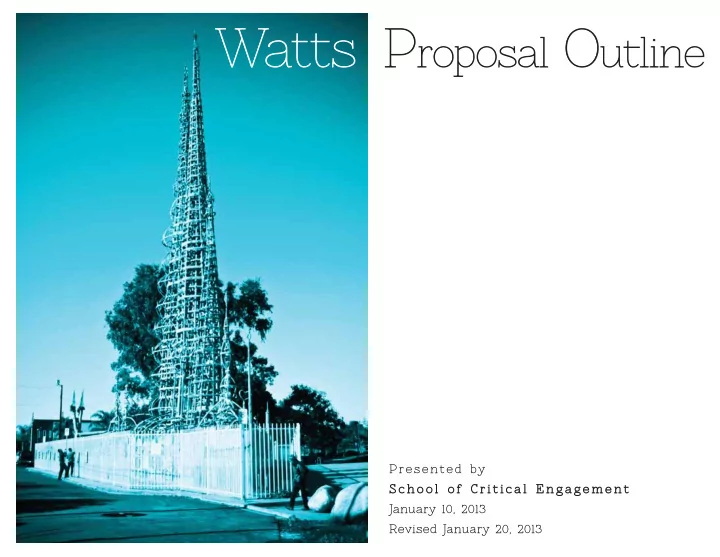
Watts Proposal Outline
P r e s e n t e d b y S c h o o l o f C r i t i c a l E n g a g e m e n t January 10, 2013 Revised January 20, 2013
1 Our presence in the neighborhood for one Watts is home to a - - PowerPoint PPT Presentation
Watts P roposal O utline P r e s e n t e d b y S c h o o l o f C r i t i c a l E n g a g e m e n t January 10, 2013 Revised January 20, 2013 C ontents School of Critical Engagement 1 & Watts 2 The Cloud 3 Tourism 4 +5 Civic
P r e s e n t e d b y S c h o o l o f C r i t i c a l E n g a g e m e n t January 10, 2013 Revised January 20, 2013
School of Critical Engagement & Watts The Cloud Tourism Civic Transparency Timeline Budget Objectives Community Impact Collaborators Biographies
School of Critical Engagement is an action-based think tank that works with communities, professional partnerships, and educational institutions to transgress the barriers between theory and practice. We work with challenges facing space/place making. As an organization, we weave educational and professional
provide sustainable economic development solutions. Watts is home to a culturally diverse population and the Watts Towers is one of only nine works of folk art listed on the National Register of Historic Places. However, nearly 50% of the population lives below the poverty line. By comparison, out of the entire population of Los Angeles, 15% are below the poverty line. Additionally, it is a food desert – a historical problem endemic among poverty-stricken urban and rural areas across the country. Watts has a tremendous opportunity to propel itself progressively forward as a national and international prototype for new forms of resilient development—inclusive, user-driven, ecologically and economically sustainable. The new Watts urban farm is an excellent example of a development initiative that can positively transform the entire community. It provides a key blueprint for educating community members on how to be self-sufficient food producers. This impulse can span even further to new and innovative products that can be researched, developed and prototyped within the Watts community, which
further
models centered around community resiliency. We believe individual civic engagement is necessary to building a sustainable and resilient
individual citizens are able to understand what resources are available to them, how they can utilize them, and what obstacles, human and natural, may impede their use. Watts already has an incredible community infrastructure due to organizations already operating in the area (i.e. WLCAC). Watts is poised to implement a living and working community prototype for new and more effective ideas, tools, and products in ecological and economic development, citizen-engaged urban design, and community building.
Our presence in the neighborhood for one year will include:
a resilient community from the inside out; ecologically, economically and culturally.
community organizations and individuals.
long-term resiliency through multiple projects, events, and outreach efforts.
working together towards positive change that is locally built by community stakeholders.
Our goals for the one year occupation of The Cloud residency are:
bi-weekly gatherings; a space for classes, workshops, exhibitions, and panels; a space to be utilized for college and high school students across the region; and to provide a general space for community gatherings.
vacant lots, location of fruit trees for public use, crime reporting, free health clinics, etc.) The residency will develop two distinct websites addressing tourism and civic transparency as well as relevant applications utilizing this information.
institutions that are globally relevant.
Tourism Lab development.
Project Leaders: Rori Knudtson, Marlise Fratinardo, Matthew Johnson and Bailey Ferguson
What kind of tourism does Watts want and need? Are we showcasing a resilient, sustainable neighborhood in the making? Why does Watts want this? Is tourism a viable mechanism for developing Watts into a prototype for hyper-local, resilient community building? We need to establish layers of this tourism. Preliminary tourism layer suggestions:
struggle, frame what is happening now and in the near future as the logical next step for self-reliance and empowerment;
dispersement, moving from a food desert to a food
for urban development; present new art and architectural methods and outcomes;
wayfinding stratgies.
collection—Whose? Oral histories? Written histories? Why? This will overlap with Watts Political Transparency and Cloud residency programming.
four layers, as well as the work done with students and facilities. Target important locations: when and where did historical events occur and with what consequences? Establish community identity by encouraging members to claim their own history. Provide information about tourist destinations -- and brand them.
A fully integrated 21st century tourist map that will be accessible online and via mobile devices. The tourist map will be a fluid and iterative framework built upon GIS mapping, Web 2.0 programming and apps that can be rendered in multiple mediums.
Project Leaders: Dominic Muttel, Rustin Knudtson, Matthew Johnson and Bailey Ferguson
The concept that each citizen of a community has the right to know where their local resources are, how they can utilize them, and who makes the decisions on how they are allocated. (These resources can range from locally grown food markets, to health services, even to places to find cheap gas.) The key, however, is not only in being able to see what resources are at a community member's disposal but in the underlying connections that hinder or enable that community member's utilization of them as well as how that individual's decision regarding said resource affects the community. To facilitate this transparency we will create a website and mobile application employing the involvement
community members during the development process to ensure a final product that suits their
in Watts to know how best to tailor their day-to-day and long-term decisions if they wish to help their neighborhood and themselves. Hypothetical: Imagine a person in Watts wants a healthy meal and has only so much money. With this platform they will be able to find where they can purchase what they
they will be able to understand how their choice impacts their community. If the choices are Ralph's, a liquor store, or a community garden market, they can assess factors such as the prices and quality of items, the pay of the employees, the backers, or
impact for purchasing an item at one establishment versus another. Aditionally this platform will also have information specific to gardening, sustainability, reuse, and how to build there own economically resilient households. With information in hand, the choices become evident. For example, purchases at a liquor store barely helps the community as the owners live in another area, purchases at Ralph's do not help the community because they pay their workers very little and funnel the profits far away from Watts, and purchases at the community market recirculate dollars directly into the local economy.
(….using interviews, google maps, etc.) via the WLCAC and other organizations, which could include:
and community members can socialize and learn about one another as well as SoCE and The Cloud residency projects. Potential examples include:
projects with simple outcomes. Possibilities include:
furniture and fixture fabrication.
created and left behind for the community.
computer coders (Similar- Code Academy)
civic transparency.
in the The Cloud, to help in the implementation of Cloud residency expansion initiatives, and to help with The Cloud website and application development.
College
develop the website and application further to more perfectly suit the needs and desires of the neighborhood.
locations for the community to utilize this transparency platform. Ideas include:
product
networks, grow the platforms to encompass more communities around the country, and utilize this growth with our computer coding space to begin a small jobs program for community. coders (Similar to Code Academy).
and SoCE to determine layers of present and future tourism interests.
adoption with Fallen Fruit in mid-February with international press and Sunday afternoon coffee & tea.
international marketing and press development.
applications.
establish strengthen teams to implement projects.
press coverage of its evolution. Internally begin writing articles connecting to local individuals helping.
effectiveness of web and application platforms.
series and public space interventions) and The Cloud expansion.
for handing over ownership of the web platforms.
the community to look at developing stable economic framework for cultural work with outside institutions.
implementation strategies.
continuation
continued concurrently with the website.
WLCAC, SoCE, Woodbury and others.
institute that will go international second quarter 2013) begins working with watts business owners to help develop an internal economic platform.
registration, hosting and moderate operational costs to begin further fundraising) as well as fiscal
international entrepreneurial community. (Commencing late January 2013)
January 2013)
methods of profitability for Watts Community (initiatives in economic development) and SoCE.
Nonprofit Finance Fund.
software, materials and fabrication equipment.
funding (commence late January 2013), e-mail campaigns.
To ensure our requests for foundational support enhances support already working in Watts. Our efforts should not create any conflicts in fiscal development for Watts and WLCAC but leverage and strengthen mission together.
Overall, it will create informed and user-driven methods in bottom-up planning and
to other communities meaning Watts becomes a global focal point for new community development methods. Tourism
This will create an expanded global audience and greater visibility for Watts that increases awareness
the towers. This will include framing Watts as a prototype in building resilient communities, a location for ecological education and workshops and a cultural mecca in the heart of Los Angeles. It is our aim to work both online and offline in articulating the rich and evolving cultural, ecological, and economic landscape of Watts.
Civic Transparency
By understanding what resources are in the community, how they can utilize them, and who controls them, we hope the Watts community can decipher what problems it has and how best to fix them. It is our intention that this platform will be creating a community-developed template that will evolve, for and by the community. If this model is effective, both it and the process used to create it, will be transferred to many other communities, in order to find out what information and resources are priorities to the specific areas. This will then allow for a continuing study on how we can address our worlds civic and political demands.
Academic Institutes
Woodbury School of Architecture: http://architecture.woodbury.edu/ UCLA Department of Computer Science: http://www.cs.ucla.edu/ Otis MFA in Paublic Practice: http://www.otis.edu/academics/graduate_public_practice/index.html Cal Arts: http://calarts.edu/ (Critical Writing program) Bergen Architecture School: http://www.bas.org/en/About-BAS NYU Shack Institute of Real Estate: http://www.scps.nyu.edu/academics/departments/schack.html School of Visual Arts:http://www.sva.edu/ Cal State Dominguez Hills: http://www.csudh.edu/ Code Academy: http://www.codecademy.com/ OKCupid Labs: http://www.okcupidlabs.com/
Local Art Collectives and Entrepreneurs
Finishing School: http://finishing-school-art.net/ Fallen Fruit: fallenfruit.org Materials and Applications: http://www.emanate.org/ma-info.htm Network Architecture Lab: http://networkarchitecturelab.org/ de Lab: http://designeastoflabrea.blogspot.com/ LA Forum for Architecture and Urban Design: http://laforum.org/ L.A. Urban Rangers: http://laurbanrangers.org/site/ Start Up Los Angeles: http://la.startupweekend.org/# Slanguage Studio: http://slanguagestudio.com/ Resilient Communities: http://www.resilientcommunities.com/
National Art Collectives
W.A.G.E. Artists: http://www.wageforwork.com/
International
Messess (chile): http://www.mess.cl/ Gehl Architects (denmark): http://www.gehlarchitects.com/ Bzzz Interaction Design (denmark): http://www.bzzz.dk/ PB43 (denmark): http://pb43.dk/ Civilised Money (uk/global): http://www.civilisedmoney.co.uk/ Early To Rise: http://www.earlytorise.com/ The Winter Office: http://thewinteroffice.net/english.html
Rori Knudtson Rori is an artist and architect working with installation, sound, video and performance questioning physical, psychological and social constructs of space. She is one of the founding partners of the School of Critical Engagement and concurrently is in production on a film project in
School of Architecture (Norway), Otis College of Art and Design Public Practice Department (Los Angeles), and the Bergen Academy of Art and Design, and is former faculty at Bergen Architecture School the University of Colorado (Boulder/Denver). Rori has been in residency with Galleri Svalbard (Norway), USF Verftet/Bergen (Norway) and RedLine (US). She is the recipient of grants from the Royal Norwegian Ministry of Foreign Affairs, Danish Arts Council, the Jennifer Moulton Foundation, fiscal sponsorship with the New York Foundation for the Arts and was awarded the Alpha Rho Chi Medal in 2007. Knudtson has exhibited in the 2010 Biennial of the Americas and will be exhibiting in the 55th Venice Bienniale. She is the mother of two young sons andt loves to play in dirt. She lives and works between Denver, Los Angeles and Bergen (Norway). Joern Langhorst Joern grew up at the edge of the vast Ruhrgebiet industrial area in Germany. He witnessed the decay
industrial ruins next to tranquil forests. Watching the lines between nature and culture, past and future, community and place being redrawn and blur, he became an explorer, critic, author and maker of the spaces in between. Joern has a background in landscape architecture, architecture, planning and urban design, and is currently an assistant professor in the College of Architecture and Planning at the University of Colorado Denver. His research focuses on post-industrial and post-disaster landscapes, and for the last six years he has been involved in the rebuilding and reimagining of the Lower 9th Ward in New Orleans. His practice as an artist and designer engages places of rapid and catastrophic change, whether it is a heavily polluted brownfield site, or the diaspora of a displaced community. He is particularly interested in the idea of place as an
environment, and design responses that emphasize the temporal and temporary. Joern is a Co-Founder of School of Critical Engagement. Marlise Fratinardo Marlise has over 11 years of experience in economic development, community planning, place-based initiatives, and heritage documentation projects in the United States and abroad. Working as a nonprofit office manager during the late 1990s, her concern about the rampant demolition
transition as a researcher for a statewide study commissioned by the Colorado Historical Society to develop comprehensive, bottom-line information
reusing existing building stock. When the award-winning study “The Economic Benefits of Historic Preservation in Colorado” was completed, the study’s prime consultant, Clarion Associates, a national land use and real estate consulting firm, hired Marlise as an urban planner. Seeking to expand her knowledge of place-based initiatives and ecological design, Marlise received a master’s degree in landscape architecture in 2006 from the University of Colorado in Denver. In 2008, she moved to Los Angeles as an environmental planning and historic preservation consultant to explore the challenges and opportunities of sustainable urban development in large cities. Matthew P. Johnson Matthew is a computer scientist, currently working as a postdoc at UCLA. He received his PhD in 2010 from the City University of New York, and earlier studied philosophy and math at Columbia and Lawrence Universities. He has occasionally taught at various places, mostly as a means of procrastination. His research interests broadly concern algorithmic and game-theoretic problems wherever they arise. Although it is proof-oriented, typically concerning
results, and so on, beside a few exceptions this work mostly involves the application of algorithmic analysis to real-world problems that somebody out there actually wants solved. Application areas most frequently represented are energy and smart grids, game theory and security, and networking. In particular, his past research problems and
projects have included online algorithms for
game-theoretic security patrol strategies in forests and subways, and routing and broadcast in wireless networks. In recent years, he has become interested in interested in extending algorithmic game theory (AGT) to policy problems in other domains, such as public policy and criminology, as well as to extending AGT techniques to account for subrational, human players. Bailey Ferguson Bailey is an artist-designer hybrid, infused with a passion for the social common good. She cares about people, culture and information, and is driven by community-centered problems. As a multidisciplinary designer her skill set is vast; her greatest expertise is within graphic design and typographic treatment including editorial layout, brand identity development, print collateral as well as strategic approaches to social media. She is interested in exploring how art, technology and communication can aid in developing public space, social interaction and ultimately help improve people’s life. She was the PR/Marketing/Communication Guru during Living Copenhagen. Dominic Muttel Dominic was born and raised in Northern Colorado. He received his Bachelor of Fine Art with an emphasis in photography in May of 2012. While periodically in school he has spent the last twelve years traveling, and gathering information in order to procure pragmatic solutions relevant to our futures demands. He has traveled to the United Kingdom, Denmark, Sweden, Norway, Holland, Germany, Luxembourg, France, Switzerland, Belgium, Italy, and Belize. Dominic’s body
work includes videos, photographs, paintings, installations, social arts, and art interventions. He is constantly looking for new ways to shift art and design in hopes of creating new conceptual models of interpretation. He enjoys exploring theories throughout many different disciplines in order to develop a research-based process that aids in a refined
and motivate others to do the same in his new home, Los Angeles California. (http://designofhappiness.tumblr.com/) Rustin Knudtson Rustin began his career in independent film, publishing, and commercial-oriented design. (He has worked with the Silver Lake Film Festival, the Sundance Film Festival, Los Angeles Film Festival and is the recipient of the 2005 Goldfarb award for short film). While these experiences helped him hone his skills while learning the nuances of general project development, having a background in philosophy can be a bane under such
remaining unquestioned, social justice never being addressed, work environments of bitterness and hostility permeating, abundant ignorance on subjects vital to the human species, and at the center of everything; bad argumentation facilitating general awfulness. Rustin began working with political organizations, educating himself and others in more formal science and technology information, and strove to reach a new plateau of aesthetic development in his film work. His ultimate goal is to ensure that he leaves the world, even in some small way, better than how he found it. Lynn M. Lomibao Lynn is a versatile communications specialist with over 10 years of experience creating marketing and PR materials, as well as building relationships with media outlets and local
media, radio and TV and specializes in producing informative and compelling online content that generates leads, increases conversion, boosts
public awareness and grows donor support. Lynn’s interest and dedication to social justice has led to work as a community organizer and grant
services center in Los Angeles, she secured over $150,000 in funding from corporate, foundation and government grants. Working closely with local
community activities, including speaking engagements, theater performances, bicycle donation drives and clothing drives. Lynn has a BA from UCLA in English/American Studies and recently completed Troy University's master's program in International Relations with summa com laude honors. She is a 2013 candidate for California State Northridge's MPA program.