1 Method Outline Fragment Matching Fragment Extraction Individual - - PDF document

1
SMART_READER_LITE
LIVE PREVIEW

1 Method Outline Fragment Matching Fragment Extraction Individual - - PDF document

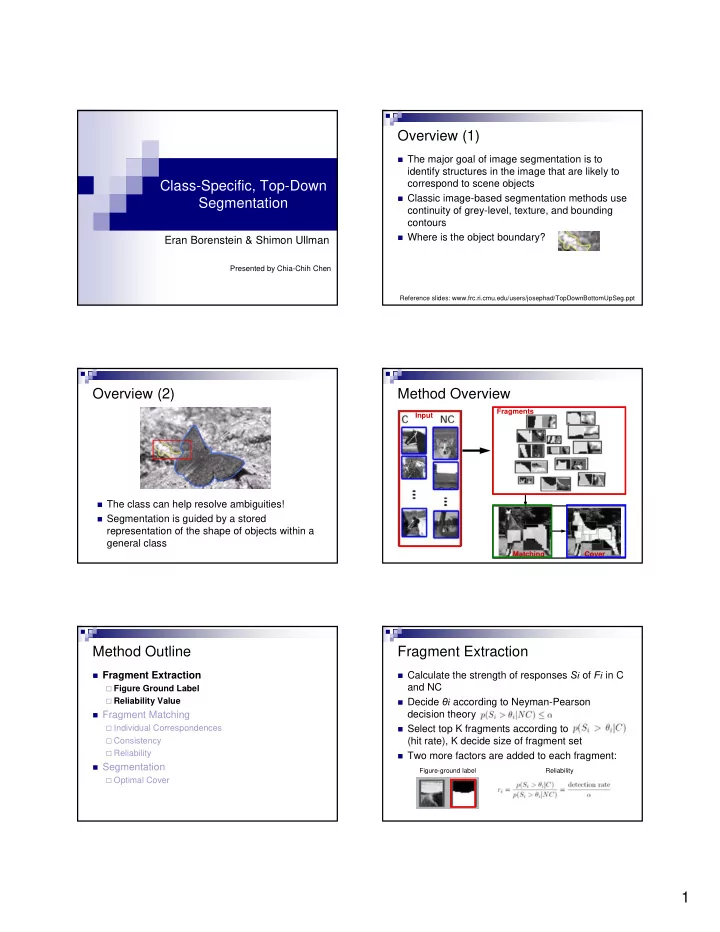
Overview (1) The major goal of image segmentation is to identify structures in the image that are likely to Class-Specific, Top-Down correspond to scene objects Classic image-based segmentation methods use Segmentation continuity of


slide-1
SLIDE 1

1

Class-Specific, Top-Down Segmentation

Eran Borenstein & Shimon Ullman

Presented by Chia-Chih Chen

Overview (1)

The major goal of image segmentation is to

identify structures in the image that are likely to correspond to scene objects

Classic image-based segmentation methods use

continuity of grey-level, texture, and bounding contours

Where is the object boundary?

Reference slides: www.frc.ri.cmu.edu/users/josephad/TopDownBottomUpSeg.ppt

Overview (2)

The class can help resolve ambiguities! Segmentation is guided by a stored

representation of the shape of objects within a general class

Method Overview

Input Fragments Matching Cover

Method Outline

Fragment Extraction

Figure Ground Label Reliability Value

Fragment Matching

Individual Correspondences Consistency Reliability

Segmentation

Optimal Cover

Fragment Extraction

Calculate the strength of responses Si of Fi in C

and NC

Decide θi according to Neyman-Pearson

decision theory

Select top K fragments according to

(hit rate), K decide size of fragment set

Two more factors are added to each fragment:

Figure-ground label Reliability

slide-2
SLIDE 2

2

Method Outline

Fragment Extraction

Figure Ground Label Reliability Value

Fragment Matching

Individual Correspondences Consistency Reliability

Segmentation

Optimal Cover

Fragment Matching

Individual Correspondence Consistency Reliability

Region Correlation Edge Detector

Method Outline

Fragment Extraction

Figure Ground Label Reliability Value

Fragment Matching

Individual Correspondences Consistency Reliability

Segmentation

Optimal Cover

Segmentation – Optimal Cover (1)

The best cover should maximize individual

match quality, consistency and reliability

Thus the cover score is written:

Penalizes for inconsistent

  • verlapping

fragments Rewards for match quality and reliability Constant that determines the magnitude of the penalty for insufficient consistency Interaction is zero for non-overlapping pairs

Segmentation – Optimal Cover (2)

Initialize with a sub-window that has the maximal

concentration of reliable fragments

Similarity of all the reliable fragments is examined at 5

scales at all possible locations

Iterative Algorithm:

Select a small number (M=15) of good candidate

fragments

Add to cover a subset of the M fragments that

maximally improve the score

Remove existing fragments inconsistent with new

cover (fragments with cumulative negative score)

Guaranteed to converge to a local maximum

Results

Paper algorithm: 0.71 Normalized-cuts: 0.31 Random segmentation: 0.23

slide-3
SLIDE 3

3

Conclusions

Demonstrate the feasibility of using class-based

criteria to generate segmentation corresponds to visual objects

The cover algorithm resembles solving jigsaw

puzzle

(# of reliable fragments)(# of pixels in each

scale)(# of scales)

Future work: 1) using pyramid of image segments

2) boundaries can be refined by image-based methods

T h a n k y o u ! Q u e s t i o n s ?