1 Course Course objectives objectives & limits & limits - - PDF document

1
SMART_READER_LITE
LIVE PREVIEW

1 Course Course objectives objectives & limits & limits - - PDF document

2004/2005


slide-1
SLIDE 1

1

  • G. Bianchi, G. Neglia
  • 2004/2005
  • !
  • G. Bianchi, G. Neglia
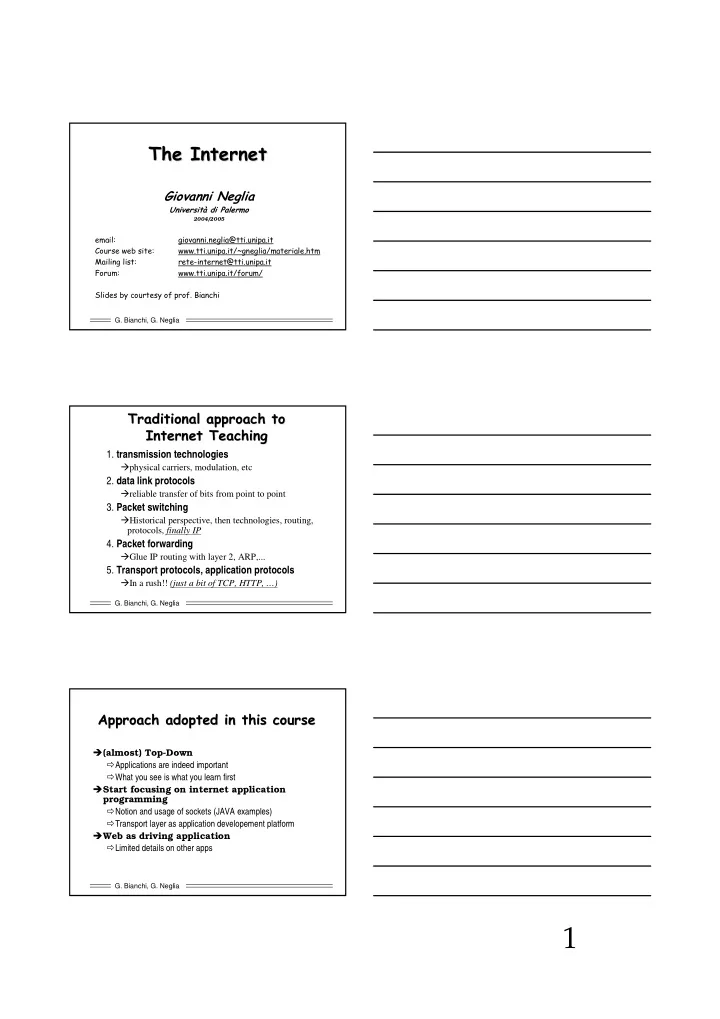
  • 1. transmission technologies

physical carriers, modulation, etc

  • 2. data link protocols

reliable transfer of bits from point to point

  • 3. Packet switching

Historical perspective, then technologies, routing, protocols, finally IP

  • 4. Packet forwarding

Glue IP routing with layer 2, ARP,...

  • 5. Transport protocols, application protocols

In a rush!! (just a bit of TCP, HTTP, …)

  • G. Bianchi, G. Neglia
  • (almost) Top-Down

Applications are indeed important What you see is what you learn first Start focusing on internet application programming Notion and usage of sockets (JAVA examples) Transport layer as application developement platform Web as driving application Limited details on other apps

slide-2
SLIDE 2

2

  • G. Bianchi, G. Neglia

Course Course objectives

  • bjectives & limits

& limits

!"

"#$ "

  • %

&' # (

#$!"

)*+#,# %

  • .

& / $% &

  • G. Bianchi, G. Neglia

Teaching Teaching Material Material

Book and notes Nicola Blefari Melazzi, dispense, versione 4.2 (in italian), 2003

Available online In progress (310 pages at the moment)

James F. Kurose, Keith W. Ross, 2000

Italian version: Internet e reti di calcolatori, McGraw-Hill, approx 40 top-down approach

Additional reference books & material Stevens (vol. 1), 1994

to dip into technical issues a VALUABLE book (though a bit too old)

RFCs: the real stuff… Sites: www.ietf.org Internet standardization www.w3.org Web standardization

  • G. Bianchi, G. Neglia

Course Course contents contents

PART A: Applications Internet architecture, internet standardization, switching basics Application addressing, Internet applications development (JAVA-based) World wide web; HTTPv1.0 details Domain Name System PART B: Transport User Datagram Protocol Introduction to TCP, pipelining, performance issues TCP algorithms: (a) window flow control; (b) TCP error control; (c) TCP congestion control. PART C: Network IP addressing IP packet forwarding (ARP), IP address assignment (RARP, DHCP) Advanced IP addressing: subnetting & supernetting (CIDR) IP and ICMP details IP routing extra Time? Never happened…

slide-3
SLIDE 3

3

  • G. Bianchi, G. Neglia

Internet Internet traffic traffic growth growth (USA (USA -

  • recent

recent measurements measurements) )

  • G. Bianchi, G. Neglia

Traffic Traffic share share -

  • projections

projections

IP TRAFFIC MIX - P2P SCENARIO

0% 10% 20% 30% 40% 50% 60% 70% 80% 90% 100% 2001 2002 2003 2004 2005 2006 2007 2008 SHARE OF TOTAL TRAFFIC WEB PAGES RICH MEDIA P2P S2S source: Cohen Communications Group

  • G. Bianchi, G. Neglia

Why Why “ “All All” over IP? ” over IP?

200 400 600 800 1000 1200 97 98 99 00 01 02 Telephony Internet

PetaBytes per Month Year End

Packet 15 Times Greater Than Circuit Source: M. Decina, 2000

slide-4
SLIDE 4

4

  • G. Bianchi, G. Neglia

Voice over IP Voice over IP – – deployment deployment

(source: F. Carlini, november 2003) (source: F. Carlini, november 2003)

ITA: Fastweb All-IP Voice service ITA: Telecom Italia

100% (!!) Telephone traffic, MI-RM-NA backbone is IP

Did you know? International traffic

12% of whole international traffic is IP

Ongoing direction:

User VoIP awareness (e.g. Fastweb)

  • G. Bianchi, G. Neglia

What What was was the Internet the Internet ( (for

for the mass the mass-

  • media, a few

media, a few years years ago ago)

)

Internet synonimous of WWW (World Wide Web) sites & pages:

millions of documents Spreaded worldwide mostly written in HTML language (HyperText Markup Language) mostly accessible via the HTTP protocol (HyperText Transfer Protocol)

  • G. Bianchi, G. Neglia

What What was was the Internet the Internet ( (for

for the the scientist scientist in the 80s in the 80s)

)

Internet synonimous of FTP (File Transfer Protocol) and e-mail:

Scientists were the only ones having a presence on the Internet (unix logins)

» contacts via email, talk program

Research documents archived in FTP sites

» accessible via FTP, gopher

Scientific (and cultural) forums: Usenet news

slide-5
SLIDE 5

5

  • G. Bianchi, G. Neglia

What What is is the internet the internet ( (for

for the mass media, the mass media, today today)

)

Huge marketplace for e-business B2B and B2C portals with full-fledged transaction capabilities Virtual communities Chat & messaging Peer to peer applications Communication network IP Telephony / Multimedia commun.

  • G. Bianchi, G. Neglia

What What will will be be the Internet the Internet (in 2010?) (in 2010?)

High speed unique integrated telecommunication network and business services platform

High Speed = Broadband Unique = integrated services network Services = from communication to distributed systems ???

Worldwide operating system? Content delivery network? p2p?

???

Internet Appliances, the real revolution?

???

  • G. Bianchi, G. Neglia

What What is is the Internet the Internet

( (For For networking networking engineers engineers: : We We!) !)

1. A worldwide computer network

  • Connecting end-systems (host, servers)
  • Each uniquely identified by a numeric address (IP address)

2. the world wide group of networks combined with TCP/IP

  • TCP/IP synonimous of the entire suite of networking

protocols.

  • The name comes from the two most important:

» TCP = Transmission Control Protocol » IP = Internet Protocol

3. A packet switching network

slide-6
SLIDE 6

6

  • G. Bianchi, G. Neglia

TCP/IP TCP/IP characteristics characteristics

TCP/IP provides services necessary to create the Internet, by:

interconnecting computers & interconnecting networks

Independence from underlying network topology, physical network hardware, Operating Systems, etc Universal connectivity throughout the network Standardize High Level protocols

  • G. Bianchi, G. Neglia

What What Internet Internet is is: a network of : a network of heterogeneous heterogeneous networks networks

router host

Token Ring

router

Internet and Private Nets

Ethernet

Power- line central

Power line

%& &'& ! '

Host = 1 interface Router = 2+ interfaces

  • G. Bianchi, G. Neglia

What What Internet Internet attempts attempts to to be be

( (but but only

  • nly loosely

loosely is is): ):

a a hierarchical hierarchical network... network...

slide-7
SLIDE 7

7

  • G. Bianchi, G. Neglia

Architecture Architecture Hierarchy Hierarchy -

  • USA

USA

Local ISPs Regional ISPs National & International Backbone Providers (NBPs)

InternetMCI, Sprintlink, PSINet, UUNet, Technologies, AGIS, … interconnected via big switching centers called Network Access Points (NAPs), or Metropolitan Area Exchanges (MAEs)

  • G. Bianchi, G. Neglia

A NAP: just A NAP: just another another router… router…? ? Pacific Pacific Bell Bell

  • S. Francisco
  • S. Francisco

NAP NAP

  • G. Bianchi, G. Neglia

STM-N: Syn. Transport Module, level N STS-N: Syn. Transport Signal, level N OC-N:

  • Syn. Optical Network, level N

HD-WDM -High Density-Wavelength Division Multiplexing

End 2001: Commercial: 128 wavelengths @ STM-64 Experimental: 1024 wavelengths @ STM-64 STM-1/ OC-3 (+STS-3) STM -4/ OC-12 STM-16/ OC-48 STM-64/ OC-192 155.52 Mbit/s 622.08 Mbit/s 2,488.32 Mbit/s 9,953.28 Mbit/s STM-256/ OC-768 39,813.12 Mbit/s STM-1024/ OC-3072 159,252.48 Mbit/s

The core: Digital Transmission The core: Digital Transmission Hierarchy Levels Hierarchy Levels

SDH (Europe): Synchronous Digital Hierarchy SONET (USA): Synchronous Optical NETwork

slide-8
SLIDE 8

8

  • G. Bianchi, G. Neglia

Broadband access, USA Broadband access, USA

(fixed networks) (fixed networks)

10 20 30 40 50 Cable DSL Fixed wireless Satellite Fiber 2005 2004 2003 2002 2001 2000 Broadband households (millions) Cable DSL Fixed wireless Satellite Fiber Total (millions) 3.74 7.76 11.42 15.81 19.43 22.42 1.25 2.96 6.61 10.07 14.06 17.75 0.02 0.25 0.66 1.25 2.22 4.20 0.00 0.00 0.19 0.55 1.11 1.87 0.00 0.00 0.01 0.06 0.19 0.47 5.00 10.97 18.89 27.73 37.01 46.72 (numbers may not total due to rounding) Source: Forrester Research, 2000

  • G. Bianchi, G. Neglia

Source: Forrester Research, 2000

Broadband access, Europe Broadband access, Europe

(fixed networks) (fixed networks)

  • G. Bianchi, G. Neglia

Broadband Access Broadband Access in Italy in Italy

2000 2001 2002 2003 2004 2005 2006 2007 fibra 0,0 0,1 0,2 0,2 0,4 0,5 0,8 1,0 satellite 0,0 0,1 0,1 0,2 0,4 0,7 1,0 1,2 wireless loops 0,0 0,0 0,2 0,4 0,7 1,0 1,2 1,4 dsl 0,1 0,3 0,8 1,8 2,7 3,8 4,5 5,0 totale fisso lb 0,1 0,5 1,3 2,6 4,2 6,0 7,5 8,6 mobile lb umts 0,0 0,0 0,3 1,5 3,0 6,0 10,0 15,0

(Millions of units)

UPDATED: march 2001

slide-9
SLIDE 9

9

  • G. Bianchi, G. Neglia

Where Where the the networking networking software software stays stays

SERVER USER TERMINAL TCP/IP Networking SW TCP/IP Networking SW

INTERNET

  • G. Bianchi, G. Neglia

Telephony Service Control Architecture

Network provides Intelligence Proprietary API

Switch Service Node Service Creation Environment Base Station

Internet Network Architecture

Intelligence at the Edge: Network only provides “bearer services” Open API

Router Subnetwork ‘Pipe’

CLIENT-SERVER APPLICATIONS

Telecom Telecom vs vs Internet Intelligence Internet Intelligence

A major motivation for Internet success A major motivation for Internet success

  • G. Bianchi, G. Neglia

SUBNET 2 SUBNET 2 SUBNET 2 SUBNET 1 SUBNET 1 SUBNET 1 SUBNET 3 SUBNET 3 SUBNET 3 … …. . … …. . HOSTS HOSTS HOSTS HOSTS ROUTER ROUTER ROUTER ROUTER SUBNET 1 SUBNET 1 SUBNET 1 SUBNET 2 SUBNET 2 SUBNET 2 SUBNET 3 SUBNET 3 SUBNET 3

IP IP IP IP IP IP AP AP AP AP AP AP

HOST HOST HOST HOST ROUTER ROUTER ROUTER ROUTER

Architecture Architecture and and layers layers

TCP/UDP TCP/UDP TCP/UDP

IP IP IP

TCP/UDP TCP/UDP TCP/UDP

IP IP IP

slide-10
SLIDE 10

10

  • G. Bianchi, G. Neglia

TCP/IP TCP/IP protocol protocol layers layers

and and relationship relationship with with OSI OSI

APPLICATION INTERNET TRANSPORT Network Transport Session Presentation Application Data Link Physical Network interface Physical

  • G. Bianchi, G. Neglia

TCP/IP basic TCP/IP basic protocol protocol stack stack

HTTP RTSP FTP TELNET SMTP SNMP BOOTP DHCP NNTP DNS X-windows.. IP TCP APPLICATION TRANSPORT UDP RTP INTERNET Ethernet, PPP, ATM(?!), … DATA LINK

  • G. Bianchi, G. Neglia

Internet Internet early early history history

( (before before Internet) Internet) 1957: Cold War, USA establishes ARPA Early 1960: concept of packet switching

(Paul Baran? Leonard Kleinrock?)

1967: ARPA presents ARPANET concepts

Computers connected through “Interface Message Processors”

1969: ARPANET becomes real

4 nodes (UCLA Los Angeles, UCSB Santa Barbara, Stanford Research Instuitute, University Utah) 50 kbps lines Network Control Protocol (NCP)

1971: 15 nodes

slide-11
SLIDE 11

11

  • G. Bianchi, G. Neglia

Internet Internet history history

(The Birth of Internet) (The Birth of Internet) 1972: Vint Cerf, Bob Karn join ARPANET

Launch the “Internetting Project”

1973: Cerf, Karn: TCP/IP design (monolitic protocol) 1973: first satellite link (California-Hawaii) 1973: Ethernet (PhD dissertation, Bob Metcalfe) 1977: first true inter-network

ARPANET + Packet Radio Network + Satellite network

1977/79: TCP and IP become two distinct protocols 1979: 100 nodes ARPANET 1981: CSNET (early network from NSF) 1983: old ARPANET protocols dismissed

TCP/IP as official and UNIQUE protocol

1983: 4.2 BSD Unix (from UCB) with TCP/IP: first widely available TCP/IP implementation!

  • G. Bianchi, G. Neglia

Internet Internet history history

(the (the growth growth) ) 1983: split ARPANET (research) - MILNET (military) 1984: 1000 nodes 1884: DNS (Internet names) 1986: NSFNET backbone

T1 speed (1.544 mbps)

1986: Internet meltdown

Jacobson foresees Internet collapse (congestion)

1988: 4.3 BSD Tahoe: TCP serious improvements (slow start, congestion avoidance, fast retransmit) 1989: 100.000 nodes; Berners Lee: intuition on WWW concepts 1990: ARPANET fully replaced by NSFNET 1990: 4.3 BSD, TCP Reno 1992: MBONE (multicasting) 1992: 1M nodes

  • G. Bianchi, G. Neglia

Internet Internet recent recent history history

(mass (mass-

  • market)

market) 1993: WWW deployment (mosaic) Starting from early 1990: security attacks 1995: Sun Java 1996: 10M nodes 1996: Microsoft enters Web business 1999: 2M web servers 1999: Commercial Wireless Internet on 2G cellular 2000: widespread emergence of peer to peer 2000: 100M nodes 2002: Wireless Internet Hotspots on wi-fi

slide-12
SLIDE 12

12

  • G. Bianchi, G. Neglia
  • "

"

( ( ) )* * + + * *

No single administrative organization IETF - Internet Engineering Task Force Developement of current protocols and specifications for standardization.

International community, open to everyone Most of the work via mailing lists Meets three times/year

  • rganized in areas and working groups

Dynamically activated & deactivated on need group coordination: IESG (Internet Engineering Steering Group)

Industry also preemptively determine standards

  • G. Bianchi, G. Neglia

Technical Technical Bodies Bodies Structure Structure

ISOC – Internet SOCiety

Professional society to promote, support the use of the internet

IAB – Internet Architecture Board

responsible for technical oversight and coordination

IETF IRTF

IESG IRSG

Steering Groups

Internet Engineering Internet Research

Task Force

  • G. Bianchi, G. Neglia

IETF credo IETF credo

We reject kings, presidents and voting. We believe in rough consensus and running code

David Clark (MIT), 1992

slide-13
SLIDE 13

13

  • G. Bianchi, G. Neglia

Internet Standard Internet Standard Process Process

INTERNET DRAFT RFC Proposed Standard Draft Standard Internet Standard STANDARD TRACK Draft version for information review and comments. 6 months lifetime Official Internet publication: never expires Entry level - protocol specification should be stable technically At least 2 independent & interoperable implementations testing all spec. fcts Have had significant field use and clear community interest in production use

  • G. Bianchi, G. Neglia

Non Non-

  • Standard Track

Standard Track

(the (the most most common track!!) common track!!) Specifications may not be intended to be an Internet standard Three labels

Informational Experimental Historic

Informational status: entry status for any proposal...

  • G. Bianchi, G. Neglia

Internet Internet Documents Documents

RFC - Request For Comments

RFC3000 in Nov 2000, RFC3901 in Sept 2004 295 RFCs in 2004 Updated RFCs published with new numbers Not all describe protocols Not all used!

BCP - Best Current Practice FYI - For Your Information

RFC subseries: FYI = no protocol specs (es. RFC1718: the Tao of the Internet)

STD - STanDard

  • fficial Internet Standard
slide-14
SLIDE 14

14

  • G. Bianchi, G. Neglia

Important Important Documents Documents

all all RFCs RFCs from from ftp:// ftp://ds.internic.net ds.internic.net/ /rfc rfc RFCs RFCs + + IDs IDs + WG: + WG: http://www.ietf.org http://www.ietf.org

RFC2300 (STD0001): Internet Official Protocol Standards RFC1340 (STD0002): Assigned Numbers RFC1122 + RFC1123 (STD0003) Requirement for Internet hosts - communication layer (1122), Application and support (1123)

  • G. Bianchi, G. Neglia

Internet Internet Administration Administration

IAB (Internet Architecture Board)

general operation trends coordination standard approval

ICANN (Internet Corporation For Assigned Names and Numbers)

Internet Protocol (IP) address space allocation protocol identifier assignment generic (gTLD) and country code (ccTLD), Top-Level Domain name system management, and root server system management functions. These services were originally performed under U.S. Government contract by the IANA (Internet Assigned Numbers Authority) and other entities.