IP and ARP Security, Earlence Fernandes UW Madison CS 642 1 Todays - - PowerPoint PPT Presentation

ip and arp security earlence fernandes
SMART_READER_LITE
LIVE PREVIEW

IP and ARP Security, Earlence Fernandes UW Madison CS 642 1 Todays - - PowerPoint PPT Presentation

IP and ARP Security, Earlence Fernandes UW Madison CS 642 1 Todays agenda IP Spoofing Denial of Service attack (DoS) Distributed DoS (DoS) Source address validation Link layer security Address resolution protocol (ARP)


slide-1
SLIDE 1

UW Madison CS 642 1
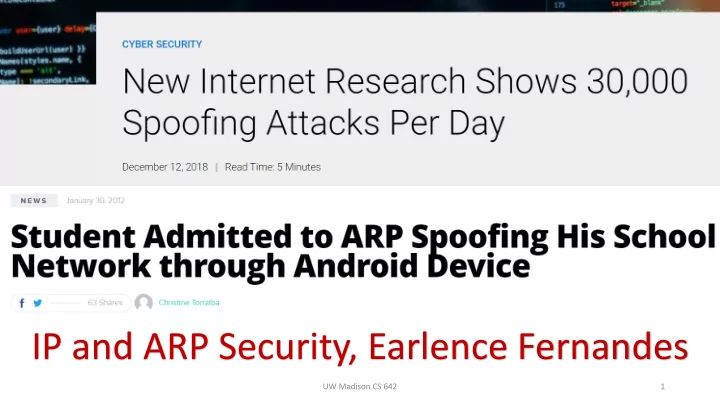
IP and ARP Security, Earlence Fernandes

slide-2
SLIDE 2

Today’s agenda

  • IP Spoofing
  • Denial of Service attack (DoS)
  • Distributed DoS (DoS)
  • Source address validation
  • Link layer security
  • Address resolution protocol (ARP)
  • Mapping IP to MAC address
  • MAC address spoofing

UW Madison CS 642 2

slide-3
SLIDE 3

Announcements

  • Midterm 1 in class Mar 10 Tuesday
  • Open notes/books with laptop but NO INTERNET
  • 70 minutes, 70 points
  • Everything we’ve covered until and including today
  • Questions biased towards earlier material
  • Free form, recall and creative thinking
  • Feedback forms are out
  • Take a minute now to put some feedback in
  • Very helpful for us

UW Madison CS 642 3

slide-4
SLIDE 4

Recap: Network threat model

UW Madison CS 642 4

backbone ISP1 ISP2

  • 1. Malicious hosts
  • 2. Subverted

routes or links

  • 3. Malicious ISPs or backbone
slide-5
SLIDE 5

Recap: Internet Protocol Stack

HTTP, FTP, SMTP, SSH, etc. TCP, UDP IP, ICMP, IGMP user data user data Appl hdr user data Appl hdr TCP hdr TCP segment user data Appl hdr TCP hdr IP hdr IP datagram user data Appl hdr TCP hdr IP hdr ENet hdr ENet tlr Ethernet frame 14 20 20 46 to 1500 bytes PORT IP MAC 802.11, Ethernet, 802x

UW Madison CS 642 5

slide-6
SLIDE 6

Recap: Identifiers on the internet

  • Port: 0 – 65535 (16-bit)
  • 0 – 1023 : System reserved, 80: HTTP, 443: HTTPS, 53: DNS,
  • 1024 – 49151 : Semi-reserved, used by application developer
  • 49152 – 65535 : Used by client programs, e.g. Browser
  • IP: 32-bit (IPv4) or 128-bit (IPv6) identifier
  • a.b.c.d – four unsigned integers
  • CIDR (Classless Inter-Domain routing): a.b.c.d/x
  • x – bit prefix is “owned” by the entity,
  • Or, IP addresses with same /x prefix share some portion of route
  • MAC # (Media access control): 48-bit identifier
  • Unique for the ethernet/wifi card
  • Often preset by manufacturer, but one can change them easily

UW Madison CS 642 6

slide-7
SLIDE 7

Denial of Service (DoS) attacks

ISP1 ISP2 1.2.3.4 5.6.7.8 Backbone

Goal: prevent legitimate users from accessing victim (1.2.3.4)

15.6.9.18 victim

slide-8
SLIDE 8

DoS

UW Madison CS 642 8

  • Overwhelm the victim with malicious traffic
  • E.g., ICMP Flood, SYN flood
  • Many types
  • Application layer DoS
  • Locking all user accounts in a system (by repeated password guesses)
  • Distributed DoS
  • Get a pool of (compromised) machines/devices to send malicious traffic
  • SYN floods
  • Reflected DoS
  • Send spoofed IP packets to benign servers who responds with large amount data
slide-9
SLIDE 9

ICMP (Internet Control Message Protocol)

ICMP message IP hdr ICMP hdr 8-bit code 8-bit type 16-bit checksum 4-byte more of header (depends on type) message …

slide-10
SLIDE 10

ICMP Flood

ISP1 ISP2 1.2.3.4 5.6.7.8 Backbone 15.6.9.18

ICMP ping flood

  • Attacker sends ICMP pings as fast as possible to victim
  • When will this work as a DoS?
  • How can this be prevented?

Ingress filtering near victim Attacker resources > victim’s

victim

slide-11
SLIDE 11

TCP SYN Flood

UW Madison CS 642 11

Send a bunch of SYN packet to a router/server

  • Never respond with an ACK
  • Half-open TCP connections hold resources in the server
  • Legitimate users cannot access the server
slide-12
SLIDE 12

Reflected DoS attacks

ISP1 ISP2 1.2.3.4 5.6.7.8 Backbone ISP3 8.7.3.4 victim source: 1.2.3.4 dest: 8.7.3.4 5.6.7.8 sends IP packet like this

Attacker sends packets with spoofed source address

Filter based on source may be incorrect

slide-13
SLIDE 13

DoS with resource asymmetry

ISP1 ISP2 1.2.3.4 5.6.7.8 Backbone

Attacker uses few resources to cause victim to consume lots of resources

  • DNS amplification attack
  • Send DNS request w/ spoofed target IP (~64-byte request)
  • DNS replies sent to target (~512-byte response)
  • Smurf Attack
  • Broadcast ICMP ping on a router with spoofed victim’s IP address
  • (not allowed with newer router)
  • Ping of death
  • A single packet that causes crash on remote system
  • Early on: ping packet with size > 65,535
slide-14
SLIDE 14

How to prevent spoofing?

ISP1 ISP2 1.2.3.4 5.6.7.8 Backbone ISP3 8.7.3.4

Spoofed IPs means we cannot know where packets came from. Solution:

  • BCP 38 (RFC 2827)
  • upstream ingress filtering to drop spoofed packets
  • source address validation
  • IP traceback
  • Identify sources of attack
slide-15
SLIDE 15

IP traceback

ISP1 ISP2

IP traceback approaches:

  • Logging – each router keeps logs of packets going by
  • Input debugging – feature of routers allowing filtering egress port traffic based on

ingress port. Associate egress with ingress

  • Controlled flooding – mount your own DoS on links selectively to see how it affects

malicious flood

  • Marking – router probabilistically marks packets with info

1.2.3.4 5.6.7.8 Backbone ISP3 8.7.3.4

slide-16
SLIDE 16

BCP38: Network Ingress filtering

ISP1 ISP2

Before forwarding on packets, check at ingress that source IP legitimate

1.2.3.4 5.6.7.8 Backbone ISP3 8.7.3.4

slide-17
SLIDE 17

BCP 38: We are getting there…

Still 14-21% are still spoofable

slide-18
SLIDE 18

Preventing DoS: beat the power

1.2.3.4 Filtering box Lots of SYNs Lots of SYN/ACKs Few ACKs

Just need a beefy box to help with filtering. There are several anti-DoS protection

  • Prolexic (acquired by Akamai)
  • Cloudflare
  • Google Cloud Armor
slide-19
SLIDE 19

Mirai

  • September 2016, 600 Gbps attack on Krebs,

Dyn.

  • IoT devices: IP Cameras
  • Peak infection: 600k devices, steady state:

200 to 300k

  • Default username/passwords on IP Cameras

UW Madison CS 642 19

slide-20
SLIDE 20

UW Madison CS 642 20

slide-21
SLIDE 21

Paras Jha, co-author of Mirai

  • 2500 hours community service
  • Home confinement
  • 8.6 million USD in restitution
  • Why DDoS?
  • Juvenile reasons (student at Rutgers CS)
  • Delay calculus exam
  • Prevent others from registering for an advanced CS course he wanted to take

UW Madison CS 642 21

https://krebsonsecurity.com/2017/01/who-is-anna-senpai-the-mirai-worm-author/ https://krebsonsecurity.com/2018/10/mirai-co-author-gets-6-months-confinement-8-6m-in- fines-for-rutgers-attacks/

slide-22
SLIDE 22

Link layer security

UW Madison CS 642 22

slide-23
SLIDE 23

Link layer: Ethernet/WiFi

Carrier Sense, Multiple Access with Collision Detection (CSMA/CD)

  • Take turns using broadcast channel

(the wire)

  • Detect collisions, jam, and random back
  • ff

Security issues?

UW Madison CS 642 23

slide-24
SLIDE 24

Address resolution protocol (ARP)

IP IP routin ing:

  • Figure out where to send an IP packet

based on destination address.

  • Link layer and IP layer must cooperate to

get things sent

  • ARP/RARP enables this cooperation by

mapping IPs to MACs

32-bit IP address 48-bit MAC address ARP RARP

UW Madison CS 642 24

slide-25
SLIDE 25

Media Access Control Number (MAC)

  • “Unique” identifier for a device.

Two types

  • Globally administered
  • Locally administered
  • OS can “change” MAC

UW Madison CS 642 25

https://en.wikipedia.org/wiki/MAC_address

slide-26
SLIDE 26

MAC Spoofing

UW Madison CS 642 26

For privacy

APPLE: $ sudo ifconfig en0 ether xx:xx:xx:xx:xx:xx LINUX $ sudo ip link set eth0 address xx:xx:xx:xx:xx:xx

For stealing

slide-27
SLIDE 27

MAC spoofing is not illegal, but can show criminal intent

UW Madison CS 642 27

http://en.wikinews.org/wiki/Aaron_Swartz_arrested_and_charge d_for_downloading_JSTOR_articles Aaron Swartz, a fellow at Harvard University's Center for Ethics and an open source programmer involved with creating the RSS 1.0 specification and more generally in the

  • pen culture movement, has been arrested and charged with wire fraud, computer

fraud, unlawfully obtaining information from a protected computer, and recklessly damaging a protected computer after he entered a computer lab at MIT in Cambridge, Massachusetts and downloaded two-thirds of the material on JSTOR, an academic journal repository. https://www.internethalloffame.org/inductees/aaron-swartz

slide-28
SLIDE 28

Address resolution protocol

fra rame typ ype

  • 0x0806 (ARP)
  • 0x8035 (RARP)

6 6 2 2 2 1 1 2 enet dest enet src type hw type prot type hw size prot size

  • p

sender hw addr ip sender target hw addr ip target CRC pad 6 4 6 4 18 4 hw hw typ ype, pr prot

  • t(ocol) typ

ype specify what types of addresses we’re looking up

  • p
  • p specifies whether this is

an ARP request, ARP reply, RARP request, RARP reply en enet dest

  • all 1’s,

0xFFFFFFFFFFFF for broadcast

UW Madison CS 642 28

Ethernet header (14B) ARP message (28B)

Se Sender hw hw add address Host’s MAC address for ARP and ARP reply Target t hw hw add address Ignored in ARP request

slide-29
SLIDE 29

ARP caches

  • Hosts maintain cache of ARP data
  • just a table mapping between IPs and MACs

UW Madison CS 642 29

slide-30
SLIDE 30

ARP has no authentication

  • Easy to sniff packets on (non-switched) ethernet
  • What else can we do?

Easy Denial of Service (DoS): Send ARP reply associating gateway 192.168.1.1 with a non-used MAC address

UW Madison CS 642 30

slide-31
SLIDE 31

ARP has no authentication

  • Easy to sniff packets on (non-switched) ethernet
  • What else can we do?

192.168.1.2 MAC2 192.168.1.3 MAC3 192.168.1.1 MAC1

Active Man-in-the-Middle:

ARP reply to MAC2 192.168.1.1 -> MAC3 ARP reply to MAC1 192.168.1.2 -> MAC3

Now traffic “routed” through malicious box

UW Madison CS 642 31

slide-32
SLIDE 32

ARP Poisoning

UW Madison CS 642 32

slide-33
SLIDE 33

UW Madison CS 642 33

slide-34
SLIDE 34

Detection and prevention

  • ARPWATCH
  • logs ARP mapping changes
  • emails admin if something suspicious comes up
  • Static ARP Map
  • For critical services, pre-load IP <-> MAC mapping
  • Antidote
  • Linux daemon that monitors for unusually large number of ARP packets
  • Switched networks with real authentication
  • Check MACs against AAA system (authentication, authorization, accounting)

UW Madison CS 642 36

slide-35
SLIDE 35

Recap in Network Security

  • TLS: End-to-End confidentiality, integrity, and authenticity
  • Server verification via certificate
  • Client verification?
  • TCP/IP/Link layer protocols
  • DNS: domain -> IP => DNS cache poisoning
  • ARP: IP -> MAC => MAC spoofing/ ARP spoofing
  • BGP: find path from IP -> IP => IP spoofing, BGP hijack
  • Talked about physical layer attacks, and defenses
  • Switched network with real authentication of MAC -> IP (CS n/w)
  • You cannot just plug your machine and get connected to the internet

UW Madison CS 642 37