1 Properties of agents: Properties of agents: rationality - - PDF document

1
SMART_READER_LITE
LIVE PREVIEW

1 Properties of agents: Properties of agents: rationality - - PDF document

2. Single-agent systems 2.1 Formal Definitions and Properties n Term agent used with many different meanings: Our goal: rather broad definition l Agent of an agency (see James Bond) l Agent as a person acting on behalf of another Definition


slide-1
SLIDE 1

1

Multi-Agent Systems

Jörg Denzinger

  • 2. Single-agent systems

n Term “agent” used with many different meanings:

l Agent of an agency (see James Bond) l Agent as a person acting on behalf of another

person

l Agent as a substance achieving some

change/effect n Even in Computer Science no agreement! n Also under discussion if there is such a thing as a single-agent system (agent acts in environment and some see environment as a second agent)

Multi-Agent Systems

Jörg Denzinger

2.1 Formal Definitions and Properties

Our goal: rather broad definition Definition: Agent An agent Ag is a triple Ag = (Sit,Act,Dat) where n Sit is a set of situations Ag can be in n Act is a set of actions Ag can perform n Dat, Ag’s internal data, is the set of possible values Ag’s internal data areas can have From outside, Ag seems to be a “function” gAg:Sit‘Act, but in reality we have fAg:Sit 5Dat‘Act

Multi-Agent Systems

Jörg Denzinger

Remarks (I)

n gAg is not really a function, it can be a relation!

l If we want to use observations (from outside) to

predict the behavior of an agent, we can be in trouble!

l Even if we know the real function fAg ,predictions

are not easy if we do not exactly know the actual values of the agent’s internal data areas.

l Many problems that we have with multi-agent

systems have their roots in this problem!

Multi-Agent Systems

Jörg Denzinger

Remarks (II)

n Our definition is really broad:

l Every computer program fulfills it. l Human beings l Animals l Lifeless objects

F Some authors require additional properties from an agent, but different authors require different properties and some of them cannot be easily formalized!

Multi-Agent Systems

Jörg Denzinger

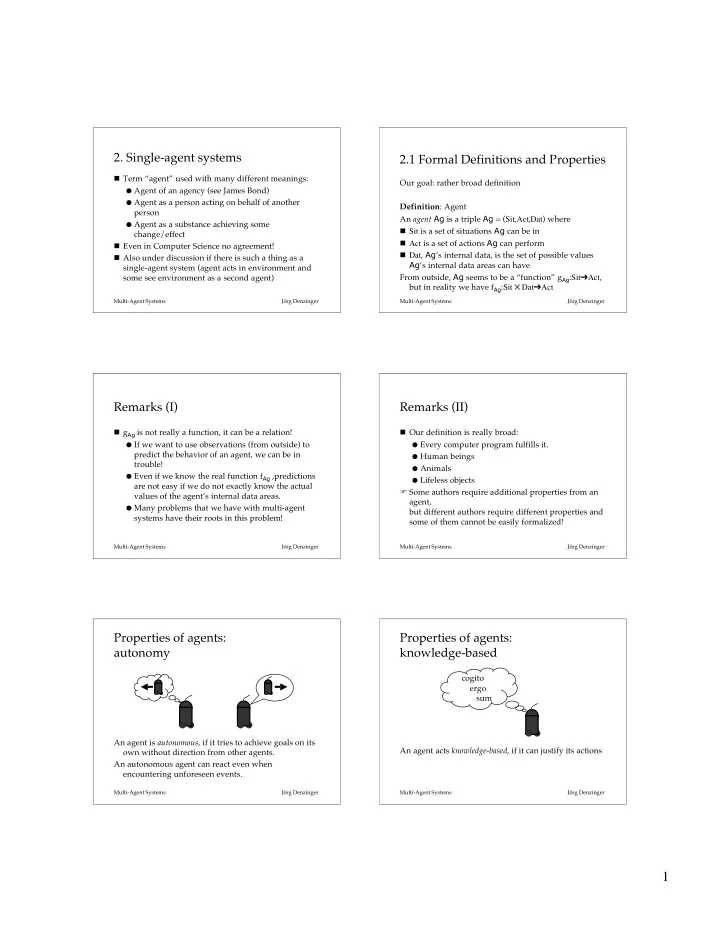
Properties of agents: autonomy

An agent is autonomous, if it tries to achieve goals on its

  • wn without direction from other agents.

An autonomous agent can react even when encountering unforeseen events.

Multi-Agent Systems

Jörg Denzinger

Properties of agents: knowledge-based

An agent acts knowledge-based, if it can justify its actions cogito ergo sum

slide-2
SLIDE 2

2

Multi-Agent Systems

Jörg Denzinger

Properties of agents: rationality

An agent is and acts rational, if its behavior is oriented

  • n fulfilling its goals as completely and as good as

possible. $ $ $ $ $ $ $

Multi-Agent Systems

Jörg Denzinger

Properties of agents: reflectivity and reactivity (I)

An agent acts reflective, if it bases its decisions on how to act very much on the actual value from Dat.

?

Multi-Agent Systems

Jörg Denzinger

Properties of agents: reflectivity and reactivity (II)

Else it acts reactive.

Multi-Agent Systems

Jörg Denzinger

Properties of agents: social

An agent acts social, if it does not hinder other agents in their actions

No !

Multi-Agent Systems

Jörg Denzinger

Some formal properties of agents: action language of an agent

Let Ag = (Sit,Act,Dat) be an agent. A set LAg Õ Act* is an action language to Ag, if for each word w Œ LAg holds: each start word v of w (i.e. w =vu) is element of LAg

bbaa bba bb b abaa aba ab a

Multi-Agent Systems

Jörg Denzinger

Remarks

n Does this mean an agent can “do” only one thing at a time? No! We model performing actions a1, a2, and a3 at the same time by performing action a1,2,3 that is defined as performing a1, a2, and a3 at the same time. n In most cases, we are interested in sequences of actions of agents (i.e words of the action language), not only single actions/decisions.

slide-3
SLIDE 3

3

Multi-Agent Systems

Jörg Denzinger

Some formal properties of agents: deadlock free

An agent Ag = (Sit,Act,Dat) with action language Lag is called deadlock free, if there is no w Œ LAg such that for all v Œ Act*holds: wv œ LAg.

?

Multi-Agent Systems

Jörg Denzinger

Some formal properties of agents: liveliness

Let Ag = (Sit,Act,Dat) be an agent with action language

  • LAg. An action t Œ Act is alive in LAg, if for all w Œ LAg

holds: there is a v Œ Act* with wvt Œ Lag. Ag is called alive, if for all t Œ Act t is alive in LAg.

S O S !

Multi-Agent Systems

Jörg Denzinger

Some formal properties of agents: fairness

Let Ag = (Sit,Act,Dat) be an agent with action language

  • LAg. Ag is fair, if for all infinite words w with all start

words of it within LAg and all t Œ Act holds: If there are infinitely many start words vi of w, such that vit Œ LAg, then t appears in w infinitely often.

Multi-Agent Systems

Jörg Denzinger

Remarks

n The properties described first obviously are of a certain relevance when looking at multi-agent systems. n The formal properties will be needed later to show a very basic problem of multi-agent systems: Even if all agents in a MAS have a certain property, then the MAS as a whole is not guaranteed to have this property. So, do not immediately forget these properties.