On Self-Approaching and Increasing-Chord Drawings of 3-Connected - - PowerPoint PPT Presentation

on self approaching and increasing chord drawings of 3
SMART_READER_LITE
LIVE PREVIEW

On Self-Approaching and Increasing-Chord Drawings of 3-Connected - - PowerPoint PPT Presentation

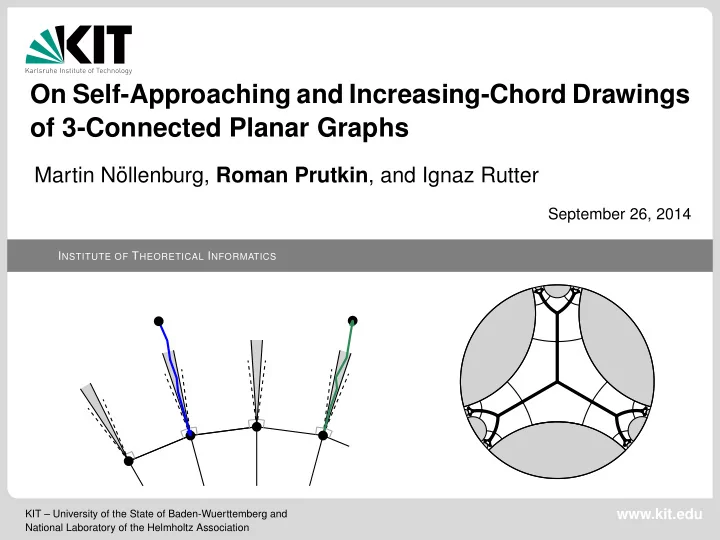
On Self-Approaching and Increasing-Chord Drawings of 3-Connected Planar Graphs Martin N ollenburg, Roman Prutkin , and Ignaz Rutter September 26, 2014 I NSTITUTE OF T HEORETICAL I NFORMATICS www.kit.edu KIT University of the State of


slide-1
SLIDE 1
  • M. N¨
  • llenburg, R. Prutkin, and I. Rutter – On Self-Approaching and Increasing-Chord Drawings

Institute of Theoretical Informatics

  • Prof. Dr. Dorothea Wagner

On Self-Approaching and Increasing-Chord Drawings

  • f 3-Connected Planar Graphs

Martin N¨

  • llenburg, Roman Prutkin, and Ignaz Rutter

www.kit.edu

KIT – University of the State of Baden-Wuerttemberg and National Laboratory of the Helmholtz Association

INSTITUTE OF THEORETICAL INFORMATICS

September 26, 2014

slide-2
SLIDE 2
  • M. N¨
  • llenburg, R. Prutkin, and I. Rutter – On Self-Approaching and Increasing-Chord Drawings

Institute of Theoretical Informatics

  • Prof. Dr. Dorothea Wagner

Drawings with Geodesic-Path Tendency

1/16

straight-line drawings of G = (V, E); for each pair s, t ∈ V exists st path ρ, along which we get closer to t s t

ρ

Empirical findings such drawings make path-finding tasks easier

[Huang et al. 2009], [Purchase et al. 2013]

slide-3
SLIDE 3
  • M. N¨
  • llenburg, R. Prutkin, and I. Rutter – On Self-Approaching and Increasing-Chord Drawings

Institute of Theoretical Informatics

  • Prof. Dr. Dorothea Wagner

Drawings with Geodesic-Path Tendency

1/16

straight-line drawings of G = (V, E); for each pair s, t ∈ V exists st path ρ, along which we get closer to t s t

ρ

possible interpretations of closer greedy: get closer on vertices self-approaching: . . . on all intermediate points increasing chords: self-approaching in both directions monotone: closer regarding projection on some line strongly monotone: . . . regarding projection on line st

slide-4
SLIDE 4
  • M. N¨
  • llenburg, R. Prutkin, and I. Rutter – On Self-Approaching and Increasing-Chord Drawings

Institute of Theoretical Informatics

  • Prof. Dr. Dorothea Wagner

Greedy Embeddings (GE)

2/16

s t

[Rao et al. 2003]

greedy path exists between each pair s, t ∈ V path ρ = (v1, v2, . . . , t) greedy if |vi+1t| < |vit| for all i motivated by local routing in wireless sensor networks v1 v2

slide-5
SLIDE 5
  • M. N¨
  • llenburg, R. Prutkin, and I. Rutter – On Self-Approaching and Increasing-Chord Drawings

Institute of Theoretical Informatics

  • Prof. Dr. Dorothea Wagner

Greedy Embeddings (GE)

2/16

[Rao et al. 2003]

  • pen: planar GE of 3-conn. graphs?

Related Work 3-conn. planar graphs have GE in R2 virtual coordinates with O(log n) bits in H2 and R2 every tree has GE in hyperbolic plane H2 characterization of trees with GE in R2

[Papadimitriou, Ratajczak 2005], [Leighton, Moitra 2010], [Angelini et al. 2010] [Eppstein, Goodrich 2008], [Goodrich, Strash 2009] [Kleinberg, 2007] [N¨

  • llenburg, Prutkin 2013]

greedy path exists between each pair s, t ∈ V path ρ = (v1, v2, . . . , t) greedy if |vi+1t| < |vit| for all i motivated by local routing in wireless sensor networks

slide-6
SLIDE 6
  • M. N¨
  • llenburg, R. Prutkin, and I. Rutter – On Self-Approaching and Increasing-Chord Drawings

Institute of Theoretical Informatics

  • Prof. Dr. Dorothea Wagner

Monotone Drawings

3/16

s t strongly monotone path

[Angelini et al. 2012]

monotone path exists between each pair s, t ∈ V path monotone if its curve monotone strongly monotone: monotonicity direction st

slide-7
SLIDE 7
  • M. N¨
  • llenburg, R. Prutkin, and I. Rutter – On Self-Approaching and Increasing-Chord Drawings

Institute of Theoretical Informatics

  • Prof. Dr. Dorothea Wagner

Monotone Drawings

3/16

[Angelini et al. 2012]

monotone path exists between each pair s, t ∈ V path monotone if its curve monotone strongly monotone: monotonicity direction st

  • pen: strongly monotone planar drawings of triangulations

biconnected planar graphs admit monotone drawings plane graphs admit monotone drawings with few bends

slide-8
SLIDE 8
  • M. N¨
  • llenburg, R. Prutkin, and I. Rutter – On Self-Approaching and Increasing-Chord Drawings

Institute of Theoretical Informatics

  • Prof. Dr. Dorothea Wagner

Self-Approaching Drawings

4/16

s t a b c self-approaching curve: for any a, b, c along the curve, |bc| ≤ |ac| equivalent: no normal crosses the curve later on

slide-9
SLIDE 9
  • M. N¨
  • llenburg, R. Prutkin, and I. Rutter – On Self-Approaching and Increasing-Chord Drawings

Institute of Theoretical Informatics

  • Prof. Dr. Dorothea Wagner

Self-Approaching Drawings

4/16

s t self-approaching curve: for any a, b, c along the curve, |bc| ≤ |ac| equivalent: no normal crosses the curve later on

slide-10
SLIDE 10
  • M. N¨
  • llenburg, R. Prutkin, and I. Rutter – On Self-Approaching and Increasing-Chord Drawings

Institute of Theoretical Informatics

  • Prof. Dr. Dorothea Wagner

Self-Approaching Drawings

4/16

s t self-approaching curve: for any a, b, c along the curve, |bc| ≤ |ac| equivalent: no normal crosses the curve later on

slide-11
SLIDE 11
  • M. N¨
  • llenburg, R. Prutkin, and I. Rutter – On Self-Approaching and Increasing-Chord Drawings

Institute of Theoretical Informatics

  • Prof. Dr. Dorothea Wagner

Self-Approaching Drawings

4/16

s t self-approaching curve: for any a, b, c along the curve, |bc| ≤ |ac| equivalent: no normal crosses the curve later on

slide-12
SLIDE 12
  • M. N¨
  • llenburg, R. Prutkin, and I. Rutter – On Self-Approaching and Increasing-Chord Drawings

Institute of Theoretical Informatics

  • Prof. Dr. Dorothea Wagner

Self-Approaching Drawings

4/16

s t self-approaching curve: for any a, b, c along the curve, |bc| ≤ |ac| equivalent: no normal crosses the curve later on

slide-13
SLIDE 13
  • M. N¨
  • llenburg, R. Prutkin, and I. Rutter – On Self-Approaching and Increasing-Chord Drawings

Institute of Theoretical Informatics

  • Prof. Dr. Dorothea Wagner

Self-Approaching Drawings

4/16

s t self-approaching curve: for any a, b, c along the curve, |bc| ≤ |ac| equivalent: no normal crosses the curve later on

slide-14
SLIDE 14
  • M. N¨
  • llenburg, R. Prutkin, and I. Rutter – On Self-Approaching and Increasing-Chord Drawings

Institute of Theoretical Informatics

  • Prof. Dr. Dorothea Wagner

Self-Approaching Drawings

4/16

s t self-approaching curve: for any a, b, c along the curve, |bc| ≤ |ac| equivalent: no normal crosses the curve later on

slide-15
SLIDE 15
  • M. N¨
  • llenburg, R. Prutkin, and I. Rutter – On Self-Approaching and Increasing-Chord Drawings

Institute of Theoretical Informatics

  • Prof. Dr. Dorothea Wagner

Self-Approaching Drawings

4/16

s t self-approaching curve: for any a, b, c along the curve, |bc| ≤ |ac| equivalent: no normal crosses the curve later on

slide-16
SLIDE 16
  • M. N¨
  • llenburg, R. Prutkin, and I. Rutter – On Self-Approaching and Increasing-Chord Drawings

Institute of Theoretical Informatics

  • Prof. Dr. Dorothea Wagner

Self-Approaching Drawings

4/16

s t self-approaching curve: for any a, b, c along the curve, |bc| ≤ |ac| equivalent: no normal crosses the curve later on

slide-17
SLIDE 17
  • M. N¨
  • llenburg, R. Prutkin, and I. Rutter – On Self-Approaching and Increasing-Chord Drawings

Institute of Theoretical Informatics

  • Prof. Dr. Dorothea Wagner

Self-Approaching Drawings

4/16

s t self-approaching curve: for any a, b, c along the curve, |bc| ≤ |ac| equivalent: no normal crosses the curve later on

slide-18
SLIDE 18
  • M. N¨
  • llenburg, R. Prutkin, and I. Rutter – On Self-Approaching and Increasing-Chord Drawings

Institute of Theoretical Informatics

  • Prof. Dr. Dorothea Wagner

Self-Approaching Drawings

4/16

s t self-approaching curve: for any a, b, c along the curve, |bc| ≤ |ac| equivalent: no normal crosses the curve later on

slide-19
SLIDE 19
  • M. N¨
  • llenburg, R. Prutkin, and I. Rutter – On Self-Approaching and Increasing-Chord Drawings

Institute of Theoretical Informatics

  • Prof. Dr. Dorothea Wagner

Self-Approaching Drawings

4/16

s t a b c d increasing chords: for a, b, c, d along the curve, |bc| ≤ |ad| equivalent: self-approaching in both directions self-approaching curve: for any a, b, c along the curve, |bc| ≤ |ac| equivalent: no normal crosses the curve later on

slide-20
SLIDE 20
  • M. N¨
  • llenburg, R. Prutkin, and I. Rutter – On Self-Approaching and Increasing-Chord Drawings

Institute of Theoretical Informatics

  • Prof. Dr. Dorothea Wagner

Self-Approaching Drawings

4/16

increasing chords: for a, b, c, d along the curve, |bc| ≤ |ad| equivalent: self-approaching in both directions Related Work paths have bounded detour length ≤ 5.33|st| for self-approaching,

≤ 2.09|st| for increasing chords

characterization of trees with self-approaching drawing

[Alamdari et al. 2013]

  • pen: 3-connected planar?

planar self-approaching drawings? planar self-approaching drawings?

[Icking et al. 1995] [Rote 1994]

self-approaching curve: for any a, b, c along the curve, |bc| ≤ |ac| equivalent: no normal crosses the curve later on

slide-21
SLIDE 21
  • M. N¨
  • llenburg, R. Prutkin, and I. Rutter – On Self-Approaching and Increasing-Chord Drawings

Institute of Theoretical Informatics

  • Prof. Dr. Dorothea Wagner

Contributions

5/16

Every triangulation has an increasing-chord drawing. has spanning downward-triangulated binary cactus such cactus has increasing-chord drawing

[Angelini et al. 2010]

slide-22
SLIDE 22
  • M. N¨
  • llenburg, R. Prutkin, and I. Rutter – On Self-Approaching and Increasing-Chord Drawings

Institute of Theoretical Informatics

  • Prof. Dr. Dorothea Wagner

Contributions

5/16

Every triangulation has an increasing-chord drawing. has spanning downward-triangulated binary cactus such cactus has increasing-chord drawing

[Angelini et al. 2010]

Some binary cactuses have no self-approaching drawing. above proof strategy does not work :( it worked for greedy drawings

slide-23
SLIDE 23
  • M. N¨
  • llenburg, R. Prutkin, and I. Rutter – On Self-Approaching and Increasing-Chord Drawings

Institute of Theoretical Informatics

  • Prof. Dr. Dorothea Wagner

Contributions

5/16

Every triangulation has an increasing-chord drawing. has spanning downward-triangulated binary cactus such cactus has increasing-chord drawing

[Angelini et al. 2010]

Some binary cactuses have no self-approaching drawing. above proof strategy does not work :( it worked for greedy drawings Planar 3-trees have planar increasing-chord drawings. first construction for str. monotone/greedy drawings of pl. 3-trees

slide-24
SLIDE 24
  • M. N¨
  • llenburg, R. Prutkin, and I. Rutter – On Self-Approaching and Increasing-Chord Drawings

Institute of Theoretical Informatics

  • Prof. Dr. Dorothea Wagner

Contributions

5/16

Every triangulation has an increasing-chord drawing. has spanning downward-triangulated binary cactus such cactus has increasing-chord drawing

[Angelini et al. 2010]

Some binary cactuses have no self-approaching drawing. above proof strategy does not work :( it worked for greedy drawings Planar 3-trees have planar increasing-chord drawings. first construction for str. monotone/greedy drawings of pl. 3-trees Hyperbolic plane is more powerful for increasing-chord drawings. characterize drawable trees every 3-connected planar graph is drawable

slide-25
SLIDE 25
  • M. N¨
  • llenburg, R. Prutkin, and I. Rutter – On Self-Approaching and Increasing-Chord Drawings

Institute of Theoretical Informatics

  • Prof. Dr. Dorothea Wagner

Recall: GE of 3-connected Planar Graphs

drawing spanner greedily G has Hamiltonian path: easy 3-conn. planar are “almost” Hamiltonian: contain closed 2-walk have spanning binary cactus

6/16

slide-26
SLIDE 26
  • M. N¨
  • llenburg, R. Prutkin, and I. Rutter – On Self-Approaching and Increasing-Chord Drawings

Institute of Theoretical Informatics

  • Prof. Dr. Dorothea Wagner

Recall: GE of 3-connected Planar Graphs

drawing spanner greedily G has Hamiltonian path: easy 3-conn. planar are “almost” Hamiltonian: contain closed 2-walk have spanning binary cactus

6/16

binary cactus each edge part of ≤ 1 cycle each vertex part of ≤ 2 cycles

slide-27
SLIDE 27
  • M. N¨
  • llenburg, R. Prutkin, and I. Rutter – On Self-Approaching and Increasing-Chord Drawings

Institute of Theoretical Informatics

  • Prof. Dr. Dorothea Wagner

GE of a Binary Cactus

[Leighton, Moitra 2008] [Angelini et al. 2009]

7/16

slide-28
SLIDE 28
  • M. N¨
  • llenburg, R. Prutkin, and I. Rutter – On Self-Approaching and Increasing-Chord Drawings

Institute of Theoretical Informatics

  • Prof. Dr. Dorothea Wagner

GE of a Binary Cactus

[Leighton, Moitra 2008] [Angelini et al. 2009]

7/16

slide-29
SLIDE 29
  • M. N¨
  • llenburg, R. Prutkin, and I. Rutter – On Self-Approaching and Increasing-Chord Drawings

Institute of Theoretical Informatics

  • Prof. Dr. Dorothea Wagner

GE of a Binary Cactus

[Leighton, Moitra 2008] [Angelini et al. 2009]

7/16

slide-30
SLIDE 30
  • M. N¨
  • llenburg, R. Prutkin, and I. Rutter – On Self-Approaching and Increasing-Chord Drawings

Institute of Theoretical Informatics

  • Prof. Dr. Dorothea Wagner

GE of a Binary Cactus

[Leighton, Moitra 2008] [Angelini et al. 2009]

7/16

slide-31
SLIDE 31
  • M. N¨
  • llenburg, R. Prutkin, and I. Rutter – On Self-Approaching and Increasing-Chord Drawings

Institute of Theoretical Informatics

  • Prof. Dr. Dorothea Wagner

Similar Idea for Increasing Chords

8/16

r Triangulations have downward-triangulated spanning binary cactus.

[Angelini et al. 2010]

slide-32
SLIDE 32
  • M. N¨
  • llenburg, R. Prutkin, and I. Rutter – On Self-Approaching and Increasing-Chord Drawings

Institute of Theoretical Informatics

  • Prof. Dr. Dorothea Wagner

Similar Idea for Increasing Chords

8/16

downward edges r Triangulations have downward-triangulated spanning binary cactus.

[Angelini et al. 2010]

slide-33
SLIDE 33
  • M. N¨
  • llenburg, R. Prutkin, and I. Rutter – On Self-Approaching and Increasing-Chord Drawings

Institute of Theoretical Informatics

  • Prof. Dr. Dorothea Wagner

Similar Idea for Increasing Chords

8/16

v0 v1 vk vi vj base case Theorem Every triangulation has an increasing-chords drawing. Proof (similar to proof for GE) By induction: every downward-triangulated binary cactus has increasing-chord drawing with almost-vertical downward edges

slide-34
SLIDE 34
  • M. N¨
  • llenburg, R. Prutkin, and I. Rutter – On Self-Approaching and Increasing-Chord Drawings

Institute of Theoretical Informatics

  • Prof. Dr. Dorothea Wagner

Similar Idea for Increasing Chords

8/16

v1 s vi

ρi

t vj

ρ−1

j

induction step draw child cactuses inside narrow cones Theorem Every triangulation has an increasing-chords drawing. Proof (similar to proof for GE) By induction: every downward-triangulated binary cactus has increasing-chord drawing with almost-vertical downward edges

slide-35
SLIDE 35
  • M. N¨
  • llenburg, R. Prutkin, and I. Rutter – On Self-Approaching and Increasing-Chord Drawings

Institute of Theoretical Informatics

  • Prof. Dr. Dorothea Wagner

Similar Idea for Increasing Chords

8/16

induction step draw child cactuses sufficiently small vi−1 vi

♦i

sr

i−1

>

9 0◦

< 90◦

Theorem Every triangulation has an increasing-chords drawing. Proof (similar to proof for GE) By induction: every downward-triangulated binary cactus has increasing-chord drawing with almost-vertical downward edges

slide-36
SLIDE 36
  • M. N¨
  • llenburg, R. Prutkin, and I. Rutter – On Self-Approaching and Increasing-Chord Drawings

Institute of Theoretical Informatics

  • Prof. Dr. Dorothea Wagner

Contributions

Every triangulation has an increasing-chord drawing. has spanning downward-triangulated binary cactus such cactus has increasing-chord drawing

[Angelini et al. 2010]

Some binary cactuses have no self-approaching drawing. above proof strategy does not work :( it worked for greedy drawings Planar 3-trees have planar increasing-chord drawings. first construction for str. monotone/greedy drawings of pl. 3-trees Hyperbolic plane is more powerful for increasing-chord drawings. characterize drawable trees every 3-connected planar graph is drawable

slide-37
SLIDE 37
  • M. N¨
  • llenburg, R. Prutkin, and I. Rutter – On Self-Approaching and Increasing-Chord Drawings

Institute of Theoretical Informatics

  • Prof. Dr. Dorothea Wagner

Non-Triangulated Binary Cactus

G0 G1

b0 Gn−1

ν

a0 c0 r0 Gn−1

Gn

depth 0 depth 1 depth 2

Theorem G9 has no self-approaching drawing. This covers all embeddings of G9 including non-planar.

9/16

slide-38
SLIDE 38
  • M. N¨
  • llenburg, R. Prutkin, and I. Rutter – On Self-Approaching and Increasing-Chord Drawings

Institute of Theoretical Informatics

  • Prof. Dr. Dorothea Wagner

Non-Triangulated Binary Cactus

bi ai ci ri

block µi with root ri

ck

subcactus with root ck block µj is parent of µi

µj µi

Theorem G9 has no self-approaching drawing. Each block is smaller than its parent block. Claim 1

9/16

Proof overview. Every self-approaching drawing of G9 contains a drawing of a subcactus, in which:

slide-39
SLIDE 39
  • M. N¨
  • llenburg, R. Prutkin, and I. Rutter – On Self-Approaching and Increasing-Chord Drawings

Institute of Theoretical Informatics

  • Prof. Dr. Dorothea Wagner

Non-Triangulated Binary Cactus

path downwards and to the right

bi bi ai ci aj ck

Theorem G9 has no self-approaching drawing. Each block is smaller than its parent block. Claim 1

path downwards and to the left

each self-approaching path from bi downwards and to the left uses ai; each self-approaching path from bi downwards and to the right uses ci; Claim 2

9/16

Proof overview. Every self-approaching drawing of G9 contains a drawing of a subcactus, in which:

slide-40
SLIDE 40
  • M. N¨
  • llenburg, R. Prutkin, and I. Rutter – On Self-Approaching and Increasing-Chord Drawings

Institute of Theoretical Informatics

  • Prof. Dr. Dorothea Wagner

Non-Triangulated Binary Cactus

path downwards and to the right

bi bi ai ci aj ck

Theorem G9 has no self-approaching drawing. Each block is smaller than its parent block. Claim 1

path downwards and to the left

each self-approaching path from bi downwards and to the left uses ai; each self-approaching path from bi downwards and to the right uses ci; Claim 2

9/16

Claim 3 Claim 2 ⇒ some block is bigger than its parent block; to Claim 1. Proof overview. Every self-approaching drawing of G9 contains a drawing of a subcactus, in which:

slide-41
SLIDE 41
  • M. N¨
  • llenburg, R. Prutkin, and I. Rutter – On Self-Approaching and Increasing-Chord Drawings

Institute of Theoretical Informatics

  • Prof. Dr. Dorothea Wagner

Divergence of Blocks, Small Angles

s t v1 vk

10/16

Lemma Consider greedy drawing of a cactus, vertices s, t and cutvertices v1, . . . , vk on each st path. It holds: (s, v1, . . . , vk, t) is drawn greedily, i.e., each of its subpaths is greedy; rays from v1 through s and from vk through t diverge.

slide-42
SLIDE 42
  • M. N¨
  • llenburg, R. Prutkin, and I. Rutter – On Self-Approaching and Increasing-Chord Drawings

Institute of Theoretical Informatics

  • Prof. Dr. Dorothea Wagner

Divergence of Blocks, Small Angles

10/16

r Lemma Consider greedy drawing of a cactus, vertices s, t and cutvertices v1, . . . , vk on each st path. It holds: (s, v1, . . . , vk, t) is drawn greedily, i.e., each of its subpaths is greedy; rays from v1 through s and from vk through t diverge. Cone Ur of upward directions of subcactus rooted at r Def. Lemma Consider self-appr. drawing of G9. If |Uri| < 180◦, then Uai ∩ Uci = ∅. There exists a cutvertex r at depth 4 and |Ur| < 22.5◦ (sufficiently small for our proof). From now on, consider Gr.

slide-43
SLIDE 43
  • M. N¨
  • llenburg, R. Prutkin, and I. Rutter – On Self-Approaching and Increasing-Chord Drawings

Institute of Theoretical Informatics

  • Prof. Dr. Dorothea Wagner

Divergence of Blocks, Small Angles

10/16

s t v1 vk ri ai ci bi

in subcactus Gr rooted at r, all riai, rici are almost vertical. Wlog,

slide-44
SLIDE 44
  • M. N¨
  • llenburg, R. Prutkin, and I. Rutter – On Self-Approaching and Increasing-Chord Drawings

Institute of Theoretical Informatics

  • Prof. Dr. Dorothea Wagner

Divergence of Blocks, Small Angles

10/16

s t v1 vk ri ai ci bi

in subcactus Gr rooted at r, all riai, rici are almost vertical. Wlog, Lemma All aibi, bici are almost horizontal and point rightwards. A line between points of sibling subcactuses is almost horizontal.

slide-45
SLIDE 45
  • M. N¨
  • llenburg, R. Prutkin, and I. Rutter – On Self-Approaching and Increasing-Chord Drawings

Institute of Theoretical Informatics

  • Prof. Dr. Dorothea Wagner

Blocks Become Smaller

ri ci ai

≤ ε ≤ ε

11/16

Claim 1 Each block is smaller than its parent block.

slide-46
SLIDE 46
  • M. N¨
  • llenburg, R. Prutkin, and I. Rutter – On Self-Approaching and Increasing-Chord Drawings

Institute of Theoretical Informatics

  • Prof. Dr. Dorothea Wagner

Self-approaching Downward Left/Right Paths

12/16

b2 a2 c2 a1 c0

each self-approaching path from bi downwards and to the left uses ai; each self-approaching path from bi downwards and to the right uses ci; Claim 2

slide-47
SLIDE 47
  • M. N¨
  • llenburg, R. Prutkin, and I. Rutter – On Self-Approaching and Increasing-Chord Drawings

Institute of Theoretical Informatics

  • Prof. Dr. Dorothea Wagner

Self-approaching Downward Left/Right Paths

12/16

b2 a2 c2 a1 c0

each self-approaching path from bi downwards and to the left uses ai; each self-approaching path from bi downwards and to the right uses ci; Claim 2 Proof

∠a1c1b2 < 90◦ ⇒ b2c2 can not lie on a

self-appr. b2-a1 path.

slide-48
SLIDE 48
  • M. N¨
  • llenburg, R. Prutkin, and I. Rutter – On Self-Approaching and Increasing-Chord Drawings

Institute of Theoretical Informatics

  • Prof. Dr. Dorothea Wagner

Deriving Contradiction

13/16

Claim 3 Claim 2 ⇒ some block is bigger than its parent block.

slide-49
SLIDE 49
  • M. N¨
  • llenburg, R. Prutkin, and I. Rutter – On Self-Approaching and Increasing-Chord Drawings

Institute of Theoretical Informatics

  • Prof. Dr. Dorothea Wagner

Deriving Contradiction

13/16

Claim 3 Claim 2 ⇒ some block is bigger than its parent block. consider common cutver- tices

  • f

self-approaching downward paths Key Idea

slide-50
SLIDE 50
  • M. N¨
  • llenburg, R. Prutkin, and I. Rutter – On Self-Approaching and Increasing-Chord Drawings

Institute of Theoretical Informatics

  • Prof. Dr. Dorothea Wagner

Deriving Contradiction

13/16

Claim 3 Claim 2 ⇒ some block is bigger than its parent block. consider common cutver- tices

  • f

self-approaching downward paths Key Idea

slide-51
SLIDE 51
  • M. N¨
  • llenburg, R. Prutkin, and I. Rutter – On Self-Approaching and Increasing-Chord Drawings

Institute of Theoretical Informatics

  • Prof. Dr. Dorothea Wagner

Deriving Contradiction

13/16

Claim 3 Claim 2 ⇒ some block is bigger than its parent block. consider common cutver- tices

  • f

self-approaching downward paths Key Idea

slide-52
SLIDE 52
  • M. N¨
  • llenburg, R. Prutkin, and I. Rutter – On Self-Approaching and Increasing-Chord Drawings

Institute of Theoretical Informatics

  • Prof. Dr. Dorothea Wagner

Deriving Contradiction

13/16

Claim 3 Claim 2 ⇒ some block is bigger than its parent block. consider common cutver- tices

  • f

self-approaching downward paths Key Idea

⇒ lie inside cone

slide-53
SLIDE 53
  • M. N¨
  • llenburg, R. Prutkin, and I. Rutter – On Self-Approaching and Increasing-Chord Drawings

Institute of Theoretical Informatics

  • Prof. Dr. Dorothea Wagner

Deriving Contradiction

13/16

Claim 3 Claim 2 ⇒ some block is bigger than its parent block. consider common cutver- tices

  • f

self-approaching downward paths Key Idea

⇒ lie inside cone ⇒ lie inside 2 cones

slide-54
SLIDE 54
  • M. N¨
  • llenburg, R. Prutkin, and I. Rutter – On Self-Approaching and Increasing-Chord Drawings

Institute of Theoretical Informatics

  • Prof. Dr. Dorothea Wagner

Deriving Contradiction

13/16

must converge!

Claim 3 Claim 2 ⇒ some block is bigger than its parent block. consider common cutver- tices

  • f

self-approaching downward paths Key Idea

⇒ lie inside cone ⇒ lie inside 2 cones

slide-55
SLIDE 55
  • M. N¨
  • llenburg, R. Prutkin, and I. Rutter – On Self-Approaching and Increasing-Chord Drawings

Institute of Theoretical Informatics

  • Prof. Dr. Dorothea Wagner

Deriving Contradiction

13/16

must converge!

Claim 3 Claim 2 ⇒ some block is bigger than its parent block. consider common cutver- tices

  • f

self-approaching downward paths Key Idea

⇒ lie inside cone ⇒ lie inside 2 cones ⇒ lie inside a strip

slide-56
SLIDE 56
  • M. N¨
  • llenburg, R. Prutkin, and I. Rutter – On Self-Approaching and Increasing-Chord Drawings

Institute of Theoretical Informatics

  • Prof. Dr. Dorothea Wagner

Deriving Contradiction

13/16

must converge!

Claim 3 Claim 2 ⇒ some block is bigger than its parent block. consider common cutver- tices

  • f

self-approaching downward paths Key Idea

⇒ lie inside cone ⇒ lie inside 2 cones ⇒ lie inside a strip ⇒ lie inside 2 strips

slide-57
SLIDE 57
  • M. N¨
  • llenburg, R. Prutkin, and I. Rutter – On Self-Approaching and Increasing-Chord Drawings

Institute of Theoretical Informatics

  • Prof. Dr. Dorothea Wagner

Deriving Contradiction

13/16

r a c

consider intersection of two such strips Claim 3 Claim 2 ⇒ some block is bigger than its parent block. consider common cutver- tices

  • f

self-approaching downward paths Key Idea

⇒ lie inside cone ⇒ lie inside 2 cones ⇒ lie inside a strip ⇒ lie inside 2 strips

slide-58
SLIDE 58
  • M. N¨
  • llenburg, R. Prutkin, and I. Rutter – On Self-Approaching and Increasing-Chord Drawings

Institute of Theoretical Informatics

  • Prof. Dr. Dorothea Wagner

Deriving Contradiction

13/16

Claim 3 Claim 2 ⇒ some block is bigger than its parent block. consider common cutver- tices

  • f

self-approaching downward paths Key Idea

⇒ lie inside cone ⇒ lie inside 2 cones ⇒ lie inside a strip ⇒ lie inside 2 strips

slide-59
SLIDE 59
  • M. N¨
  • llenburg, R. Prutkin, and I. Rutter – On Self-Approaching and Increasing-Chord Drawings

Institute of Theoretical Informatics

  • Prof. Dr. Dorothea Wagner

Deriving Contradiction

13/16

Claim 3 Claim 2 ⇒ some block is bigger than its parent block. consider common cutver- tices

  • f

self-approaching downward paths Key Idea

⇒ lie inside cone ⇒ lie inside 2 cones ⇒ lie inside a strip ⇒ lie inside 2 strips ⇒ parent block is small

slide-60
SLIDE 60
  • M. N¨
  • llenburg, R. Prutkin, and I. Rutter – On Self-Approaching and Increasing-Chord Drawings

Institute of Theoretical Informatics

  • Prof. Dr. Dorothea Wagner

Contributions

Every triangulation has an increasing-chord drawing. has spanning downward-triangulated binary cactus such cactus has increasing-chord drawing

[Angelini et al. 2010]

Some binary cactuses have no self-approaching drawing. above proof strategy does not work :( it worked for greedy drawings Planar 3-trees have planar increasing-chord drawings. first construction for str. monotone/greedy drawings of pl. 3-trees Hyperbolic plane is more powerful for increasing-chord drawings. characterize drawable trees every 3-connected planar graph is drawable

slide-61
SLIDE 61
  • M. N¨
  • llenburg, R. Prutkin, and I. Rutter – On Self-Approaching and Increasing-Chord Drawings

Institute of Theoretical Informatics

  • Prof. Dr. Dorothea Wagner

Planar Increasing-Chord Drawings of 3-Trees

coloring and orientation of edges external vertices r, g, b: all edges incoming internal: one outgoing in each color, cyclic order counting triangles in red, green, blue regions gives coordinates of plane drawing Schnyder labeling of a triangulation

slide-62
SLIDE 62
  • M. N¨
  • llenburg, R. Prutkin, and I. Rutter – On Self-Approaching and Increasing-Chord Drawings

Institute of Theoretical Informatics

  • Prof. Dr. Dorothea Wagner

Planar Increasing-Chord Drawings of 3-Trees

120◦

α

2

coloring and orientation of edges external vertices r, g, b: all edges incoming internal: one outgoing in each color, cyclic order counting triangles in red, green, blue regions gives coordinates of plane drawing Schnyder labeling of a triangulation

  • utgoing edges are inside cones of size α

α-Schnyder drawings for α ∈ [0, 60◦]

slide-63
SLIDE 63
  • M. N¨
  • llenburg, R. Prutkin, and I. Rutter – On Self-Approaching and Increasing-Chord Drawings

Institute of Theoretical Informatics

  • Prof. Dr. Dorothea Wagner

Planar Increasing-Chord Drawings of 3-Trees

14/16

Lemma 30◦-Schnyder drawings are increasing-chords.

slide-64
SLIDE 64
  • M. N¨
  • llenburg, R. Prutkin, and I. Rutter – On Self-Approaching and Increasing-Chord Drawings

Institute of Theoretical Informatics

  • Prof. Dr. Dorothea Wagner

Planar Increasing-Chord Drawings of 3-Trees

14/16

b g r s u t

ρb ρr

s u t Lemma 30◦-Schnyder drawings are increasing-chords. Proof consider paths from s, t to external vertices r, g, b combine ρr, ρb: no normal crosses another edge

slide-65
SLIDE 65
  • M. N¨
  • llenburg, R. Prutkin, and I. Rutter – On Self-Approaching and Increasing-Chord Drawings

Institute of Theoretical Informatics

  • Prof. Dr. Dorothea Wagner

Planar Increasing-Chord Drawings of 3-Trees

14/16

1) pick a triangle 2) 3 nodes inside cones 3) insert new edges 3) move pattern slightly, goto 2 Theorem Planar 3-trees have ε-Schnyder drawings ∀ε > 0 and, thus, have increasing-chords drawings.

slide-66
SLIDE 66
  • M. N¨
  • llenburg, R. Prutkin, and I. Rutter – On Self-Approaching and Increasing-Chord Drawings

Institute of Theoretical Informatics

  • Prof. Dr. Dorothea Wagner

Contributions

Every triangulation has an increasing-chord drawing. has spanning downward-triangulated binary cactus such cactus has increasing-chord drawing

[Angelini et al. 2010]

Some binary cactuses have no self-approaching drawing. above proof strategy does not work :( it worked for greedy drawings Planar 3-trees have planar increasing-chord drawings. first construction for str. monotone/greedy drawings of pl. 3-trees Hyperbolic plane is more powerful for increasing-chord drawings. characterize drawable trees every 3-connected planar graph is drawable

slide-67
SLIDE 67
  • M. N¨
  • llenburg, R. Prutkin, and I. Rutter – On Self-Approaching and Increasing-Chord Drawings

Institute of Theoretical Informatics

  • Prof. Dr. Dorothea Wagner

Increasing-Chord in the Hyperbolic Plane

15/16

increasing-chord drawing of complete binary tree in H2 Theorem A tree has a self-approaching/increasing-chord drawing in H2 iff it has

  • max. degree 3 or is a subdivision of K1,4

⇒ 3-conn. planar graphs have increasing-chord drawings in H2.

Binary cactuses have planar increasing-chord drawings in H2.

slide-68
SLIDE 68
  • M. N¨
  • llenburg, R. Prutkin, and I. Rutter – On Self-Approaching and Increasing-Chord Drawings

Institute of Theoretical Informatics

  • Prof. Dr. Dorothea Wagner

Conclusion

16/16

Every triangulation has an increasing-chord drawing. Some binary cactuses have no self-approaching drawing. Planar 3-trees have planar increasing-chord drawings. Hyperbolic plane is more powerful for increasing-chord drawings.

slide-69
SLIDE 69
  • M. N¨
  • llenburg, R. Prutkin, and I. Rutter – On Self-Approaching and Increasing-Chord Drawings

Institute of Theoretical Informatics

  • Prof. Dr. Dorothea Wagner

Conclusion

16/16

Open questions

Every triangulation has an increasing-chord drawing. Some binary cactuses have no self-approaching drawing. Planar 3-trees have planar increasing-chord drawings. Hyperbolic plane is more powerful for increasing-chord drawings. graphs with self-appr. but without incr.-chord drawing? self-approaching/increasing-chord drawings for 3-conn. planar? if yes, not just by drawing cactus spanner planar self-approaching/incr.-chords drawings of triangulations?