1 What Is The New Process? What Is The New Process? PS Basics PS - - PDF document

1
SMART_READER_LITE
LIVE PREVIEW

1 What Is The New Process? What Is The New Process? PS Basics PS - - PDF document

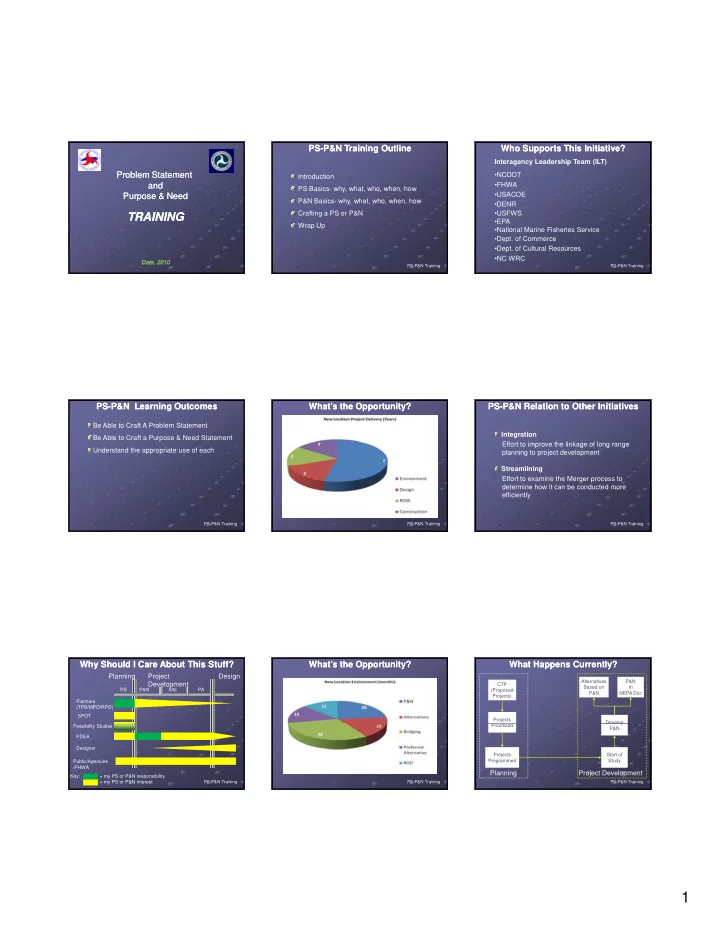
PS PS- -P&N Training Outline P&N Training Outline Who Supports This Initiative? Who Supports This Initiative? Interagency Leadership Team (ILT) Problem Statement Problem Statement NCDOT Introduction and and FHWA PS


slide-1
SLIDE 1

1

Problem Statement Problem Statement and and Purpose & Need Purpose & Need

TRAINING TRAINING

Date, 2010 Date, 2010

Be Able to Craft A Problem Statement Be Able to Craft a Purpose & Need Statement Understand the appropriate use of each

PS PS-

  • P&N Learning Outcomes

P&N Learning Outcomes

PS-P&N Training

Planning Project Development Design

PS P&N Alts Planners (TPB/MPO/RPO) PA SPOT

Why Should I Care About This Stuff? Why Should I Care About This Stuff?

PDEA Designer Public/Agencies /FHWA Key: = my PS or P&N responsibility = my PS or P&N interest Feasibility Studies PS-P&N Training

Introduction PS Basics- why, what, who, when, how P&N Basics- why, what, who, when, how

PS PS-

  • P&N Training Outline

P&N Training Outline

Crafting a PS or P&N Wrap Up

PS-P&N Training

What’s the Opportunity? What’s the Opportunity?

PS-P&N Training

What’s the Opportunity? What’s the Opportunity?

PS-P&N Training

Interagency Leadership Team (ILT)

  • NCDOT
  • FHWA
  • USACOE
  • DENR

Who Supports This Initiative? Who Supports This Initiative?

  • USFWS
  • EPA
  • National Marine Fisheries Service
  • Dept. of Commerce
  • Dept. of Cultural Resources
  • NC WRC
PS-P&N Training

Integration Effort to improve the linkage of long range planning to project development

PS PS-

  • P&N Relation to Other Initiatives

P&N Relation to Other Initiatives

Streamlining Effort to examine the Merger process to determine how it can be conducted more efficiently

PS-P&N Training

What Happens Currently? What Happens Currently?

CTP (Proposed Projects) Develop Alternatives Based on P&N P&N In NEPA Doc Projects P i iti d PS-P&N Training Develop P&N Prioritized Projects Programmed Start of Study

Planning Project Development

slide-2
SLIDE 2

2

What Is The New Process? What Is The New Process?

PS refined CTP (Proposed Projects with PS) Projects P i iti d Alternatives Based on P&N P&N In NEPA Doc PS-P&N Training refined into P&N Project Initiation Prioritized Projects Programmed

Planning

Start of Study

Project Development Transition Why What Who When

PS Basics PS Basics

How

PS-P&N Training

Purpose Communicate the context, concept and justification for proposed projects (all modes) in a CTP

PS Basics PS Basics

WHY WHY, what, who, when, how

, what, who, when, how Intent Form substantial core of P&N Save time in preparing and/or agreeing to the purpose and need in project development

PS-P&N Training

FHWA “Linking Planning & NEPA” SAFETEA-LU: Statewide Transportation Planning and Metropolitan Transportation Planning (23 USC Section 134, 135)

PS Basics PS Basics

WHY WHY, what, who, when, how

, what, who, when, how

PS-P&N Training

Appendix A of 23 CFR Part 450: Linking the Transportation Planning and NEPA Processes Environment and Planning Linkage Processes Legal Guidance 23 CFR 450.212, .318, & Appendix A “The results or decisions of these transportation planning studies may be used as part of the overall project development process consistent with NEPA ”

PS Basics PS Basics

WHY WHY, what, who, when, how

, what, who, when, how process consistent with NEPA…

  • P&N or goals & objective statements
  • General travel corridor and/ or mode(s) definition
  • Basic description of environmental setting
  • Preliminary identification of environmental impacts

& mitigation

PS-P&N Training

Full PS Minimum PS

PS Basics PS Basics

why, why, WHAT

WHAT, who, when, how

, who, when, how PS that References a P&N Underway or Completed

PS-P&N Training

Identified Problem

  • Justification of Need
  • Community Vision and Problem History

CTP Project Proposal

Components of a Full PS Components of a Full PS

  • Project Description and Overview
  • Natural & Human Environmental Context
  • Relationship to Land Use Plans
  • Linkages to Other Plans and Proposed Project History
  • Multi-modal Considerations
  • Public/ Stakeholder Involvement
PS-P&N Training

Components of a Minimum PS Components of a Minimum PS

Include:

Concise description of the problem Primary purpose(s) & goal(s) to be accomplished Describe the concept of the proposed project Briefly any known supporting information (e g other Briefly, any known supporting information (e.g. other applicable elements from Full PS)

PS-P&N Training

Include:

Concise description of the primary goals the proposed project is expected to accomplish Summary of the concept and purpose A reference to the P&N underway

PS Referencing P&N Underway PS Referencing P&N Underway

y

PS-P&N Training
slide-3
SLIDE 3

3

Criteria for selecting projects for Full PS: Time Frame

  • 5-year Work Program and STIP*

PS Basics PS Basics

why, why, WHAT

WHAT, who, when, how

, who, when, how

  • 10-year Work Program
  • Closest interim years, project priorities list

Scope

  • major new location, major multi-lane widening,

major projects other modes

PS-P&N Training

Developed by NCDOT-TPB or MPOs, in consultation with RPOs & municipal/ county staff Full PS: TPB will request review by PDEA

PS Basics PS Basics

why, what, why, what, WHO

WHO, when, how

, when, how Full PS: TPB will request review by PDEA Coordinate with Agencies & Public as part of the CTP process

PS-P&N Training

During CTP development (documented as part of CTP report) Upon Request by PDEA (if CTP has less

PS Basics PS Basics

why, what, who, why, what, who, WHEN

WHEN, how

, how Upon Request by PDEA (if CTP has less than full PS & for areas TPB has provided planning assistance in the past)

PS-P&N Training

Transfer & Use For CTP: Conceptualize/ document problems & Link problems to proposed solutions

PS Basics PS Basics

why, what, who, when, why, what, who, when, HOW

HOW

For prioritization: informs relative needs For project initiation: provides PDEA with project information For P&N: foundation of P&N

PS-P&N Training

Why What Who When

PS Review PS Review

How

PS-P&N Training

“There's more than one way to look at a problem, and they all may be right”

  • -Norman Schwarzkopf

Questions? Questions?

PS-P&N Training

Why What Who When

P&N Basics P&N Basics

How

PS-P&N Training

National Environmental Policy Act (NEPA) “…To declare a national policy which will encourage productive and enjoyable harmony between man and his environment…”

Why P&N? Why P&N?

PS-P&N Training

NEPA applies to Federal discretionary actions

Why P&N? Why P&N?

PS-P&N Training
slide-4
SLIDE 4

4

Why P&N? Why P&N?

CEQ regulations for an EIS require: “The statement shall briefly specify the underlying purpose and need to which the agency is responding in proposing the alternatives including the proposed action.” g p p CEQ regulations for an EA require: “Shall include brief discussions of the need for the proposal…”

PS-P&N Training

Describes key problem(s) & causes Provides the factual & quantifiable foundation for the purpose statement E t bli h id f t f t

What: Need What: Need

Establishes evidence of current or future transportation problems or deficiencies Establishes and justifies logical termini

PS-P&N Training

States clearly and succinctly why the project is being proposed Articulates positive intended outcomes Presents objectives to address the need

What: Purpose What: Purpose

PS-P&N Training

What: Primary v. Secondary Purpose What: Primary v. Secondary Purpose

To communicate the full range of factors considered in decision-making: A primary purpose is a “driver” of the project (a fundamental reason for the project) A secondary purpose (“other desirable

  • utcome”) is desirable, but not a core purpose
PS-P&N Training

PP#1 PP#1 PP#2 PP#2 ODO#1 ODO#1 ODO#2 ODO#2 Alt 1 Alt 1 N N Y Y Y Y N N Alt 2 Alt 2 Y Y N N Y

Exercise Exercise

Which alternative(s) meet PS or P&N? Which alternative(s) meet PS or P&N? Alt 2 Alt 2 Y Y N N Y Alt 3 Alt 3 Y Y Y Y N N N N Alt 4 Alt 4 Y Y N N Y Y Y Y

PS-P&N Training

Avoid stating the purpose as a solution: “The purpose is to widen the road to 4 lanes” “The purpose is to replace the bridge”

What: Purpose What: Purpose

Avoid the “kitchen sink” approach

PS-P&N Training

Who Develops P&N? Who Develops P&N?

Responsibility rests with the lead Federal agency preparing the NEPA document For Federal-aid projects, the lead Federal agency is FHWA (NCDOT through g y ( g Stewardship Agreement)

PS-P&N Training

CEQ regulations: no requirement for agencies/public Scoping: forum for agencies/public input SAFETEA-LU Section 6002: “opportunity for involvement” for agencies/public

Who Do We Coordinate With for P&N? Who Do We Coordinate With for P&N?

involvement for agencies/public

PS-P&N Training

SAFETEA-LU Section 6002: joint lead agencies (JLA) share FHWA’s authority to define the P&N Disagreement between JLA must be

Who Do We Coordinate With for P&N? Who Do We Coordinate With for P&N?

g resolved JLA consider input from agencies/public, but ultimately decide on P&N

PS-P&N Training
slide-5
SLIDE 5

5

Who Do We Coordinate With for P&N? Who Do We Coordinate With for P&N?

From Council on Environmental Quality: “In the case of a proposal intended to address transportation needs, joint lead or cooperating agencies should afford substantial deference to the DOT agency's articulation of purpose and need”

PS-P&N Training

FHWA and FTA observe:

  • ther Federal agencies

“should only raise questions regarding our P&N statements when those questions relate to

Who Do We Coordinate With for P&N? Who Do We Coordinate With for P&N?

questions relate to substantive or procedural problems (including omission

  • f factors) important to that

agency’s independent legal responsibilities.”

PS-P&N Training

The Merger process calls for “concurrence” by all agencies represented on individual project teams at various environmental milestones (with P&N being the first il t )

Who Do We Coordinate With for P&N? Who Do We Coordinate With for P&N?

milestone) “Concurrence” is defined as: "I do not object to the proposed action based

  • n the laws and regulations of my program

and agency."

PS-P&N Training

What Happens Currently? What Happens Currently?

CTP (Proposed Projects) Develop Alternatives Based on P&N P&N In NEPA Doc Projects P i iti d PS-P&N Training Develop P&N Prioritized Projects Programmed Start of Study

Planning Project Development

What Is The New Process? What Is The New Process?

PS refined CTP (Proposed Projects with PS) Projects P i iti d Alternatives Based on P&N P&N In NEPA Doc PS-P&N Training refined into P&N Project Initiation Prioritized Projects Programmed

Planning

Start of Study

Project Development Transition Avoid an ill-conceived project Share understanding of the problems Define a project’s scope Guide development & evaluation of alternatives Allow decisions to be legally defensible

How is P&N used? How is P&N used?

g y Justify impacts and spending of funds

PS-P&N Training

Why What Who When

P&N Review P&N Review

How

PS-P&N Training

Citizens Local Planner (MPO/RPO) NCDOT TPB Funding Decision-makers

PS PS-

  • P&N: What’s In It For Me?

P&N: What’s In It For Me?

g NCDOT Project Manager Agency

PS-P&N Training

So What’s The Difference? So What’s The Difference?

Data: possible differences in level of detail and/ or age Public/ Agency Involvement: only required for P&N for EIS, no formal agreement or

PS-P&N Training

for P&N for EIS, no formal agreement or concurrence on PS PS contains additional information, particularly the CTP Project Proposal section

slide-6
SLIDE 6

6

Crafting a PS Crafting a PS-

  • P&N Statement

P&N Statement

Get SMART!

Specific Measurable Agreed Realistic Time-bound

PS-P&N Training

The purpose is to reduce congestion The purpose is to widen the road

Exercise Exercise

Assess these PS Assess these PS-

  • P&N Purposes

P&N Purposes (use the (use the SMART SMART principles) principles) e pu pose s o de e oad The purpose is to provide a travel speed of at least 45 mph in the design year

PS-P&N Training

“Always get married early in the morning. That way, if it doesn't work out, you haven't wasted a whole day”

  • -Mickey Rooney

Questions? Questions?

“Always get P&N early in the process. That way, if it doesn't work out, you haven't wasted a couple of years”

  • -unknown
PS-P&N Training

So Which One(s) Do I Pick? So Which One(s) Do I Pick?

PS-P&N Training

Transportation Congestion Safety Facility Deficiencies

Possible Purposes Possible Purposes

Other Goals/Objectives

  • Legislative Intent
  • Environmental Protection
  • Growth/Economic Dev.

Access System Linkage Mobility Emergency Evacuation

  • National Defense/Security
PS-P&N Training

Congestion Congestion

PS-P&N Training

What is Congestion? TRB: “Travel time in excess of that normally incurred under light or free-flow conditions” Wikipedia: “a state of excessive accumulation or overfilling or overcrowding”

Congestion Congestion

accumulation or overfilling or overcrowding Dictionary.com: “overcrowding, clogging” Find a definition for your project! If you can’t define it, you won’t know if you’ve achieved it!

PS-P&N Training

Possible Sources for Definition: MPO LRTP TMA CMP CTP National Guidelines

Congestion Congestion

National Guidelines State Guidelines/Standards/Policies/Plans Highway Capacity Manual FHWA NC Division office determinations Local government standards/policies/guidelines

PS-P&N Training

Example Performance Measures: Speed (peak hour/period) Delay (peak hour/period) LOS (peak hour/period) V/C Ratio (peak hour/period) VMT

Congestion Congestion

VMT Density/Headway Signal Cycle Failure Queue Length Vehicle Hours of Travel

PS-P&N Training
slide-7
SLIDE 7

7

Purpose: “To improve the capacity of existing I-240 west of Asheville to accommodate the existing and forecasted (2030 design year) traffic in this growing area.” Performance Criteria: “since the project will be part

Congestion Congestion

Performance Criteria: since the project will be part

  • f the Interstate System, it should be designed to

achieve LOS D or better for the type and volumes

  • f traffic anticipated for the twenty-year period

beyond the time construction is authorized by FHWA”

PS-P&N Training

Source: “NCDOT Policy on Desirable Levels of Service for State Highway System Streets and Highways in Urban Areas” (1997)

Congestion Congestion

  • Avg. Speed
  • Avg. Speed

(suburban) (suburban)

  • Avg. Speed
  • Avg. Speed

(Intermediate) (Intermediate)

  • Avg. Speed
  • Avg. Speed

(CBD) (CBD) Primary Primary Freeway Freeway

50 50-

  • 60

60 50 50-

  • 55

55 45 45-

  • 55

55

PS-P&N Training

Congestion Congestion

Rate these examples (Good, Bad, OK) The purpose is to widen US 5 to six lanes. The purpose is to eliminate congestion on US 5. The purpose is to reduce congestion on US 5. The purpose is to achieve LOS D on US 5. The purpose is to achieve a minimum travel speed of 45 mph in the design year for US 5.

PS-P&N Training

Safety Safety

True or False? Any improvement we do to a facility will make the facility safer

PS-P&N Training

Is there a safety problem? Road crash rate v. statewide averages Critical Crash Rate (CCR)

Safety Safety

PS-P&N Training

CCR = A statistical tool that assists in screening for high crash locations by utilizing a confidence interval that can be adjusted (up or down) to

Safety Safety

adjusted (up or down) to accommodate the needs of the safety program

PS-P&N Training

How to define?

  • verall

particular type/severity rate/number/percent

Safety Safety

PS-P&N Training

Safety Safety

What is the crash pattern?

PS-P&N Training

Safety Safety

Possible Cause Countermeasure Slippery Pavement Overlay existing pavement Provide adequate drainage Groove existing pavement Reduce speed limit "Slippery When Wet" signs S ppe y e e s g s Poor Delineation Install pavement markings Install roadside delineators Install advance warning signs

PS-P&N Training
slide-8
SLIDE 8

8

Countermeasure Potential Effectiveness

Safety Safety

Countermeasure: Install a traffic signal Crash Pattern Affected Percent Reduction Total Crashes 22 Total Angle Crashes 65

PS-P&N Training

Do consult w/ NCDOT Safety Planning Group Do base analysis on accepted engineering practices

Safety: Do’s and Don’ts Safety: Do’s and Don’ts

Don’t include safety w/o documented crash data Don’t add safety because it “sounds good” Don’t add safety to increase justification Don’t forget to consider unintended consequences

PS-P&N Training

Safety Safety

Rate these examples (Good, Bad, OK) The purpose is to improve safety on US 5. The purpose is to reduce crashes on US 5. The purpose is to reduce angle crashes on US 5. The purpose is to eliminate crashes on US 5. The purpose is to achieve a minimum 20% reduction of crashes on US 5.

PS-P&N Training

Facility Deficiencies Facility Deficiencies

PS-P&N Training

Physical characteristics of a facility that are below the desired performance Substandard geometrics Load limits on structures Inadequate cross-sections

Facility Deficiencies Facility Deficiencies

Inadequate cross sections High maintenance costs

PS-P&N Training

Possible information sources: Pavement Management System Bridge Management System Maintenance Management System Roadway Design Manuals and Guidelines

Facility Deficiencies Facility Deficiencies

Roadway Design Manuals and Guidelines Structure Standards Access Management Policy

PS-P&N Training

Rate these examples (Good, Bad, OK) The purpose of this project is to eliminate the “deficient” rating of the bridge. The purpose is to replace the bridge.

Facility Deficiencies Facility Deficiencies

The purpose is to replace the bridge. The purpose of this project is to achieve minimum acceptable pavement standards. The purpose is to bring the roadway geometry up to current design standards.

PS-P&N Training

Access Access

PS-P&N Training

Assume a congested two-lane undivided road A four-lane divided facility is proposed Is access improved? For which users? Is access restricted? For which users?

Access Access

Need to define access!

PS-P&N Training
slide-9
SLIDE 9

9

Access Access

Mobility

Interstate System: highest mobility/lowest access Other freeways/controlled access: Higher mobility/lower access Arterials: high mobility/low access

PS-P&N Training

Access

high mobility/low access Collectors: Lower mobility/higher access Local Roads: Lowest mobility/highest access

For an Interstate project: Operation and safety is paramount New access points will never improve the

  • peration and safety of the Interstate

D t i

Access Access

Do not propose access as a primary purpose or “other desirable outcome”

PS-P&N Training

For non-Interstate projects: Determine whether access is the root cause of the problem (usually it’s congestion or facilitating economic development)

Access Access

PS-P&N Training

Access Access

Rate these examples (Good, Bad, OK) The purpose is to improve access on I-40. The purpose is to increase accessibility to RTP RTP. The purpose is to provide transportation access to the proposed business park.

PS-P&N Training

System Linkage System Linkage

PS-P&N Training

Definition Linking two or more: Existing transportation facilities Modal facilities

System Linkage System Linkage

Geographic areas Regional traffic generators

PS-P&N Training

Rate these examples (Good, Bad, OK) The purpose is to link I-40 and I-74. The purpose is to link the roadway network with the proposed passenger rail station

System Linkage System Linkage

with the proposed passenger rail station. The purpose is to link the mainland transportation system with the Outer Banks transportation system.

PS-P&N Training

Mobility Mobility

PS-P&N Training

What is Mobility? Connecting more people and vehicles in less time with their work, school, community services, marketplaces, and each other FHWA Planning Glossary: “the ability to

Mobility Mobility

FHWA Planning Glossary: the ability to move or be moved from place to place” Movement of people…

PS-P&N Training
slide-10
SLIDE 10

10

What is Mobility? Connecting more people and vehicles in less time with their work, school, community services, marketplaces, and each other FHWA Planning Glossary: “the ability to

Mobility Mobility

FHWA Planning Glossary: the ability to move or be moved from place to place” Movement of people and goods Other?

PS-P&N Training

Identify sources to support mobility in P&N: Long Range Transportation Plan/ Comprehensive Transportation Plan State transportation plans Local government transportation plans

Mobility Mobility

PS-P&N Training

Rate these examples (Good, Bad, OK) The purpose is to improve the mobility of freight The purpose is to improve the mobility along Corridor X

Mobility Mobility

Corridor X The purpose of this project is to improve mobility The purpose is to improve the mobility of motorized vehicles along Corridor X during the PM peak period”

PS-P&N Training

Emergency Evacuation Emergency Evacuation

PS-P&N Training

Only applies to: Hurricane evacuation Nuclear power plant evacuation

Emergency Evacuation Emergency Evacuation

PS-P&N Training

When considering as a primary purpose, the following must be documented: Adopted emergency evacuation plan Location is on an identified evacuation route

Emergency Evacuation Emergency Evacuation

Location is on an identified evacuation route Scope addresses all relevant needs for successful evacuation

PS-P&N Training

Identify total v. partial evacuation need Don’t forget about: Feeder & Receiver routes Disabled vehicles Motorist facilities

Emergency Evacuation Emergency Evacuation

Motorist facilities (gas, restrooms, food, etc.)

PS-P&N Training

Rate these examples (Good, Bad, OK) The purpose is to improve hurricane evacuation. The purpose is to achieve the 18-hour standard for hurricane evacuation of Pea Island.

Emergency Evacuation Emergency Evacuation

for hurricane evacuation of Pea Island. The purpose is to reduce hurricane evacuation clearance times for Pea Island. The purpose is to widen the intersection for hurricane evacuation.

PS-P&N Training

“Creative minds have always been known to survive any kind of bad training” Anna Freud

Questions? Questions?

  • -Anna Freud
PS-P&N Training
slide-11
SLIDE 11

11

Transportation Congestion Safety Facility Deficiencies

Possible Purposes Possible Purposes

Other Goals/Objectives Legislative Intent Environmental Protection Growth/Economic Development Access System Linkage Mobility Emergency Evacuation National Defense/Security

PS-P&N Training

Who? Congress State legislatures How?

Legislative Intent Legislative Intent

Specific corridor Special funding Mode Non-discretionary

PS-P&N Training

Project-specific legislation does not necessarily determine the project purpose Lead agency still must exercise judgment in the NEPA process when deciding if and how to incorporate legislative direction into the purpose

Legislative Intent Legislative Intent

Unless legislative intent exempts FHWA from compliance with relevant laws (e.g. NEPA), legislative intent cannot be used as the sole reason for directing decisions on the project

PS-P&N Training

Congressional example (from SAFETEA-LU) “…Environmental studies and construction of U.S. 74 Monroe Bypass Extension...”

Legislative Intent Legislative Intent

PS-P&N Training

Congressional example (HR 105-504) “Trappers Loop connector Road- Provides that actions related to construction of the Trappers Loop connector Road that are undertaken by agencies or entities other than the Forest Service are deemed t b di ti ti th i d d

Legislative Intent Legislative Intent

to be nondiscretionary actions authorized and directed by Congress…”

PS-P&N Training

Congressional example (REAL ID Act of 2005 ) “…the Secretary of Homeland Security shall have the authority to waive, and shall waive, all laws such Secretary, in such Secretary's sole discretion, determines necessary to ensure expeditious construction of the barriers and roads under this

Legislative Intent Legislative Intent

section....”

PS-P&N Training

NC General Assembly examples “[to construct a new toll bridge] of more than two miles in length going from the mainland to a peninsula bordering the State of Virginia.” (NCGS 136-89.183(a)(2))

Legislative Intent Legislative Intent

(NCGS 136 89.183(a)(2))

PS-P&N Training

Environmental Protection Environmental Protection

PS-P&N Training

P&N should focus on the underlying reasons based

  • n meeting a

transportation need How the project is i d t ( idi /

Environmental Protection Environmental Protection

carried out (avoiding/ minimizing impacts) is distinct from the P&N

PS-P&N Training
slide-12
SLIDE 12

12

“EO 13274 Task Force on Purpose and Need”: “for the bulk of transportation projects, most staff across Federal agencies agreed that although environmental protection and community enhancement are important goals, these issues h ld t b t f th d d

Environmental Protection Environmental Protection

should not be a part of the purpose and need statement itself.”

PS-P&N Training

Protected Living Marine Resources Program “The USCG proposes this action to aid in the fulfillment of its missions, including protection of the environment, while fulfilling USCG obligations to protect listed species”

Environmental Protection Environmental Protection

PS-P&N Training

Rate these examples (Good, Bad, OK) The purpose is to protect the environment. The purpose is to reduce environmental impacts from US 5.

Environmental Protection Environmental Protection

from US 5. The purpose is to protect habitat for the dwarf wedgemussel for impacts to the species associated with future Federal-aid highway projects. The purpose is to mitigate for environmental impacts

PS-P&N Training

Growth/Economic Development Growth/Economic Development

PS-P&N Training

Public infrastructure (e.g. water, sewer, schools & transportation) and other considerations (e.g. tax rates, available workforce, available land and/or buildings, real estate values) collectively help determine how and where a community will grow and prosper economically

Growth/Economic Development Growth/Economic Development

will grow and prosper economically

PS-P&N Training

P&N should focus on the underlying reasons based on meeting a transportation need A desired outcome of a transportation project can be the facilitation of growth

Growth/Economic Development Growth/Economic Development

PS-P&N Training

Example Language from SAFETEA-LU: “Transportation Improvements at Piedmont Triad Research Park, Winston-Salem, NC”

Growth/Economic Development Growth/Economic Development

PS-P&N Training

Example Original Purpose language: “The Park’s primary purpose and need is to provide the Piedmont Triad with a new biotechnology employment sector to replace jobs

Growth/Economic Development Growth/Economic Development

biotechnology employment sector to replace jobs eliminated by tobacco and textile manufacturing”

PS-P&N Training

Example Revised Purpose language: “The purpose of the project is to improve connectivity, north-south traffic capacity and access to property between Stadium Drive and

Growth/Economic Development Growth/Economic Development

access to property between Stadium Drive and Third Street near the downtown Winston-Salem CBD”

PS-P&N Training
slide-13
SLIDE 13

13

Rate these examples (Good, Bad, OK) The purpose of the project is to promote growth/land use. The purpose is to provide needed transportation infrastructure to support

Growth/Economic Development Growth/Economic Development

transportation infrastructure to support community growth objectives as identified in [title of a plan]. The purpose is to provide needed transportation infrastructure to support community growth objectives for the US 5 corridor, as identified in [title of a plan].

PS-P&N Training

Highway Rail Ports Installations

National Defense/Security National Defense/Security

PS-P&N Training

Strategic Highway Network (STRAHNET)

National Defense/Security National Defense/Security

Ensure the defense readiness capability of public highway infrastructure and establish policy on how DOD uses the public highway system

PS-P&N Training

Ports for National Defense: Ensure the identification, adequacy and responsiveness of defense-important port infrastructure in both peacetime and wartime

National Defense/Security National Defense/Security

PS-P&N Training

Port Purpose Example: “the purpose of the Port Expansion Project is to replace functionally obsolete structures; increase POA [Port of Anchorage] capacity, efficiency, and security; and accommodate the needs of the U.S. military for rapid deployment”

National Defense/Security National Defense/Security

y p p y

PS-P&N Training

Railroads for National Defense: ensures readiness capability of the national railroad network to support defense deployment and peacetime needs

National Defense/Security National Defense/Security

Strategic Rail Corridor Network (STRACNET)

PS-P&N Training

Example Need from DOD

National Defense/Security National Defense/Security

“WHEREAS, Camp Lejeune has plans to execute a roadway project roadway project that will impact NC 24 by requiring a new entrance to the Base off on NC 24”

PS-P&N Training

Installation Purpose Example: The DOD eliminated public access to Beulah Street and Woodlawn Road within Fort Belvoir following events of 9.11.01 “The purpose…is to replace the once-public id d b VA R t 618 (W dl

National Defense/Security National Defense/Security

access provided by VA Route 618 (Woodlawn Road) and VA Route 613 (Beulah Street) between U.S. Route 1 and VA Route 611 (Telegraph Road)…The project purpose is to

  • ffer replacement connectivity compatible with

force protection concerns.”

PS-P&N Training

Understand how the project was conceived Develop a range of potential purposes Analyze each potential purpose to determine if there is a well-defined and well-supported need Choose one: primary purpose “ th d i bl t ”

So Which One(s) Do I Pick? So Which One(s) Do I Pick?

“other desirable outcome” do not include Note: there needs to be at least one primary purpose and all it takes to justify a project is one primary purpose

PS-P&N Training
slide-14
SLIDE 14

14

So Which One(s) Do I Pick? So Which One(s) Do I Pick?

PS-P&N Training

“What I hear, I forget. What I see, I

  • remember. What I do, I understand.”

Questions? Questions?

  • - Kung Fu Tzu (Confucius)
PS-P&N Training

Connecting PS and P&N What’s My Role? Learning Outcomes Review

Summary/ Wrap Summary/ Wrap-

  • Up

Up

g

PS-P&N Training

NCDOT Integration (includes PS Guidance, P&N Guidance, PS FAQs): www.ncdot.org/doh/preconstruct/tpb/IP/default.html

Resources Resources

PS-P&N Training