Sort Sort If g is in O(f) we say that f is an upper bound - - PDF document

sort sort
SMART_READER_LITE
LIVE PREVIEW

Sort Sort If g is in O(f) we say that f is an upper bound - - PDF document

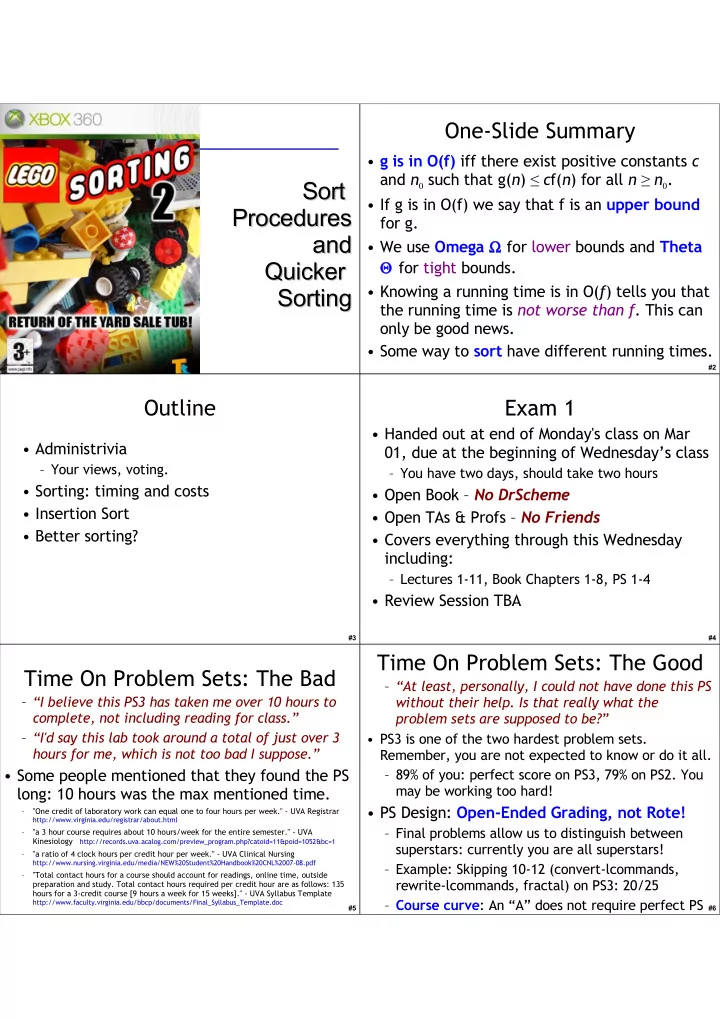
One-Slide Summary g is in O(f) iff there exist positive constants c and n 0 such that g( n ) c f( n ) for all n n 0 . Sort Sort If g is in O(f) we say that f is an upper bound Procedures Procedures for g. and and We use


slide-1
SLIDE 1

Sort Sort Procedures Procedures and and Quicker Quicker Sorting Sorting

#2

One-Slide Summary

  • g is in O(f) iff there exist positive constants c

and n0 such that g(n) ≤ cf(n) for all n ≥ n0.

  • If g is in O(f) we say that f is an upper bound

for g.

  • We use Omega Ω for lower bounds and Theta

Θ for tight bounds.

  • Knowing a running time is in O(f) tells you that

the running time is not worse than f. This can

  • nly be good news.
  • Some way to sort have different running times.

#3

Outline

  • Administrivia

– Your views, voting.

  • Sorting: timing and costs
  • Insertion Sort
  • Better sorting?

#4

Exam 1

  • Handed out at end of Monday's class on Mar

01, due at the beginning of Wednesday’s class

– You have two days, should take two hours

  • Open Book – No DrScheme
  • Open TAs & Profs – No Friends
  • Covers everything through this Wednesday

including:

– Lectures 1-11, Book Chapters 1-8, PS 1-4

  • Review Session TBA

#5

Time On Problem Sets: The Bad

– “I believe this PS3 has taken me over 10 hours to complete, not including reading for class.” – “I'd say this lab took around a total of just over 3 hours for me, which is not too bad I suppose.”

  • Some people mentioned that they found the PS

long: 10 hours was the max mentioned time.

– "One credit of laboratory work can equal one to four hours per week." - UVA Registrar

http://www.virginia.edu/registrar/about.html

– "a 3 hour course requires about 10 hours/week for the entire semester." - UVA Kinesiology http://records.uva.acalog.com/preview_program.php?catoid=11&poid=1052&bc=1 – "a ratio of 4 clock hours per credit hour per week." - UVA Clinical Nursing

http://www.nursing.virginia.edu/media/NEW%20Student%20Handbook%20CNL%2007-08.pdf

– "Total contact hours for a course should account for readings, online time, outside preparation and study. Total contact hours required per credit hour are as follows: 135 hours for a 3-credit course [9 hours a week for 15 weeks]." - UVA Syllabus Template

http://www.faculty.virginia.edu/bbcp/documents/Final_Syllabus_Template.doc #6

Time On Problem Sets: The Good

– “At least, personally, I could not have done this PS without their help. Is that really what the problem sets are supposed to be?”

  • PS3 is one of the two hardest problem sets.

Remember, you are not expected to know or do it all. – 89% of you: perfect score on PS3, 79% on PS2. You may be working too hard!

  • PS Design: Open-Ended Grading, not Rote!

– Final problems allow us to distinguish between superstars: currently you are all superstars! – Example: Skipping 10-12 (convert-lcommands, rewrite-lcommands, fractal) on PS3: 20/25 – Course curve: An “A” does not require perfect PS

slide-2
SLIDE 2

#7

Tutoring and Hints

– “Is there any way to get one on one tutoring for this type of problem set?”

  • In the past, the ACM and ACM-W have offered
  • ne-on-one tutoring. Send me (or the course

staff) email if you are interested; I will try to set something up.

– “More hints written into PS if possible please? This way I can work on it independently of TAs”

  • I will add more hints on a optional links for PS4
  • n. On your honor!

#8

TA Time Limit?

– “It is absolutely ridiculous that my partner and I had to wait an hour and forty minutes for help when we entered our our name on the wait list shortly after we arrived.”

  • Recall that previously we voted for no time
  • limit. We will vote again:
  • I believe each TA should spend some maximum

amount of time with each group (e.g., 10 minutes) before moving on. A group that still has questions after 10 minutes can add themselves to the queue again.

#9

Writing The Code

– “I'd rather have maybe 4 or 5 comprehensive questions where I wrote the entire snippet, because I would get more chances to work off of my own code.”

  • Multiple people had this comment. Your wish is
  • granted. Check out PS4, where there is no “fill

in the blanks” code at all.

– “Also, 1 dropped problem set grade please!”

  • Nine people made such comments. Vote?

– If so: drop lowest PS that is not the final project and that you got at least three points on.

#10

Recall: Asymptotic Complexity

g is in O(f) iff: There are positive constants c and n0 such that g(n) ≤ cf(n) for all n ≥ n0. g is in Ω(f) iff: There are positive constants c and n0 such that g(n) ≥ cf(n) for all n ≥ n0. g is in Θ(f) iff: g is in O(f) and g is in Ω(f).

#11

Is our sort good enough?

Takes over 1 second to sort 1000-length list. How long would it take to sort 1 million items?

1s = time to sort 1000 4s ~ time to sort 2000 1M is 1000 * 1000 Sorting time is n2 so, sorting 1000 times as many items will take 10002 times as long = 1 million seconds ~ 11 days Note: there are 800 Million VISA cards in circulation. It would take 20,000 years to process a VISA transaction at this rate.

#12

Which of these is true?

  • Our sort procedure is too slow for VISA

because its running time is in O(n2)

  • Our sort procedure is too slow for VISA

because its running time is in Ω(n2)

  • Our sort procedure is too slow for VISA

because its running time is in Θ(n2)

slide-3
SLIDE 3

#13

Which of these is true?

  • Our sort procedure is too slow for VISA

because its running time is in O(n2)

  • Our sort procedure is too slow for VISA

because its running time is in Ω(n2)

  • Our sort procedure is too slow for VISA

because its running time is in Θ(n2)

Knowing a running time is in O(f) tells you the running time is not worse than f. This can only be good news. It doesn’t tell you anything about how bad it is. (Lots of people and books get this wrong.)

#14

Liberal Arts Trivia: Art History

  • Name the work shown

and its sculptor. The artist is generally considered the progenitor of modern sculpture: he departed from mythology and allegory and modeled the human body with realism, celebrating individual character and physicality.

#15

Liberal Arts Trivia: Chinese History

  • This period of Chinese history roughly

corresponds to the Eastern Zhou dynasty (8th century BCE to 5th century BCE). China was feudalistic, with Zhou kings controlling only the capital (Luoyang) and granting the rest as fiefdoms to several hundred nobles (including the Twelve Princes). As the era unfolded, powerful states annexed smaller ones until a few large principalities controlled China. By 6th century BCE, the feudal system had crumbled and the Warring States period had begun.

#16

Sorting Cost

(define (best-first-sort lst cf) (if (null? lst) lst (let ((best (find-best lst cf))) (cons best (best-first-sort (delete lst best) cf))))) (define (find-best lst cf) (if (null? (cdr lst)) (car lst) (pick-better cf (car lst) (find-best (cdr lst) cf))))

The running time of best-first-sort is in Θ(n2) where n is the number of elements in the input list.

Assuming the comparison function passed as cf has constant running time.

#17

Divide and Conquer sorting?

  • Best first sort: find the lowest in the list,

add it to the front of the result of sorting the list after deleting the lowest.

  • Insertion sort: insert the first element of

the list in the right place in the sorted rest

  • f the list.

– Let's write this together! – Hint: use/write helper function insert-one – (insert-one 2 (list 1 3 4 5)) --> (1 2 3 4 5)

#18

insert-sort

(define (insert-sort lst cf) (if (null? lst) null (insert-one (car lst) (insert-sort (cdr lst) cf) cf)))

Try writing insert-one. (define (insert-one element lst cf) ...) (insert-one 2 (list 1 3 5) <) --> (1 2 3 5)

slide-4
SLIDE 4

#19

insert-one

(define (insert-one el lst cf) (if (null? lst) (list el) (if (cf el (car lst)) (cons el lst) (cons (car lst) (insert-one el (cdr lst) cf)))))

#20

How much work is insert-sort?

How many times does insert- sort evaluate insert-one?

(define (insert-sort lst cf) (if (null? lst) null (insert-one (car lst) (insert-sort (cdr lst) cf) cf))) (define (insert-one el lst cf) (if (null? lst) (list el) (if (cf el (car lst)) (cons el lst) (cons (car lst) (insert-one el (cdr lst) cf)))))

#21

How much work is insert-sort?

running time of insert-

  • ne is ?

How many times does insert- sort evaluate insert-one?

n times (once for each element)

(define (insert-sort lst cf) (if (null? lst) null (insert-one (car lst) (insert-sort (cdr lst) cf) cf))) (define (insert-one el lst cf) (if (null? lst) (list el) (if (cf el (car lst)) (cons el lst) (cons (car lst) (insert-one el (cdr lst) cf)))))

#22

How much work is insert-sort?

running time of insert-

  • ne is in Θ(n)

How many times does insert- sort evaluate insert-one?

n times (once for each element)

(define (insert-sort lst cf) (if (null? lst) null (insert-one (car lst) (insert-sort (cdr lst) cf) cf))) (define (insert-one el lst cf) (if (null? lst) (list el) (if (cf el (car lst)) (cons el lst) (cons (car lst) (insert-one el (cdr lst) cf)))))

#23

How much work is insert-sort?

running time of insert-

  • ne is in Θ(n)

How many times does insert- sort evaluate insert-one?

n times (once for each element)

insert-sort has running time in Θ(n2) where n is the number of elements in the input list

(define (insert-sort lst cf) (if (null? lst) null (insert-one (car lst) (insert-sort (cdr lst) cf) cf))) (define (insert-one el lst cf) (if (null? lst) (list el) (if (cf el (car lst)) (cons el lst) (cons (car lst) (insert-one el (cdr lst) cf)))))

#24

Which is better?

  • Is insert-sort faster than best-first-sort?
slide-5
SLIDE 5

> (insert-sort < (revintsto 20)) (1 2 3 4 5 6 7 8 9 10 11 12 13 14 15 16 17 18 19 20) Requires 190 applications of < > (insert-sort < (intsto 20)) (1 2 3 4 5 6 7 8 9 10 11 12 13 14 15 16 17 18 19 20) Requires 19 applications of < > (insert-sort < (rand-int-list 20)) (0 11 16 19 23 26 31 32 32 34 42 45 53 63 64 81 82 84 84 92) Requires 104 applications of < > (best-first-sort < (intsto 20)) (1 2 3 4 5 6 7 8 9 10 11 12 13 14 15 16 17 18 19 20) Requires 210 applications of < > (best-first-sort < (rand-int-list 20)) (4 4 16 18 19 20 23 32 36 51 53 59 67 69 73 75 82 82 88 89) Requires 210 applications of <

best-first-sort vs. insert-sort

  • Both are Θ(n2) worst case (reverse list)
  • Both are Θ(n2) when sorting a

randomly ordered list – But insert-sort is about twice as fast

  • insert-sort is Θ(n) best case (ordered

input list)

Can we do better?

(insert-one < 88 (list 1 2 3 5 6 23 63 77 89 90))

Suppose we had procedures

(first-half lst) (second-half lst)

that quickly divided the list in two halves?

#29

quicker-insert using halves

(define (quicker-insert el lst cf) (if (null? lst) (list el) ;; just like insert-one (if (null? (cdr lst)) (if (cf el (car lst)) (cons el lst) (list (car lst) el)) (let ((front (first-half lst)) (back (second-half lst))) (if (cf el (car back)) (append (quicker-insert el front cf) back) (append front (quicker-insert el back cf)))))))

#30

Evaluating quicker-sort

> (quicker-insert < 3 (list 1 2 4 5 7)) |(quicker-insert #<procedure:traced-<> 3 (1 2 4 5 7)) | (< 3 1) | #f | (< 3 5) | #t | (quicker-insert #<procedure:traced-<> 3 (1 2 4)) | |(< 3 1) | |#f | |(< 3 4) | |#t | |(quicker-insert #<procedure:traced-<> 3 (1 2)) | | (< 3 1) | | #f | | (< 3 2) | | #f | | (quicker-insert #<procedure:traced-<> 3 (2)) | | |(< 3 2) | | |#f | | (2 3) | |(1 2 3) | (1 2 3 4) |(1 2 3 4 5 7) (1 2 3 4 5 7)

Every time we call quicker- insert, the length of the list is approximately halved!

(define (quicker-insert el lst cf) (if (null? lst) (list el) (if (null? (cdr lst)) (if (cf el (car lst)) (cons el lst) (list (car lst) el)) (let ((front (first-half lst)) (back (second-half lst))) (if (cf el (car back)) (append (quicker-insert el front cf) back) (append front (quicker-insert el back cf)))))))

slide-6
SLIDE 6

#31

How much work is quicker-sort?

Each time we call quicker-insert, the size of lst halves. So doubling the size of the list only increases the number of calls by 1.

List Size # quicker-insert applications 1 1 2 2 4 3 8 4 16 5

(define (quicker-insert el lst cf) (if (null? lst) (list el) (if (null? (cdr lst)) (if (cf el (car lst)) (cons el lst) (list (car lst) el)) (let ((front (first-half lst)) (back (second-half lst))) (if (cf el (car back)) (append (quicker-insert el front cf) back) (append front (quicker-insert el back cf)))))))

#32

Homework

  • Problem Set 4
  • Read Chapter 8
  • Exam 1 Out Monday