1 Probability Recap Reasoning over Time or Space - - PDF document

1
SMART_READER_LITE
LIVE PREVIEW

1 Probability Recap Reasoning over Time or Space - - PDF document

Announcements CSE 473: Ar+ficial Intelligence Markov Models No class on Wed Daniel S. Weld --- University of Washington 2 [Most slides


slide-1
SLIDE 1

1

CSE ¡473: ¡Ar+ficial ¡Intelligence ¡

¡

Markov ¡Models ¡

Daniel ¡S. ¡Weld ¡-­‑-­‑-­‑ ¡University ¡of ¡Washington ¡

[Most ¡slides ¡were ¡created ¡by ¡Dan ¡Klein ¡and ¡Pieter ¡Abbeel ¡for ¡CS188 ¡Intro ¡to ¡AI ¡at ¡UC ¡Berkeley. ¡ ¡All ¡CS188 ¡materials ¡are ¡available ¡at ¡hMp://ai.berkeley.edu.] ¡

Announcements ¡

§ No ¡class ¡on ¡Wed… ¡

2

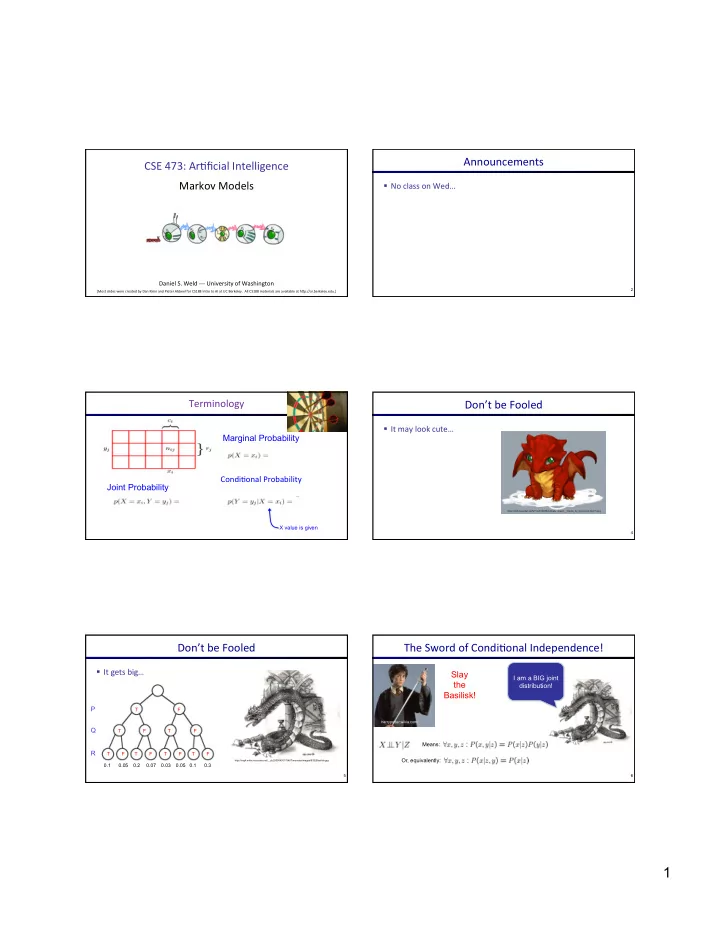
Terminology ¡

Condi+onal ¡Probability ¡ Joint Probability Marginal Probability

X value is given

Don’t ¡be ¡Fooled ¡

§ It ¡may ¡look ¡cute… ¡ ¡

4

https://fc08.deviantart.net/fs71/i/2010/258/4/4/baby_dragon__charles_by_imsorrybuti-d2yti11.png

Don’t ¡be ¡Fooled ¡

§ It ¡gets ¡big… ¡ ¡

5

http://img4.wikia.nocookie.net/__cb20090430175407/monster/images/9/92/Basilisk.jpg

T T T F T T T F T F

P

F F F F

Q R

0.1 0.05 0.2 0.07 0.03 0.05 0.1 0.3

The ¡Sword ¡of ¡Condi+onal ¡Independence! ¡

6

Slay the Basilisk!

harrypotter.wikia.com/

I am a BIG joint distribution!

Means: Or, equivalently:

slide-2
SLIDE 2

2

Probability ¡Recap ¡

§ Condi+onal ¡probability ¡ § Product ¡rule ¡ § Chain ¡rule ¡ ¡

¡ ¡ ¡

§ Bayes ¡rule ¡ § X, ¡Y ¡independent ¡if ¡and ¡only ¡if: ¡ § X ¡and ¡Y ¡are ¡condi+onally ¡independent ¡given ¡Z: ¡ ¡ ¡ ¡ ¡ ¡ ¡ ¡ ¡ ¡ ¡ ¡ ¡ ¡ ¡ ¡ ¡ ¡ ¡ ¡ ¡ ¡ ¡ ¡ ¡ ¡ ¡ ¡ ¡if ¡and ¡only ¡if: ¡

Reasoning ¡over ¡Time ¡or ¡Space ¡

§ O^en, ¡we ¡want ¡to ¡reason ¡about ¡a ¡sequence ¡of ¡observa+ons ¡

§ Speech ¡recogni+on ¡ § Robot ¡localiza+on ¡ § User ¡aMen+on ¡ § Medical ¡monitoring ¡

§ Need ¡to ¡introduce ¡+me ¡(or ¡space) ¡into ¡our ¡models ¡

Markov ¡Models ¡Recap ¡

§ Explicit ¡assump+on ¡for ¡all ¡ ¡ ¡t ¡: ¡ § Consequence, ¡joint ¡distribu+on ¡can ¡be ¡wriMen ¡as: ¡ ¡ § Addi+onal ¡explicit ¡assump+on: ¡ ¡ ¡ ¡ ¡ ¡ ¡ ¡ ¡ ¡ ¡ ¡ ¡ ¡ ¡ ¡ ¡ ¡ ¡ ¡ ¡ ¡ ¡ ¡ ¡is ¡the ¡same ¡for ¡all ¡t ¡

Xt ⊥ ⊥ X1, . . . , Xt−2 | Xt−1

P(X1, X2, . . . , XT ) = P(X1)P(X2|X1)P(X3|X2) . . . P(XT |XT −1) = P(X1)

T

Y

t=2

P(Xt|Xt−1) P(Xt | Xt−1)

is the same for all t T-1 T

Example ¡Markov ¡Chain: ¡Weather ¡

§ States: ¡X ¡= ¡{rain, ¡sun} ¡

¡

rain ¡ sun ¡ 0.9 ¡ 0.7 ¡ 0.3 ¡ 0.1 ¡

Two ¡new ¡ways ¡of ¡represen+ng ¡the ¡same ¡CPT ¡

sun ¡ rain ¡ sun ¡ rain ¡ 0.1 ¡ 0.9 ¡ 0.7 ¡ 0.3 ¡ Xt-­‑1 ¡ Xt ¡ P(Xt|Xt-­‑1) ¡ sun ¡ sun ¡ 0.9 ¡ sun ¡ rain ¡ 0.1 ¡ rain ¡ sun ¡ 0.3 ¡ rain ¡ rain ¡ 0.7 ¡

§ Ini+al ¡distribu+on: ¡1.0 ¡sun ¡ § CPT ¡P(Xt ¡| ¡Xt-­‑1): ¡

Example ¡Markov ¡Chain: ¡Weather ¡

§ Ini+al ¡distribu+on: ¡1.0 ¡sun ¡ § What ¡is ¡the ¡probability ¡distribu+on ¡a^er ¡one ¡step? ¡

rain ¡ sun ¡ 0.9 ¡ 0.7 ¡ 0.3 ¡ 0.1 ¡

Mini-­‑Forward ¡Algorithm ¡

§ Ques+on: ¡What’s ¡P(X) ¡on ¡some ¡day ¡t? ¡

Forward simulation

X2 X1 X3 X4

P(xt) =

X

xt−1

P(xt−1, xt) = X

xt−1

P(xt | xt−1)P(xt−1)

slide-3
SLIDE 3

3

Example ¡Run ¡of ¡Mini-­‑Forward ¡Algorithm ¡

§ From ¡ini+al ¡observa+on ¡of ¡sun ¡ ¡ ¡ § From ¡ini+al ¡observa+on ¡of ¡rain ¡ § From ¡yet ¡another ¡ini+al ¡distribu+on ¡P(X1): ¡

P(X1) P(X2) P(X3) P(X∞) P(X4) P(X1) P(X2) P(X3) P(X∞) P(X4) P(X1) P(X∞)

… [Demo: ¡L13D1,2,3] ¡

Video ¡of ¡Demo ¡Ghostbusters ¡Basic ¡Dynamics ¡ Video ¡of ¡Demo ¡Ghostbusters ¡Circular ¡Dynamics ¡ Video ¡of ¡Demo ¡Ghostbusters ¡Whirlpool ¡Dynamics ¡

§ Sta+onary ¡distribu+on: ¡

§ The ¡distribu+on ¡we ¡end ¡up ¡with ¡is ¡called ¡ the ¡sta+onary ¡distribu+on ¡ ¡ ¡ of ¡the ¡ chain ¡ § It ¡sa+sfies ¡

Sta+onary ¡Distribu+ons ¡

§ For ¡most ¡chains: ¡

§ Influence ¡of ¡the ¡ini+al ¡distribu+on ¡ gets ¡less ¡and ¡less ¡over ¡+me. ¡ § The ¡distribu+on ¡we ¡end ¡up ¡in ¡is ¡ independent ¡of ¡the ¡ini+al ¡distribu+on ¡ P∞(X) = P∞+1(X) = X

x

P(X|x)P∞(x)

P∞

Example: ¡Sta+onary ¡Distribu+ons ¡

§ Ques+on: ¡What’s ¡P(X) ¡at ¡+me ¡t ¡= ¡infinity? ¡

X2 X1 X3 X4

Xt-­‑1 ¡ Xt ¡ P(Xt|Xt-­‑1) ¡ sun ¡ sun ¡ 0.9 ¡ sun ¡ rain ¡ 0.1 ¡ rain ¡ sun ¡ 0.3 ¡ rain ¡ rain ¡ 0.7 ¡

P∞(sun) = P(sun|sun)P∞(sun) + P(sun|rain)P∞(rain) P∞(rain) = P(rain|sun)P∞(sun) + P(rain|rain)P∞(rain) P∞(sun) = 0.9P∞(sun) + 0.3P∞(rain) P∞(rain) = 0.1P∞(sun) + 0.7P∞(rain) P∞(sun) = 3P∞(rain) P∞(rain) = 1/3P∞(sun) P∞(sun) + P∞(rain) = 1

P∞(sun) = 3/4 P∞(rain) = 1/4 Also: ¡

slide-4
SLIDE 4

4

Applica+on ¡of ¡Sta+onary ¡Distribu+on: ¡Web ¡Link ¡Analysis ¡

§ PageRank ¡over ¡a ¡web ¡graph ¡

§ Each ¡web ¡page ¡is ¡a ¡state ¡ § Ini+al ¡distribu+on: ¡uniform ¡over ¡pages ¡ § Transi+ons: ¡ § With ¡prob. ¡c, ¡uniform ¡jump ¡to ¡a ¡ ¡random ¡page ¡(doMed ¡lines, ¡not ¡all ¡shown) ¡ § With ¡prob. ¡1-­‑c, ¡follow ¡a ¡random ¡ ¡outlink ¡(solid ¡lines) ¡

§ Sta+onary ¡distribu+on ¡

§ Will ¡spend ¡more ¡+me ¡on ¡highly ¡reachable ¡pages ¡ § E.g. ¡many ¡ways ¡to ¡get ¡to ¡the ¡Acrobat ¡Reader ¡download ¡page ¡ § Somewhat ¡robust ¡to ¡link ¡spam ¡ § Google ¡1.0 ¡returned ¡the ¡set ¡of ¡pages ¡containing ¡all ¡your ¡ keywords ¡in ¡decreasing ¡rank, ¡now ¡all ¡search ¡engines ¡use ¡link ¡ analysis ¡along ¡with ¡many ¡other ¡factors ¡(rank ¡actually ¡gerng ¡ less ¡important ¡over ¡+me) ¡

Hidden ¡Markov ¡Models ¡

§ Markov ¡chains ¡not ¡so ¡useful ¡for ¡most ¡agents ¡

§ Eventually ¡you ¡don’t ¡know ¡anything ¡anymore ¡ § Need ¡observa+ons ¡to ¡update ¡your ¡beliefs ¡

§ Hidden ¡Markov ¡models ¡(HMMs) ¡

§ Underlying ¡Markov ¡chain ¡over ¡states ¡S ¡ § You ¡observe ¡outputs ¡(effects) ¡at ¡each ¡+me ¡step ¡ § As ¡a ¡Bayes’ ¡net: ¡

X5 X2 E1 X1 X3 X4 E2 E3 E4 E5 XN EN

Example ¡

§ An ¡HMM ¡is ¡defined ¡by: ¡

§ Ini+al ¡distribu+on: ¡ § Transi+ons: ¡ § Emissions: ¡

Hidden ¡Markov ¡Models ¡

§ Defines ¡a ¡joint ¡probability ¡distribu+on: ¡ X5 X2 E1 X1 X3 X4 E2 E3 E4 E5 XN EN

Ghostbusters ¡HMM ¡

§ P(X1) ¡= ¡uniform ¡ § P(X’|X) ¡= ¡ghosts ¡usually ¡move ¡clockwise, ¡ ¡ ¡ ¡ ¡ ¡ ¡ ¡ ¡ ¡ ¡ ¡ ¡ ¡ ¡ ¡ ¡ ¡ ¡ ¡ ¡ ¡but ¡some+mes ¡move ¡in ¡a ¡random ¡direc+on ¡or ¡stay ¡put ¡ § P(E|X) ¡= ¡same ¡sensor ¡model ¡as ¡before: ¡ red ¡means ¡close, ¡green ¡means ¡far ¡away. ¡

1/9 1/9 1/9 1/9 1/9 1/9 1/9 1/9 1/9 P(X1) P(X’|X=<1,2>) 1/6 1/6 1/6 1/2

X2 E1 X1 X3 X4 E1 E3 E4 E5

P(red | 3) P(orange | 3) P(yellow | 3) P(green | 3) 0.05 0.15 0.5 0.3 P(E|X) Etc… (must specify for other distances) Etc…

HMM ¡Computa+ons ¡

§ Given ¡ ¡ § parameters ¡ § evidence E1:n =e1:n § Inference problems include: § Filtering, find P(Xt|e1:t) for all t § Smoothing, find P(Xt|e1:n) for all t § Most probable explanation, find x*1:n = argmaxx1:n P(x1:n|e1:n)

slide-5
SLIDE 5

5

Real ¡HMM ¡Examples ¡

§ Speech ¡recogni+on ¡HMMs: ¡

§ Observa+ons ¡are ¡acous+c ¡signals ¡(con+nuous ¡valued) ¡ § States ¡are ¡specific ¡posi+ons ¡in ¡specific ¡words ¡(so, ¡tens ¡of ¡thousands) ¡ X2 E1 X1 X3 X4 E1 E3 E4

Real ¡HMM ¡Examples ¡

§ Machine ¡transla+on ¡HMMs: ¡

§ Observa+ons ¡are ¡words ¡(tens ¡of ¡thousands) ¡ § States ¡are ¡transla+on ¡op+ons ¡ X2 E1 X1 X3 X4 E1 E3 E4

Real ¡HMM ¡Examples ¡

§ Robot ¡tracking: ¡

§ Observa+ons ¡are ¡range ¡readings ¡(con+nuous) ¡ § States ¡are ¡posi+ons ¡on ¡a ¡map ¡(con+nuous) ¡ X2 E1 X1 X3 X4 E1 E3 E4

Condi+onal ¡Independence ¡

§ HMMs ¡have ¡two ¡important ¡independence ¡proper+es: ¡

§ Markov ¡hidden ¡process, ¡future ¡depends ¡on ¡past ¡via ¡the ¡present ¡ X2 E1 X1 X3 X4 E1 E3 E4 ? ?

Condi+onal ¡Independence ¡

§ HMMs ¡have ¡two ¡important ¡independence ¡proper+es: ¡

§ Markov ¡hidden ¡process, ¡future ¡depends ¡on ¡past ¡via ¡the ¡present ¡ § Current ¡observa+on ¡independent ¡of ¡all ¡else ¡given ¡current ¡state ¡ X2 E1 X1 X3 X4 E1 E3 E4 ? ?

Condi+onal ¡Independence ¡

§ HMMs ¡have ¡two ¡important ¡independence ¡proper+es: ¡

§ Markov ¡hidden ¡process, ¡future ¡depends ¡on ¡past ¡via ¡the ¡present ¡ § Current ¡observa+on ¡independent ¡of ¡all ¡else ¡given ¡current ¡state ¡

§ Quiz: ¡does ¡this ¡mean ¡that ¡observa+ons ¡are ¡independent ¡given ¡no ¡evidence? ¡

§ [No, ¡correlated ¡by ¡the ¡hidden ¡state] ¡ X2 E1 X1 X3 X4 E1 E3 E4 ? ?

slide-6
SLIDE 6

6

Filtering ¡/ ¡Monitoring ¡

§ Filtering, ¡or ¡monitoring, ¡is ¡the ¡task ¡of ¡tracking ¡the ¡distribu+on ¡B(X) ¡(the ¡belief ¡state) ¡

  • ver ¡+me ¡

§ We ¡start ¡with ¡B(X) ¡in ¡an ¡ini+al ¡serng, ¡usually ¡uniform ¡ § As ¡+me ¡passes, ¡or ¡we ¡get ¡observa+ons, ¡we ¡update ¡B(X) ¡ § The ¡Kalman ¡filter ¡(one ¡method ¡– ¡Real ¡valued ¡values) ¡

§ invented ¡in ¡the ¡60’s ¡as ¡a ¡method ¡of ¡trajectory ¡es+ma+on ¡for ¡the ¡Apollo ¡program ¡

Example: ¡Robot ¡Localiza+on ¡

t=0 ¡ Sensor ¡model: ¡never ¡more ¡than ¡1 ¡mistake ¡ Mo+on ¡model: ¡may ¡not ¡execute ¡ac+on ¡with ¡small ¡prob. ¡

1 Prob

Example from Michael Pfeiffer

Example: ¡Robot ¡Localiza+on ¡

t=1 ¡

1 Prob

Example: ¡Robot ¡Localiza+on ¡

t=2 ¡

1 Prob

Example: ¡Robot ¡Localiza+on ¡

t=3 ¡

1 Prob

Example: ¡Robot ¡Localiza+on ¡

t=4 ¡

1 Prob

slide-7
SLIDE 7

7

Example: ¡Robot ¡Localiza+on ¡

t=5 ¡

1 Prob

Inference ¡Recap: ¡Simple ¡Cases ¡

E1 X1 X2 X1

Online ¡Belief ¡Updates ¡

§ Every ¡+me ¡step, ¡we ¡start ¡with ¡current ¡P(X ¡| ¡evidence) ¡ § We ¡update ¡for ¡+me: ¡

¡

§ We ¡update ¡for ¡evidence: ¡

¡

§ The ¡forward ¡algorithm ¡does ¡both ¡at ¡once ¡(and ¡doesn’t ¡normalize) ¡ § Problem: ¡space ¡is ¡|X| ¡and ¡+me ¡is ¡|X|2 ¡per ¡+me ¡step ¡

X2

X1

X2 E2

Passage ¡of ¡Time ¡

§ Assume ¡we ¡have ¡current ¡belief ¡P(X ¡| ¡evidence ¡to ¡date) ¡ § Then, ¡a^er ¡one ¡+me ¡step ¡passes: ¡ § Or, ¡compactly: ¡ § Basic ¡idea: ¡beliefs ¡get ¡“pushed” ¡through ¡the ¡transi+ons ¡

§ With ¡the ¡“B” ¡nota+on, ¡we ¡have ¡to ¡be ¡careful ¡about ¡what ¡+me ¡step ¡t ¡the ¡belief ¡is ¡about, ¡and ¡ what ¡evidence ¡it ¡includes ¡

X2 X1

Example: ¡Passage ¡of ¡Time ¡

§ As ¡+me ¡passes, ¡uncertainty ¡“accumulates” ¡

T = 1 T = 2 T = 5 Transition model: ghosts usually go clockwise

Observa+on ¡

§ Assume ¡we ¡have ¡current ¡belief ¡P(X ¡| ¡previous ¡evidence): ¡ § Then: ¡ § Or: ¡ § Basic ¡idea: ¡beliefs ¡reweighted ¡by ¡likelihood ¡of ¡evidence ¡ § Unlike ¡passage ¡of ¡+me, ¡we ¡have ¡to ¡renormalize ¡

E1 X1

slide-8
SLIDE 8

8

Example: ¡Observa+on ¡

§ As ¡we ¡get ¡observa+ons, ¡beliefs ¡get ¡reweighted, ¡uncertainty ¡ “decreases” ¡

Before observation After observation

The ¡Forward ¡Algorithm ¡

§ We ¡want ¡to ¡know: ¡ § We ¡can ¡derive ¡the ¡following ¡updates ¡ § To get , compute each entry and normalize

Example: ¡Run ¡the ¡Filter ¡

§ An ¡HMM ¡is ¡defined ¡by: ¡

§ Ini+al ¡distribu+on: ¡ § Transi+ons: ¡ § Emissions: ¡

Example ¡HMM ¡ Example ¡Pac-­‑man ¡ Summary: ¡Filtering ¡

§ Filtering ¡is ¡the ¡inference ¡process ¡of ¡finding ¡a ¡distribu+on ¡over ¡XT ¡given ¡e1 ¡through ¡eT ¡: ¡ P( ¡XT ¡| ¡e1:t ¡) ¡ § We ¡first ¡compute ¡P( ¡X1 ¡| ¡e1 ¡): ¡ § For ¡each ¡t ¡from ¡2 ¡to ¡T, ¡we ¡have ¡P( ¡Xt-­‑1 ¡| ¡e1:t-­‑1 ¡) ¡ ¡ § Elapse time: ¡compute ¡P( ¡Xt ¡| ¡e1:t-­‑1 ¡) ¡ § Observe: compute ¡P(Xt ¡| ¡e1:t-­‑1 ¡, ¡et) ¡= ¡P( ¡Xt ¡| ¡e1:t ¡) ¡

slide-9
SLIDE 9

9

Recap: ¡Reasoning ¡Over ¡Time ¡

§ Sta+onary ¡Markov ¡models ¡

X2 X1 X3 X4

rain sun 0.7 0.7 0.3 0.3

X5 X2 E1 X1 X3 X4 E2 E3 E4 E5

X E P rain umbrella 0.9 rain no umbrella 0.1 sun umbrella 0.2 sun no umbrella 0.8 § Hidden Markov models

Recap: ¡Filtering ¡

§ ¡

Elapse time: ¡compute ¡P( ¡Xt ¡| ¡e1:t-­‑1 ¡) ¡ ¡ ¡ ¡ Observe: compute ¡P( ¡Xt ¡| ¡e1:t ¡) ¡ X2 E1 X1 E2

<0.5, 0.5> Belief: <P(rain), P(sun)> <0.82, 0.18> <0.63, 0.37> <0.88, 0.12> Prior on X1 Observe Elapse time Observe

Par+cle ¡Filtering ¡

§ Some+mes ¡|X| ¡is ¡too ¡big ¡to ¡use ¡exact ¡inference ¡

§ |X| ¡may ¡be ¡too ¡big ¡to ¡even ¡store ¡B(X) ¡ § E.g. ¡X ¡is ¡con+nuous ¡ § |X|2 ¡may ¡be ¡too ¡big ¡to ¡do ¡updates ¡

§ Solu+on: ¡approximate ¡inference ¡

§ Track ¡samples ¡of ¡X, ¡not ¡all ¡values ¡ § Samples ¡are ¡called ¡par+cles ¡ § Time ¡per ¡step ¡is ¡linear ¡in ¡the ¡number ¡of ¡samples ¡ § But: ¡number ¡needed ¡may ¡be ¡large ¡ § In ¡memory: ¡list ¡of ¡par+cles, ¡not ¡states ¡

§ This ¡is ¡how ¡robot ¡localiza+on ¡works ¡in ¡prac+ce ¡

0.0 0.1 0.0 0.0 0.0 0.2 0.0 0.2 0.5

Representa+on: ¡Par+cles ¡

§ Our ¡representa+on ¡of ¡P(X) ¡is ¡now ¡a ¡list ¡of ¡N ¡par+cles ¡ (samples) ¡ § Generally, ¡N ¡<< ¡|X| ¡ § Storing ¡map ¡from ¡X ¡to ¡counts ¡would ¡defeat ¡the ¡point ¡ § P(x) ¡approximated ¡by ¡number ¡of ¡par+cles ¡with ¡value ¡ x ¡ § So, ¡many ¡x ¡will ¡have ¡P(x) ¡= ¡0! ¡ ¡ § More ¡par+cles, ¡more ¡accuracy ¡ § For ¡now, ¡all ¡par+cles ¡have ¡a ¡weight ¡of ¡1 ¡

Particles: (3,3) (2,3) (3,3) (3,2) (3,3) (3,2) (2,1) (3,3) (3,3) (2,1)

Par+cle ¡Filtering: ¡Elapse ¡Time ¡

§ Each ¡par+cle ¡is ¡moved ¡by ¡sampling ¡its ¡next ¡posi+on ¡from ¡ the ¡transi+on ¡model ¡

§ This ¡is ¡like ¡prior ¡sampling ¡– ¡samples’ ¡frequencies ¡reflect ¡the ¡ transi+on ¡probs ¡ § Here, ¡most ¡samples ¡move ¡clockwise, ¡but ¡some ¡move ¡in ¡another ¡ direc+on ¡or ¡stay ¡in ¡place ¡

§ This ¡captures ¡the ¡passage ¡of ¡+me ¡

§ If ¡we ¡have ¡enough ¡samples, ¡close ¡to ¡the ¡exact ¡values ¡before ¡ and ¡a^er ¡(consistent) ¡

Par+cle ¡Filtering: ¡Observe ¡

§ Slightly ¡trickier: ¡

§ Don’t ¡do ¡rejec+on ¡sampling ¡(why ¡not?) ¡ § We ¡don’t ¡sample ¡the ¡observa+on, ¡we ¡fix ¡it ¡ § This ¡is ¡similar ¡to ¡likelihood ¡weigh+ng, ¡so ¡we ¡downweight ¡our ¡ samples ¡based ¡on ¡the ¡evidence ¡ § Note ¡that, ¡as ¡before, ¡the ¡probabili+es ¡don’t ¡sum ¡to ¡one, ¡since ¡ most ¡have ¡been ¡downweighted ¡(in ¡fact ¡they ¡sum ¡to ¡an ¡ approxima+on ¡of ¡P(e)) ¡
slide-10
SLIDE 10

10

Par+cle ¡Filtering: ¡Resample ¡

§ Rather ¡than ¡tracking ¡weighted ¡ samples, ¡we ¡resample ¡ § N ¡+mes, ¡we ¡choose ¡from ¡our ¡ weighted ¡sample ¡distribu+on ¡ (i.e. ¡draw ¡with ¡replacement) ¡ § This ¡is ¡equivalent ¡to ¡ renormalizing ¡the ¡distribu+on ¡ § Now ¡the ¡update ¡is ¡complete ¡for ¡ this ¡+me ¡step, ¡con+nue ¡with ¡the ¡ next ¡one ¡

Old Particles: (3,3) w=0.1 (2,1) w=0.9 (2,1) w=0.9 (3,1) w=0.4 (3,2) w=0.3 (2,2) w=0.4 (1,1) w=0.4 (3,1) w=0.4 (2,1) w=0.9 (3,2) w=0.3 New Particles: (2,1) w=1 (2,1) w=1 (2,1) w=1 (3,2) w=1 (2,2) w=1 (2,1) w=1 (1,1) w=1 (3,1) w=1 (2,1) w=1 (1,1) w=1

Recap: ¡Par+cle ¡Filtering ¡

At each time step t, we have a set of N particles / samples § Initialization: Sample from prior, reweight and resample § Three step procedure, to move to time t+1:

  • 1. Sample transitions: for each each particle x, sample next state
  • 2. Reweight: for each particle, compute its weight given the actual observation e
  • Resample: normalize the weights, and sample N new particles from the resulting

distribution over states

Par+cle ¡Filtering ¡Summary ¡

§ Represent current belief P(X | evidence to date) as set of n samples (actual assignments X=x) § For each new observation e:

  • 1. Sample transition, once for each current particle x
  • 2. For each new sample x’, compute importance weights for the new

evidence e:

  • 3. Finally, normalize the importance weights and resample N new particles

Robot ¡Localiza+on ¡

§ In ¡robot ¡localiza+on: ¡

§ We ¡know ¡the ¡map, ¡but ¡not ¡the ¡robot’s ¡posi+on ¡ § Observa+ons ¡may ¡be ¡vectors ¡of ¡range ¡finder ¡readings ¡ § State ¡space ¡and ¡readings ¡are ¡typically ¡con+nuous ¡(works ¡basically ¡like ¡a ¡very ¡fine ¡grid) ¡and ¡so ¡we ¡ cannot ¡store ¡B(X) ¡ § Par+cle ¡filtering ¡is ¡a ¡main ¡technique ¡

Robot ¡Localiza+on ¡

QuickTime™ and a GIF decompressor are needed to see this picture.

Which ¡Algorithm? ¡

Exact filter, uniform initial beliefs

slide-11
SLIDE 11

11

Which ¡Algorithm? ¡

Particle filter, uniform initial beliefs, 300 particles

Which ¡Algorithm? ¡

Particle filter, uniform initial beliefs, 25 particles

P4: ¡Ghostbusters ¡

§ Plot: Pacman's ¡grandfather, ¡Grandpac, ¡learned ¡to ¡hunt ¡ ghosts ¡for ¡sport. ¡ ¡ ¡ § He ¡was ¡blinded ¡by ¡his ¡power, ¡but ¡could ¡hear ¡the ¡ghosts’ ¡ banging ¡and ¡clanging. ¡ § Transition Model: All ¡ghosts ¡move ¡randomly, ¡but ¡are ¡ some+mes ¡biased ¡ § Emission Model: Pacman ¡knows ¡a ¡“noisy” ¡distance ¡to ¡ each ¡ghost ¡

15 13 11 9 7 5 3 1

Noisy distance prob True distance = 8

Dynamic ¡Bayes ¡Nets ¡(DBNs) ¡

§ We ¡want ¡to ¡track ¡mul+ple ¡variables ¡over ¡+me, ¡using ¡mul+ple ¡sources ¡of ¡evidence ¡ § Idea: ¡Repeat ¡a ¡fixed ¡Bayes ¡net ¡structure ¡at ¡each ¡+me ¡ § Variables ¡from ¡+me ¡t ¡can ¡condi+on ¡on ¡those ¡from ¡t-1 § Discrete ¡valued ¡dynamic ¡Bayes ¡nets ¡are ¡also ¡HMMs ¡

G1

a

E1a E1b G1

b

G2

a

E2a E2b G2

b

t =1 t =2 G3

a

E3a E3b G3

b

t =3

Exact ¡Inference ¡in ¡DBNs ¡

§ Variable ¡elimina+on ¡applies ¡to ¡dynamic ¡Bayes ¡nets ¡ § Procedure: ¡“unroll” ¡the ¡network ¡for ¡T ¡+me ¡steps, ¡then ¡eliminate ¡variables ¡un+l ¡P(XT| e1:T) ¡is ¡computed ¡ § Online ¡belief ¡updates: ¡Eliminate ¡all ¡variables ¡from ¡the ¡previous ¡+me ¡step; ¡store ¡factors ¡ for ¡current ¡+me ¡only ¡

G1

a

E1a E1b G1

b

G2

a

E2a E2b G2

b

G3

a

E3a E3b G3

b

t =1 t =2 t =3 G3

b

DBN ¡Par+cle ¡Filters ¡

§ A ¡par+cle ¡is ¡a ¡complete ¡sample ¡for ¡a ¡+me ¡step ¡ § Initialize: ¡Generate ¡prior ¡samples ¡for ¡the ¡t=1 ¡Bayes ¡net ¡ § Example ¡par+cle: ¡G1

a = ¡(3,3) ¡G1 b = ¡(5,3) ¡ ¡

§ Elapse time: ¡Sample ¡a ¡successor ¡for ¡each ¡par+cle ¡ ¡ § Example ¡successor: ¡G2

a = ¡(2,3) ¡G2 b = ¡(6,3) ¡

§ Observe: ¡Weight ¡each ¡en+re ¡sample ¡by ¡the ¡likelihood ¡of ¡the ¡evidence ¡condi+oned ¡on ¡ the ¡sample ¡ § Likelihood: ¡P(E1

a |G1 a ) ¡* ¡P(E1 b |G1 b ) ¡ ¡

§ Resample: Select ¡prior ¡samples ¡(tuples ¡of ¡values) ¡in ¡propor+on ¡to ¡their ¡likelihood ¡

slide-12
SLIDE 12

12

SLAM ¡

§ SLAM ¡= ¡Simultaneous ¡Localiza+on ¡And ¡Mapping ¡

§ We ¡do ¡not ¡know ¡the ¡map ¡or ¡our ¡loca+on ¡ § Our ¡belief ¡state ¡is ¡over ¡maps ¡and ¡posi+ons! ¡ § Main ¡techniques: ¡Kalman ¡filtering ¡(Gaussian ¡HMMs) ¡and ¡par+cle ¡methods ¡

§ [DEMOS] ¡

DP-SLAM, Ron Parr

Best ¡Explana+on ¡Queries ¡

§ Query: ¡most ¡likely ¡seq: ¡

X5 X2 E1 X1 X3 X4 E2 E3 E4 E5

State ¡Path ¡Trellis ¡

§ State ¡trellis: ¡graph ¡of ¡states ¡and ¡transi+ons ¡over ¡+me ¡ § Each ¡arc ¡represents ¡some ¡transi+on ¡ § Each ¡arc ¡has ¡weight ¡ § Each ¡path ¡is ¡a ¡sequence ¡of ¡states ¡ § The ¡product ¡of ¡weights ¡on ¡a ¡path ¡is ¡the ¡seq’s ¡probability ¡ § Can ¡think ¡of ¡the ¡Forward ¡(and ¡now ¡Viterbi) ¡algorithms ¡as ¡compu+ng ¡sums ¡of ¡all ¡ paths ¡(best ¡paths) ¡in ¡this ¡graph ¡

sun rain sun rain sun rain sun rain

Viterbi ¡Algorithm ¡

sun rain sun rain sun rain sun rain

22

Example ¡

23