
SLIDE 1
1
Computer Graphics
CSE 167 [Win 19], Lecture 15: Ray Tracing Ravi Ramamoorthi
http://viscomp.ucsd.edu/classes/cse167/wi19
Effects needed for Realism
§ (Soft) Shadows § Reflections (Mirrors and Glossy) § Transparency (Water, Glass) § Interreflections (Color Bleeding) § Complex Illumination (Natural, Area Light) § Realistic Materials (Velvet, Paints, Glass) § And many more
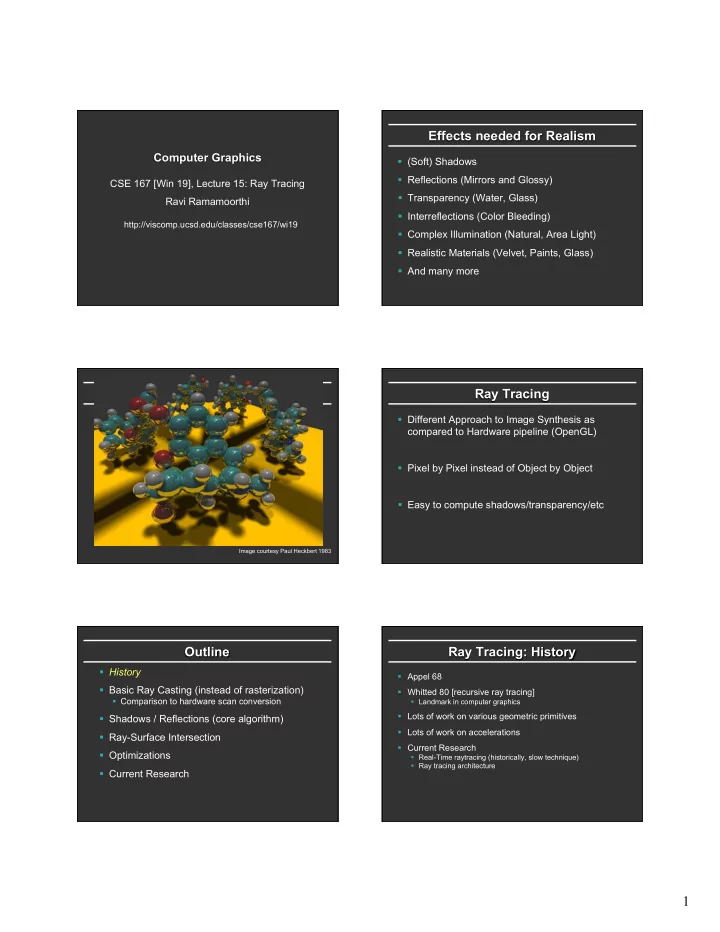
Image courtesy Paul Heckbert 1983
Ray Tracing
§ Different Approach to Image Synthesis as compared to Hardware pipeline (OpenGL) § Pixel by Pixel instead of Object by Object § Easy to compute shadows/transparency/etc
Outline
§ History § Basic Ray Casting (instead of rasterization)
§ Comparison to hardware scan conversion
§ Shadows / Reflections (core algorithm) § Ray-Surface Intersection § Optimizations § Current Research
Ray Tracing: History
§ Appel 68 § Whitted 80 [recursive ray tracing]
§ Landmark in computer graphics
§ Lots of work on various geometric primitives § Lots of work on accelerations § Current Research
§ Real-Time raytracing (historically, slow technique) § Ray tracing architecture