
SLIDE 1
1
1
CS 391L: Machine Learning: Ensembles Raymond J. Mooney
University of Texas at Austin
2
Learning Ensembles
- Learn multiple alternative definitions of a concept using
different training data or different learning algorithms.
- Combine decisions of multiple definitions, e.g. using
weighted voting.
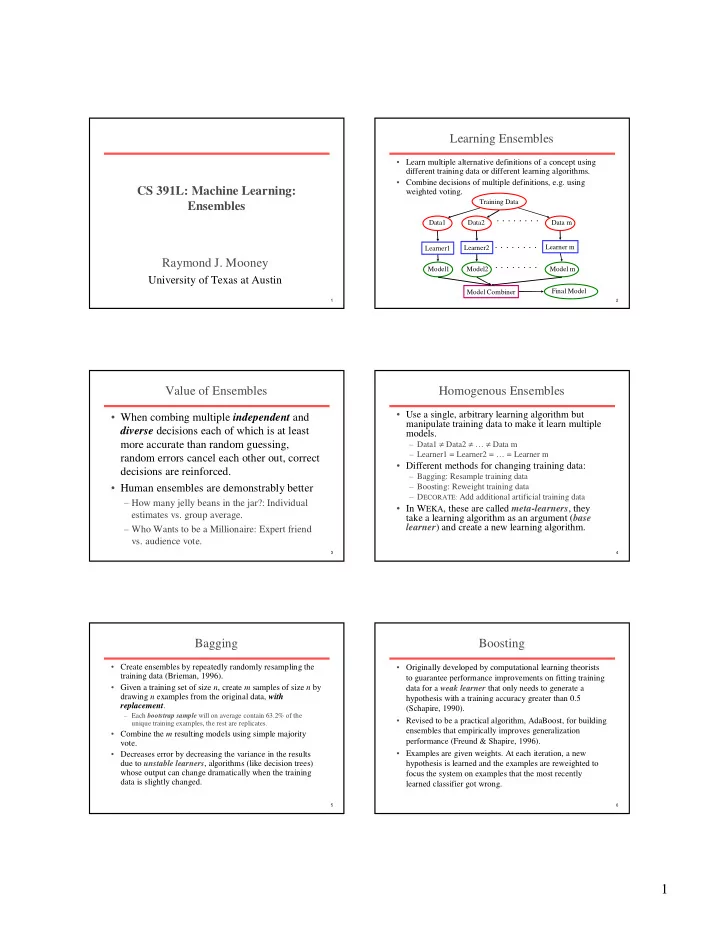
Training Data Data1 Data m Data2
⋅ ⋅ ⋅ ⋅ ⋅ ⋅ ⋅ ⋅
Learner1 Learner2 Learner m
⋅ ⋅ ⋅ ⋅ ⋅ ⋅ ⋅ ⋅
Model1 Model2 Model m
⋅ ⋅ ⋅ ⋅ ⋅ ⋅ ⋅ ⋅
Model Combiner Final Model
3
Value of Ensembles
- When combing multiple independent and
diverse decisions each of which is at least more accurate than random guessing, random errors cancel each other out, correct decisions are reinforced.
- Human ensembles are demonstrably better
– How many jelly beans in the jar?: Individual estimates vs. group average. – Who Wants to be a Millionaire: Expert friend
- vs. audience vote.
4
Homogenous Ensembles
- Use a single, arbitrary learning algorithm but
manipulate training data to make it learn multiple models.
– Data1 ≠ Data2 ≠ … ≠ Data m – Learner1 = Learner2 = … = Learner m
- Different methods for changing training data:
– Bagging: Resample training data – Boosting: Reweight training data – DECORATE: Add additional artificial training data
- In WEKA, these are called meta-learners, they
take a learning algorithm as an argument (base learner) and create a new learning algorithm.
5
Bagging
- Create ensembles by repeatedly randomly resampling the
training data (Brieman, 1996).
- Given a training set of size n, create m samples of size n by
drawing n examples from the original data, with replacement.
– Each bootstrap sample will on average contain 63.2% of the unique training examples, the rest are replicates.
- Combine the m resulting models using simple majority
vote.
- Decreases error by decreasing the variance in the results
due to unstable learners, algorithms (like decision trees) whose output can change dramatically when the training data is slightly changed.
6
Boosting
- Originally developed by computational learning theorists
to guarantee performance improvements on fitting training data for a weak learner that only needs to generate a hypothesis with a training accuracy greater than 0.5 (Schapire, 1990).
- Revised to be a practical algorithm, AdaBoost, for building
ensembles that empirically improves generalization performance (Freund & Shapire, 1996).
- Examples are given weights. At each iteration, a new