1 Fire protection of buildings (FPB) Definitions of fire test - - PDF document

1
SMART_READER_LITE
LIVE PREVIEW

1 Fire protection of buildings (FPB) Definitions of fire test - - PDF document

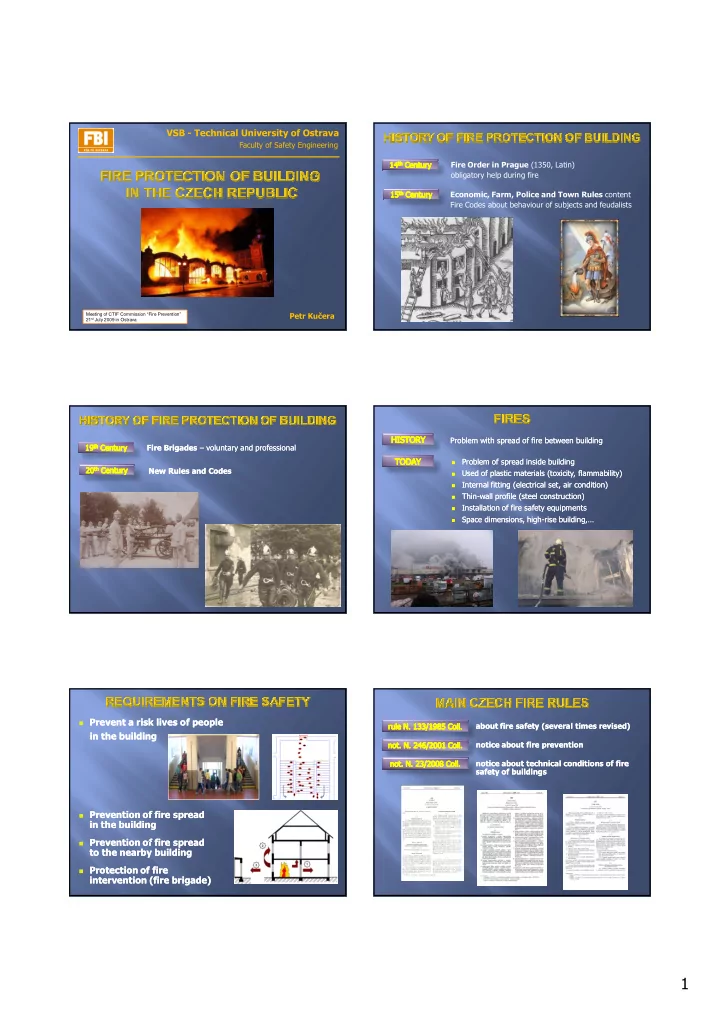
VSB Technical University of Ostrava Faculty of Safety Engineering Fire Order in Prague (1350, Latin) obligatory help during fire Economic, Farm, Police and Town Rules content Fire Codes about behaviour of subjects and feudalists Petr Kuera


slide-1
SLIDE 1

1

VSB Technical University of Ostrava

Faculty of Safety Engineering

Meeting of CTIF Commission “Fire Prevention” 21st July 2009 in Ostrava

Petr Kučera Economic, Farm, Police and Town Rules content Fire Codes about behaviour of subjects and feudalists Fire Order in Prague (1350, Latin)

  • bligatory help during fire

New Rules and Codes New Rules and Codes 19th Century Fire Brigades Fire Brigades – – voluntary and professional voluntary and professional Problem with spread of fire between building Problem with spread of fire between building

  • Problem of spread inside building

Problem of spread inside building

  • Used of plastic materials (toxicity, flammability)

Used of plastic materials (toxicity, flammability)

  • Internal fitting (electrical set, air condition)

Internal fitting (electrical set, air condition)

  • Thin

Thin* *wall profile (steel construction) wall profile (steel construction)

  • Space dimensions,

Space dimensions, h high igh* *rise building rise building,… ,…

  • Installation of fire safety equipments

Installation of fire safety equipments

  • Prevent a risk lives of people

Prevent a risk lives of people in the building in the building

  • Prevention of fire spread

Prevention of fire spread in the building in the building

  • Prevention of fire spread

Prevention of fire spread to the nearby building to the nearby building

  • Protection of fire

Protection of fire intervention (fire brigade) intervention (fire brigade)

about fire safety (several times revised) about fire safety (several times revised) notice about fire prevention notice about fire prevention notice about technical conditions of fire notice about technical conditions of fire safety of buildings safety of buildings

slide-2
SLIDE 2

2

CSN 73 0802 Fire protection of buildings (FPB)

Non*industrial buildings

CSN 73 0804 CSN 73 0810 CSN 73 0831 CSN 73 0833 CSN 73 0834 CSN 73 0835 CSN 73 0845 OTHERS…

Industrial buildings General requirements Assembly rooms Buildings for dwelling and lodging Changes of buildings Buildings for sanitary maters and social care Storage rooms

Definitions of fire test standard and assessment of requirement properties CSN EN a CSN EN ISO (about 36 standards) Fire classification of construction products and building elements (e.g. classification using test data from reaction to fire tests) * CSN EN Chosen values of fire technical properties (e.g. values of fire resistance, heat values) * CSN Technical conditions of fire safety facilities (e.g. equipment for fire*water supply) * CSN

Determination of fire risk Partition to fire compartments Safety distances Dimension of fire compartment (verification) Level of fire safety (construction) Escape routes Requirement to building constructions Building equipments Conditions for fire intervention

Bounded space of building with fire dividing constructions OPTIMUM Costs Damages Area S [m2] FPB – industrial buildings

No acceptable area Acceptable area Probability index of extent of the fire damages Probability index of fire origin and fire spread

Conversion of heat value all flammability material in fire compartment to nominal heat value of wood

computing fire load ….. pv [kg.m2]

expressive of theoretical intensity of fire and FPB expressive of theoretical intensity of fire and FPB

slide-3
SLIDE 3

3

pv = p . a . b . c [kg.m*2]

Fire load [kg.m*2] Factor of rate burning (character of flammability materials) Factor of rate of burning (structural conditions) Factor of fire safety equipments

p = pn + ps

Accidental fire load [kg.m*2] Steady fire load [kg.m*2] pn [kg.m2] – combustible materials (facilities)

NO paint of technological arrangement

Type of duty pn [ [ [ [kg.m-2] ] ] ] Office Library Boardroom, Bank hall Dance hall Chemist Perfumery Ironmonger s Boiler-room Cloak-room 40 120 20 15 60 60 30 15 50

Annex A.1 CSN 73 0802 Accidental fire load pn

pS [kg.m2] – combustible materials (construction)

NO fire dividing and load bearing construction Table 1 CSN 73 0802 Steady fire load ps

Combustible door, windows, floor, lining…

Area of room ps window [ [ [ [kg.m-2] ] ] ] ps door [ [ [ [kg.m-2] ] ] ] ps floor [ [ [ [kg.m-2] ] ] ] to 500 m2 above 500 to 1000 m2 above 1000 m2 3,0 1,5 0,7 2,0 1,0 0,5 5,0 5,0 5,0

Coefficient expressive rate of burning in term

  • f character of combustible material

a p a p a p p

n n s s n s

= + + .. .

as = 0,9 (constant) coefficient

  • f steady fire load

an Annex A1 CSN 73 0802 calculation coefficient

  • f accidental fire load

Type of duty an Office Library Boardroom, Bank hall Dance hall Chemist Perfumery Ironmonger s Boiler-room Cloak-room 1,0 0,7 0,9 1,2 1,1 1,15 0,8 1,1 1,0

Coefficient expressive rate of burning in term

  • f construction conditions (influence venting)

b S k S h

  • =

. .

Area window Heigh window in external walls and roof

range 0,5 ≤ ≤ ≤ ≤ b ≤ ≤ ≤ ≤ 1,7

Area fire compartment coefficient k

COEFFICIENT EXPRESSIVE FIRE SAFETY EQUIPMENTS

  • Coeff. c

Equipments Range Tables CSN 73 0802 c1 c2 c3 c4 Fire detection Fire brigade Sprinkler Exhaust of smoke 0,7 – 1,0 0,5 – 0,95 0,5 – 0,8 0,6 – 0,9

  • tab. 2
  • tab. 3 a 4
  • tab. 5
  • tab. 6

Value this coefficient always c ≤ ≤ ≤ ≤ 1 (c = 1 …. It means than there isn t fire safety equipments) Values c1 until c4 no count up ⇒ It is possible used only one coefficient At every combination fire safety equipments ⇒ It is possible to reduce value of coefficient c (in %)

slide-4
SLIDE 4

4

Advantages utilization this coefficient

1) Reduction of fire risk (i.e. fire load) 2) Expansion of limiting dimension of fire compartment 3) Expansion of limiting dimension of size exit ways in this fire compartment

Probably time fire duration ….. τ τ τ τ [min]

There is fire intensity that is characterized by probably fire duration τ τ τ τ and corresponding probably temperature of combustion gases Tg

Temperature of gases in burning spaces Tg according to venting parameter F0 [m1/2]

„REACTION TO FIRE TESTS“ Fire classification of construction products and building elements dividing to 7 classes (A1, A2, B, C, D, E, F) Determination of flame propagation along the surface of building materials index of flame spread is (mm/min) CSN EN 13501-1 CSN 73 0863 Classification using test data from resistance fire tests CSN EN 13501-2

Classification time of fire resistance [min]:

10, 15, 20, 30, 45, 60, 90, 120, 180, 240, 360

Limiting states:

R capacity and stability E integrity I isolation function – limitation of temperature in no heated surface W limiting density of thermal flow in in no heated side S transmission of smoke products (smoke resistant) C self*closing facilities XXothers parameters

slide-5
SLIDE 5

5

QUESTION Is it material of construction flammability? YES

* It influences to capacity of elements * If effects to fire severity

DP1 DP2 DP3 capacity no yes yes fire severity no no yes

SHEATH OF PLASTERBOARDS REACTION TO THE FIRE A2 ISOLATION ANY REACTION TO FIRE METAL CARIER ELEMENTS REACTION TO THE FIRE A1 SHEATH OF PLASTERBOARDS REACTION TO THE FIRE A2 WOOD CARRIER ELEMENTS REACTION TO FIRE C or D WOOD SHEATHING REACTION TO THE FIRE C or D WOOD CARRIER ELEMENTS REACTION TO FIRE C or D ISOLATION ANY REACTION TO FIRE ISOLATION ANY REACTION TO FIRE

Constructional system of building forms:

Carrier construction ensuring stability of building Fire dividing construction

Vertical and horizontal construction must be DP1

Example: Brickwork building with concrete, ceramic

  • r combined ceiling

(steel beam + ceramic boards)

Vertical construction must be DP1 Horizontal construction can be DP2

Example: Building with wood beam ceiling with subfloor and plaster soffit

Variant 1) Variant 1)

Vertical and horizontal carrier construction and fire dividing DP2

Variant 2) Variant 2)

Some vertical and horizontal carrier construction and fire dividing DP3

slide-6
SLIDE 6

6

⇒ limiting states (R, E, I,…) ⇒ time (minutes) ⇒ type of constructional part (e.g. DP1) ⇒ test report ⇒ tables CSN 73 0821 ⇒ calculation

requirement fire resistance

real fire resistance

CSN 73 0810 CSN 73 0802 or 04 FIRE TEST EUROCODES

Defined limiting states, Example:

REI bearing fire dividing constructions (walls and ceiling)

  • [

[ [ [] ] ] ]

  • !" [

[ [ [] ] ] ]

  • #$

# %& '&

  • %&

( # %&

  • )$

( ' *$ )$

  • '&

( ' # %& )$

  • +&

( ( ' # %& )$

  • Building construction

Fire safety degreein fire compartment I. II. III. IV. V. VI. VII. Fire resistance of building construction 1 Fire walls and fire ceilings a) in background floor b) in over ground floor c) in last over ground floor d) between building 30 DP1 15 15 30 DP1 45 DP1 30 15 45 DP1 60 DP1 45 30 60 DP1 90 DP1 60 30 90 DP1 120 DP1 90 45 120 DP1 180 DP1 120 DP1 60 DP1 180 DP1 180 DP1 180 DP1 90 DP1 180 DP1

CSN 73 0810 CSN 73 0802

REI 45 Example requirement fire resistance fire wall:

  • III. SPB

FIRE TEST CSN 73 0821 EUROCODES

Design fire scenario Design fire Thermal analysis Mechanical analysis

Evacuation of People

ensure protection of people

⇒ before fire (temperature, flames,…) ⇒ before hot smoke (design of smoke venting)

Problem with evacuation

⇒ assembly buildings ⇒ building for dwelling and lodging ⇒ building for sanitary matters

…… organisational and technical provisions

slide-7
SLIDE 7

7

* each permanent free communication * leads to exit from building or to protected escape route (CHUC) * needn t to divide fire dividing constructions

Unprotected escape routes (NUC) Protected escape routes (CHUC) – type A, B or C

* each permanent free communication * leads to exit from building (to esplanade) *must be protected before fire (temperature, smoke) fire dividing construction (only DP1) * is necessary to solve way of venting (natural, forced)

Design each type of CHUC is bound to height of building and number of floors

Alternative escape possibilities

Windows in down stair (store windows), escape ladders, sliding bar,…

CHUC type A CHUC type B or C

Fire compartment with fire risk

time of safety stay 4 minutes

Fire compartment with fire risk Fire hall

time of safety stay 15 minutes (CHUC type B) 30 minutes (CHUC type C)

→ escape from over ground floors to safety space

(high of building h ≤ 9 m)

→ escape from 1 underground floor to safety space,…

Unprotected escape routes (NUC) Protected escape routes (CHUC)

→ escape from multistory buildings (It decides requisite time for evacuation)

Number of escape routes from fire compartment, resp. building Type of protected route (CHUC) Over ground floors Under ground floors Height of building h [m] to 22,5 above 22,5 to 45,0 above 45,0 to 4,5 above 4,5 to 8,0 above 8 One escape route A B C or B + B A B C Other escape route A A B A A B

Number of evacuated persons (E)

according norm CSN 73 0818 (tabulated)

Type of room Area (m2 ) to 1 person Coefficient

  • f design person

Office 5,0

  • Boardroom

1,5

  • Classroom

2,0

  • Sales area

1,5

  • Library

2,5

  • Flat

20 1,5

Example: Office S = 20 m2 Number E E = 20/5 = 4 persons

slide-8
SLIDE 8

8

Conditions of evacuation (s)

physical and psychical ability a) People of able self movement

* common people (students, adults)

b) People with limited able of movement

* reduced move ability (handicapped people, patients,..) * children from 3 to 6 years or elderly people (above 60years) (maternity school, rest home,…)

c) People of disable of movement

* blind people or immovable people (patients in the beds) * children to 3 years (infantile institution, nursery) * mentally deficient people (psychiatry)

Organization of escape

a

a) Simultaneous evacuation

* evacuation along NUC from fire comp. * evacuation along CHUC from building (it goes into max. 3 fire compartment)

b) Sequential evacuation

* evacuation along CHUC from building (it goes into > 3 fire compartment)

Calculation detailed design of evacuation

> 1000 people according CSN 73 0818 > 500 people in multi*storey building (hp > 22,5 m) Software: buildingEXODUS, SIMULEX,…

Real length of NUC (nonprotected escape route)

It measures from most distant place fire compartment to exit from building (safety place) or to protected escape route.

Coefficient a Maximal lenght nonprotected escape route

lu,max [ [ [ [m] ] ] ]

Fire compartment One escape route

  • ver (ground) floors

More escape route

  • ver (ground) floors

to 0,3 45 (30) 90 (45) 0,4 45 (30) 80 (45) 0,5 45 (30) 70 (45) 0,6 40 (30) 60 (45) 0,7 40 (30) 55 (45) 0,8 35 (30) 50 (40) 0,9 30 (30) 45 (40) 1,0 25 (25) 40 (40) 1,1 20 (20) 35 (30)

Condition: lu ≤ ≤ ≤ ≤ lu,max

lu [ [ [ [m] ] ] ] umin * number of escape lane (e.g. 1; 1,5, 2; 2,5) 1 escape lane = 0,55 m E * number of people (table CSN 73 0818)

People Type of evacuation Value of coefficient s (NUC) 1 People of able self movement simultaneous 1,0 sequential

  • 2

People with limited able

  • f movement

simultaneous 1,5 sequential

  • 3

People of disable

  • f movement

simultaneous 2,0 sequential

  • Number of no

protected routes from fire compartment Number of escape people in one escape lane in NUC Coefficient a of fire compartment >1,3 1,1 1,0 0,9 0,8 0,7 0,6 One escape route straight

  • 40

55 70 80 90 100 downstairs

  • 30

40 50 60 70 80 upstairs

  • 25

35 45 50 55 60 Others escape routes straight 55 80 105 120 135 150 160 downstairs 40 60 80 90 100 110 120 upstairs 35 50 65 75 85 95 100

s * coefficient of evacuation condition K * capacity of one escape lane

Condition: umin ≤ ≤ ≤ ≤ u

u * real width of NUC (e.g. width of exit door)

u E K s = .

min

slide-9
SLIDE 9

9

u . K s . E v l , t

u u u u

+ = 75

where lu is length escape route [m] vu velocity of people movement [m/min] 25-40 E number of people [people] s coefficient of evacuation condition Ku capacity of one escape lane [person/min] u number of escape lane

lu vu u E s

a / h . , t

/ s e 2 1

25 1 =

where hs is height of fire compartment [m] a coefficient of burning velocity /fire load/

e u

t t ≤

Condition: Evacuation time [min] Smoke time [min]

Evacuation /resp. fire/ lifts

→ buildings of medial facility → buildings containing 10 persons with reduced mobility

Specificity:

* Standby supply (min. 45 min) *

  • Min. proportions of lift

* Incombustibility materials * Travelling time (max. 2,5 min)

Fire lift Evacuation lift

Fire doors

→ opening door in direction escape (obligation for evacuation > 200 peoples) → door check (self closing device) for fire protected escape → automatic opening of door (it must be also manual) → door with door latch leave out to width escape route

Door fittings

Emergency lighting

→ design according CSN EN 1838 → protected escape routes – obligatory → accessories emergency lighting (2 independent energy resources)

Safety marking of escape routes

→ design according CSN ISO 3864 → escape routes must be clearly marked

Emergency Alarm (device)

→ > 200 people in the building or hotels,….

slide-10
SLIDE 10

10

Occurrence of fire in the building

Radiation throughout openings in external walls throughout roof cladding (fully or partly fire open areas)

FIRE RISK AREA (FRA)

in practice

Fire risk area Fire risk area Fire distance d [m] Fire distance d [m]

Fire distance measures as perpendicular distance from fire

  • pen area to bound of fire risk area.

Fire distance is calculated:

a) places of falling burning particles from external walls or roof cladding - d1 [m] b) density of heat flow - d2 [m]

Than the equation is valid:

d1 < dresulting > d2 [m]

Falling burning particles from building

Fire distances is specified condition of falling burning particles (e.g. cladding of external wall * DP3). It is assumed that falling burning particles falls under angle 20o from vertical of building.

Fire distance depends

  • n total height of building

d1 = 0,36 . hc [m] METHODS OF ASSESMENT d2

Calculation of density heat flow Determination by table in Appendix F of CSN 73 0802

Fire distance between building will be safety if it value of initial density

  • f thermal flow I0 on distance d

between buildings falls down critical density of thermal flow I. I = 18,5 kW/m2 ...... about 450 oC

  • 1. Computing fire load pv [kg/m2]
  • 2. Area of external wall of fire

compartment [m2]

  • 3. Fire open areas Spo [m2]
  • 4. Percent of open area po [%]
  • 5. Fire distance d [m]

I = I0 . φ φ φ φ

φ is positional factor that is the function of dimension of external wall and distance d (by EUROCODE - CSN EN 1991-1-2)

Computing fire load changes according to construction systems:

* about 5 kg/m2 for construction system * mixed * about 10 kg/m2 for construction system * combustible (DP2) * about 15 kg/m2 for construction system * combustible (DP3) (Value pv doesn t change for noncombustible system) ui i p

h l S . =

  • 1. Computing fire load pv [kg/m2]
  • 2. Area of external wall of fire compartment [m2]

l – length of external wall hu – height of external wall

slide-11
SLIDE 11

11

3 3 2 2 1

. .

po po po po

S k S k S S + + =

Spo1 – fully fire open area of external wall (opening glazed flat glass,…) Spo2 – partly fire open area of external wall (spandrel * lining between window) Spo3 – fire open area of roof cladding k2, k3 – rate coefficients of density of thermal flow from radiant areas (in table)

100 .

p po

  • S

S p = Table F CSN 730802 as function (pv , hu , l , po)

  • 3. Fire open areas Spo [m2]
  • 4. Percent of open area po [%]
  • 5. Fire distance [m]

Height m Length m Percent

  • f open

area Fire distance in m for computation fire load pv in kg.m-2

≤ ≤ ≤ ≤ 10 20 30 40 50 60 80 100 120 > 180 to 3,0 to 4,5 100 80 60 40 2,5 2,1 1,5 0,2 3,5 2,9 2,3 1,5 4,0 3,5 2,8 1,9 4,4 3,8 3,1 2,3 4,7 4,1 3,4 2,5 5,0 4,4 3,6 2,7 5,4 4,7 4,0 3,0 5,7 5,0 4,2 3,2 6,0 5,3 4,5 3,4 6,7 5,9 5,0 3,9 9,0 100 80 60 40 3,1 2,5 1,7 0,3 4,5 3,7 2,8 1,7 5,3 4,5 3,5 2,3 5,9 5,0 4,0 2,8 6,3 5,4 4,4 3,1 6,7 5,8 4,7 3,4 7,3 6,4 5,2 3,8 7,8 6,8 5,6 4,2 8,2 7,2 5,9 4,4 9,1 8,0 6,7 5,1 15,0 100 80 60 40 3,4 2,6 1,7 0,3 5,1 4,1 3,0 1,8 6,1 5,1 3,9 2,4 6,9 5,8 4,5 2,9 7,5 6,3 5,0 3,3 8,0 6,8 5,4 3,7 8,8 7,5 6,0 4,2 9,5 8,1 6,6 4,6 10,0 8,6 7,0 5,0 11,3 9,7 8,0 5,9 24,0 100 80 60 40 3,5 2,7 1,8 0,3 5,4 4,3 3,1 1,8 6,6 5,4 4,0 2,5 7,6 6,2 4,7 3,0 8,4 6,9 5,3 3,4 9,0 7,5 5,7 3,8 10,1 8,4 6,5 4,4 10,9 9,2 7,2 4,9 11,6 9,9 7,7 5,3 13,2 11,3 9,0 6,3 above 36,0 100 80 60 40 3,5 2,7 1,8 0,3 5,5 4,3 3,1 1,8 6,9 5,5 4,0 2,5 8,0 6,4 4,8 3,0 8,9 7,2 5,4 3,4 9,6 7,8 5,9 3,8 10,9 8,9 6,8 4,5 11,9 9,8 7,5 5,0 12,8 10,6 8,1 5,4 14,8 12,3 9,6 6,5

1) Communication

  • hardened communication

(load capacity 80 kN to axletree)

  • width of communication at least 3,0 m
  • distance from building max. 20 m

2) Gateway and Passage

  • min dimension

3,5 m x 4,1 m (width x height)

3) Ascending area for fire brigade

  • obligatory for building ….. h > 12 m
  • r for building with complicated access
  • hardened communication
  • width of this hard stand

at least 3,5 m

ladder vehicle

4) Safety ladder

  • obligatory for area of plane roof S > 200 m2

5) Fire walkway 6) Internal firefighting ways

  • obligatory for building … h > 22,5 m
  • generally protected

escape routes type B and C

7) Fire lift

  • obligatory for building

h > 45 m

slide-12
SLIDE 12

12

8) External hydrants (rules in CSN 73 0873)

  • max. distance from building
  • max. distance between external hydrant
  • dimension of flow rate [l/s]
  • overpressure (min. 0,2 MPa)
  • nominal inside diameter (DN)
  • water reservoir (m3)

9) Internal hydrants (CSN 73 0873) p . S > 9000

where S is area of fire compartment [m2] p fire load [kg.m2]

10) Fire extinguishers

  • water, foam, powder,…
  • in any fire compartment designates number
  • f fire extinguishers:

nr = 0,15 (S . a . c3)1/2 ≥ ≥ ≥ ≥ 1,0

where S is area of fire compartment [m2] a coefficient of fire load [-] c3 coefficient of fire load [-] (no sprinkler c3 = 1)