1 KSDE Community Conversations General Community Non-Academic - - PDF document

1
SMART_READER_LITE
LIVE PREVIEW

1 KSDE Community Conversations General Community Non-Academic - - PDF document

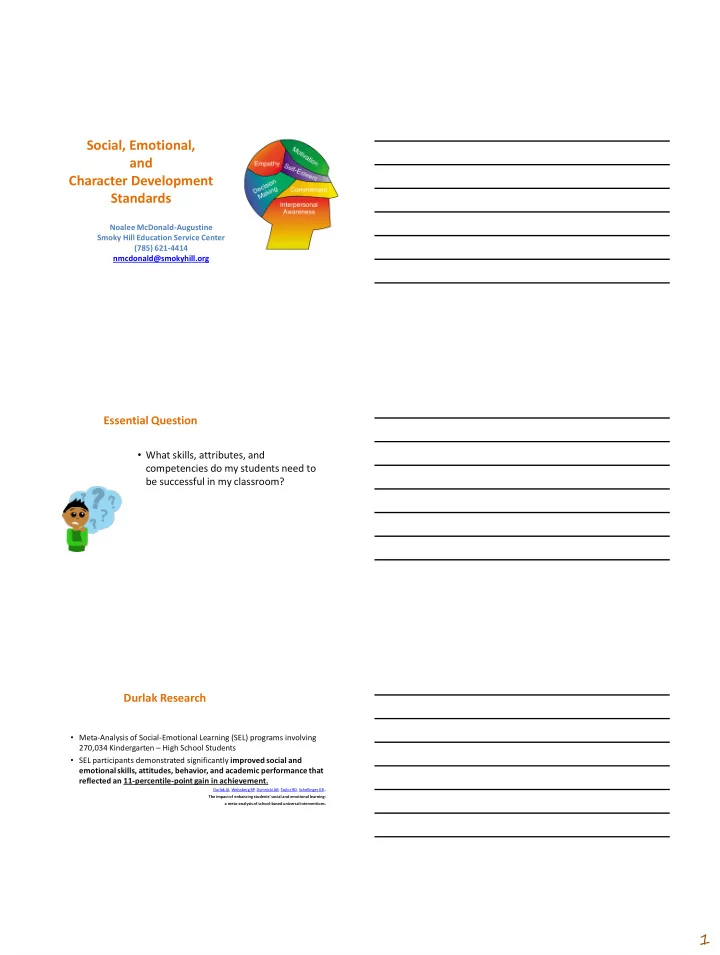
Social, Emotional, and Character Development Standards Noalee McDonald-Augustine Smoky Hill Education Service Center (785) 621-4414 nmcdonald@smokyhill.org Essential Question What skills, attributes, and competencies do my students need


slide-1
SLIDE 1

1

Social, Emotional, and Character Development Standards

Noalee McDonald-Augustine Smoky Hill Education Service Center (785) 621-4414 nmcdonald@smokyhill.org

Essential Question

  • What skills, attributes, and

competencies do my students need to be successful in my classroom?

Durlak Research

  • Meta-Analysis of Social-Emotional Learning (SEL) programs involving

270,034 Kindergarten – High School Students

  • SEL participants demonstrated significantly improved social and

emotional skills, attitudes, behavior, and academic performance that reflected an 11-percentile-point gain in achievement.

Durlak JA, Weissberg RP, Dymnicki AB, Taylor RD, Schellinger KB., The impact of enhancing students' social and emotional learning: a meta-analysis of school-based universal interventions.

slide-2
SLIDE 2

2

KSDE Community Conversations

  • General Community

– Non-Academic Skills – 70% – Academic Skills – 23%

  • Business Community

– Non-Academic Skills – 81% – Academic Skills – 15%

  • Academic Skills

– Instrumental Skills (Applied Knowledge) & Critical Thinking

Mission of the Kansas State Board of Education

“to prepare Kansas students for lifelong success through rigorous, quality academic instruction, career training, and character development according to each student's gifts and talents.”

Habits of Mind

One of the three “keys for success” stressed in the Kansas College and Career Ready Standards –Habits of Mind –Collaboration –Focus on Instruction

slide-3
SLIDE 3

3

Habits of Mind

  • 9. Thinking and communicating with

clarity and precision

  • 10. Gather data through all senses
  • 11. Creating, imagining, and innovating
  • 12. Responding with wonderment and

awe

  • 13. Taking responsible risks
  • 14. Finding humor
  • 15. Thinking interdependently
  • 16. Remaining open to continuous

learning

  • 1. Persisting
  • 2. Managing impulsivity
  • 3. Listening with understanding and

empathy

  • 4. Thinking flexibly
  • 5. Thinking about your thinking
  • 6. Striving for accuracy
  • 7. Questioning and problem solving
  • 8. Applying past knowledge to new

situations

Bena O. Kallick & Arthur L. Costa

Rose Capacities

slide-4
SLIDE 4

4

KANSAS STATE DEPARTMENT OF EDUCATION | www.ksde.org

Creating a Vision for Kansas

Student Achievement does not always equate to Student SUCCESS!

SECD Standards

slide-5
SLIDE 5

5

SECD Standards

SECD is about teaching, practicing, modeling and encouraging essential personal life habits that are almost universally understood as making people successful human beings.

Ed Dunkelblau, Character Education Partnership

  • Social Awareness
  • Interpersonal Skills

Social Development

  • Core Principles
  • Responsible Decision

Making and Effective Problem Solving

Character Development

  • Self -Awareness
  • Self-Management

Personal Development

Kansas Social, Emotional, and Character Education Standards

Character Development

Definition: Developing skills to help students identify, define and live in accordance with core principles that aid in effective problem solving and responsible decision making. Rationale: Our schools have the job of preparing our children for American citizenship and participation in an interdependent world. Success in school and life is built upon the ability to make responsible decisions, solve problems effectively, and to identify and demonstrate core principles.

Social, Emotional, Character Development Standards

Core Principles Responsible Decision Making and Effective Problem Solving

  • 1. Recognize, select, and ascribe to a set of core ethical and

performance values as a foundation of good character and be able to define character comprehensively to include thinking, feeling and doing.

  • 2. Develop, implement, promote, and model core ethical and

performance values.

  • 3. Create a caring community.
  • 1. Develop, implement, and model responsible decision making

skills.

  • 2. Develop, implement, and model effective problem solving

skills.

slide-6
SLIDE 6

6

Social, Emotional, Character Development Standards

Personal Development

Definition: Developing skills that help students identify, understand and effectively manage their thoughts, feelings and behaviors. Rationale: Personal and academic success are built upon the ability to consider thoughts, understand feelings and manage one’s responses. Personal thoughts and feelings impact management of experiences and determine behavior outcomes. Self Awareness - Understanding and expressing personal thoughts and emotions in constructive ways. Self-Management – Understanding and practicing strategies for managing thoughts and behaviors, reflecting on perspectives, and setting and monitoring goals.

  • A. Understand and analyze thoughts and

emotions

  • B. Identify and assess personal qualities

and external supports

  • A. Understand and practice strategies for managing thoughts, and

behaviors.

  • B. Reflect on perspectives and emotional responses.
  • C. Set, monitor, adapt, and evaluate goals to achieve success in

school and life.

Social, Emotional, Character Development Standards

Social Development Definition: Developing skills that establish and maintain positive relationships and enable communication with others in various settings and situations. Rationale: Building and maintaining positive relationships and communicating well with others are central to success in school and life. Recognizing the thoughts, feelings, and perspectives of others leads to effective cooperation, communication, and conflict resolution. Social Awareness Interpersonal Skills

  • A. Be aware of the thoughts, feelings, and

perspectives of others.

  • B. Demonstrate awareness of cultural issues and a

respect for human dignity and differences.

  • A. Demonstrate communication and social skills to

interact effectively.

  • B. Develop and maintain positive relationships.
  • C. Demonstrate an ability to prevent, manage, and resolve

interpersonal conflicts.

Three Essential Aspects of Character

  • Ethical Consciousness

– Cognition/Thinking – Know What’s Right

  • Ethical Commitment

– Feeling/Emotion – Love What’s Right

  • Ethical Competencies

– Acting/Behavior – Do What’s Right

slide-7
SLIDE 7

7

Power2Achieve Curriculum Institute for Excellence & Ethics

Social, Emotional and Character

Development Standards are “NOT one more thing ON the plate… they ARE the plate!

SECD Integration

slide-8
SLIDE 8

8

Integration Approaches

  • Contributions – least involvement – not specified as part of

the curriculum, book or activity that celebrate a holiday or event.

  • Additive – content is added without changing the basic

structure of the curriculum.

  • Transformation – changing the structure of curriculum.
  • Social Action – combines Transformation with activities to

strive for social change.

Awareness Activities Standing In Another’s Shoes

slide-9
SLIDE 9

9

Medal of Honor Character Development

Students learned about the Medal of Honor and then as teams researched a specific recipient. Each team then created a visual display and delivered an oral presentation about their recipient. Content Integration –Government, History, Language Arts, Art

Hoisington HS in Hoisington, KS – KS Schools of Character Award Winner

College & Career Competency Framework Research Collaboration

  • 1. Adaptability
  • 12. Networking
  • 2. Assertiveness
  • 13. Organization and Time

Management

  • 3. Communication
  • 14. Perseverance/Grit
  • 4. Conflict Management
  • 15. Problem Solving
  • 5. Creative Thinking
  • 16. Self-Awareness
  • 6. Curiosity
  • 17. Self-Care
  • 7. Empathy
  • 18. Self-Efficacy
  • 8. Goal Setting
  • 19. Self-Regulation
  • 9. Initiative
  • 20. Social Awareness
  • 10. Integrity & Ethics
  • 21. Sustained Attention
  • 11. Learning Schema
  • 22. Teamwork

Walk the High Road

  • The event focused on building healthy relationships.
  • Started with a short presentation by Jana’s Campaign on teen

dating violence and then also a presentation on relational aggression/bullying.

  • The guys wore heels to represent walking in the steps of

women/girls.

  • The gals wore boots and backpacks to represent the weight
  • f relational aggression.
  • Students walked two total laps.
  • On the first lap, students held up the signs with the negative

comment being shown. As the girls walk by a can of food was added to their backpacks. (By the end of the first lap, each girl will have 17 cans in her backpack)

  • On the second lap, students held up the sign with the positive

comment being shown. As the girls walk by a can of food was removed from their back packs.

  • TMP HS in Hays, KS – KS Schools of Character Award Winner
slide-10
SLIDE 10

10

SECD Classroom Examples

  • Core Principles
  • Rules
  • Expectations
  • Behavior Management
  • Discipline
  • Relationships of Mutual Respect
  • School Improvement Plan

Integration into School Policies & Procedures Transforming Math

  • Taught Students About Performance Character

– High Expectations & Quality Work

  • Classroom Policies That Promoted Performance Character

– Revisions, Test Re-Takes, & Classroom Expectations

  • Partnered with Parents

– Open House & Math Night

  • Taught Goal-Setting

– Yearly Goal, Quarterly and Bi-Weekly Goals, Goals and Accomplishments Sheet, & Developing Action Plans

  • Goal Partners

– Accountability

  • Public Presentation

– Success Posters – Goals for the Year, Revisions Wall of Fame, Revisions +10 Club, & “A” Poster

  • Individual Student Contracts

– Students struggling to complete and revise work

slide-11
SLIDE 11

11

Discipline Policies & Procedures

  • Relevant – logically related to the rule or offense
  • Respectful – not embarrassing or demeaning
  • Reasonable – not harsh or excessive
  • Restorative – restoring or repair the relationship by making

restitution

  • Resource-Building – helps students develop

character qualities

De-Stress Techniques

  • 1. What did

you do?

  • 2. When you did that,

what did you want?

  • 4. What will you do next

time?

  • 3. What are four other

things you could have done instead?

Mediating to Change Behavior

slide-12
SLIDE 12

12

Formative Assessment & Growth Measures

Assessment Approaches

Skill/Ski kill Lev evel el A B C D F Attendance

100%; does not miss out on valuable instructions, class discussion or assignments; on time and remains in classroom; lucky to be 100% healthy misses school/class time rarely, usually due to school-related activities; on time to class, requests make up work previous to absence; proactive
  • ccasional absences or tardies,
avoids leaving class for personal reasons, reactive in making up work but communicates with teacher before next class frequent absences or tardies; leaves class often, is reactive in making up work, waits until next class to find out what has been missed; lacks initiative frequent absences or tardies; excessive need to leave class, does not make the effort to make up work or communicate with the teacher about what is missed

Aptitude

scores in the 90’s+ on each and every assignment; exceeds requirements; demonstrates high comprehension and ability to reason; critical thinker; expresses self clearly grasps material but still learning how to apply it or use it to make connections to the big picture, scores consistently in the 80-90% range; developing higher order skills average performance on daily assignments, quizzes, tests and projects, adequate content knowledge, 70-80% range, lacks ability to use reason but makes a true effort struggles with content; tries but requires extra practice; sometimes unwilling to put in effort; difficulty making connections; should seek assistance from classroom teachers or tutors severe skill discrepancy or… does not turn work in making it difficult to determine academic content or skill strengths & weaknesses; evidence of aptitude or skill not available

Attitude

ardent; demonstrates a passion and enthusiasm for learning; recognizes impact of current choices on the future; takes time to think; treats others with respect at all times; flexible; ambitious and self-disciplined! understands the importance of education; actions usually support student desire to succeed; takes time to think; treats others with respect at all times; motivated; developing self-discipline; somewhat ambitious states the desire to succeed but does not always follow through with actions; usually shows respect to others but needs reminders; occasionally expresses discontent with school, teachers or activities takes a “good enough” approach to completing assignments; complains about school or assignments but doesn’t want to fail; usually shows respect to
  • thers; lacks motivation & self-
discipline; minimal class participation careless; disrespectful; fails to take time to think about how personal actions affect the people who care and are trying to help; complains about school, teachers & peers; does not participate; severely lacks motivation, self-discipline, accountability

Accountability

all assignments are completed and turned in on time; student is careful to plan ahead; proactive ALL of the time; takes complete responsibility for their work; NO EXCUSES!; accepts that their grade is EARNED not given. assignments are mostly completed and turned in on time; student does not make excuses when requirements are not met; reflects on what needs to be done differently in the future to prevent mistake and follows through assignments are turned in on time but at times inadequately; student tends to make excuses when requirements are not met but is trying to make improvements; recognizes the necessity of time management skills work is incomplete or late; tends to make excuses and expect that exceptions will be made; tends to blame others or circumstances for disappointments; minimal reflection; lacks the motivation to truly make a change toward progress misses excessive number of deadlines, does not use class time wisely or do homework, makes excuses or blames others or circumstances for failure instead of trying to figure out what could have been done to prevent or solve the problem

Attention to Detail

takes extra time to read instructions; highlights or marks instructions and notes; uses rubrics as checklists; keeps track
  • f due dates in agenda; uses
feedback to make improvements; fixes the “hole in the bucket” independently; clever reads through instructions but tends to miss details on
  • ccasion; uses rubrics as
checklists; keeps track of due dates in agenda; uses feedback to make improvements; needs some guidance to help fix the “hole in the bucket;” makes the effort rushes through assignments and
  • ften misses important details
in the instructions; resists seeking information independently; wants someone else to fix the “hole in the bucket;” listens to feedback but doesn’t always apply it expects the teacher to repeat instructions over and over; resists reading or following instructions independently; leaves the “hole in the bucket” for someone else to fix; does not use feedback to make improvements; inconsistent use of agenda & other tools does not read directions; does not ask questions; does not pay attention; does not use active listening skills; does not participate in class; ignores constructive feedback; frequently unprepared for class; does not bring supplies; does not use agenda or other tools

Student Performance Rubric Tina Williams Chapman HS

slide-13
SLIDE 13

13

Grading System Tina Williams Chapman HS

Effort Achievement 4 – Excellent I worked on the task until it was completed. I pushed myself to continue working on the task even when difficulties arose or a solution was not immediately

  • evident. I viewed difficulties as opportunities to

strengthen my understanding. I exceeded the objectives of the task or lesson. 3 – Good I worked on the task until it was completed. I pushed myself to continue to working on the task even when difficulties arose or a solution was not immediately evident. I met the objectives of the task or lesson. 2 – Needs Improvement I put some effort into the task, but I stopped working when difficulties arose. I met a few of the objectives of the task

  • r lesson but did not meet others.

1 – Unacceptable I put very little effort into the task. I did not meet the objectives of the lesson.

Effort & Achievement Rubric

Category 4 Advanced 3 Proficient 2 Basic 1 Below Basic Attitude – I feel positive about working

  • n my math facts.

I always have a positive attitude about learning my math facts. I often have a positive attitude about learning my math facts. I usually have a positive attitude about learning my math facts. I often have a negative attitude about learning my math facts. Commitment – I think working hard will pay

  • ff.

I practice math facts at home 5 or more times a week. I practice math facts at home 3-4 times a week. I practice math facts at home 2 times a week. I practice math facts at home 0-1 times a week. Pride – I feel satisfied when I improve on my math facts. I try my hardest all of the time when practicing my math facts and my weekly score improves 5 points or more. I try my hardest most

  • f the time when

practicing my math facts and my weekly score improves 3 points or more. I try my hardest some

  • f the time when

practicing my math facts and my weekly score stays the same. I do not try very hard when practicing my math facts and my weekly score goes down.

Effort Rubric – Math Facts

slide-14
SLIDE 14

14

Habits for Excellence Empathy

  • Practice – When someone is upset, try to show them that you

understand how they feel. Give them a hug or try to talk to them about it. When reading a book or watching a movie, ask yourself how you would feel, think, and/or act if you were one

  • f the characters.
  • Will & Grit – Commit to trying to see things from other

people’s perspectives. Ask questions when you don’t understand, ask the individual to explain why they feel the way they do. Commit to avoid saying statements like, “You are wrong” or “Why would you be upset about that”.

  • Coaching & Critique – Seek help from the teacher or fellow

student when you are unsure of steps to take or what to say. Remain calm and reflective when a teacher or fellow student suggests an alternative behavior or phrase or asks you to apologize.

Self Reflection Self Reflection

slide-15
SLIDE 15

15

Power2Achieve

Institute for Excellence and Effort

Performance Character Self-Reflection Power2Achieve

Institute for Excellence and Effort

Moral Character Self-Reflection Power2Achieve

Institute for Excellence and Effort

Group Reflection

slide-16
SLIDE 16

16

College & Career Competency Framework

Research Collaboration

Self-Reflection

  • Turn and Talk
  • Stand Up, Hand Up, Pair Up
  • Inside Outside Circle
  • Socratic Seminars
  • Debate Circles
  • Compact-4-Excellence
  • Exit Cards
  • Top Ten List
  • Journals
  • What can you learn from this?
  • What mistake did you make that taught you something?
  • What did you do today that made you think hard?
  • What is an example of empathy that you demonstrated this

week?

Using What Questions

slide-17
SLIDE 17

17

Character Growth Card South Valley Academy Middle School “Growth Card” Angela Duckworth Character Lab

SECD Student Growth Measures

slide-18
SLIDE 18

18

HRC Soccer Bailey Schmitz

Data – Example Surveys & Assessments

  • KS Communities that Care

– New Legislation – Opt In

  • Culture of Excellence & Ethics Assessment – IEE

– Student – Teacher – Parent

  • 11 Principles of Effective Character Education Rubric
  • Olweus Bullying Questionnaire
  • Create Your Own

– Survey Monkey

“Squaring up, pointing out, & circling for a landing”

What is one thing that squares with you? What are 3 main learning points that stick with you?

What questions are circling in your mind?

slide-19
SLIDE 19

19

“If schools only focus on academic instruction and school management in their efforts to help students attain academic success, they will likely fall short of their goals.”

Zins, Weissberg, Wang, Walberg, “Building Academic Success on Social and Emotional Learning; What does the research say,” (2004) New York: Teachers College Press