1 Factors that affect cracking Our goal Age Eliminate cracking in - - PDF document

1
SMART_READER_LITE
LIVE PREVIEW

1 Factors that affect cracking Our goal Age Eliminate cracking in - - PDF document

Outline Overview of LC-HPC Specifications and their application Program Background and Where we stand Introduction to Specifications 9 th Annual Meeting - Construction of Crack-Free Concrete Bridge Decks July 19, 2011 Kansas City,


slide-1
SLIDE 1

1

Program Background and Introduction to Specifications

9th Annual Meeting - Construction of Crack-Free Concrete Bridge Decks July 19, 2011 Kansas City, MO

Outline

Overview of LC-HPC Specifications and their application Where we stand Scope of Work

Low-Cracking High Performance Concrete (LC-HPC) Bridge Decks 23 LC-HPC decks (28 placements) ( p ) completed through 2010 1 LC-HPC deck to be constructed this year More to be let in MN

Bridges

Primarily composite steel girder bridges Full-depth slabs Removable forms Matching bridges to serve as a control where possible (Phase I)

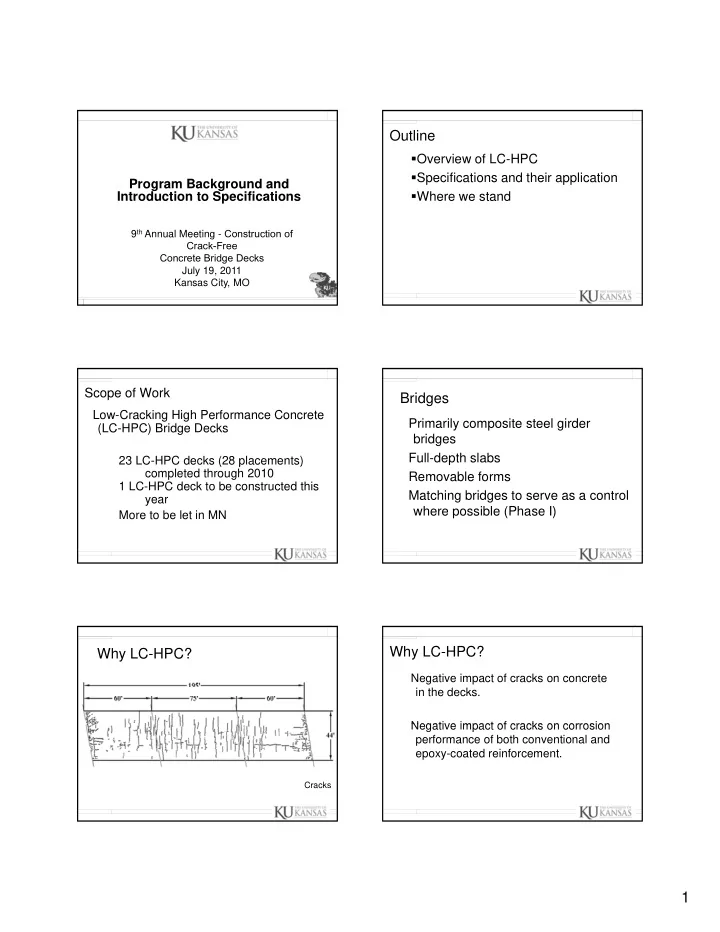
Why LC-HPC?

Cracks

Why LC-HPC?

Negative impact of cracks on concrete in the decks. Negative impact of cracks on corrosion Negative impact of cracks on corrosion performance of both conventional and epoxy-coated reinforcement.

slide-2
SLIDE 2

2

Our goal

Eliminate cracking in bridge decks To do this, we need to minimize cracking due to cracking due to

Plastic shrinkage Settlement over reinforcing bars Thermal contraction Drying shrinkage

Factors that affect cracking

Age Deck type Cement paste content Compressive strength Air content Air content Slump Temperature Construction date Curing Construction techniques

Age

0.60 0.80 1.00 1.20 ensity, m/m2

Monolithic

0.00 0.20 0.40 25 50 75 100 125 150 175 200 225 250 275 Crack De Bridge Age, months

Bridge Deck Type

0.51 0.49 0.44 0.33

0 20 0.30 0.40 0.50 0.60 0.70 0.80 0.90 ck Density, m/m2

Age Corrected

0.00 0.10 0.20 7% SFO 5% SFO CO MONO Bridge Deck Type Cra

Number of Bridges (9) (18) (30) (16) Number of Surveys (9) (36) (52) (32)

Paste Content

0.19 0.16 0.68 0.73

0.20 0.30 0.40 0.50 0.60 0.70 0.80 0.90 ack Density, m/m2

Age Corrected

0.00 0.10 26 27 28 29 Percent Volume of Water and Cement, % Cra

Number of Placements Number of Surveys (8) (16) (4) (5) (16) (31) (8) (11)

Monolithic

0.18 0.31 0.51 0.87 0 15 0.19 0.22

0 20 0.30 0.40 0.50 0.60 0.70 0.80 0.90 ack Density, m/m2

Age Corrected

Uncorrected Adjusted for Water Content

Slump

0.11 0.15

0.00 0.10 0.20

38 (1.5) 51 (2.0) 64 (2.5) 76 (3.0)

Slump, mm (in.) Cra

Number of Placements Number of Surveys (5) (20) (5) (1) (10) (40) (11) (3)

Monolithic

slide-3
SLIDE 3

3

Compressive Strength

0.16 0.26 0.49

0 20 0.30 0.40 0.50 0.60 0.70 0.80 0.90 ack Density, m/m2

Age Corrected

0.00 0.10 0.20 31 (4500) 38 (5500) 45 (6500) Compressive Strength, MPa (psi) Cra

Number of Placements Number of Surveys (7) (12) (10) (13) (24) (23)

Monolithic

0.37 0.38

0.30 0.40 0.50 0.60 0.70 0.80 0.90 ck Density, m/m2

Age Corrected

Air Content

0.13

0.00 0.10 0.20 4.5 5.5 6.5 Air Content, % Crac

Number of Placements Number of Surveys (7) (19) (5) (14) (40) (10)

Monolithic

0.19 0.33 0.37 0.44 0 20 0.30 0.40 0.50 0.60 0.70 0.80 0.90

ack Density, m /m

2 Age Corrected

High Air Temperature

0.00 0.10 0.20 5 (41) 15 (59) 25 (77) 35 (95)

High Air Temperature, C (F) Cra

Number of Placements Number of Surveys (4) (15) (9) (4) (8) (31) (17) (9)

Monolithic

0.50

0.30 0.40 0.50 0.60 0.70 0.80 0.90 ck Density, m /m

2 Age-Corrected

Date of Construction - Monolithic

0.16

0.00 0.10 0.20 1984-1987 1990-1993 Date of Construction Crac

Number of Bridges (6) (7) Number of Surveys (12) (16) 0.24 0.53 0.81

0.30 0.40 0.50 0.60 0.70 0.80 0.90 ack Density, m /m

2 Age Corrected

Date of Construction - Conventional Overlays

0.00 0.10 0.20 1985-1987 1990-1992 1993-1995 Date of Construction Cra

(6) (36) (6) (6) (17) (3) Number of Bridges Number of Surveys

slide-4
SLIDE 4

4

0.87 0.55 0.42 0.48

0.30 0.40 0.50 0.60 0.70 0.80 0.90 ck Density, m /m

2 A ge Corrected

Date of Construction - Silica Fume Overlays

0.00 0.10 0.20 1990-1991 1995-1996 1997-1998 2000-2002 Date of Construction Crac

(6) (20) (16) (10) (2) (10) (8) (10) Number of Bridges Number of Surveys

Control of early evaporation and improved curing

0.87 0.58 0.61 0.39 0.48

0 30 0.40 0.50 0.60 0.70 0.80 0.90 kD en sity, m /m

2 A g e C

  • rre

c te d

Control of early evaporation and improved curing - Silica Fume Overlays

0.00 0.10 0.20 0.30 NONE R1, R2 R3 R4, R5, R6 R8, R9 Special Provision, (R#) C ra ck

A g

(6) (8) (10) (18) (10) (2) (4) (5) (9) (10) Number of Bridges Number of Surveys

4 5 6 7 lump, in.

MONO CO Subdecks 5% SFO Subdecks 7% SFO Subdecks

1 2 3 1984 1986 1988 1990 1992 1994 1996 1998 2000 2002 2004 Sl Placement Date 5 6 7 8 9 10 ump, in.

MONO CO Subdecks 5% SFO Subdecks 7% SFO Subdecks

1 2 3 4 1984 1986 1988 1990 1992 1994 1996 1998 2000 2002 2004 2006 2008 Slu Placement Date

Overall Approach

Work to reduce plastic, settlement, thermal and drying shrinkage cracking Low cement & water contents Low slump Low slump High strength is not good Low evaporation rate Construction methods and materials matter More early cracking means more total cracking

slide-5
SLIDE 5

5

LC-HPC Specifications

Optimized Aggregate Gradation Low-absorption Aggregate 1 inch Max Size Aggregate Cement Content ≤ 540 lb/yd3 w/c ratio = 0.43 – 0.45 Air Content of 8 ±1½% Designated slump 1½ – 3 in. (4 3½ in. max) Controlled temperature Improved curing

Concrete temperature control

55 – 70°F 50 – 75°F if approved by Engineer pp y g

Cold-weather concreting

Maintain temperature of both girders and deck.

Alternatives to Pumping

  • Concrete Buckets
  • Conveyor Belts
slide-6
SLIDE 6

6

Placing

Air cuff/bladder valve on pump or limit drop with conveyor Filling end walls and diaphragms ahead

  • f slab

Consolidation Requirements

Vertically mounted internal gang vibrators

Concrete Finishing

General Rule: Less is More

Pan or burlap drag Bullfloating only if needed needed Water is not a finishing aid!

Curing

Presoaked burlap Timely placement Constantly wet Constantly wet

Spray hoses Soaker hoses 14 days

Three work bridges. Four rolls of pre-cut, pre-soaked burlap, two on each side

Cost effectiveness

Cost of equipment: approximately $5000 Cuts work crew to handle burlap on day of placement from 11 to 5 Contractor added power to move the work bridges between first and second deck

slide-7
SLIDE 7

7

Curing

Followed by curing compound to slow the rate of evaporation

Qualification Batch & Slab

Construction Schedule

Bridge Construction

Concrete Testing & Acceptance

Clearly define testing schedule ahead of time C i t Communicate how out-of-spec concrete will be handled

Specifications

07-PS0167 Construction 07-PS0166 Concrete 07 PS0165 Aggregates 07-PS0165 Aggregates

slide-8
SLIDE 8

8

Where we stand

LC-HPC decks are working Current provisions, however, don’t encompass all of the technologies that can be brought to bare can be brought to bare We chose not to propose those technologies until we were assured that they posed no durability problems We’ve now evaluated those technologies for durability and are prepared to recommend their adoption Ready for some more decks!

This year’s crack surveys

Adherence to the rules...

Questions

The University of Kansas

David Darwin, Ph.D., P.E.

Deane E. Ackers Distinguished Professor Director, Structural Engineering & Materials Laboratory

  • Dept. of Civil, Environmental & Architectural Engineering

2142 Learned Hall Lawrence, Kansas, 66045-7609 (785) 864-3827 Fax: (785) 864-5631 daved@ku.edu

The University of Kansas

JoAnn Browning, Ph.D., P.E.

Professor

  • Dept. of Civil, Environmental & Architectural Engineering

2142 Learned Hall Lawrence, Kansas, 66045-7609 (785) 864-3723 Fax: (785) 864-5631 jpbrown@ku.edu