1 The symbol of integrity watching signalling checking - - PDF document

1
SMART_READER_LITE
LIVE PREVIEW

1 The symbol of integrity watching signalling checking - - PDF document

Why committed SAO itself to the integrity approach in the fight against corruption? Presentation by Gyula Pulay, supervisory manager SAI of Hungary The symbol of corruption 1 The symbol of integrity watching signalling checking


slide-1
SLIDE 1

1

Why committed SAO itself to the integrity approach in the fight against corruption?

Presentation by Gyula Pulay, supervisory manager SAI of Hungary

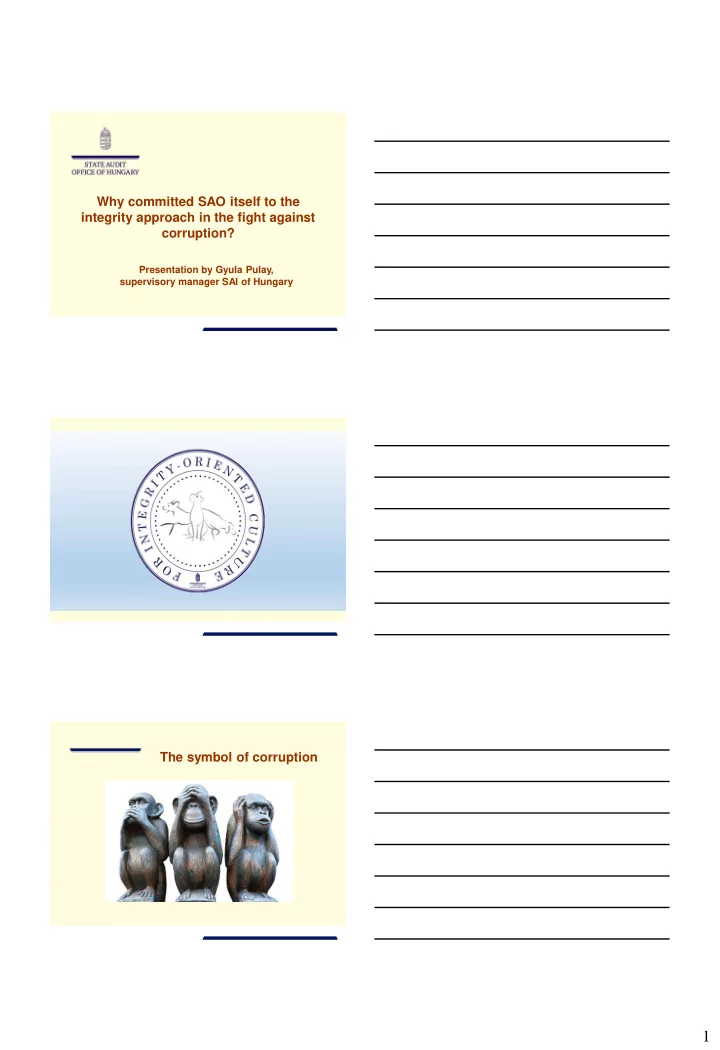
The symbol of corruption

slide-2
SLIDE 2

2

The symbol of integrity

watching signalling checking

Antecedents of the Integrity Project

  • SAO tried to follow international „best practices”
  • The integrity based fight against corruption in the

Netherlands arose our interest

  • Launching a Twinning Light Project in

collaboration with the Netherlands Court of Audit

  • Duration: Six months (2007 autumn - 2008 spring)
  • Result: Final comprehensive study on the

corruption risk assessment methodology

Corruption and integrity

  • Integrity: agreement in action, on the basis of

moral values, norms and legal regulations

  • General requirements
  • Forms:

personal integrity

  • rganisational integrity

integrity of the national economy

  • Breach of integrity: corruption, fraud, nepotism,

conflicts of private and public interests

  • Strengthening integrity = prevention of

corruption

slide-3
SLIDE 3

3

Fried eggs (sunny side up) Scrambled eggs Integrity is a new approach, it needs a new way of thinking

slide-4
SLIDE 4

4

Traditional anti-corruption approach

State Individuals By communication By legislation By punishments (law enforcement)

Modell of risk analysis

Exposure to risks Resistance

Integrity approach: based on the risk analysis modell

Corruption risks Integrity controls

Organisation

slide-5
SLIDE 5

5

Integrity approach

Corruption risks Integrity controls Organisation

  • 2016. február 24.

14

The essence of the method

Inherent corruption risks Integrity control system Corruption risks enhancing factors

Fried eggs or scrambled eggs ?

slide-6
SLIDE 6

6

Risk based approach

  • Scrambled eggs are not worse than fried eggs
  • Because of the technology there is the risk that less

than four eggs would be used for a portion of scrambled eggs from four eggs. It is an inherent risk.

  • Risk enhancing factors:

– Meals are prepared in a remote kitchen – Drivers are in a hurry

  • Possible control:

– Meals must be prepared openly, just in front of the guests.

Exposure to risks

  • There are processes at every budgetary

institution, in which corruption risks are more likely to occur (exposure to risks).

  • Some specific functions, tasks and processes

pose higher risk due to their nature (e.g. tax collection, issuing permissions, providing subsidies)

  • Certain circumstances may increase risks

inherent in tasks/processes (e.g. time-pressure, high amount of money .)

Integrity controls

  • They strengthen the organisation’s

resistance to corruption.

  • Hard controls:

binding internal regulations

  • ‘Soft’ controls:

rules of conduct, strategies

slide-7
SLIDE 7

7

Integrity approach – hard controls

Corruption risks Organisation Hard controls

Integrity approach – soft controls 1.

Corruption risks Organisation Soft controls: strategy

Integrity approach – soft controls 2.

Corruption risks Organisation Soft controls: culture

slide-8
SLIDE 8

8

Two approaches of the fight against corruption

Characteristics Traditional approach Integrity approach Object of the fight Corruption itself Risk of corruption Goal of the fight Detection of corruption Prevention of corruption Scene of the fight Whole country Organisation Main actors Authorities Management of the organisation Means of the fight Legislation, punishment Integrity controls Results of the fight Cases of corruption are detected and punished The integrity of the

  • rganisation is

strengthened

Possibilities of the compilation of an integrity profile (map)

  • Self assessment
  • Assessment carried out by an external body
  • Audit carried out by independent auditors
  • All three
  • Integrity Project of SAO of Hungary:

questionnaire survey

Integrity risk mapping project

Project owner: State Audit Office of Hungary (SAO) Start of implementation:

  • 01. 12. 2009

. End of Project:

  • 30. 04. 2012. (+5 years)

Project budget: 1,05 million euro Ratio of EU (European Social Fund) subsidies: 100%

slide-9
SLIDE 9

9

Project goals

To change administrational culture and

  • fficials’

attitude To measure the corruption risk level of budgetary organs (bench marking) To develop audit methodologies To train the civil servants To help governmental bodies

Project content

Country-wide surveys for public organizations exploring the state’s corruption protection system (integrity risk register) Conclusions about each participant’s level of risk are visualized in digital „risk maps” accessible for all via Internet Scientific research, analysis, publications recommendations Create new methodologies for integrity risk management

Applied methods of the survey Voluntary based data collecting Using smart, digital form via Internet Automated data processing Summing up risk points Visualisation of results on digital map (search & compare)

slide-10
SLIDE 10

10

Whose sculpture is this? Columbo, Peter Falk What is the name of this sculpture?

slide-11
SLIDE 11

11

Where is Columbo’s wife?

Sustaining project results

  • Maintain Integrity Homepage:

integritas.asz.hu

  • Applying integrity approach in the training of

civil servants: There are several training courses organised by the University of Public Administration.

  • Launch 5 additional surveys till 2017: Five

surveys have been implemented

  • Analyse data, constant assessment: A

comprehensive study was prepared every year.

  • Turn experiences into audit practice
slide-12
SLIDE 12

12

Additional results

  • The integrity-based approach has become one
  • f the pillars of the anti-corruption measures of

the government.

  • The culture of integrity is being developed

among the Hungarian public institutions

Thank you for your attention!