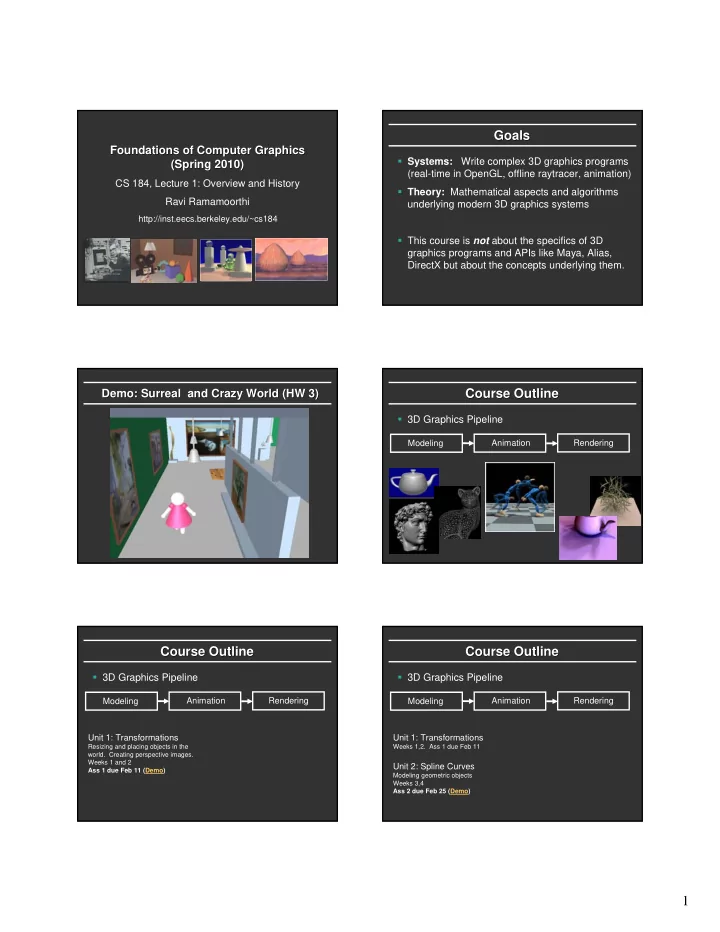
1 Course Outline Course Outline Course Outline Course Outline 3D - - PDF document

1
SMART_READER_LITE
LIVE PREVIEW

1 Course Outline Course Outline Course Outline Course Outline 3D - - PDF document

Goals Goals Foundations of Computer Graphics Foundations of Computer Graphics Systems: Write complex 3D graphics programs (Spring 2010) (Spring 2010) (real-time in OpenGL, offline raytracer, animation) CS 184, Lecture 1: Overview and


slide-1
SLIDE 1

1

Foundations of Computer Graphics Foundations of Computer Graphics (Spring 2010) (Spring 2010)

CS 184, Lecture 1: Overview and History Ravi Ramamoorthi

http://inst.eecs.berkeley.edu/~cs184

Goals Goals

  • Systems:

Write complex 3D graphics programs (real-time in OpenGL, offline raytracer, animation)

  • Theory: Mathematical aspects and algorithms

underlying modern 3D graphics systems

  • This course is not about the specifics of 3D

graphics programs and APIs like Maya, Alias, DirectX but about the concepts underlying them.

Demo: Surreal and Crazy World (HW 3) Demo: Surreal and Crazy World (HW 3)

Course Outline Course Outline

  • 3D Graphics Pipeline

Modeling Animation Rendering

Course Outline Course Outline

  • 3D Graphics Pipeline

Unit 1: Transformations

Resizing and placing objects in the

  • world. Creating perspective images.

Weeks 1 and 2 Ass 1 due Feb 11 (Demo)

Modeling Animation Rendering

Course Outline Course Outline

  • 3D Graphics Pipeline

Unit 1: Transformations

Weeks 1,2. Ass 1 due Feb 11

Unit 2: Spline Curves

Modeling geometric objects Weeks 3,4 Ass 2 due Feb 25 (Demo)

Modeling Animation Rendering

slide-2
SLIDE 2

2

Course Outline Course Outline

  • 3D Graphics Pipeline

Unit 1: Transformations

Weeks 1,2. Ass 1 due Feb 11

Unit 2: Spline Curves

Weeks 3,4. Ass 2 due Feb 25

Unit 3: OpenGL

Weeks 5-7. Ass 3 due Mar 18

Modeling Animation Rendering

Course Outline Course Outline

  • 3D Graphics Pipeline

Unit 1: Transformations

Weeks 1,2. Ass 1 due Feb 11

Unit 2: Spline Curves

Weeks 3,4. Ass 2 due Feb 25

Unit 3: OpenGL

Weeks 5-7. Ass 3 due Mar 18

Modeling Animation Rendering Unit 4: Animation

Week 8. Ass 4 due Apr 8

Course Outline Course Outline

  • 3D Graphics Pipeline

Unit 1: Transformations

Weeks 1,2. Ass 1 due Feb 11

Unit 2: Spline Curves

Weeks 3,4. Ass 2 due Feb 25

Unit 3: OpenGL

Weeks 5-7. Ass 3 due Mar 18

Modeling Animation Rendering Unit 4: Animation

Week 8. Ass 4 due Apr 8

Unit 5: Shading, Ray Tracing

Weeks 9-12. Ass 5 due Apr 29

Image Synthesis Examples Image Synthesis Examples Logistics Logistics

  • Website http://inst.eecs.berkeley.edu/~cs184 has most
  • f the information (look at it)
  • Office hours: before or after class (or send me e-mail)
  • TA: Fu-Chung Huang, Daniel Ritchie, Rm 545, 537?
  • Course bulletin board, cs184@imail.eecs.berkeley.edu
  • Textbook: Fundamentals of Computer Graphics by

Shirley (3rd edition) , OpenGL Programming Guide 6th or 7th ed by Shreiner, Woo, …

  • Many optional textbooks of interest on reserve
  • Website for late, collaboration policy, etc
  • Questions?

Workload Workload

  • Lots of fun, rewarding but may involve significant work
  • 5 programming projects; latter three are time-consuming

(but you have 3 weeks, groups of two, intermediate milestones). START EARLY !!

  • Course will involve understanding of mathematical,

geometrical concepts taught (tested on midterm, final)

  • Prerequisites: Solid C/C++/Java programming
  • background. Linear algebra (review on Mon) and

general math skills

  • Should be a difficult, but fun and rewarding course
slide-3
SLIDE 3

3

To Do To Do

  • Look at website
  • Various policies etc. for course. Send e-mail if confused.
  • Skim assignments if you want. First two are ready
  • Rest will be up soon
  • Submission instructions for assignments 1,2 soon
  • Assignment 0, Due Jan 28 Thu (see website). Set up your

account and tell us about yourself, providing a digital photo (so we can put names to faces).

  • Any questions?

History History

  • Brief history of significant developments in field
  • Couple of animated shorts for fun
  • Towards end of course: movie, history of CG

What is Computer Graphics? What is Computer Graphics?

  • Anything to do with visual representations on a computer
  • Includes much of 2D graphics we take for granted
  • And 3D graphics modeling and rendering (focus of course)
  • Computer animation (both 2D and 3D)
  • Auxiliary problems: Display devices, physics and math for

computational problems

The term Computer Graphics was coined by William Fetter of Boeing in 1960 First graphic system in mid 1950s USAF SAGE radar data (developed MIT)

2D Graphics 2D Graphics

Many of the standard operations you’re used to:

  • Text
  • Graphical User Interfaces (Windows, MacOS, ..)
  • Image processing and paint programs (Photoshop, …)
  • Drawing and presentation (Powerpoint, …)

How far we How far we’ ’ve come: TEXT ve come: TEXT

Manchester Mark I Display

From Text to GUIs From Text to GUIs

  • Invented at PARC circa 1975. Used in the Apple

Macintosh, and now prevalent everywhere.

Xerox Star Windows 1.0

slide-4
SLIDE 4

4

Drawing: Sketchpad (1963) Drawing: Sketchpad (1963)

  • Sketchpad (Sutherland, MIT 1963)
  • First interactive graphics system (VIDEO)
  • Many of concepts for drawing in current systems
  • Pop up menus
  • Constraint-based drawing
  • Hierarchical Modeling
  • SuperPaint system: Richard Shoup, Alvy Ray Smith

(PARC, 1973-79)

  • Nowadays, image processing programs like

Photoshop can draw, paint, edit, etc.

Paint Systems Paint Systems

  • Digitally alter images, crop, scale, composite
  • Add or remove objects
  • Sports broadcasts for TV (combine 2D and 3D processing)

Image Processing Image Processing 3D Graphics 3D Graphics

  • 3D Graphics Pipeline

Modeling Animation Rendering

Applications Applications

  • Entertainment (Movies), Art
  • Design (CAD)
  • Video games
  • Education, simulators, augmented reality
  • Image processing and photography

Modeling Modeling

  • Spline curves, surfaces: 70s – 80s
  • Utah teapot: Famous 3D model
  • More recently: Triangle meshes often acquired

from real objects

slide-5
SLIDE 5

5

Rendering: 1960s (visibility) Rendering: 1960s (visibility)

  • Roberts (1963), Appel (1967) - hidden-line algorithms
  • Warnock (1969), Watkins (1970) - hidden-surface
  • Sutherland (1974) - visibility = sorting

Images from FvDFH, Pixar’s Shutterbug Slide ideas for history of Rendering courtesy Marc Levoy

1970s - raster graphics

  • Gouraud (1971) - diffuse lighting, Phong (1974) - specular lighting
  • Blinn (1974) - curved surfaces, texture
  • Catmull (1974) - Z-buffer hidden-surface algorithm

Rendering: 1970s (lighting) Rendering: 1970s (lighting)

Rendering (1980s, 90s: Global Illumination) Rendering (1980s, 90s: Global Illumination) early 1980s - global illumination

  • Whitted (1980) - ray tracing
  • Goral, Torrance et al. (1984) radiosity
  • Kajiya (1986) - the rendering equation

History of Computer Animation History of Computer Animation

  • 10 min clip from video on history of animation
  • Covers sketchpad, animation, basic modeling,

rendering

  • A synopsis of what this course is about

Related courses Related courses

  • CS 283 (taught as 294), graduate class taught for first

time in the fall this year

  • Many CS 294 and similar courses, e.g. visualization,

physical simulation, geometric modeling, …

  • Other related courses: Computer Vision, Robotics, User

Interfaces Computational Geometry, Photography, …

Short Videos Short Videos