1 Software management 5 6 Management activities distinctions - - PDF document

1
SMART_READER_LITE
LIVE PREVIEW

1 Software management 5 6 Management activities distinctions - - PDF document

1 2 Project management Objectives To introduce software project management Organizing, planning and scheduling and to describe its distinctive software projects characteristics To discuss project planning and the planning process


slide-1
SLIDE 1

1

1

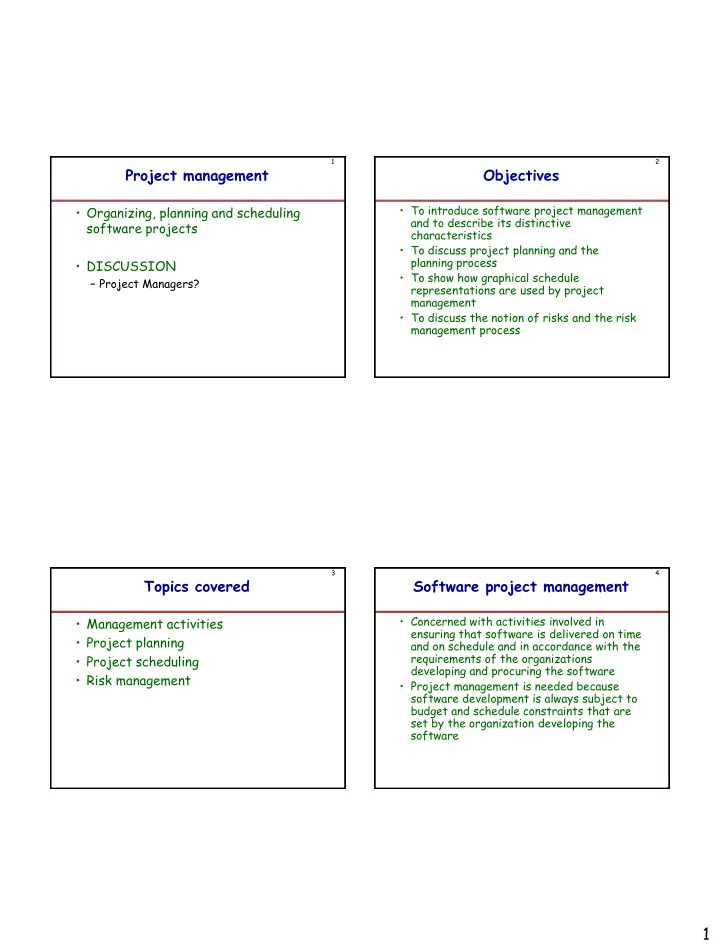
Project management

  • Organizing, planning and scheduling

software projects

  • DISCUSSION

– Project Managers?

2

Objectives

  • To introduce software project management

and to describe its distinctive characteristics

  • To discuss project planning and the

planning process

  • To show how graphical schedule

representations are used by project management

  • To discuss the notion of risks and the risk

management process

3

Topics covered

  • Management activities
  • Project planning
  • Project scheduling
  • Risk management

4

Software project management

  • Concerned with activities involved in

ensuring that software is delivered on time and on schedule and in accordance with the requirements of the organizations developing and procuring the software

  • Project management is needed because

software development is always subject to budget and schedule constraints that are set by the organization developing the software

slide-2
SLIDE 2

2

5

Software management distinctions

  • The product is intangible
  • The product is uniquely flexible
  • Software engineering is not recognized as

an engineering discipline with the same status as mechanical, electrical engineering, etc.

  • The software development process is not

standardized

6

Management activities

  • Proposal writing
  • Project planning and scheduling
  • Project costing
  • Project monitoring and reviews
  • Personnel selection and evaluation
  • Report writing and presentations

7

Management commonalities

  • These activities are not peculiar to

software management

  • Many techniques of engineering project

management are equally applicable to software project management

  • Technically complex engineering systems

tend to suffer from the same problems as software systems

8

Project staffing

  • May not be possible to appoint the ideal

people to work on a project

– Project budget may not allow for the use of highly-paid staff – Staff with the appropriate experience may not be available – An organization may wish to develop employee skills on a software project

  • Managers have to work within these

constraints especially when (as is currently the case) there is an international shortage

  • f skilled IT staff
slide-3
SLIDE 3

3

9

Project planning

  • Probably the most time-consuming project

management activity

  • Continuous activity from initial concept

through to system delivery. Plans must be regularly revised as new information becomes available

  • Various different types of plans may be

developed to support the main software project plan that is concerned with schedule and budget

10

Types of project plans

Plan Description Quality plan Describes the quality procedures and standards that will be used in a project. Validation plan Describes the approach, resources and schedule used for system validation. Configuration management plan Describes the configuration management procedures and structures to be used. Maintenance plan Predicts the maintenance requirements of the system, maintenance costs and effort required. Staff development plan. Describes how the skills and experience of the project team members will be developed.

11

Project plan structure

  • Introduction
  • Project organization
  • Risk analysis
  • Hardware and software resource

requirements

  • Work breakdown
  • Project schedule
  • Monitoring and reporting mechanisms

12

Activity organization

  • Activities in a project should be organized

to produce tangible outputs for management to judge progress

  • Milestones are the end-point of a process

activity

  • Deliverables are project results delivered

to customers

  • The waterfall process allows for the

straightforward definition of progress milestones

slide-4
SLIDE 4

4

13

Milestones in the RE process

14

Project scheduling

  • Split project into tasks and estimate time

and resources required to complete each task

  • Organize tasks concurrently to make
  • ptimal use of workforce
  • Minimize task dependencies to avoid delays

caused by one task waiting for another to complete

  • Dependent on project managers intuition

and experience

15

The project scheduling process

16

Scheduling problems

  • Estimating the difficulty of problems and

the cost of developing a solution is not easy

  • Productivity is not proportional to the

number of people working on a task

  • Adding people to a late project makes it

later because of communication overheads

  • The unexpected always happens. Always

allow contingency in planning

slide-5
SLIDE 5

5

17

Bar charts and activity networks

  • Graphical notations used to illustrate the

project schedule

  • Show project breakdown into tasks. Tasks

should not be too small. They should take about a week or two

  • Activity charts show task dependencies

and the the critical path

  • Bar charts show schedule against calendar

time

18

Task durations and dependencies

Task Duration (days) Dependencies T1 8 T2 15 T3 15 T1 (M1) T4 10 T5 10 T2, T4 (M2) T6 5 T1, T2 (M3) T7 20 T1 (M1) T8 25 T4 (M5) T9 15 T3, T6 (M4) T10 15 T5, T7 (M7) T11 7 T9 (M6) T12 10 T11 (M8)

19

Activity network

20

Staff allocation

slide-6
SLIDE 6

6

21

Risk management

  • Risk management is concerned with

identifying risks and drawing up plans to minimize their effect on a project.

  • A risk is a probability that some adverse

circumstance will occur.

– Project risks affect schedule or resources – Product risks affect the quality or performance

  • f the software being developed

– Business risks affect the organization developing or procuring the software

  • PROJECT

– Any risk planning?

22

Software risks

Risk Risk type Description Staff turnover Project Experienced staff will leave the project before it is finished. Management change Project There will be a change of organizational management with different priorities. Hardware unavailability Project Hardware that is essential for the project will not be delivered on schedule. Requirements change Project and product There will be a larger number of changes to the requirements than anticipated. Specification delays Project and product Specifications of essential interfaces are not available on schedule Size underestimate Project and product The size of the system has been underestimated. CASE tool under- performance Product CASE tools which support the project do not perform as anticipated Technology change Business The underlying technology on which the system is built is superseded by new technology. Product competition Business A competitive product is marketed before the system is completed.

23

The risk management process

  • Risk identification

– Identify project, product and business risks

  • Risk analysis

– Assess the likelihood and consequences of these risks

  • Risk planning

– Draw up plans to avoid or minimize the effects

  • f the risk
  • Risk monitoring

– Monitor the risks throughout the project

24

The risk management process

slide-7
SLIDE 7

7

25

Risk identification

  • Technology risks
  • People risks
  • Organizational risks
  • Requirements risks
  • Estimation risks

26

Risks and risk types

Risk type Possible risks Technology The database used in the system cannot process as many transactions per second as expected. Software components that should be reused contain defects limiting their functionality. People It is impossible to recruit staff with the skills required. Key staff members are ill and unavailable at critical times. Required training for staff is not available. Organizational The organization is restructured so that different management is responsible for the project. Organizational financial problems force reductions in the project budget. Tools The code generated by CASE tools is inefficient. CASE tools cannot be integrated. Requirements Changes to requirements requiring major design rework are proposed. Customers fail to understand the impact of requirements changes. Estimation The time required to develop the software is underestimated. The rate of defect repair is underestimated. The size of the software is underestimated. 27

Risk analysis

  • Assess probability and seriousness of

each risk

  • Probability may be very low, low,

moderate, high or very high

  • Risk effects might be catastrophic,

serious, tolerable or insignificant

28

Risk planning

  • Consider each risk and develop a strategy

to manage that risk

  • Avoidance strategies

– The probability that the risk will arise is reduced

  • Minimization strategies

– The impact of the risk on the project or product will be reduced

  • Contingency plans

– If the risk arises, contingency plans deal with that risk