1 In other application areas The basic issue (source: Siemens) - - PDF document

1
SMART_READER_LITE
LIVE PREVIEW

1 In other application areas The basic issue (source: Siemens) - - PDF document

Chair of Softw are Engineering Chair of Softw are Engineering Einfhrung in die Programmierung Einfhrung in die Programmierung Introduction to Programming Introduction to Programming Prof. Dr. Bertrand Meyer Prof. Dr. Bertrand Meyer


slide-1
SLIDE 1

1

Einführung in die Programmierung Introduction to Programming

  • Prof. Dr. Bertrand Meyer

October 2006 – February 2007

Chair of Softw are Engineering

Lectures 23-24: From Programming to Software Engineering

Einführung in die Programmierung Introduction to Programming

  • Prof. Dr. Bertrand Meyer

October 2006 – February 2007

Chair of Softw are Engineering

  • Intro. to Programming, lecture 23: From Programming t o Software Engineering 3

Software engineering (1)

The processes, methods, techniques, tools and languages for developing quality operational software.

  • Intro. to Programming, lecture 23: From Programming t o Software Engineering 4

Software engineering (2)

The processes, methods, techniques, tools and languages for developing quality operational software that may need to

Be of large size Be developed and used over a long period Involve many developers Undergo many changes and revisions

  • Intro. to Programming, lecture 23: From Programming t o Software Engineering 5

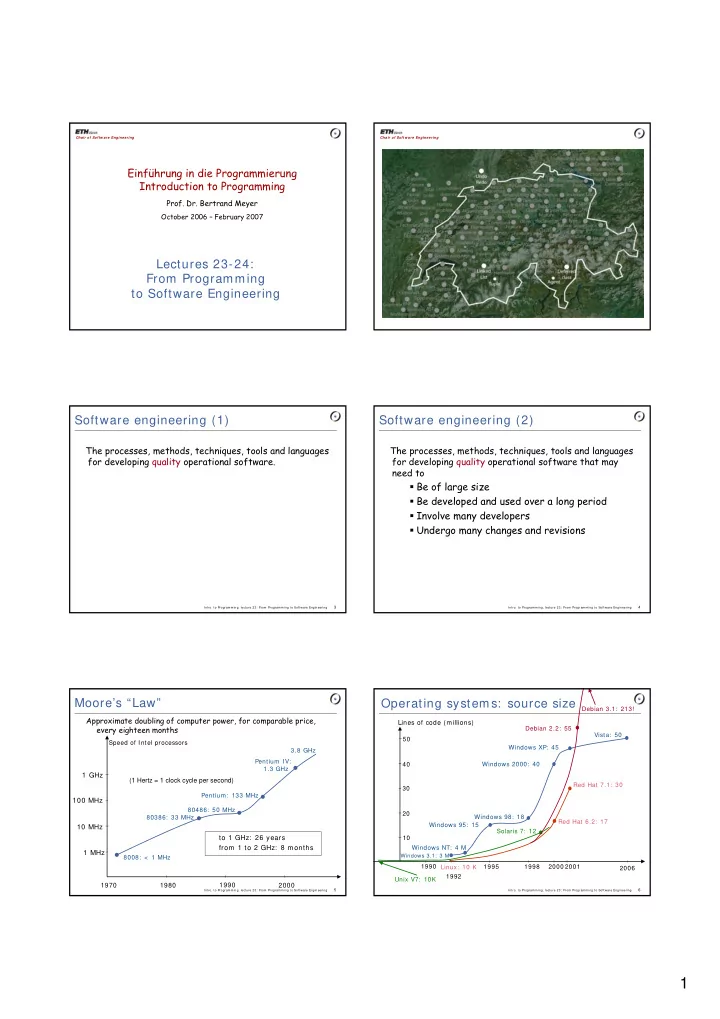
Moore’s “Law”

Approximate doubling of computer power, for comparable price, every eighteen months

2000 1 MHz 10 MHz 1 GHz 100 MHz 1990 1980 1970 8008: < 1 MHz 80386: 33 MHz 80486: 50 MHz Pentium: 133 MHz Pentium IV: 1.3 GHz to 1 GHz: 26 years from 1 to 2 GHz: 8 months Speed of Intel processors (1 Hertz = 1 clock cycle per second) 3.8 GHz

  • Intro. to Programming, lecture 23: From Programming t o Software Engineering 6

Operating systems: source size

Unix V7: 10K 1990 1992 1995 1998 2000 Red Hat 7.1: 30 Linux: 10 K 10 20 40 30 Lines of code (millions)

Windows 3.1: 3 M

Windows NT: 4 M Windows 95: 15 Windows 98: 18 Windows 2000: 40 Red Hat 6.2: 17 Solaris 7: 12 Windows XP: 45 2006 50 Vista: 50 Debian 2.2: 55 Debian 3.1: 213! 2001

slide-2
SLIDE 2

2

  • Intro. to Programming, lecture 23: From Programming t o Software Engineering 7

In other application areas

(source: Siemens)

  • Intro. to Programming, lecture 23: From Programming t o Software Engineering 8

The basic issue

Developing software systems that are

On time and within budget Of high immediate quality Possibly large and complex Extendible

  • Intro. to Programming, lecture 23: From Programming t o Software Engineering 9

Software engineering What does software quality mean?

  • Intro. to Programming, lecture 23: From Programming t o Software Engineering 10

Non-quality

  • Intro. to Programming, lecture 23: From Programming t o Software Engineering 11

Associated Press, 21 October 2000

LOS ANGELES. Failure of the Southwest's main air traffic radar system was traced to new software unable to recognize data typed manually by Mexico controllers. The software installed Wednesday evening at the FAA's Los Angeles Center in the Mojave Desert, which controls aircraft over a 100,000- square-mile area, is the same upgrade completed successfully at 19 other FAA radar centers. But designers didn't allow for information typed in by Mexico controllers, who don’t have a computerized system, the FAA spokesman said. "The computer didn't recognize the information from Mexico and it aborted". "A digit out of place could do it." When controllers at the LA Center switched to the new system Thursday morning, it quickly failed when data from a Mexico controller was received. The radar system instantly switched to backup. The computer with the new software was restarted later, but failed again. The old system was reinstalled and the system returned to operation more than two hours

  • later. Air travel schedules were left in disarray as the FAA ordered a

nationwide ground stop for all flights bound for the Southwest, causing cancellations, rerouting, long delays and airport gridlock. Technicians must now rewrite the software to recognize Mexico controller

  • information. It wasn't clear when a revised program would be installed.
  • Intro. to Programming, lecture 23: From Programming t o Software Engineering 12

1998 Mars Orbiter Vehicle*

The orbiter was lost due to a miscalculation in trajectory. The miscalculation was caused by an unintended and undetected mismatch between metric and English units of

  • measurement. The use of metric units as well as the data

formats to employ were specified in a navigation software interface specification (SIS) published by JPL in 1996. Despite this, the flight operations team at Lockheed Martin provided impulse data in English units of pound- force seconds rather than newton seconds. These values were incorrect by a factor of 4.45 (1 lbf = 4.45 N). The mix-up caused erroneous course corrections that resulting in the orbiter descending too low in Mars atmosphere. The vehicle either burned up or bounced off into space.

* Source: Wikipedia

slide-3
SLIDE 3

3

  • Intro. to Programming, lecture 23: From Programming t o Software Engineering 13

Ariane-5 maiden launch, 1996

37 seconds into flight, exception in Ada program not processed;

  • rder given to abort mission. Loss estimated to $10 billion.

Exception was caused by an incorrect conversion: a 64-bit real value was incorrectly translated into a 16-bit integer. Systematic analysis had “proved” that the exception could not

  • ccur – the 64-bit value (“horizontal bias” of the flight) was

proved to be always representable as a 16-bit integer ! It was a REUSE error:

The analysis was correct – for Ariane 4 ! The assumption was documented – in a design document !

See Jean-Marc Jézéquel & Bertrand Meyer, “Design by Contract: The Lessons of Ariane, IEEE Computer, January 1997, available at

se.ethz.ch/~meyer/publications/computer/ariane.pdf

  • Intro. to Programming, lecture 23: From Programming t o Software Engineering 14

Security example: the buffer overflow

System expects some input from an external user:

First name: Last name: Address:

  • Intro. to Programming, lecture 23: From Programming t o Software Engineering 15

Getting the input from i := 1 until i > input_size loop buffer [i ] := input [i ] i := i + 1 end

  • Intro. to Programming, lecture 23: From Programming t o Software Engineering 16

C brings in a special twist…

For a string, there’s no way to know input_size in advance You have to read until you find the string terminator, \0 (the null character)

These two strings walk into a bar. The bartender says: “What will it be?" The first string says: "I think I'll have a beer zdiup tako^jDjftk /. \\134.206.21.02 C#VB.NET 8086%N ~~|~~#@$ Dz @-)))" "Please excuse my friend," the second string says, “He isn't null-terminated."

17

Overflowing a buffer! Data “The stack” Programs

Max

Routine 1 Routine 2

Return address, arguments, locals Routine n

My nasty code

Main

Return address My return address Code of routine n-1

The buffer (overflowing) The buffer

(activation records)

Memory

18

Getting the input

from i := 1 until i > input_size loop buffer [i ] := input [i ] i := i + 1 end

  • r i > buffer_size
slide-4
SLIDE 4

4

  • Intro. to Programming, lecture 23: From Programming t o Software Engineering 19

US software industry, 2000

Source: Standish report Project leaders and CIOs representing several thousand software projects Project outcome:

  • 28% success

(1998: 26% )

  • 23% failure

(1998: 28% )

  • Rest: “challenged”

(1998: 46% ) (completed over budget, over time, under features) Smaller projects have a higher chance of succeeding

  • Intro. to Programming, lecture 23: From Programming t o Software Engineering 20

Standish: evolution 1994-2000

  • Intro. to Programming, lecture 23: From Programming t o Software Engineering 21

NIST report on “testing” (May 2002)

Monetary effect on Developers and User due to “insufficient testing infrastructure”: $59.5 billion (Financial sector: $3.3 billion, auto/ aerospace $1.8 billion etc.)

  • Intro. to Programming, lecture 23: From Programming t o Software Engineering 22

Software quality: external vs internal

External factors: visible to customers (not just end users but e.g. purchasers)

Examples: ease of use, extendibility, timeliness

Internal factors: perceptible only to developers

Examples: good programming style, information hiding

Only external factors count in the end, but the internal factors make it possible to obtain them.

  • Intro. to Programming, lecture 23: From Programming t o Software Engineering 23

Software quality: product vs process

Product: properties of the resulting software For example: correctness, efficiency Process: properties of the procedures used to produce and “maintain” the software

  • Intro. to Programming, lecture 23: From Programming t o Software Engineering 24

Some external factors

Product quality (immediate):

Reliability Efficiency Ease of use Ease of learning

Process quality:

Production speed (timeliness) Cost-effectiveness Predictability Reproducibility Self-improvement

Product quality (long term):

Extendibility Reusability Portability

slide-5
SLIDE 5

5

  • Intro. to Programming, lecture 23: From Programming t o Software Engineering 25

Reliability

Correctness: The systems’ ability to perform according to specification, in cases covered by the specification Robustness: The systems’ ability to perform reasonably in cases not covered by the specification Security (integrity): The systems’ ability to protect itself against hostile use

Correctness Robustness Integrity HOSTILE USE ERRORS SPECIFICATION

  • Intro. to Programming, lecture 23: From Programming t o Software Engineering 26

Some internal factors

Modularity Observation of style rules Consistency Structure ...

  • Intro. to Programming, lecture 23: From Programming t o Software Engineering 27

External factors

Product quality (immediate): Reliability Efficiency Ease of use Ease of learning Process quality: Timeliness Cost-effectiveness Product quality (long term): Extendibility Reusability Portability

  • Intro. to Programming, lecture 23: From Programming t o Software Engineering 28

Software tasks

Requirements analysis Specification Design Implementation Validation & Verification (V&V) Management Planning and estimating Measurement

  • Intro. to Programming, lecture 23: From Programming t o Software Engineering 29

Requirements analysis

Understanding user needs Understanding constraints on the system

Internal constraints: class invariants External constraints

  • Intro. to Programming, lecture 23: From Programming t o Software Engineering 30

Validation & Verification

Verification: checks of internal consistency Example: type check “Checking that you have built the system right” (followed all rules) Validation: checking against a higher-level description Example: validating a program against its specification “Checking that you have built the right system” (satisfied user needs)

slide-6
SLIDE 6

6

  • Intro. to Programming, lecture 23: From Programming t o Software Engineering 31

Software lifecycle models

Describe an overall distribution of the software construction into tasks, and the ordering of these tasks They are models in two ways:

Provide an abstracted version of reality Describe an ideal scheme, not always

followed in practice

  • Intro. to Programming, lecture 23: From Programming t o Software Engineering 32

Lifecycle: the waterfall model

Feasibility study Requirements Specification Global design Detailed design Implemen- tation V & V Distribution

  • Intro. to Programming, lecture 23: From Programming t o Software Engineering 33

V-shaped

FEASIBILITY STUDY REQUIREMENTS ANALYSIS GLOBAL DESIGN DETAILED DESIGN DISTRIBUTION IMPLEMENTATION UNIT VALIDATION SUBSYSTEM VALIDATION SYSTEM VALIDATION

  • Intro. to Programming, lecture 23: From Programming t o Software Engineering 34

Arguments for the waterfall

(After B.W. Boehm: Software engineering economics)

The activities are necessary (But: merging of middle activities) The order is the right one.

  • Intro. to Programming, lecture 23: From Programming t o Software Engineering 35

Merging of middle activities

Feasibility study Requirements Specification Global design Detailed design Implemen- tation V & V Distribution

  • Intro. to Programming, lecture 23: From Programming t o Software Engineering 36

Problems with the waterfall

Late appearance of actual code. Lack of support for

requirements change — and more generally for extendibility and reusability

Lack of support for the

maintenance activity (70% of software costs?)

Division of labor hampering Total

Quality Management

Impedance mismatches Highly synchronous model

Feasibility study Requirements Specification Global design Detailed design Implemen- tation V & V Distribution

slide-7
SLIDE 7

7

  • Intro. to Programming, lecture 23: From Programming t o Software Engineering 37

Quality control?

Analysts Designers Implementers Testers Customers

  • Intro. to Programming, lecture 23: From Programming t o Software Engineering 38

Lifecycle: “impedance mismatches”

As Management requested it As the Project Leader defined it As Systems designed it As Programming developed it As Operations installed it What the user wanted

(Pre-1970 cartoon; origin unknown)

39

A modern variant

  • Intro. to Programming, lecture 23: From Programming t o Software Engineering 40

Problems with the waterfall

Separate tools:

Programming environment Analysis & design tools, e.g. UML

Consequences:

Hard to keep model, implementation,

documentation consistent

Constantly reconciling views Inflexible, hard to maintain systems Hard to accommodate bouts of late wisdom

Feasibility study Requirements Specification Global design Detailed design Implemen- tation V & V Distribution

  • Intro. to Programming, lecture 23: From Programming t o Software Engineering 41

The spiral model (Boehm)

Apply a waterfall-like approach to successive prototypes

Iteration 1 Iteration 2 Iteration 3

  • Intro. to Programming, lecture 23: From Programming t o Software Engineering 42

The Spiral model

Figure from: Ghezzi, Jazayeri, Mandrioli, Software Engineering, 2nd edition, Prentice Hall

slide-8
SLIDE 8

8

  • Intro. to Programming, lecture 23: From Programming t o Software Engineering 43

“Prototyping” in software

The term is used in one of the following meanings:

Experimentation:

Requirements capture Try specific techniques: GUI, implementation (“buying information”)

Pilot project Incremental development Throw-away development

(Fred Brooks, The Mythical Man-Month: “Plan to throw one away, you will anyhow”).

  • Intro. to Programming, lecture 23: From Programming t o Software Engineering 44

The problem with throw-away development

Software development is hard because of the need to reconcile conflicting criteria, e.g. portability and efficiency A prototype typically sacrifices some of these criteria Risk of shipping the prototype

  • Intro. to Programming, lecture 23: From Programming t o Software Engineering 45

Seamless, incremental development

The Eiffel view:

Single set of notation, tools, concepts, principles throughout Eiffel is as much for analysis & design as for implementation &

maintenance

Continuous, incremental development Keep model, implementation and documentation consistent

Reversibility: can go back and forth

  • Intro. to Programming, lecture 23: From Programming t o Software Engineering 46

Seamless development

Single notation, tools,

concepts, principles

Continuous, incremental

development

Keep model, implementation

and documentation consistent

Reversibility: go back and

forth

Example classes: PLANE, ACCOUNT, TRANSACTION… STATE, COMMAND… HASH_TABLE… TEST_DRIVER… TABLE…

Analysis Design Implemen- tation V&V Generali- zation

  • Intro. to Programming, lecture 23: From Programming t o Software Engineering 47

Generalization

Prepare for reuse. For example:

  • Remove built-in limits
  • Remove dependencies on

specifics of project

  • Improve documentation,

contracts...

  • Abstract
  • Extract commonalities and

revamp inheritance hierarchy Few companies have the guts to provide the budget for this B A* Y X Z

A D I V

G

  • Intro. to Programming, lecture 23: From Programming t o Software Engineering 48

Antoine de Saint-Exupéry

It seems that the sole purpose of the work of engineers, designers, and calculators in drawing offices and research institutes is to polish and smooth out, lighten this seam, balance that wing until it is no longer noticed, until it is no longer a wing attached to a fuselage, but a form fully unfolded, finally freed from the ore, a sort of mysteriously joined whole, and of the same quality as that of a poem. It seems that perfection is reached, not when there is nothing more to add, but when there is no longer anything to remove.

(Terre des Hommes, 1937)

slide-9
SLIDE 9

9

  • Intro. to Programming, lecture 23: From Programming t o Software Engineering 49

Reversibility

Analysis Design Implemen- tation V&V Generali- zation

  • Intro. to Programming, lecture 23: From Programming t o Software Engineering 50

The cluster model

Cluster 1 Cluster 2 A D I V&V G A D I V&V G A D I V&V G A D I V&V G

  • Intro. to Programming, lecture 23: From Programming t o Software Engineering 51

The cluster model

I V D S G I V D S G I V D S G Cluster 1 Cluster 2 I V D S G Cluster n I V D S G I V D S G

  • Intro. to Programming, lecture 23: From Programming t o Software Engineering 52

Seamless development: the Eiffel example

Diagram Tool

  • System diagrams can be produced automatically from

software text

  • Works both ways: update diagrams or update text –
  • ther view immediately updated

No need for separate UML tool Metrics Tool Profiler Tool Documentation generation tool ... Demo

  • Intro. to Programming, lecture 23: From Programming t o Software Engineering 53

Quality goals: the Osmond curves

Envisaged Release

Desirable

Other qualities

Functionality

Common

1 2 3 4

The advice: add functionality at constant quality

  • Intro. to Programming, lecture 23: From Programming t o Software Engineering 54

Agile/ lean methods and extreme programming

De-emphasize formal process Emphasize short-cycled, time-boxed iterative development Emphasize the role of tests to guide the development (“TDD”, Test-Driven Development) Emphasize the benefit of a second set of eyes: Pair programming Emphasize the role of refactoring Emphasize self-organizing teams Emphasize customer involvement

slide-10
SLIDE 10

10

  • Intro. to Programming, lecture 23: From Programming t o Software Engineering 55

Dilbert and XP

  • Intro. to Programming, lecture 23: From Programming t o Software Engineering 56

Open-source processes

Collaborative, distributed developments Concentric trust circles Success with strong project leader (e.g. Linux) “Given enough eyes, all bugs are shallow”

  • Intro. to Programming, lecture 23: From Programming t o Software Engineering 57

Validation and Verification

Not just testing:

Static Analysis tools explore code for possible

deficiencies, e.g. uninitialized variables

Proofs of correctness are increasingly becoming realistic Model checking explores the state space of an

abstracted version of the program Quality assurance should be performed throughout the process, not just at the end

  • Intro. to Programming, lecture 23: From Programming t o Software Engineering 58

Software engineering tools

Development environments (compiler, browser, debugger, …): “IDE” Documentation tools Requirements gathering tools Analysis and design tools Configuration & version management (CVS, Source Safe…) (also “make” etc.) Formal development and proof tools Integrated CASE (Computer-Aided Software Engineering) environments

  • Intro. to Programming, lecture 23: From Programming t o Software Engineering 59

Configuration management

Aim: make sure that versions used for the various components of a system are compatible When poorly done, one of the biggest sources of software catastrophes Good tools exist today, e.g. CVS, Source Safe. Any project not using one of these tools is managed by a complete idiot

  • Intro. to Programming, lecture 23: From Programming t o Software Engineering 60

Formal methods

Use mathematics as the basis for software development A software system is viewed as a mathematical theory, progressively refined until directly implementable Every variant of the theory and every refinement step is proved Proof supported by computerized tools Example: Atelier B, security system of newest Paris Metro line

slide-11
SLIDE 11

11

  • Intro. to Programming, lecture 23: From Programming t o Software Engineering 61

Metrics

Things to measure: Product attributes: lines of code, number of classes, complexity of control structure (“cyclomatic number”), complexity and depth of inheritance structure, presence of contracts... Project attributes: number of people, person-months, costs, time to completion, time of various activities (analysis, design, implementation, V&V etc.) Taking good measurements helps take good measures

  • Intro. to Programming, lecture 23: From Programming t o Software Engineering 62

Cost models

Attempt to evaluate cost of software development ahead of project, based on estimate of parameters Example: COCOMO (Constructive Cost Model), Barry Boehm

Time Effort (pm) Program type 2.5 * pm * 0.32 3.6 * L * 1.20 System 2.5 * pm * 0.35 3.0 * L * 1.12 Utility 2.5 * pm * 0.38 2.4 * L * 1.05 Application

L: 1000 * Delivered Source Instructions (KDSI)

  • Intro. to Programming, lecture 23: From Programming t o Software Engineering 63

Software reliability models

Estimate number of bugs from

Characteristics of program Number of bugs found so far

Variant: “Fault injection”

  • Intro. to Programming, lecture 23: From Programming t o Software Engineering 64

Project management

Team specialties: customer relations, analyst, designer, implementer, tester, manager, documenter... What role for the manager: managerial only, or technical too? “Chief Programmer teams”

  • Intro. to Programming, lecture 23: From Programming t o Software Engineering 65

Software engineering

In the end it’s code Don’t underestimate the role of tools, language and, more generally, technology Bad management kills projects Good technology makes projects succeed

  • Intro. to Programming, lecture 23: From Programming t o Software Engineering 66

Programming languages

Not just for talking to your computer! A programming language is a tool for thinking

slide-12
SLIDE 12

12

  • Intro. to Programming, lecture 23: From Programming t o Software Engineering 67

A bit of history

“Plankalkül”, Konrad Zuse, 1940s Fortran (FORmula TRANSlator), John Backus, IBM, 1954 Algol, 1958/1960

  • Intro. to Programming, lecture 23: From Programming t o Software Engineering 68

Some FORTRAN code

100IF (N) 150, 160, 170 150A (I) = A (I) ** 2 READ (“I6”) N GOTO 100 C THE NEXT ONE IS THE TOUGH CASE 160A (I) = A (I) + 1 READ (“I6”) N GOTO 100 170STOP END

  • Intro. to Programming, lecture 23: From Programming t o Software Engineering 69

Algol

International committee, Europeans and Americans; led to

  • IFIP. Algol 58, Algol 60.

Influenced by (and reaction against) FORTRAN; also influenced by LISP (see next). Recursive procedures, dynamic arrays, block structure, dynamically allocated variables New language description mechanism: BNF (for Algol 60).

  • Intro. to Programming, lecture 23: From Programming t o Software Engineering 70

Algol W and Pascal

Successors to Algol 60, designed by Niklaus Wirth from ETH Algol W introduced record structures Pascal emphasized simplicity, data structures (records, pointers). Small language, widely adopted for teaching. Helped trigger the PC revolution through Turbo Pascal from Borland (Philippe Kahn)

  • Intro. to Programming, lecture 23: From Programming t o Software Engineering 71

C

1968: Brian Kernighan and Dennis Richie, AT&T Bell Labs Initially, closely connected with Unix Emphasis on low-level machine access: pointers, address arithmetic, conversions Frantically adopted by industry in the 80s and 90s

  • Intro. to Programming, lecture 23: From Programming t o Software Engineering 72

Lisp and functional languages

LISt Processing, 1959, John McCarthy, MIT then Stanford Fundamental mechanism is recursive function definition Automatic garbage collection (in 1959!) Numerous successors, e.g. Scheme (MIT) Functional languages: Haskell, Scheme, ML

slide-13
SLIDE 13

13

  • Intro. to Programming, lecture 23: From Programming t o Software Engineering 73

LISP “lists”

A list is of the form (x1 x2...) where each xi is either An atom (number, identifier etc.) (Recursively) a list: Examples: () (x1 x2) (x1 (x2 x3) x4 (x5 (x6 () x7))) ((x1 x2)) is not the same as (x1 (x2))

  • Intro. to Programming, lecture 23: From Programming t o Software Engineering 74

LISP function application and definition

The application of function f to arguments a, b, c is written (f a b c) Example function definition (Scheme): (define (factorial n) (if (eq? n 0) 1 (∗ n (factorial (− n 1)))))

  • Intro. to Programming, lecture 23: From Programming t o Software Engineering 75

Basic functions

Let my_list = (A B C) (CAR my_list) = A (CDR my_list) = (B C) (CONS A (B C)) = ( A B C) A B C CAR CDR

  • Intro. to Programming, lecture 23: From Programming t o Software Engineering 76

Functions working on lists

(define double-all (list) (mapcar '(lambda (x) (∗ 2 x)) list))

(define (mapcar function f) (if (null? ls) '() (cons (function (car ls)) (mapcar function (cdr ls))) ) )

  • Intro. to Programming, lecture 23: From Programming t o Software Engineering 77

Object-oriented programming

Simula 67: Algol 60 extensions for simulation, University of Oslo, 1967 (after Simula 1, 1964). Kristen Nygaard, Ole Johan Dahl Grew into a full-fledged programming language Smalltalk (Xerox PARC) added ideas from Lisp and innovative user interface ideas. Alan Kay, Adele Goldberg, Daniel Bobrow

  • Intro. to Programming, lecture 23: From Programming t o Software Engineering 78

“Hybrid” languages

Objective-C, around 1984: Smalltalk layer on top of C C++, around 1985: “C with classes” Made O-O acceptable to mainstream industry Key moment: first OOPSLA, 1986

slide-14
SLIDE 14

14

  • Intro. to Programming, lecture 23: From Programming t o Software Engineering 79

Java and C#

C++ with enough restrictions to permit type safety and garbage collection Java initially marketed for applets in connection with the explosion of the Internet, 1995 C# adds “delegates” (agent-like mechanism)

  • Intro. to Programming, lecture 23: From Programming t o Software Engineering 80

Eiffel

First version goes back to mid-eighties, first demonstrated at OOPSLA 86 Emphasis on software engineering principles: information hiding, Design by Contract, static typing (through genericity), full application of O-O principles Has found its main application area in mission-critical industrial applications

  • Intro. to Programming, lecture 23: From Programming t o Software Engineering 81
  • Intro. to Programming, lecture 23: From Programming t o Software Engineering 82
  • Intro. to Programming, lecture 23: From Programming t o Software Engineering 83

End of lecture 23