Objectives Euclidean Algorithm to compute gcd (Greatest Common - - PDF document

objectives
SMART_READER_LITE
LIVE PREVIEW

Objectives Euclidean Algorithm to compute gcd (Greatest Common - - PDF document

More Number Theoretic Results Debdeep Mukhopadhyay Assistant Professor Department of Computer Science and Engineering Indian Institute of Technology Kharagpur INDIA -721302 Objectives Euclidean Algorithm to compute gcd (Greatest


slide-1
SLIDE 1

Low Power Ajit Pal IIT Kharagpur 1

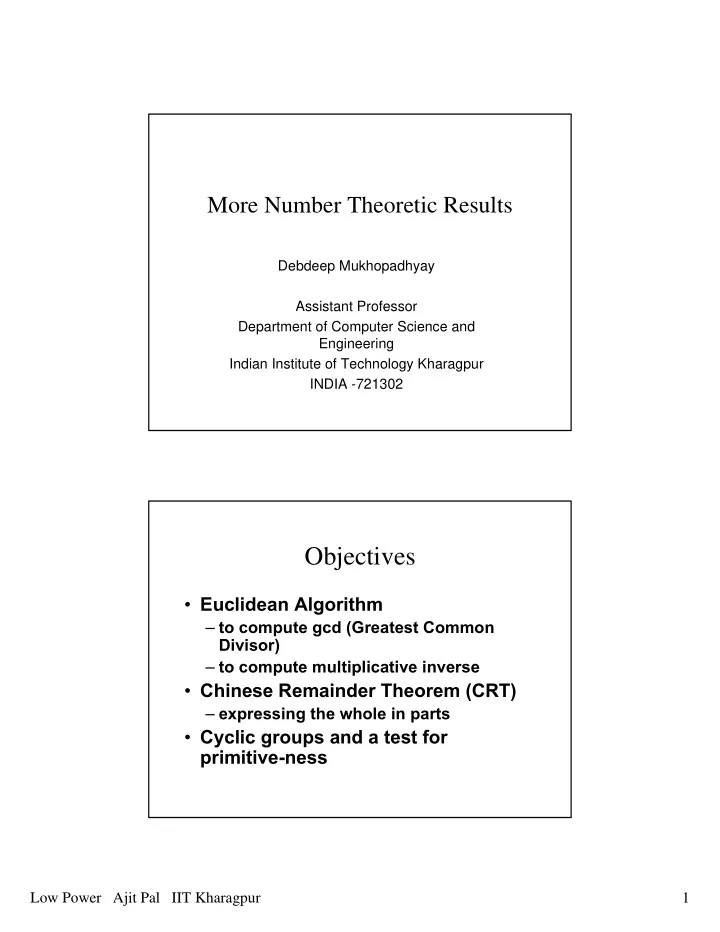
More Number Theoretic Results

Debdeep Mukhopadhyay Assistant Professor Department of Computer Science and Engineering Indian Institute of Technology Kharagpur INDIA -721302

Objectives

  • Euclidean Algorithm

– to compute gcd (Greatest Common Divisor) – to compute multiplicative inverse

  • Chinese Remainder Theorem (CRT)

– expressing the whole in parts

  • Cyclic groups and a test for

primitive-ness

slide-2
SLIDE 2

Low Power Ajit Pal IIT Kharagpur 2

Previous Results Discussed

  • Modular Arithmetic
  • The set of residues modulo n, that are

relatively prime to n is denoted by Zn*.

  • Zn* forms a multiplicative group under

multiplication.

  • Any element inside Zn* has a multiplicative

inverse.

  • Zn* is closed under multiplication.

The Euclidean Algorithm

slide-3
SLIDE 3

Low Power Ajit Pal IIT Kharagpur 3

Proof of Correctness

  • gcd(a,b)=gcd(r0,r1)=gcd(q1r1+r2,r1)=

gcd(r1,r2)=gcd(r2,r3)=…=gcd(rm-1,rm)=rm

  • Thus, the EA algorithm can be used to

compute the gcd of two positive integers

– Also to check whether an integer modulo n has a multiplicative inverse.

  • But how can we compute the inverse?

Example

  • Compute the 28-1 mod 75

75=2x28+19 28=1x19+9 19=2x9+1 9=9x1

  • So, gcd(28,75)=1. So, what is the

inverse?

  • Can you express the gcd as a linear

combination of 28 and 75?

slide-4
SLIDE 4

Low Power Ajit Pal IIT Kharagpur 4

Example

  • 19=75-2x28
  • 9=28-19=28-(75-2x28)=-75+3x28
  • 1=19-2x9=(75-2x28)-2x(-75+3x28)=

3x75-8x28

  • Thus, gcd(28,75)=1=3x75-8x28.
  • So, what is 28-1 mod 75?

Answer is -8 mod 75 = 67

So, what is the lesson?

  • All the remainders generated by the

EA algorithm can be expressed as a linear combination of the +ve integers a and b.

  • And the expression is unique.
  • The extended EA algorithm

generates/computes this linear combination in a systematic fashion

slide-5
SLIDE 5

Low Power Ajit Pal IIT Kharagpur 5

  • Define (t0, t1, …,tm) and (s0, s1, …,sm)

1

For 0 , we have that , where the ' are as defined in the Euclidean Algorithm, and the ' and the ' are as defined in the recurrence.

j j j j j j

j m r s r t r r s s s t s ≤ ≤ = + The Extended EA algorithm

slide-6
SLIDE 6

Low Power Ajit Pal IIT Kharagpur 6

Example

1=3x75+(-8)x28 Thus, taking modulo 75, 28-1 mod 75=-8=67

Improvement

The answer is -8 mod 75 = 67… take a modulo

  • peration with

a=75. Note that we do not require the si’s and can take a modulo 75 each time while computing the ti’s. This will make the algorithm efficient.

slide-7
SLIDE 7

Low Power Ajit Pal IIT Kharagpur 7

The Chinese Remainder Theorem (CRT)

  • It solves a system of congruences.
  • Suppose m1, m2,…,mr are pairwise

relatively prime positive integers.

  • System of congruences:

CRT asserts that there is a unique solution to this system

Example

  • x≡3 mod 5
  • x≡1 mod 3
  • x≡ ? mod 15
  • You can verify that the only answer

is 13 mod 15. The first thing to explain why there is only one solution.

slide-8
SLIDE 8

Low Power Ajit Pal IIT Kharagpur 8

Uniqueness

  • X(x)=(x mod 5, x mod 3)

Note that the mapping is bijective…

Example

  • M=5x3=15
  • M1=15/5=3, 3-1mod 5=2
  • M2=15/3=5, 5-1mod 3=2
  • x=(3x3x2+1x5x2)mod 15

=28 mod 15=13 What is the principle?

slide-9
SLIDE 9

Low Power Ajit Pal IIT Kharagpur 9

Generalization

  • We shall present a constructive proof
  • In fact, CRT gives an explicit formula

for X-1 mod M, where M=m1m2…mr

  • Compute, Mi=M/mi, for 1≤i≤r

– Thus, gcd(mi,Mi)=1

  • Compute yi=Mi
  • 1mod mi
  • Thus, Miyi≡1 (mod mi), for 1≤i≤r
  • Define,
  • Compute, ρ mod mi≡ai [This is because

Miyi≡1 (mod mi) and Miyi ≡0 (mod mj)]

  • Since, the domain and range have the same

cardinality and the function X() is onto, by

  • ur previous discussion the function is
  • bijective. Thus the solution is unique modulo

M.

slide-10
SLIDE 10

Low Power Ajit Pal IIT Kharagpur 10

The CRT Theorem Other Useful Facts

  • Suppose G is a multiplicative group
  • f order n, and gεG. Then the order
  • f g divides n.
  • Corollary 1: If bεZn

*, then bΦ(n)≡1

(mod n)

  • Corollary 2: Suppose p is prime and

bεZp. Then bp ≡b (mod p)

slide-11
SLIDE 11

Low Power Ajit Pal IIT Kharagpur 11

Cyclic Group

  • If p is prime, then Zp

* is a group of

  • rder p-1 and any element in Zp

* has

an order which divides (p-1).

  • In fact, if p is prime, then there exists

at least one element in Zp

* which has

  • rder equal to p-1.

– this is called cyclic group…

Primitive Element

  • If p is prime, then Zp

* is a cyclic

group.

  • Any element α having order p-1 mod

p is called a primitive element. Thus α is a primitive element iff:

slide-12
SLIDE 12

Low Power Ajit Pal IIT Kharagpur 12

  • n=19, There are 6 primitive elements.
  • Note the order of each element in Z19

*.

  • Is there a relation?

Order of any element

  • Any element β in Zp* (where p is prime) can

be written uniquely in the form β=αi, where α is a primitive element and 0≤i≤p-2.

  • The order of β is:
  • β is itself primitive iff gcd(p-1,i)=1. Hence,

what is the number of primitive elements modulo p?

slide-13
SLIDE 13

Low Power Ajit Pal IIT Kharagpur 13

Example

  • p=13
  • Thus Φ(13-1)= Φ(12)= Φ(3x22)=12(1-

1/3)(1-1/2)=12x(2/3)x(1/2)=4.

  • Question: Is 2 a primitive element of

Z13

*?

– generate all the (p-1) powers of 2. – lengthy process if p is large.

Theorem

  • Proved in the class
slide-14
SLIDE 14

Low Power Ajit Pal IIT Kharagpur 14

References

  • D. Stinson, Cryptography: Theory

and Practice, Chapman & Hall/CRC

  • W. Stallings, “Cryptography and

Network Security”

Next Days Topic

  • The RSA Cryptosystem