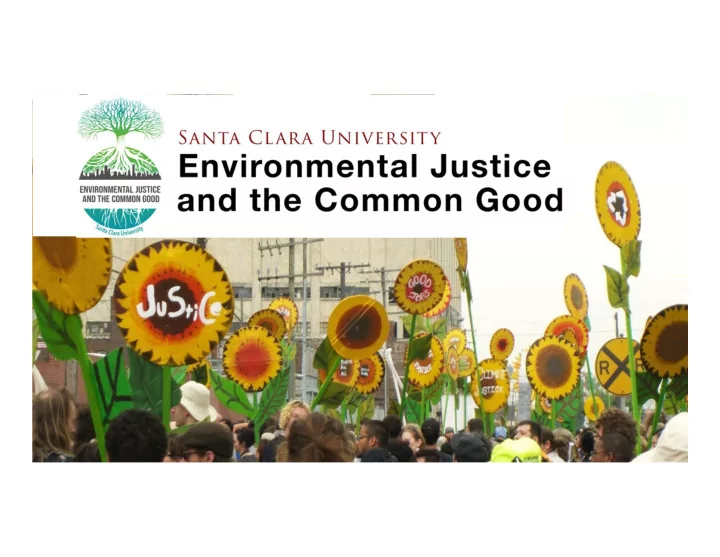
SLIDE 2
Origins Vision & Mission Community-Driven Research Environmental Justice Common Good Initial Program Areas Small Grants How Could You Connect? How Could We Support Your Work?
SLIDE 3
Ignatian Center Faculty Collaborative
ORIGINS
May 2019 Conference Integral Ecology Affinity Group Presidents’ Three- Year Commitment Laudato Si’ + SCU Conference
SLIDE 4
Conducting and fostering community-driven research for social and environmental justice
VISION
SLIDE 5 Rights of all people to healthy and livable communities, now and in the future, including fair:
- Distribution of environmental burdens and benefits
- Recognition of individual dignity and group rights, including equitable
protection against environmental harms through law, regulation, and enforcement
- Participation in environmental decision making by all who are
affected, including historically excluded groups, and consideration of future generations
ENVIRONMENTAL JUSTICE (EJ)
SLIDE 6 EJ ISSUES
- Environmental health inequities
- Occupational safety + health
- Pesticide + chemical exposure
- Access to nature + parks
- Rights of nature
- Green jobs + Green New Deal
- Safe, affordable housing
- And many more
- Indigenous land + cultural rights
- Hazardous waste siting
- Climate justice
- Energy justice + security
- Food justice + sovereignty
- Water justice + sovereignty
- Transportation justice
- Reproductive justice
SLIDE 7 EJ COMMUNITIES
- Indigenous
- People of color
- Ethnic minorities
- Low income
- Immigrants
- Women
- LGBTQ+
- Disabled
- Seniors + Youth
- Future generations
- Etc.
Neighbors, workers, consumers who are:
SLIDE 8 Emerges from collaboration among scholars/creators with community- based organizations and/or government agencies in response to community needs Partners co-design and co-conduct research as equals for mutual benefit
COMMUNITY-DRIVEN RESEARCH (CDR)
Some Examples of CDR
- Action research
- Community-based
participatory research
- Participatory action research
- Citizen science
- Community lawyering
- Community arts
- Anchor institutions
SLIDE 9
- Participatory justice includes
participating in decisions about research
- Research with (rather than on or
for) communities builds their capacities
- Increases relevance, reach, rigor,
and reflexivity of EJ research
WHY CDR FOR EJ?
“We gave birth to a conversation that people would recognize as their
- wn. We gave it a language, we gave
it words, we gave it a science base, we gave it a public policy base, and we gave it a base that was rooted in the power and mobilization of people on the ground so it couldn’t be denied.”
co-founder of West Harlem Environmental Action
SLIDE 10 Collaborating with communities to produce knowledge overcomes popular mistrust of science, academia, and government from:
- Technocratic indifference to EJ
- Authoritarian populist attacks
- n science and academia
- Disinformation spread by and
for polluters
WHY CDR FOR EJ NOW?
SLIDE 11
○ Shared & beneficial by all or most of society ○ Built and sustained through collective action
○ Science, democratic norms, the climate, clean water, and biodiversity
- How does EJ work relate to the common good?
EJ + THE COMMON GOOD
SLIDE 12
At SCU: Faculty development, funding, and networking to support research and teaching partnerships with community-based organizations that respond directly to community needs and priorities In California: Building a network to support research and teaching collaborations through partnerships among academic institutions and community-based organizations Across Jesuit Higher Education: Fostering collaborations among faculty, staff, students, and Catholic social ministry in the U.S. and around the world
MISSION
SLIDE 13 DISTINCTIVE CONTRIBUTIONS
South Bay
Strengthen EJ locally by linking academics + CBOs
Social Ministry
Strengthen links to grassroots EJ
Strengthen community- driven approach to EJ research
Jesuit Education
SLIDE 14
INITIAL PROGRAM AREAS
Food Justice Water Justice Climate Justice EJ Law & Advocacy
SLIDE 15 To support:
- Environmental justice research
- Preference for community-driven research
collaborations
- By SCU faculty/academic staff, including with
students
- Spring 2020 request for proposals
- Up to $3000 apiece in first year
- Second RFP in 2021
SMALL GRANTS PROGRAM
SLIDE 16
- How does your work connect to the
Initiative?
- How can we support your work with
professional development, resources, networking, grants?
- Any thoughts on external sources of
support we could apply for jointly?
CONNECTIONS
www.scu.edu/ej