1. Keep Possession If players chase for the ball a long time they - - PDF document

1 keep possession if players chase for the ball a long
SMART_READER_LITE
LIVE PREVIEW

1. Keep Possession If players chase for the ball a long time they - - PDF document

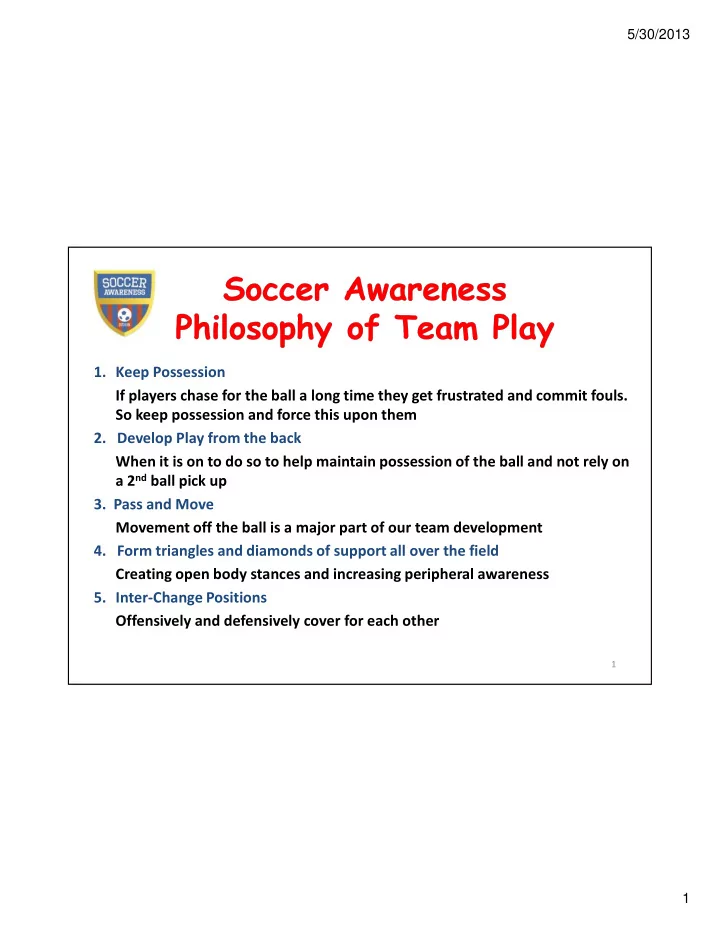
5/30/2013 1. Keep Possession If players chase for the ball a long time they get frustrated and commit fouls. So keep possession and force this upon them 2. Develop Play from the back When it is on to do so to help maintain possession of the


slide-1
SLIDE 1

5/30/2013 1

  • 1. Keep Possession

If players chase for the ball a long time they get frustrated and commit fouls. So keep possession and force this upon them

  • 2. Develop Play from the back

When it is on to do so to help maintain possession of the ball and not rely on a 2nd ball pick up

  • 3. Pass and Move

Movement off the ball is a major part of our team development

  • 4. Form triangles and diamonds of support all over the field

Creating open body stances and increasing peripheral awareness

  • 5. Inter-Change Positions

Offensively and defensively cover for each other

1

slide-2
SLIDE 2

5/30/2013 2

  • 6. Create space for your teammates; not just for yourself

Unselfish team play; Play for the TEAM

  • 7. Attacking Fullbacks using Width in Attack

Offense is the best form of defense

  • 8. Keep a very high line defensively

Squeeze opponents into their own half of the field

  • 9. Pressure opponent’s high up the field

Winning the ball back 30 yards from the opponent’s goal is better than 80 yards away

  • 10. Counter Attacking and Quick Breakaway

Developing different ways to counter attack

  • 11. You need skilful players to make this all work

We have the raw material so let’s develop them

2

slide-3
SLIDE 3

5/30/2013 3

  • 1. Setting Conditions to Force themes to happen is one way to teach.
  • 2. This would be the starting point of developing a Theme of Play.
  • 3. Once you are satisfied the players understand the Theme you are trying to

establish you can then take out the conditions and allow the players to decide where and when to effect the theme for themselves.

  • 4. Of the 10 themes; we are establishing only four in this plan of action to ensure

we don’t swamp them with too much information.

  • 5. Another time we may pick another three (or four) themes to work on.
  • 6. Ensure they are inter-related Themes.
  • 7. We are covering the following here:

A) Keep Possession B) Develop Play from the back C) Attacking Fullbacks using Width in Attack D) Forming triangles and diamonds of support all over the field

3

slide-4
SLIDE 4

5/30/2013 4

1. We use three attacking FREE ZONES to help condition the minds of the players to get into the mindset of movement off the ball and finding SPACE. 2. Defenders cannot tackle in these zones but they can shadow the attacker. 3. WE use two outside FREE ZONES IN WIDE AREAS the full length of the field to encourage conditioning the minds of the players to spread as wide as possible. 4. Defenders cannot tackle players in these wide areas but they can shadow

  • them. If you like you can say defenders cannot even enter these zones.

5. We are making them THINK: Create WIDTH; and; FIND the best SPACE to receive the ball or move a defender to allow / create for someone else some space.

4

slide-5
SLIDE 5

5/30/2013 5 8 9 6 10 4 5 1 7 2 3 11

We are trying to create triangles and diamonds of support so players can set up side on of each

  • ther. It should enable many options of support.

Attacking Phase

5

slide-6
SLIDE 6

5/30/2013 6

Using two teams of 11 players to show how the themes are established through

CONDITIONED SITUATIONS.

Free Zone for the Attacking Teams Free Zone for the Attacking Teams

Free Zone Free Zone Free Zone Free Zone Free Zone Free Zone

6

slide-7
SLIDE 7

5/30/2013 7 8 9 6 10 4 5 1 7 2 3 11

We will start with the 5 Phases of development with just one team

Free Zone for the Attacking Team Free Zone for the Attacking Team

Free Zone Free Zone Free Zone

7

slide-8
SLIDE 8

5/30/2013 8 8 9 6 10 4 5 1 7 2 3 11

This is the START POSITION team SHAPE for a 4-2-3-1

4-2-3-1 Phase One

Free Zone Free Zone Free Zone

8

slide-9
SLIDE 9

5/30/2013 9 8 9 6 10 4 5 1 7 2 3 11

This is the attacking team shape (attacking “start position”) for a 4-2-3-1. Zone 14 is the area between the opponents back three or four and their midfield. For U11, U12 and U13 to affect the minds of 7 and 11 we may call it a 4-2-1-3 so they think positive and in an attacking mode.

4-2-3-1 Phase Two

9

slide-10
SLIDE 10

5/30/2013 10 8 9 6 10 4 5 1 7 2 3 11

This is the attacking team shape now a 2-3-2-3 or 3-1-3-3 depending on the moment. This can also be the attacking team shape we change to when we are chasing a game perhaps losing 1-0 and wanting to be more positive in attack. So this now would be the start position.

2-3-2-3 Phase Three

10

slide-11
SLIDE 11

5/30/2013 11 8 9 6 10 4 5 1 7 2 3 11 Movements up front have been effected creating a diamond of support for striker 9 who becomes 7 and so on. 2-3-2-3-ish Phase Four

11

slide-12
SLIDE 12

5/30/2013 12 8 9 6 10 4 5 1 7 2 3 11

Movements up front have been effected creating a diamond of support for striker 9 who becomes 7 and so on.

2-3-2-3-ish Phase Four

12

slide-13
SLIDE 13

5/30/2013 13 8 9 6 10 4 5 1 7 2 3 11

This is the RECOVERING team SHAPE for a 4-2-3-1 which you can interpreted as a 4-4-1-1 or even a 4-5-1. The main thing is we get as many players behind the ball as possible and as quickly as possible if we cant win the ball immediately where we lose it.

4-2-3-1 Phase Five

Free Zone Free Zone Free Zone

13

slide-14
SLIDE 14

5/30/2013 14

  • 1. Have both teams do the 5 phases against and through each other.
  • 2. So they have to avoid the opponents and find space based on their

positions.

  • 3. Then stop at each phase and check the positioning of everyone.
  • 4. If a problem ask the players to solve it, don’t solve it for them.
  • 5. Now a ball each and they pass through each other; TWO SHADOW plays

at the same time going opposite directions.

  • 6. Once they get it into the striker work it back to the keeper, go to

defensive team shape and start again. Alternatively get a strike on goal and start again from the keeper.

  • 7. Challenge the players to Try to identify moments to move position

(sometimes radically, a fullback ending up as an inside forward for example) and then see if BEYOND THIS they can interchange with each

  • ther.

Start Positions for both teams

14

slide-15
SLIDE 15

5/30/2013 15

Problems to Solve

  • 1. How to get FREE AND FIND SPACE TO RECEIVE the ball and to maintain possession
  • f the ball
  • 2. How do we do this?
  • 3. Using the Thinking Process
  • 4. Players must learn to think AHEAD of the ball, to think two moves ahead in their

mind.

  • 5. So; Observation of own players positioning / Opponents positioning / SPACE

available / where the ball is in relation to all these factors.

  • 6. All done BEFORE RECEIVING THE BALL.
  • 7. Saving time doing this; Increasing time and space to play in by doing this.
  • 8. Also; POSITIONING OFF THE BALL
  • 9. Positioning to find SPACE based on their own team mates and the opponents

positioning; the position of the ball; and based on these factors: FINDING THE BEST SPACES AVAILABLE.

  • 10. Doing all of the above means: we can be successful using fewer touches on the ball.
  • 11. Doing all of the above will SAVE a touch or two on the ball; and by doing so:
  • 12. Players will: PLAY MORE QUICKLY, THINK MORE QUICKLY, MOVE MORE QUICKLY.15
slide-16
SLIDE 16

5/30/2013 16

Using Cones or Mannequins as point’s of reference

You can also use cones positioned in triangles and diamonds to give the players points of reference as to where to position, as well as using the positions of the opponents. This way the players will position as if the cones are opponents and try to find the best space based on each set of cones. So; Observation of own players positioning / Opponents positioning / SPACE available / where the ball is in relation to all these factors; and based on the cone placement also. All this as part of the THINKING PROCESS means the players will observe more deeply all the factors involved in decision making.

slide-17
SLIDE 17

5/30/2013 17 A 10 C B D 9 8

Finding the best spaces between the cones (players) Best Positioning based on the cones and the ball

slide-18
SLIDE 18

5/30/2013 18 8 9 6 10 4 5 1 7 2 3 11

Movement off the ball to Find the most space

I J H G E F D A C B k

Trying to ask questions of the defenders as to which defending player picks up which one of our team. A 3 v 2 in our favor in-front of goal.

18