( 1 ) if n < n 0 , T ( n ) = a T ( n/b ) + ( n k ) if n n 0 . - - PowerPoint PPT Presentation

1 if n n 0 t n a t n b n k if n n 0
SMART_READER_LITE
LIVE PREVIEW

( 1 ) if n < n 0 , T ( n ) = a T ( n/b ) + ( n k ) if n n 0 . - - PowerPoint PPT Presentation

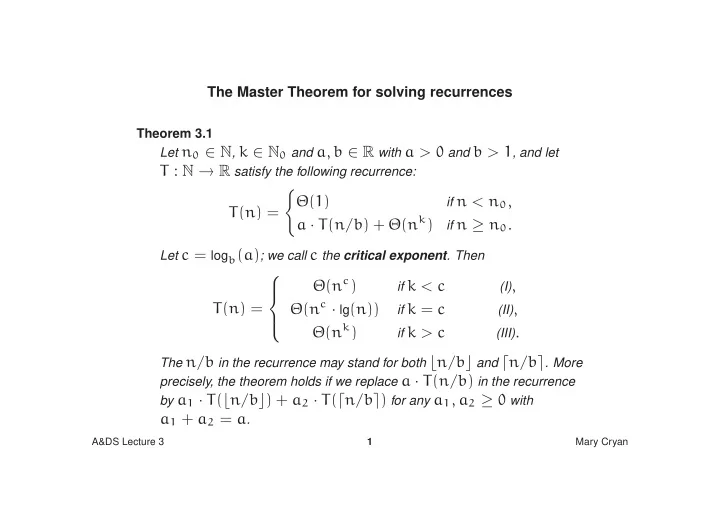
The Master Theorem for solving recurrences Theorem 3.1 Let n 0 N , k N 0 and a, b R with a > 0 and b > 1 , and let T : N R satisfy the following recurrence: ( 1 ) if n < n 0 , T ( n ) = a T ( n/b ) + ( n k )


slide-1
SLIDE 1

The Master Theorem for solving recurrences

Theorem 3.1 Let n0 ∈ N, k ∈ N0 and a, b ∈ R with a > 0 and b > 1, and let

T : N → R satisfy the following recurrence: T(n) =

  • Θ(1)

if n < n0,

a · T(n/b) + Θ(nk)

if n ≥ n0. Let c = logb(a); we call c the critical exponent. Then

T(n) =      Θ(nc)

if k < c (I),

Θ(nc · lg(n))

if k = c (II),

Θ(nk)

if k > c (III). The n/b in the recurrence may stand for both ⌊n/b⌋ and ⌈n/b⌉. More precisely, the theorem holds if we replace a · T(n/b) in the recurrence by a1 · T(⌊n/b⌋) + a2 · T(⌈n/b⌉) for any a1, a2 ≥ 0 with

a1 + a2 = a.

A&DS Lecture 3 1 Mary Cryan

slide-2
SLIDE 2

The Master Theorem (cont’d)

  • We don’t have time to prove the Master Theorem in class. You

can find the proof in Section 4.4 of [CLRS]. Section 4.4 of [CLR]. Their version of the M.T. is a bit more general than ours.

  • Homework: To get a feel for the Master Theorem, consider the

following examples:

T(n) = 4T(n/2) + n, T(n) = 4T(⌊n/2⌋) + n2, T(n) = 4T(n/2) + n3.

Use unfold-and-sum to answer the first and third of these. We solved the second one by first principles in lecture 2, and it hurt! (mostly because of the ⌊ ⌋).

A&DS Lecture 3 2 Mary Cryan

slide-3
SLIDE 3

Matrix Multiplication

Recall The product of two (n × n)-matrices

A = (aij)1≤i,j≤n

and

B = (bij)1≤i,j≤n

is the (n × n)-matrix C = AB where C = (cij)1≤i,j≤n with entries

cij =

n

  • k=1

aikbkj.

The Matrix Multiplication Problem Input: (n × n)-matrices A and B Output: the (n × n)-matrix AB

A&DS Lecture 3 3 Mary Cryan

slide-4
SLIDE 4

Matrix Multiplication

=

cij a a a b b b

i1 i2 in 1j 2j nj

row i column j

  • n multiplications and n additions for each cij.
  • there are n2 different cij entries.

A&DS Lecture 3 4 Mary Cryan

slide-5
SLIDE 5

A straightforward algorithm

Algorithm MATMULT(A, B)

  • 1. n ← number of rows of A
  • 2. for i ← 1 to n do

3.

for j ← 1 to n do

4.

cij ← 0

5.

for k ← 1 to n do

6.

cij ← cij + aik · bkj

  • 7. return C = (cij)1≤i,j≤n

Requires

Θ(n3)

arithmetic operations (additions and multiplications).

A&DS Lecture 3 5 Mary Cryan

slide-6
SLIDE 6

A naive divide-and-conquer algorithm

Observe If

A =

  • A11

A12 A21 A22

  • and

B =

  • B11

B12 B21 B22

  • for (n/2 × n/2)-submatrices Aij and Bij then

AB =

  • A11B11 + A12B21

A11B12 + A12B22 A21B11 + A22B21 A21B12 + A22B22

  • note: We are assuming n is even.

A&DS Lecture 3 6 Mary Cryan

slide-7
SLIDE 7

A naive divide-and-conquer algorithm

=

cij a a a b b b

i1 i2 in 1j 2j nj

row i

A A A A B B B B

11 12 21 22 11 21 22 12

column j

Suppose i ≤ n/2 and j ≤ n/2. Then

cij =

n

  • k=1

aikbkj =

n/2

  • k=1

aikbkj +

n

  • k=n/2+1

aikbkj ∈ A11B11 ∈ A12B21

A&DS Lecture 3 7 Mary Cryan

slide-8
SLIDE 8

A naive divide-and-conquer algorithm (cont’d)

Assume n is a power of 2. Algorithm D&C-MATMULT(A,B)

  • 1. n ← number of rows of A
  • 2. if n = 1 then return (a11b11)
  • 3. else

4.

Let Aij, Bij (for i,j = 1,2 be (n/2× n/2)-submatrices such that

A = A11 A12 A21 A22 !

and B =

B11 B12 B21 B22 !

5.

Recursively compute A11B11, A12B21, A11B12, A12B22,

A21B11, A22B21, A21B12, A22B22

6.

Compute C11 = A11B11 +A12B21, C12 = A11B12 +A12B22,

C21 = A21B11 +A22B21, C22 = A21B12 +A22B22

7.

return

C11 C12 C21 C22 !

slide-9
SLIDE 9

Analysis of D&C-MATMULT T(n) is the number of operations done by D&C-MATMULT.

  • Lines 1, 2, 3, 4, 7 require Θ(1) arithmetic operations
  • Line 5 requires 8T(n/2) arithmetic operations
  • Line 6 requires 4(n/2)2 = Θ(n2) arithmetic operations.

Remember! Size of matrices is Θ(n2), NOT Θ(n) We get the recurrence

T(n) = 8T(n/2) + Θ(n2).

Since log2(8) = 3, the Master Theorem yields

T(n) = Θ(n3).

(No improvement over MATMULT . . . why?)

A&DS Lecture 3 9 Mary Cryan

slide-10
SLIDE 10

Strassen’s algorithm (1969)

Assume n is a power of 2. Let

A =

  • A11

A12 A21 A22

  • and

B =

  • B11

B12 B21 B22

  • .

We want to compute

AB =

  • A11B11 + A12B21

A11B12 + A12B22 A21B11 + A22B21 A21B12 + A22B22

  • =
  • C11

C12 C21 C22

  • .

Strassen’s algorithm uses a trick in applying Divide-and-Conquer.

A&DS Lecture 3 10 Mary Cryan

slide-11
SLIDE 11

Strassen’s algorithm (cont’d)

Let

P1 = (A11 + A22)(B11 + B22) P2 = (A21 + A22)B11 P3 = A11(B12 − B22) P4 = A22(−B11 + B21) P5 = (A11 + A12)B22 P6 = (−A11 + A21)(B11 + B12) P7 = (A12 − A22)(B21 + B22)

(∗) Then

C11 = P1 + P4 − P5 + P7 C12 = P3 + P5 C21 = P2 + P4 C22 = P1 + P3 − P2 + P6

(∗∗)

A&DS Lecture 3 11 Mary Cryan

slide-12
SLIDE 12

Checking Strassen’s algorithm - C11

We will check the equation for C11 is correct. Strassen’s algorithm computes C11 = P1+P4−P5+P7. We have

P1 = (A11+A22)(B11+B22) = A11B11+A11B22 +A22B11 +A22B22. P4 = A22(−B11+B21) = A22B21 −A22B11. P5 = (A11+A12)B22 = A11B22+A12B22. P7 = (A12−A22)(B21+B22) = A12B21+A12B22 −A22B21 −A22B22.

Then P1+P4 = A11B11 +A11B22+A22B22+A22B21. Then P1+P4−P5 = A11B11 +A22B22+A22B21−A12B22. Then P1+P4−P5+P7 = A11B11 +A12B21, which is C11. Class exercise: check other 3 equations.

11-1

slide-13
SLIDE 13

Strassen’s algorithm (cont’d)

Crucial Observation Only 7

7 7 multiplications of (n/2 × n/2)-matrices are needed to

compute AB. Algorithm STRASSEN(A, B)

  • 1. n ← number of rows of A
  • 2. if n = 1 then return (a11b11)
  • 3. else

4.

Determine Aij and Bij for i, j = 1, 2 (as before)

5.

Compute P1, . . . , P7 as in (∗)

6.

Compute C11, C12, C21, C22 as in (∗∗)

7.

return

  • C11

C12 C21 C22

  • A&DS Lecture 3

12 Mary Cryan

slide-14
SLIDE 14

Analysis of Strassen’s algorithm

Let T(n) be the number of arithmetic operations performed by STRASSEN.

  • Lines 1 − 4 and 7 require Θ(1) arithmetic operations
  • Line 5 requires 7T(n/2) + Θ(n2) arithmetic operations
  • Line 6 requires Θ(n2) arithmetic operations. remember.

We get the recurrence

T(n) = 7T(n/2) + Θ(n2).

Since log2(7) ≈ 2.807 > 2, the Master Theorem yields

T(n) = Θ(nlog2(7)).

A&DS Lecture 3 13 Mary Cryan

slide-15
SLIDE 15

Remarks on matrix multiplication

  • The current best (for asymptotic running time) algorithm is by

Coppersmith & Winograd (1987), and has a running time of

Θ(n2.376).

  • In practice, the “school” MATMULT algorithm tends to outperform

Strassen’s algorithm, unless the matrices are huge.

  • The best known lower bound for matrix multiplication is

Ω(n2).

This is a trivial lower bound (need to look at all entries of each matrix). Amazingly, Ω(n2) is believed to be “the truth”! Open problem: Can we find a O(n2+o(1))-algorithm for Matrix Multiplication of n × n matrices?

A&DS Lecture 3 14 Mary Cryan

slide-16
SLIDE 16

Reading Assignment

[CLRS] Section 4.3 “Using the Master method” (pp. 73-75) and Section 28.2 (pp. 735-741). Corresponds to Section 4.3 (pp. 61-63) and Section 31.2 (pp. 739-745) in [CLR]. See Links from course webpage (for history).

Problems

  • 1. Exercise 4.3-2, p. 75 of [CLRS]. Ex 4.3-2, page 64 of [CLR].
  • 2. Exercise 28.2-1, p. 741 of [CLRS]. Ex 31.2-1, page 744 of [CLR].
  • 3. On page 5, I state that the “school” algorithm MATMULT has

running time Θ(n3). The O(n3) is fairly easy to see (I think! If not, ask me). Show the Ω(n3) bound for MATMULT.

A&DS Lecture 3 15 Mary Cryan