Divide and Conquer CSE 421 Algorithms Richard Anderson Lecture 12 - - PDF document

divide and conquer cse 421 algorithms
SMART_READER_LITE
LIVE PREVIEW

Divide and Conquer CSE 421 Algorithms Richard Anderson Lecture 12 - - PDF document

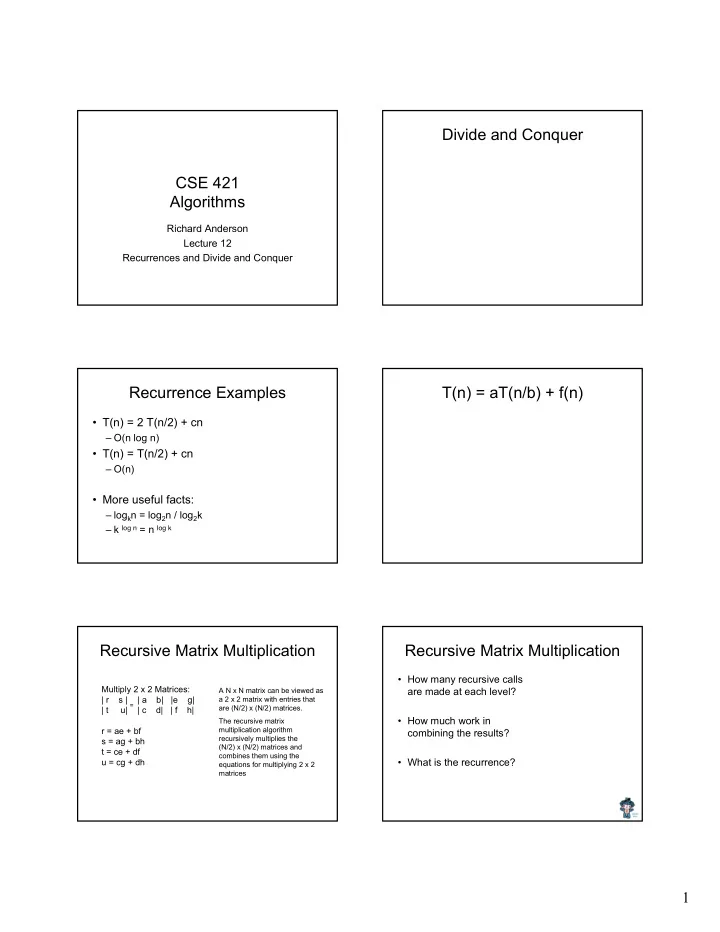
Divide and Conquer CSE 421 Algorithms Richard Anderson Lecture 12 Recurrences and Divide and Conquer Recurrence Examples T(n) = aT(n/b) + f(n) T(n) = 2 T(n/2) + cn O(n log n) T(n) = T(n/2) + cn O(n) More useful facts:


slide-1
SLIDE 1

1

CSE 421 Algorithms

Richard Anderson Lecture 12 Recurrences and Divide and Conquer

Divide and Conquer Recurrence Examples

  • T(n) = 2 T(n/2) + cn

– O(n log n)

  • T(n) = T(n/2) + cn

– O(n)

  • More useful facts:

– logkn = log2n / log2k – k log n = n log k

T(n) = aT(n/b) + f(n) Recursive Matrix Multiplication

Multiply 2 x 2 Matrices: | r s | | a b| |e g| | t u| | c d| | f h| r = ae + bf s = ag + bh t = ce + df u = cg + dh

A N x N matrix can be viewed as a 2 x 2 matrix with entries that are (N/2) x (N/2) matrices. The recursive matrix multiplication algorithm recursively multiplies the (N/2) x (N/2) matrices and combines them using the equations for multiplying 2 x 2 matrices

=

Recursive Matrix Multiplication

  • How many recursive calls

are made at each level?

  • How much work in

combining the results?

  • What is the recurrence?
slide-2
SLIDE 2

2

What is the run time for the recursive Matrix Multiplication Algorithm?

  • Recurrence:

T(n) = 4T(n/2) + cn T(n) = 2T(n/2) + n2 T(n) = 2T(n/2) + n1/2 Recurrences

  • Three basic behaviors

– Dominated by initial case – Dominated by base case – All cases equal – we care about the depth

Solve by unrolling T(n) = n + 5T(n/2)

slide-3
SLIDE 3

3

What you really need to know about recurrences

  • Work per level changes geometrically with

the level

  • Geometrically increasing (x > 1)

– The bottom level wins

  • Geometrically decreasing (x < 1)

– The top level wins

  • Balanced (x = 1)

– Equal contribution

Classify the following recurrences (Increasing, Decreasing, Balanced)

  • T(n) = n + 5T(n/8)
  • T(n) = n + 9T(n/8)
  • T(n) = n2 + 4T(n/2)
  • T(n) = n3 + 7T(n/2)
  • T(n) = n1/2 + 3T(n/4)

Strassen’s Algorithm

Multiply 2 x 2 Matrices: | r s | | a b| |e g| | t u| | c d| | f h| r = p1 + p4 – p5 + p7 s = p3 + p5 t = p2 + p5 u = p1 + p3 – p2 + p7 Where: p1 = (b + d)(f + g) p2= (c + d)e p3= a(g – h) p4= d(f – e) p5= (a – b)h p6= (c – d)(e + g) p7= (b – d)(f + h) =

Recurrence for Strassen’s Algorithms

  • T(n) = 7 T(n/2) + cn2
  • What is the runtime?

BFPRT Recurrence

  • T(n) <= T(3n/4) + T(n/5) + 20 n

What bound do you expect?