Divide-Conquer-Glue Algorithms Divide-and-conquer. Divide up - - PowerPoint PPT Presentation

divide conquer glue algorithms
SMART_READER_LITE
LIVE PREVIEW

Divide-Conquer-Glue Algorithms Divide-and-conquer. Divide up - - PowerPoint PPT Presentation

Divide-and-conquer paradigm Divide-Conquer-Glue Algorithms Divide-and-conquer. Divide up problem into several subproblems. Mergesort and Counting Inversions Solve each subproblem recursively. Combine solutions to subproblems into


slide-1
SLIDE 1

Divide-Conquer-Glue Algorithms

Mergesort and Counting Inversions Tyler Moore

CS 2123, The University of Tulsa

Some slides created by or adapted from Dr. Kevin Wayne. For more information see http://www.cs.princeton.edu/~wayne/kleinberg-tardos. Some code reused or adapted from Python Algorithms by Magnus Lie Hetland.

2

Divide-and-conquer paradigm

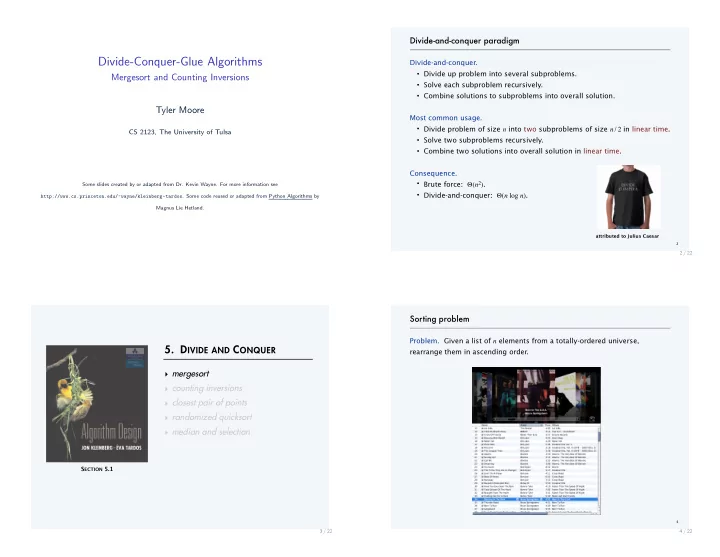
Divide-and-conquer.

・Divide up problem into several subproblems. ・Solve each subproblem recursively. ・Combine solutions to subproblems into overall solution.

Most common usage.

・Divide problem of size n into two subproblems of size n / 2 in linear time. ・Solve two subproblems recursively. ・Combine two solutions into overall solution in linear time.

Consequence.

・Brute force: Θ(n2). ・Divide-and-conquer: Θ(n log n).

attributed to Julius Caesar

2 / 22

SECTION 5.1

  • 5. DIVIDE AND CONQUER
  • mergesort
  • counting inversions
  • closest pair of points
  • randomized quicksort
  • median and selection

3 / 22

  • Problem. Given a list of n elements from a totally-ordered universe,

rearrange them in ascending order.

4

Sorting problem

4 / 22

slide-2
SLIDE 2

Obvious applications.

・Organize an MP3 library. ・Display Google PageRank results. ・List RSS news items in reverse chronological order.

Some problems become easier once elements are sorted.

・Identify statistical outliers. ・Binary search in a database. ・Remove duplicates in a mailing list.

Non-obvious applications.

・Convex hull. ・Closest pair of points. ・Interval scheduling / interval partitioning. ・Minimum spanning trees (Kruskal's algorithm). ・Scheduling to minimize maximum lateness or average completion time. ・...

5

Sorting applications

5 / 22

6

Mergesort

・Recursively sort left half. ・Recursively sort right half. ・Merge two halves to make sorted whole.

A G H I L M O R S T

merge results

A L G O R I T H M S

input

I T H M S A G L O R

sort left half

H I M S T

sort right half

A G L O R 6 / 22

7

Merging

  • Goal. Combine two sorted lists A and B into a sorted whole C.

・Scan A and B from left to right. ・Compare ai and bj. ・If ai ≤ bj, append ai to C (no larger than any remaining element in B). ・If ai > bj, append bj to C (smaller than every remaining element in A).

sorted list A 5 2

2 3 7 10 11

merge to form sorted list C

2 11

bj

17 23 3 7 10

ai

18

sorted list B

7 / 22

Canonical Divide-Conquer-Glue Algorithm

def d i v i d e a n d c o n q u e r (S , divide , glue ) : i f len (S) == 1: return S L , R = d i v i d e (S) A = d i v i d e a n d c o n q u e r (L , divide , glue ) B = d i v i d e a n d c o n q u e r (R, divide , glue ) return glue (A, B)

8 / 22

slide-3
SLIDE 3

Mergesort in Python

1 def

mergesort ( seq ) :

2

mid = len ( seq )/2 #Midpoint f o r d i v i s i o n

3

l f t , r g t = seq [ : mid ] , seq [ mid : ]

4

i f len ( l f t ) > 1 : l f t = mergesort ( l f t )#Sort by h a l v e s

5

i f len ( r g t ) > 1 : r g t = mergesort ( r g t )

6

r e s = [ ] #Merge s o r t e d h a l v e s

7

while l f t and r g t : #N e i t h e r h a l f i s empty

8

i f l f t [ −1] >= r g t [ −1]: #l f t has g r e a t e s t l a s t v a l u e

9

r e s . append ( l f t . pop ( ) ) #Append i t

10

e l s e : #r g t has g r e a t e s t l a s t v a l u e

11

r e s . append ( r g t . pop ( ) ) #Append i t

12

r e s . r e v e r s e () #R e s u l t i s backward

13

return ( l f t

  • r

r g t ) + r e s #Also add the remainder

9 / 22

How can we measure the time complexity of recursive algorithms?

Measuring the time complexity of iterative algorithms is usually straightforward: count the inputs, check for loops, etc. We know that certain operations can take linear time, constant time, logarithmic time, etc. Running those operation in a loop n times produces a multiplicative factor But how can we do this for recursive algorithms? With recurrence relations

10 / 22

Recurrence Relations

Recurrence relations specify the cost of executing recursive functions. Consider mergesort

1

Linear-time cost to divide the lists

2

Two recursive calls are made, each given half the original input

3

Linear-time cost to merge the resulting lists together

Recurrence: T(n) = 2T( n

2) + Θ(n)

Great, but how does this help us estimate the running time?

11 / 22

8

A useful recurrence relation

  • Def. T (n) = max number of compares to mergesort a list of size ≤ n.
  • Note. T (n) is monotone nondecreasing.

Mergesort recurrence.

  • Solution. T (n) is O(n log2 n).

Assorted proofs. We describe several ways to prove this recurrence. Initially we assume n is a power of 2 and replace ≤ with =. if n = 1 T ( ⎡n / 2⎤ ) + T ( ⎣n / 2⎦ ) + n

  • therwise

T(n) ≤

12 / 22

slide-4
SLIDE 4
  • Proposition. If T (n) satisfies the following recurrence, then T (n) = n log2 n.

Pf 1.

9

Divide-and-conquer recurrence: proof by recursion tree

log 2 n T(n) = n lg n n = n 2 (n/2) = n 8 (n/8) = n

T (n) 4 (n/4) = n T (n / 2) T (n / 2) T (n / 8) T (n / 8) T (n / 8) T (n / 8) T (n / 8) T (n / 8) T (n / 8) T (n / 8) T (n / 4) T (n / 4) T (n / 4) T (n / 4)

assuming n is a power of 2

if n = 1 2 T (n / 2) + n

  • therwise

T(n) =

13 / 22

10

Proof by induction

  • Proposition. If T (n) satisfies the following recurrence, then T (n) = n log2 n.

Pf 2. [by induction on n]

・Base case: when n = 1, T(1) = 0. ・Inductive hypothesis: assume T(n) = n log2 n. ・Goal: show that T(2n) = 2n log2 (2n).

assuming n is a power of 2

if n = 1 2 T (n / 2) + n

  • therwise

T(n) = T(2n) = 2 T(n) + 2n = 2 n log2 n + 2n = 2 n (log2 (2n) – 1) + 2n = 2 n log2 (2n). ▪

14 / 22

SECTION 5.3

  • 5. DIVIDE AND CONQUER
  • mergesort
  • counting inversions
  • closest pair of points
  • randomized quicksort
  • median and selection

15 / 22

13

Music site tries to match your song preferences with others.

・You rank n songs. ・Music site consults database to find people with similar tastes.

Similarity metric: number of inversions between two rankings.

・My rank: 1, 2, …, n. ・Your rank: a1, a2, …, an. ・Songs i and j are inverted if i < j, but ai > aj.

Brute force: check all Θ(n2) pairs.

Counting inversions

A B C D E me you 1 2 3 4 5 1 3 4 2 5

2 inversions: 3-2, 4-2

16 / 22

slide-5
SLIDE 5

14

Counting inversions: applications

・Voting theory. ・Collaborative filtering. ・Measuring the "sortedness" of an array. ・Sensitivity analysis of Google's ranking function. ・Rank aggregation for meta-searching on the Web. ・Nonparametric statistics (e.g., Kendall's tau distance).

ABSTRACT

Rank Aggregation Methods for the Web

Cynthia Dwork Ravi Kumar Moni Naor

  • D. Sivakumar

17 / 22

15

Counting inversions: divide-and-conquer

・Divide: separate list into two halves A and B. ・Conquer: recursively count inversions in each list. ・Combine: count inversions (a, b) with a ∈ A and b ∈ B. ・Return sum of three counts.

1 5 4 8 10 2 6 9 3 7

input

  • utput 1 + 3 + 13 = 17

count inversions in left half A 5-4

1 5 4 8 10 2 6 9 3 7

6-3 9-3 9-7 count inversions in right half B count inversions (a, b) with a ∈ A and b ∈ B 4-2 4-3 5-2 5-3 8-2 8-3 8-6 8-7 10-2 10-3 10-6 10-7 10-9

2 6 9 3 7 1 5 4 8 10 18 / 22

  • Q. How to count inversions (a, b) with a ∈ A and b ∈ B?
  • A. Easy if A and B are sorted!

Warmup algorithm.

・Sort A and B. ・For each element b ∈ B,

  • binary search in A to find how elements in A are greater than b.

16

Counting inversions: how to combine two subproblems?

2 11 16 17 23

sort A

3 7 10 14 18

sort B binary search to count inversions (a, b) with a ∈ A and b ∈ B 5 2 1 1

2 11 16 17 23 3 7 10 14 18 17 23 2 11 16

list A

7 10 18 3 14

list B

19 / 22

Count inversions (a, b) with a ∈ A and b ∈ B, assuming A and B are sorted.

・Scan A and B from left to right. ・Compare ai and bj. ・If ai < bj, then ai is not inverted with any element left in B. ・If ai > bj, then bj is inverted with every element left in A. ・Append smaller element to sorted list C.

17

Counting inversions: how to combine two subproblems?

count inversions (a, b) with a ∈ A and b ∈ B 5 2

2 3 7 10 11

merge to form sorted list C

2 11

bj

17 23 3 7 10

ai

18 20 / 22

slide-6
SLIDE 6

18

Counting inversions: divide-and-conquer algorithm implementation

  • Input. List L.
  • Output. Number of inversions in L and sorted list of elements L'.

SORT-AND-COUNT (L)

_________________________________________________________________________________________________________________________________________________________________________________________________________________________________________________________________________________________________________________________________________________________________________________________________________________________________________________________________________________________________________________________________________________________________________________________________________________________________________________________________________________________________________________________________________________________________________________________________________________________________________________________________________________________________________________________________

IF list L has one element RETURN (0, L). DIVIDE the list into two halves A and B. (rA , A) ← SORT-AND-COUNT(A). (rB , B) ← SORT-AND-COUNT(B). (rAB , L') ← MERGE-AND-COUNT(A, B). RETURN (rA + rB + rAB , L').

_________________________________________________________________________________________________________________________________________________________________________________________________________________________________________________________________________________________________________________________________________________________________________________________________________________________________________________________________________________________________________________________________________________________________________________________________________________________________________________________________________________________________________________________________________________________________________________________________________________________________________________________________________________________________________________________________

21 / 22

19

Counting inversions: divide-and-conquer algorithm analysis

  • Proposition. The sort-and-count algorithm counts the number of inversions

in a permutation of size n in O(n log n) time.

  • Pf. The worst-case running time T(n) satisfies the recurrence:

Θ(1) if n = 1 T ( ⎡n / 2⎤ ) + T ( ⎣n / 2⎦ ) + Θ(n)

  • therwise

T(n) =

22 / 22