1. (3 points) Jay owns a bakery to bake cheesecakes and Black Forest - - PowerPoint PPT Presentation

1 3 points jay owns a bakery to bake cheesecakes and
SMART_READER_LITE
LIVE PREVIEW

1. (3 points) Jay owns a bakery to bake cheesecakes and Black Forest - - PowerPoint PPT Presentation

Operations Research, Spring 2017 Lecture 4: Applications of Linear Programming Instructor: Ling-Chieh Kung Department of Information Management National Taiwan University 1. (3 points) Jay owns a bakery to bake cheesecakes and Black Forest


slide-1
SLIDE 1

Operations Research, Spring 2017 Lecture 4: Applications of Linear Programming

Instructor: Ling-Chieh Kung Department of Information Management National Taiwan University

  • 1. (3 points) Jay owns a bakery to bake cheesecakes and Black Forest
  • cakes. During any day, he can bake at most 60 cakes. The costs

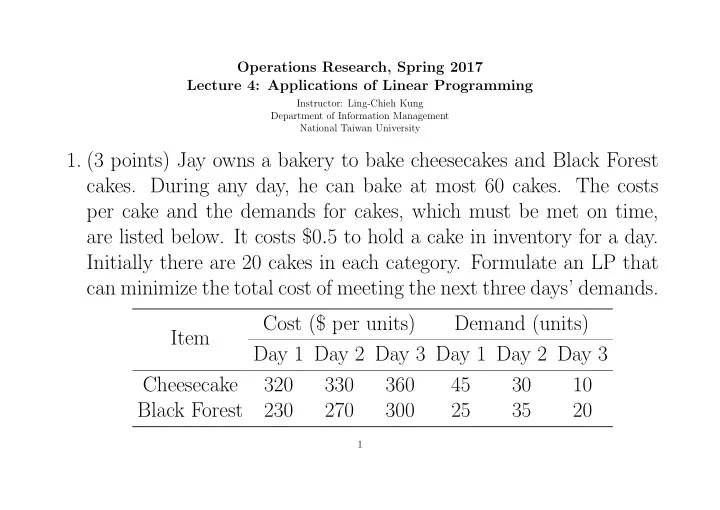
per cake and the demands for cakes, which must be met on time, are listed below. It costs $0.5 to hold a cake in inventory for a day. Initially there are 20 cakes in each category. Formulate an LP that can minimize the total cost of meeting the next three days’ demands. Item Cost ($ per units) Demand (units) Day 1 Day 2 Day 3 Day 1 Day 2 Day 3 Cheesecake 320 330 360 45 30 10 Black Forest 230 270 300 25 35 20

1

slide-2
SLIDE 2
  • 2. (3 points) John produces the drug MMS from four chemicals. Today

he must produce EXACTLY 1,000 lb of the drug. The three active ingredients in MMS are A, B, and C. By weight, at least 5% of MMS must be A, at least 4% must be B, and at least 2% must be C. The cost per pound and the amount of each active ingredient in 1 lb of each chemical are given below. At least 100 lb of chemical 2 be used. Formulate an LP whose solution would determine the cheapest way

  • f producing today’s batch of MMS.

Chemical Cost ($ per lb) A B C 1 8 .04 .02 .01 2 12 .06 .05 .01 3 13 .10 .03 .03 4 15 .11 .09 .04

2

slide-3
SLIDE 3
  • 3. (3 points) Each day, police officers at the IEDO City Police Depart-

ment work two 6-hour shifts: midnight–6am, 6am–noon, noon-6pm, and 6pm–midnight. The following number of officers are needed during each shift: for midnight–6am, 12 workers; for 6am–noon, 6 workers; for noon–6pm, 14 workers; for 6pm–midnight, 17 workers. Officers whose two shifts are consecutive are paid $800 per hour; those whose shifts are not consecutive are paid $1000 per hour. For- mulate an LP that can be used to minimize the cost of meeting the daily workforce demands of the IEDO City Police Department.

3

slide-4
SLIDE 4
  • 4. (3 points) The IEDO City Police Department employs 30 police of-
  • ficers. Each officer works 5 days per week. The crime rate fluctuates

with the day of the week, so the number of police officers required each day depends on which day of the week it is: Saturday, 25; Sunday, 16; Monday, 12; Tuesday, 20; Wednesday, 18; Thursday, 22; Friday, 25. The police department wants to schedule police of- ficers to minimize the number whose days off are NOT consecutive. Formulate an LP that will accomplish this goal.

  • Hint. Seven decision variable are not enough because there are

more than seven ways to assign an officer to five unnecessarily con- secutive days. How many possible ways do you have?

4

slide-5
SLIDE 5
  • 5. (3 points) Linearize

min 3|x2 − 5| s.t. x1 + 2x2 ≥ max{x1 + x2, 5} 2x1 + 3x2 = 4 xi ≥ 0 ∀ i = 1, 2.

5

slide-6
SLIDE 6
  • 6. A firm produces a product for the following T periods. In period t,

t = 1, ..., T, the unit production cost is Ct, the production capacity is Kt, the demand quantity (i.e., the maximum number of products that can be sold) is Dt, and the sales price is Pt. Unsold products can be stored for future sales at a holding cost H per unit per period. (a) (3 points) Suppose that all demands must be satisfied in time. Formulate an LP that can find a profit-maximizing plan. (b) (3 points) Suppose that demands need not to be satisfied in time, and unfulfilled demands will be lost. Formulate an LP that can find a profit-maximizing plan.

6

slide-7
SLIDE 7
  • 7. (3 points) A firm produces a product for the following T periods. In

period t, t = 1, ..., T, the unit production cost is Ct, the production capacity is Kt, the demand quantity is Dt, and the sales price is Pt. Unsold products can be stored for future sales at a holding cost H per unit per period. Suppose that demands need not to be satisfied in time, and unful- filled demands will be backlogged to be satisfied in the future. Each unit of backlogged demand incurs a shortage cost S per period de-

  • layed. Suppose that if a period-t demand is fulfilled at period k > t,

the sales revenue is Pt, not Pk. All demands must be fulfilled at the end of period T. Formulate an LP that can find a profit-maximizing plan.

7

slide-8
SLIDE 8
  • 8. (3 points) The IEDO county is trying to determine where to place
  • ne fire station. The locations of the county’s six major towns are

given in the following coordinates measured in kilometers. City 1: (20, 20); city 2: (60, 10); city 3: (40, 30); city 4: (40, 60); city 5: (30, 0); city 6: (10, 70). City 1 has in average 20 fires per year. For cities 2 to 6, the average numbers of fires are 30, 50, 20, 15, and 25,

  • respectively. The county wants to minimizes the average “distance

to travel.” Because in the county roads all run in either an east-west

  • r a north-south direction, we use Manhattan distances rather than

Euclidean distances. For example, if the fire station were located at (50, 40) and a fire occurred at city 4, the “distance to travel” is |50 − 40| + |40 − 60| = 30 kilometers. Formulate an LP that can determine where the fire station should be located.

8