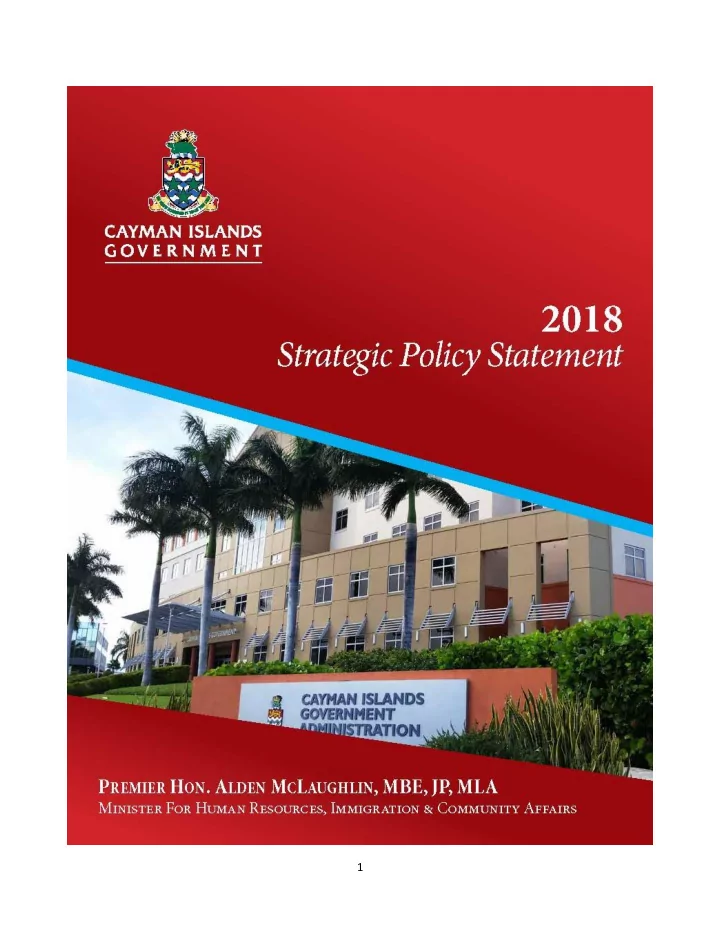
1 23 August, 2017 Mr. Speaker, this Motion seeks the approval of - - PDF document

1 23 august 2017 mr speaker this motion seeks the
SMART_READER_LITE
LIVE PREVIEW

1 23 August, 2017 Mr. Speaker, this Motion seeks the approval of - - PDF document

1 23 August, 2017 Mr. Speaker, this Motion seeks the approval of this Honourable House for the Governments 2018 -19 Strategic Policy Statement, which the Minister of Finance and Economic Development has just tabled. I would like to start by


slide-1
SLIDE 1

1

slide-2
SLIDE 2

2

23 August, 2017

  • Mr. Speaker, this Motion seeks the approval of this Honourable House for the

Government’s 2018-19 Strategic Policy Statement, which the Minister of Finance and Economic Development has just tabled. I would like to start by congratulating him for his excellent introduction to his first Strategic Policy Statement and I would like to thank him and his team in the Ministry, in particular the Financial Secretary and his team, which coordinated the production of the statement. This Strategic Policy Statement fulfils its statutory requirement to set out my Administration’s key fiscal priorities and our broad strategic outcome objectives for the Cayman Islands. It also puts forth the Government’s financial targets for the next three financial years, covering in more detail for the first time, a two- year period, 1st January, 2018, to 31st December, 2019. However, this exercise is more than simply about meeting our statutory

  • bligations. This SPS gives me the first formal chance to set out the programme of

the new Government of National Unity, which came together following last May’s election. A great deal of work has gone in to shaping this programme and I want to thank all Members in the coalition for their contributions. I said this is a government of national unity in which all views are valued and respected. I am pleased to report

  • Mr. Speaker that my colleagues on the government benches have taken me at my

word and they were certainly robust in the views expressed as we debated our priorities. This Government’s programme is stronger as a result of the vigorous nature of

  • ur discussions. It is a programme that is more ambitious for the challenges we

presented to each other in our debates. It is a programme we are confident can be delivered because of the way we have brought the civil service into our deliberations.

slide-3
SLIDE 3

3

Before I set out that programme, I hope you will indulge me, Mr. Speaker, if I digress slightly to offer the House four things that have shaped my own thinking in the last few months. The first is a feeling of humility. I am very conscious, Mr. Speaker, that I am the first Premier in our modern political history to serve a full term and then to form a second, consecutive Administration. I do not take the support of our people for

  • granted. While they elected the Progressives as the largest party in May’s

election, we were not elected as a majority government. That is why a coalition of national unity was not only necessary but also underlines the need to remain in touch with and responsive to the views of Caymanians over the next four years. In accepting the role of Premier for a second time, I realise I am taking on a great

  • responsibility. I do not believe the office of Premier is about self-promotion.

Rather, it is about service and I will continue to do all that I can to serve the people of these Islands to the best of my ability. The second thought I wanted to offer the House is that this is a time of real

  • pportunity for the Cayman Islands. Of course, there are challenges ahead and I

do not underestimate the potential of both man-made and natural disasters to knock us off course. However, I believe there are real grounds for optimism about

  • ur future and for belief that we as a people can come together and move

forward with confidence. My third reflection has been that if we are to take advantage of our opportunities we need to be more ambitious. In particular, as a Government, we need to go well beyond what has been done before, from improvements in the quality of our public services through to our approach in economic growth. We need to challenge the status quo and set stretching goals that will lead to real improvements in the quality of life for our people. My final, and perhaps most important, thought is that it is all very well to be humble and willing to serve, to recognise opportunity, and to be ambitious. However, all that is for nought if nothing different happens.

slide-4
SLIDE 4

4

I am proud of what the last Progressives-led Administration achieved. However, there were certainly times I felt the frustration of delay and inaction within the machinery that is Government. Let me be clear, I have learned from that

  • experience. As the House will know, I cannot serve, nor do I wish to serve, a third

consecutive term as Premier. So I will be going flat out to push for delivery of our priorities in the next 3 and a 1/2 years. To borrow an American sporting expression, Mr. Speaker, I will be leaving everything on the field. The crucial difference in this Administration’s approach must be that we create and sustain a consistent and constant culture of delivery. Mr. Speaker, our people have every right to expect that the promises we made as we campaigned for the election will now be delivered. In turn we will have set an expectation of delivery across Government to ensure that our people’s expectations are met. I thank the Deputy Governor and his chief

  • fficers for their willingness to embrace the challenges we are giving them.

An expectation of delivery first requires us to be clear on our intentions. The final expression of that will be the budget we will bring to this House in a couple of months’ time. Our intention is that the budget will not only be balanced and fully compliant with the requirements of prudent financial management, but that it will allocate resources to the political priorities we have promised to deliver. This Strategic Policy Statement creates the framework for that to happen. The work that has been done within the Government Caucus over the last few months has identified eight strategic objectives that are set out in the SPS that the Honourable Minister has just introduced. Under each of those objectives, Caucus has set out its ambitions for delivery and prioritised actions to be achieved in the coming two-year period the budget will cover. One reflection I will offer, if I may, Mr. Speaker, is that the eight strategic

  • bjectives were fairly readily agreed by all Members of the coalition. In our

various ways, we had all proposed similar themes during the election campaign that we found could be brought together to form a cohesive Government

  • programme. There was great discussion over how those objectives should be

achieved and over which possible actions should be prioritised. But as I have said

slide-5
SLIDE 5

5

before, one of the strengths of a working coalition is that this kind of debate can create a strong programme that will benefit Caymanian families and businesses. Throughout my political career, I have made the achievement of economic growth central to my thinking about the role of government. Put very simply, in our three small Islands, unless we secure economic growth, we have no chance of achieving anything else. I recall well former legislators who sat in this Hallowed Chamber stating that the only true independence is economic independence. They understood that economic growth is necessary to create the revenues that allow Government to pursue its objectives and ambitions for our Islands and our people. It is unsurprising then that the first strategic objective in the SPS focuses on a strong economy to help families and businesses. Central to that objective is action to enhance our key economic sectors of financial services and sustainable

  • tourism. In particular, we will drive the completion of the key infrastructure

projects begun in the last term – a modern landfill and waste to energy plant, the redevelopment of Owen Roberts International Airport, the delivery of a modern cruise pier and cargo dock, and the revitalisation of George Town. We will continue our partnership with the financial services sector, including Cayman Finance, to not only improve and market our financial services products, but to also defend our financial services business as and when needed. The challenges in this respect never go away. But we will defend our Islands and our way of living at home and abroad, just as I did last term at Chatham House, and

  • n BBC’s Hardtalk, at the Anti-corruption Summit and at the FCO in London. And

as you Mr. Speaker as the former Finance Services Minister also did in London, New York, Washington and Brussels. Indeed, Mr. Speaker the current Financial Services Minister and I will visit Brussels and the UK next month as we continue to fight off the newest round of challenges. Diplomacy and standing firm are both necessary – but so is relationship building. To this end I am pleased to say that the London Office, under the able leadership of Mr. Eric Bush, is doing an extremely good job in rebuilding and improving relationships across Westminster. And it is paying dividends. An example of this is the recent re-formation of the

slide-6
SLIDE 6

6

Cayman Islands All Party Parliamentary Group at Westminster whose members have been actively giving our Islands even more prominence in London. The Financial Services sector faces challenges but it continues to do well and we will continue to provide the support needed to ensure that it continues to thrive. We will also ensure that our Tourism Industry continues to grow from strength to

  • strength. Tourist arrivals increased significantly over the past four years and

remain robust. And they are expected to remain so in the coming years. In response to this, there are several new hotel projects planned that will cater to the increasing demand for room stock. The Owen Roberts Airport renovation project is well under way and when completed in early 2019 will readily serve increasing visitor air arrivals. To ensure we are prepared to meet the challenges and opportunities of a growing tourism market we will fully implement the new five-year National Tourism Plan in 2018 – work on which was started in October 2016. We will also continue to support Cayman Airways. The National Carrier is a key partner in helping drive our tourism product by bringing us tourists and opening new gateways and markets. As such, it is important to our economy and employs more than 300 Caymanians. Work to provide a modern cruise berthing facility and an enlarged cargo port has also been progressing, in particular in the redesign of the piers to dramatically reduce dredging and impact on the environment. Preliminary designs and cost estimations are complete. Prequalification of bidders and negotiations with cruise lines are ongoing as well as is the preparation of bid documents, with a projected tender issue date at the end of September 2017. It is worth noting that this project includes an enlarged modern cargo facility, which is key to our ongoing economic development. The ability to accept larger ships will reduce shipping costs and consequently reduce the cost of goods bought locally. It will also allow fresh fruit and produce to be brought in directly from Central America by ships that now bypass us by for Florida. And as reported recently in the Journal newspaper, the Port Authority is receiving considerable interest from shipping companies that not only want to bring their larger ships

slide-7
SLIDE 7

7

here, but have indicated that Grand Cayman could be a transhipment port for perishable cargo out of Central America. We will see how this develops, but at the moment the potential is certainly welcomed and will be pursued. Part of our tourism strategy includes the revitalisation of George Town. And so the work on the George Town Revitalisation project will move past the phase one roadbuilding stage and, starting in 2018, other aspects of the project will be introduced, including making George Town more tourist friendly. I will speak in greater detail about this when the budget comes to the House. In terms of the

  • ngoing roadworks, I believe that the public is already seeing the benefit of the

work done to date. And I wish to remind Honourable Members and the public that this work is being done not with borrowing, but from cash surpluses. Indeed, this Government, like the last Administration, continues to operate from a cash position for both operational and capital commitments. We recognise, though, that the strategy of support for our twin economic pillars creates two challenges. The first is that growth is too often centred on George Town and West Bay Road. The second is the vulnerability of our economy to shocks in either or both of the pillar industries. This Government will act to mitigate those challenges by implementing an idea set out by our coalition partners - to develop and implement area economic growth plans to secure the geographical rebalancing of our economy and sector growth plans aimed at economic diversification. Before anyone misinterprets what the economic growth plans might be about, let me be clear. This is not an attempt to recreate Stalinist economic planning in the Cayman Islands. Rather it is about government using its economic levers, from duty concessions to planning rules, to support our economy to grow in ways that are sustainable in the long term and spread benefits to families and businesses across our Islands. It is also about encouraging and assisting, where possible, growth in new and emerging sectors. Medical Tourism, conference tourism, technology and Special Economic Zones are some areas with potential. And if all goes well it may include cargo transhipment as mentioned earlier.

slide-8
SLIDE 8

8

Another crucial part of our economy is the small business sector. This Government will act to ensure it is easier to set up and grow your own business in Cayman, especially for Caymanians. We wish to see a sensible drive for practical deregulation and we are willing to work with business to cut unnecessary red

  • tape. We will seek opportunities to continue the work of last term and further

ease the burden of duties and fees on small business where possible and will do what we can to support easier access to affordable funding. We will also work with the Small Business Association to introduce a Small Business Development centre to assist with training and help for small businesses to start up and be successful. An essential economic sector for our Islands remains agriculture. Here the Government will continue to support farmers and encourage the adoption of modern farming techniques to improve both quality and yields. This makes sense for our economy and enhances our food security. As a farmer myself I would add that farming, though hard work, can provide a pretty decent livelihood. But whilst we appreciate that a strong economy is a key objective, we also acknowledge that all Caymanians should benefit from this economy. A growing economy naturally creates more jobs and offers more opportunities for Caymanians to benefit, but not all will benefit in the same way. There are things Government can do directly to help improve the standard of living for all. We will review the minimum wage to ensure it is keeping pace with inflation. Mr. Speaker, not only was this a campaign promise of the Progressives, but it is necessary to ensure that the minimum wage remains relevant to the people it is intended to help. We, and Mr. Speaker I include you and others in the Coalition Government, also campaigned on providing added assistance to those in need – but doing so in a responsible and sustainable manner. There is an expression that a rising tide lifts all boats – and indeed it does. But as Rahul Ghandi once noted, a rising tide does not lift those people who do not have boats. And so as the economy grows and benefits the majority, we need to ensure that we do not forget those who need a helping hand. So, I am happy to advise the members opposite that the

slide-9
SLIDE 9

9

Government will be fulfilling the promises made during the election campaign concerning improvements to social service assistance. Firstly, we will increase the ex-gratia ‘poor relief’ payments made to Caymanians who are challenged to provide for themselves – either because of physical disability, advanced age, or mental incapacity. Presently they receive a stipend of $550 per month and we will increase this to $650 monthly from January 2018 and then to $750 in January 2019. I would add that we were initially looking to provide a higher amount - but an additional $1,200 per year per person is what was found to be affordable and sustainable Mr. Speaker. However, it is worthwhile noting that Government also assists these individuals in many other ways – with medical costs, utilities, and other benefits as well. In this financial year alone some $125M will be spent on social services needs.

  • Mr. Speaker we will also provide an increase to the Seamen’s and Veteran’s ex-

gratia grant similar to what was just outlined for poor persons’ relief – from $550 monthly to $650 in January 2018 and to $750 in January 2019. Many of our elderly seafarers have no pension and rely every month on this stipend. I know

  • Mr. Speaker this is something you campaigned on and I am glad that we have

been able to provide an increase – albeit not to the level you sought. But again as we start to get into the next budget review we will look at this again for the 2020 and 2021 budget. And I will point out that Government does also provide health insurance for seamen and veterans – so the assistance provided is much more than the ex-gratia payment. And, Mr. Speaker, we also promised to assist civil service pensioners who served

  • ur country for many years but who are now retired in Cayman and receive a sum

that is less - in some cases far less - than what is provided for poor relief. We promised during the election campaign to correct this and so the next budget will provide an additional ex-gratia stipend to supplement the pension for retired civil servants with more than 10 years’ tenure, and who reside in the Cayman Islands. The aim is to ensure that they receive a combined sum (pension and ex-gratia payment) that is no less than paid for ‘poor relief’ payments noted previously –

slide-10
SLIDE 10

10

that is a minimum sum of $650 per month from January 2018 and $750 from January 2019. In this SPS we have not accounted for any specific reduction to government duties and fees, but neither are we looking to increase duties. As the Minister of Finance indicated, we will continue the major stimulus policies introduced during the last

  • Administration. These include reduced import duties, lower business licensing

fees, development concessions and support to small business as well as initiatives to improve diversification of our economy and employment of our people. We will seek to ensure consumers receive fair pricing in potentially uncompetitive markets - starting with the fuel market as was begun by the last Administration. And so one of the main objectives of the Utility Regulation and Competition Office will be to quickly complete the work needed to ensure fair pricing and competitiveness at the gas pump. We have recognised there are particular issues in the affordable housing market. We will encourage private sector investment in affordable housing through import duty reductions and allow homes to be built on smaller lots. In addition, we will extend the Guaranteed Home Assisted Mortgage programme so that banks can more readily lend Caymanians money to purchase these affordable homes. Ronald Reagan once commented that the best social work programme is a good

  • job. I agree - the biggest single contribution to ensuring a decent standard of

living is employment. So our second strategic objective is to improve the functioning of the labour market to ensure all Caymanians can find employment. Our commitment to full employment does not mean everyone is employed all the

  • time. There are short term economic fluctuations in construction and tourism, for

example, which means many people face short periods of unemployment. However, there is no reason for short term fluctuations to become a long term problems. Caymanians wishing to work should be able to access employment and should not be disadvantaged in the labour market. The Government in the short term will act to make changes to immigration regulations to improve the fairness and

slide-11
SLIDE 11

11

transparency of job advertising. In the longer term, we are establishing the new Human Resources Department to take on the labour, pensions, and work permits functions and to give government the strategic oversight and planning of future human resource requirements. If the strengthening of regulations and their enforcement is required, we will not hesitate to act. This is not all a one-way street. Many businesses actively hire and develop Caymanians and we will put in place a system to recognise and reward those

  • businesses. The further development of the National Jobs Clearing House will

improve the transparency of the work permits process and ultimately make things easier for business and job-seekers alike as all available jobs will be required to be listed there. Work on this was started by the last Administration and will be completed in 2018. The Cayman success story has been built on the ability of businesses to not only hire and train Caymanians, but also to bring in guest workers to ensure that we have the resources and expertise to grow the economy. As we allow individuals to come and live and work with us, we need to accept that many of them will remain and become Caymanians and have families, children and grandchildren who will become part of the Caymanian fabric. This is how we have grown and how we will continue to develop and build our country. But we must strike the right balance to ensure that the immigration and work permit systems work more efficiently and are more transparent and fair to those seeking employment, including Caymanians and those wanting to become Permanent Residents. And so we will improve the Immigration Law and points system to try to get this balance right. Still, some Caymanians need more help to access the labour market. In our last term, Ready2work.Ky was a successful partnership between business and government aimed at supporting such individuals into work. During the pilot of the Ready2Work.Ky programme, assistance was provided to 137 Caymanians who had difficulty keeping employment. When the pilot programme ended, 89 individuals had completed the programme; 64 of which obtained employment

slide-12
SLIDE 12

12

and 25 who were engaged in ongoing training, development and recruitment activities. Government will extend Ready2Work.Ky in this budget cycle and develop new work programmes as necessary to make Caymanians who need extra help work- ready and successful in the workplace. We will also look at how best to work with the private sector to provide more apprenticeship programmes and other work based training for Caymanians. Work programmes though are a short-term necessity; not a long-term strategy. The key in the longer term is that the Caymanian workforce has the level of education and skills needed in the increasingly globally competitive marketplace. Education was raised as a key concern by both parents and young people during the election campaign. We have heard directly from businesses about the current and future requirements needed for their workers. Our third strategic objective is therefore to ensure that we give the best educational opportunities to all our children. Great education is about the quality of teaching and learning. It reflects strong and able leadership of schools and is underpinned by the quality of the learning

  • environment. It is seen in the results young people achieve and in their future

desire to learn that they take with them into work. As the provider of public education, the Government has an absolute responsibility to support our young people to develop themselves, to help nurture their hopes and ambitions, and ultimately to enable them to achieve all that they strive for. This government will not shirk from that responsibility. We need to get the basics right. Students in public schools must have the right materials and supplies. Schools themselves must have appropriate equipment and facilities. In this SPS we have budgeted an additional $18M to cover special education; enhancing science, literacy and math; additional teachers as well as skills upgrading for 400 teachers and assistants; and for scholarships and youth programmes.

slide-13
SLIDE 13

13

In addition, on the capital side we have included some $56M for computer software and equipment, and needed improvements at Savannah Primary, Bodden Town Primary, and Red Bay Primary. This also includes funding to start the initial planning work for a new West Bay Primary School as well as complete the new John Gray High School. Across public schools we are developing plans to expand the use of technology to assist teaching and learning. I believe that with this continued focus and investment the country will appreciate how committed we are to provide our children with the best education possible. The new Education Law passed by the last Administration devolves greater authority to schools for their own management and decision-

  • making. In return, we will not hesitate to hold principals and teachers to account

for their performance. We will judge that performance partly in traditional academic terms. We will work with schools to focus on achieving higher standards of attainment, particularly in literacy, numeracy and science. However, for many students - and to meet the needs of our economy - that drive for academic improvement needs to go hand in hand with the expansion of high quality technical and vocational education and skills. By expansion I not only mean programmes and courses, but also expanding the opportunities for youngsters to be exposed to Trade and Vocational Education Training and, where appropriate, encourage them to consider further TVET training locally or overseas. This encouragement should come from the home as well as the school. And so we will ensure that schools’ guidance counsellors also point youngsters to the kind of vocational careers where TVET provides the right training ground. For many of our young people, training and accomplishment in a trade can bring with it a good livelihood as well as employment security for a lifetime. The vast majority of the work permits issued are in the trades – this is because in modern times our people have shied away from the trades including the tourism and construction fields. And in part because of this general lack of interest, TVET courses have suffered from the development of single purpose initiatives and uncoordinated activity. Contrary to what many believe and say, there are a significant number of TVET

slide-14
SLIDE 14

14

programmes available throughout the public and private sectors. In the coming months we will audit the current provision of programmes available and bring forward a coherent strategy to better utilise these programmes. And we will dialogue with private sector to determine what their needs are regarding trained

  • employees. With limited resources, we must ensure that quality available

programmes are fully utilised and supported to avoid spending funds unnecessarily and duplicating efforts. We must ensure that we are providing training in the jobs employers need filled.

  • Mr. Speaker, the House should not be under any illusion about the priority we will

attach to acting on the results of the TVET review. So much so that we will be making a clear commitment by setting a target for at least 75 per cent of high school graduates to move on to post-secondary education or training, locally or

  • verseas, by the end of this term. This represents a significant challenge but one

to which we are determined to rise.

  • Mr. Speaker, this Government is also determined to improve the life chances of

students with special needs. We will ensure that schools have facilities appropriate to meet the needs of this cohort of learners and that teachers have the necessary training. It is vital that there is an effective partnership between the schools and parents to create the right environment for special needs students. We will encourage the creation of new support mechanisms for parents that facilitate that partnership. When education does not deliver for young people, when people cannot get work and the benefits of growth are not felt by all in society, and when some in

  • ur society feel left behind, it creates divisions in our communities and the

conditions that foster criminality. We were left in no doubt talking to voters at the election that crime has become a real concern right across the Cayman Islands. And only recently I attended a residents’ meeting in Central Scranton Park and again heard directly about the crime issues facing that community. And so our fourth strategic objective is to reduce crime and the fear of crime.

slide-15
SLIDE 15

15

For many, the prime concern has become violent crime, too often involving guns and too often arising out of gangs and drugs issues. Others express concerns about what happens in their community in terms of “nuisance” crime – everything from petty theft, illegal motorcycles and speeding vehicles. The immediate response has to be more effective policing. My Government has met with and received the requests from the Police Commissioner for new resources to tackle crime on our streets, particularly planned investment in community policing. I will note now that we were not able to entirely meet his requests as the costs exceeded the available funding. But we also had concerns with the request to increase the officer count by a significant number - requiring

  • verseas recruitment - without sight of an overall plan of action. That

notwithstanding, we are committed to providing a substantial number of new

  • fficers – 75 over the next three years together with added civil service support
  • staff. We campaigned on the need for improvements to community policing and I

was heartened that the Commissioner is of the same view and this is one of his priority areas. That said, I have asked that he look into utilising a community warden approach, as has been used in the United Kingdom and elsewhere, to enhance the community policing efforts rather than police constables who may be better utilised solving crimes. I was encouraged that he has agreed to look at

  • this. The community warden approach has the benefit of not only utilising a

suitable person who will know the people in the communities served, but importantly they will know and trust him or her. Community wardens need to be trained to understand aspects of the law and some policing methods; but do not have to fulfil the requirements of a trained police officer. Indeed, there may be former police officers who, though retired, are still fit enough to serve in a warden capacity. We are also committing additional funding on the capital side to bolster coastal defence, including creating a Coast Guard Unit; purchasing new police vehicles and tactical firearms assets; and to provide significant enhancements to border control at our airports. We will also start the work on requirements for building a new West Bay Police Station and a new George Town Police Headquarters; both

  • f which are badly needed.
slide-16
SLIDE 16

16

However, in line with my earlier point on creating a culture of delivery, we will not only provide additional resources to the RCIPS but we will also insist that resources are used as agreed and will hold the Commissioner to account for the

  • results. This will mean creating new approaches that foster accountability and

enhance the responsiveness of the RCIPS to the people’s concerns. Our proposal to accomplish this is the establishment of a Cayman Islands Police Authority and we will discuss with Her Excellency, the Governor, how we can establish such a mechanism quickly. We also need to act more broadly to make things more difficult for criminals. Key to tackling that at the national level is to make our border control more effective – at our airports and around our waters. In addition to a Coast Guard to assist with search and rescue as well as the detection and interdiction of boats arriving in Cayman waters with illegal cargo, we will reform current services to create a new border protection agency. We will do this by combining the law enforcement units in immigration and customs to make a single cohesive border protection unit that will, together with the capabilities of the a coastguard service, have a profound impact on border security. We are serious about making it very difficult for drugs, guns, or illegal persons to enter our waters and for stolen goods to leave our shores. At the local level, the safest communities are those that take responsibility for

  • themselves. We will encourage and support the establishment of more

neighbourhood watch schemes. These, coupled with a more visible Community Warden policing presence, should help keep our communities safer. These measures are about dealing with crime now. In the longer term, the answer lies in stopping our people turning to crime in the first place. I believe the most significant contribution to crime reduction will come from the early identification of young people at risk of offending behaviour and putting programmes in place to support them to make better life choices – choices that will benefit them, their families and their communities. Work on this commenced during the last administration and an Inter-Ministerial Committee on Youth Affairs

slide-17
SLIDE 17

17

has been established to serve as the coordinating and advisory body to implement plans in this area. Plans also include Department of Children and Family Services operating a Preventive Programme with social workers who specialize in family crises resolution and trauma work. Preventive services are designed to help parents manage their children’s concerning behaviours and help keep at-risk young people out of the juvenile justice system. It is a tall order, but one to which we are committed. Just as we will look to keep youngsters out of jail, we will not give up on those already caught up in the criminal justice system. We need to cut repeat offending by encouraging the rehabilitation of offenders and support them into employment on their release from prison. Our last Administration passed the Criminal Records (Spent Convictions) Law to positively impact the prospects of Caymanians who have served their time for

  • ffences and have demonstrated their individual ability to live productive lives. It

will enhance the employment prospects of ex-offenders and assist in removing travel restrictions. The Law also helps reduce the barriers to successful reintegration into the community. The next step with the Law is for the Governor to appoint members to the Expungement Board. This board will be able to expunge the records in the Cayman Islands of former and reformed offenders, which aligns us with contemporary international standards while ensuring public safety and

  • protection. Government is leading the way with our Second Chances programme

that seeks to provide employment to former prisoners. There are also several private sector companies that do their part - but more needs to be done and this will be a focus area for us. Another focus will be plans to build a much-needed new courthouse. I hope that by the time we present the budget I will be able to say more on this. But we will be budgeting funds to ensure that the necessary preliminary work can be started.

slide-18
SLIDE 18

18

We will also explore building a new fire station that will serve the Eastern

  • Districts. Necessary repairs will be made to existing stations and new vehicles,

including fire trucks, will be purchased. In addition funding will be provided to hire additional fire officers for both the domestic and aerodrome services, and we will invest in necessary protective gear. Turning to the Prison, funding will be available for necessary repairs but we will also begin exploring building a new facility. This is a major initiative but regrettably a very necessary one as facilities at the Prison are becoming more unsuitable. Another of the major social issues facing our country is reflected in this Government’s fifth strategic objective – ensuring people have access to quality, affordable healthcare. We are proud to have some of the best health facilities available anywhere in the region here on Grand Cayman at Health City, and at other medical facilities as

  • well. Yet many Caymanians complain that they are unable to readily benefit from

those facilities. Indeed we recently saw a very short lived attempt by a private insurance company refusing to pay claims for services provided by Health City. Admittedly, in recent times some CINICO clients have seen improvements to accessing care at Health City, but we still receive too many complaints from the public regarding roadblocks to receiving tertiary care at institutions such as Health

  • City. There are times when patients are being sent overseas when quality tertiary

care is available locally - at less cost to Government and to families. And so Government will develop a new working arrangement with Health City, and with other medical facilities, to ensure that more Caymanians insured through CINICO can benefit from the high-quality healthcare they provide. At the same time, our own medical services offered through the Health Services Authority must not only be of a high standard but must be run efficiently. The Auditor General’s Report on the Cayman Islands Health System, along with their health industry survey, provides useful insight into the state of local healthcare - what we are doing well and where there are challenges. Improving the efficiency and effectiveness of our healthcare system will require a long term, strategic

slide-19
SLIDE 19

19

  • change. A first step will be to talk with the industry players, including those at the

HSA to determine what reforms are needed, and to devise new working arrangements that will catalyse the changes we need to see and perhaps identify what services should be focused on in future years. In terms of procurement, work has already begun to reduce costs with the use of the reverse auction system to purchase pharmaceuticals and medical supplies. To date the savings are substantial, at a projected 32 per cent of the cost, compared to using traditional procurement methods. The needs of those suffering mental health problems will not be neglected. The previous Administration began work on a new long-term mental health facility, and this Government continues that work. We recently appointed architects to design the facility, which will enable us to treat people here closer to their families and communities rather than sending them at great cost to America or Jamaica. More needs to be done to prevent health problems arising in the first place. Too many people in our communities are dying prematurely or have to live with long- term preventable conditions. The Government will renew its efforts in public health programmes and promote healthy lifestyles among our people. But perhaps the best opportunities for change lie with teaching our children at an early age the value of healthy food choices and a love for physical activity. The Government will also make it a priority to ensure that Caymanians access appropriate health insurance at a fair price. This was an election campaign promise of ours and I know it has been a concern for many of us in and outside this House. It is thought that the insurance market does not function fairly, with too many Caymanians still unable to receive affordable insurance cover because

  • f pre-existing conditions, and with senior citizens in particular unable to afford

premiums after they retire, if they are even able to get insurance. Many are forced to seek to be declared as indigent to receive assistance from CINICO. In short, those who need it most are being priced out of insurance coverage. We believe that part of the solution will be for the role of CINICO to be broadened as part of a reform of the insurance market. At the moment it falls to CINICO to

slide-20
SLIDE 20

20

cover those who are unable to afford private insurance cover – essentially with Government picking up the full cost. This is unsustainable and we will look at how best to position CINICO to provide insurance cover to a broader demographic that includes younger and healthier persons so as to lower the overall costs to the public purse. The Finance Minister spoke about CINICO in his presentation, and he noted the increasing cost of CINICO premiums - in large part due to Government providing insurance cover to the market segment that the private sector will not serve. Our sixth strategic objective is to create stronger communities and to support the most vulnerable in our society. As I have said publicly very recently, some of the programmes we have put in place to support vulnerable people fail them. Our social services and welfare programmes are inefficient and the programmes, as well as the agencies that deliver them, need reform. In short, Mr. Speaker, we need to ensure that we get the right help to the right people at the right time. Following the critical Auditor General’s report on welfare programmes in 2015, the last Administration committed to a programme of changes to help meet that

  • bjective. The successful implementation of that programme will be one of the

key priorities of this new Administration. I have only recently, as Minister for Community Affairs, received the Outline Business Case on the Proposed Modernisation of Social Assistance Programmes and discussed the broad proposals with my chief officer. My Caucus and Cabinet will review the recommendations in the OBC over the next few months as we prepare for the detailed budget plans. I can confirm that we will address the concerns of the effectiveness of the Needs Assessment Unit as well as improve the speed at which landlords and others who provide services to our social services agencies receive payment. Both of these are major areas of complaint and we will correct them. Whilst I appreciate the concern and desire for Government to construct or purchase housing to be used for temporary accommodations by Social Services, the fact is that approach is not only impractical and cannot be afforded in this budget, but is also unnecessary. There is more than sufficient housing stock

slide-21
SLIDE 21

21

available in the private sector and Government would be robbing landlords by going into competition with them – the issue that landlords have is with receiving payment in a timely manner as well as concerns about damage caused to their

  • property. By ensuring that rent payments are received on time, and that they are

treated fairly regarding damages, then we can largely solve the issue without government taking on the burden of owning an estate of houses with the ongoing

  • perating costs. The approach we are taking is affordable and practical.

As with individuals, some communities need more help than others. So our plans are to introduce an Urban Development Commission to help improve the quality

  • f life in disadvantaged communities where more help is required. This will

initially be part of the George Town Revitalisation initiative but will eventually be expanded to communities across all districts that also need help. One of the key expressions of community, Mr. Speaker, is culture and heritage. In the Cayman Islands we have a culture and heritage to be proud of. The last Administration consulted widely on the development of a National Culture Policy. This Government will pick up the challenge of its implementation. We will promote culture and heritage in schools and to guest workers; we will celebrate with cultural festivals that attract locals and visitors alike; and we will promote the work of our artists and crafts persons. I spoke at length about this Government’s commitment to the education of our young people. We are equally committed to enhancing their life chances more broadly through community activity and through sport. Community facilities will be encouraged and we will ensure that these are well maintained to enable

  • participation. Where we have athletes with potential to attain elite status we will

support them to fulfil their potential. Similarly, older persons deserve our respect and thanks and, where necessary, our

  • support. Again, the last Administration put the foundations in place with the long-

term ambitions set out in the Older Persons’ Policy. Plans for its implementation are well advanced and will be taken up by this Government.

slide-22
SLIDE 22

22

For those who need residential care, this Government will continue to support the Pines Retirement Home, Sunrise Cottage, Golden Age Home and Kirkconnell Rest Home. Our seventh strategic objective is to ensure Caymanians benefit from a healthy environment. These three Cayman Islands remain a very special place to all who live and visit

  • here. Part of what makes us so special is our sea, sand and sunshine combined

with our unique flora and fauna. We have a responsibility to this and future generations of Caymanians to do what we can to protect and manage our marine, natural and built environments. This is why, in the last Administration, we passed a comprehensive National Conservation Law, purchased land near Smith’s Barcadere and also began the work to review our marine parks. We remain committed to protecting our environment, but we must also ensure that we get the balance right between preserving our environment and the need to responsibly develop our Islands to help provide employment and opportunities for our people. We will continue to support the environment but we cannot ignore some tension that exists between allowing necessary responsible development and protection of our environment – particularly following the passage of the National Conservation Law. As an example, we are being told that going forward almost every new government road will require some form of Environmental Impact Assessment - increasing the cost as well as the timeliness

  • f completing necessary roads. Truth be told this tension has always been there –

and perhaps in the past too often development has won over protecting the

  • environment. However, both aims are important and need to co-exist, with

Cabinet receiving proper advice and having the ability to mediate or decide in cases where a side must be chosen. And so, we will look again at the National Conservation Law to determine what amendments need to be made to ensure the proper balance is struck. Central to our efforts to protect our environment we will continue to move towards more sustainable energy production and usage, including by CUC. We will encourage green energy through the increased use of solar panels and other

slide-23
SLIDE 23

23

forms of renewable energy across all three Islands, including at Government

  • facilities. Getting this right will also help create new jobs in green industries. Our

plans around sustainable energy were set out in the National Energy Policy, which was passed during our last Administration. And speaking of green, we intend to put in place an ongoing programme for the eradication of the green iguana. Whatever form this programme takes it will not be like that last carried out by DoE, which included some form of lottery. We will also broaden the programme for the eradication of the Aedes Aegypti mosquito island wide with the continued assistance of Oxitec. There are specific needs on the Sister Islands to which we will respond. The landfill will be closed and we will continue to build infrastructure to deliver piped water throughout Cayman Brac. Work continues on the multi-purpose centre on the Bluff as well as at the sports facility on the Bluff. We will implement the new integrated solid waste management strategy developed under the last Administration. This will involve new infrastructure including a waste to energy plant and recycling and composting facilities. The remediation work on the existing landfill will start in 2018 and it will be closed when the new facilities come on stream. This implementation of the new waste management system will dramatically reduce the need for the landfill and so will resolve once and for all the question that has vexed successive governments of these Islands - what do we do with the dump. The Government is committed to maintaining beach access rights and to creating more public open spaces. Programmes to safeguard land either through planning restrictions or through purchase by the government (utilising the environmental fund where appropriate) will be implemented. Another environmental infrastructure requirement is reflected in this Government’s commitment to ensure there is sufficient cemetery space available to meet the future needs of the country. I am happy to advise you Mr. Speaker that this includes a much needed cemetery for West Bay – another promise that we both campaigned on, as did the Minister for Financial Services, who is the member for West Bay South.

slide-24
SLIDE 24

24

The seven strategic objectives I have outlined so far are all outward facing, focusing our attention on the outcomes we wish to achieve for the country and its

  • people. Our eighth objective recognises our own responsibilities to ensure the

effective governance of our Islands through stable, effective and accountable government. The last Administration restored sound public finances and moved us to compliance with the requirements of the Public Management and Finance Law. This Government will maintain that record of compliance. I want to note that this SPS was prepared on the basis of four fundamental principles that underpin this Government’s fiscal policy with a number of

  • bjectives in mind, including:

1) It must provide significant surpluses; 2) It must not include any new debt or taxes 3) It must repay at least half of the bullet bond in 2019 4) And it must be affordable and fully comply with the Framework for Fiscal Responsibility set out in the PMFL. By committing to economic growth, we will grow government revenues and in parallel we will challenge the civil service to deliver efficiencies to reduce costs – essentially growing our revenues and managing our costs. This approach will enable the investment needed to provide for the priorities I have highlighted

  • today. And healthy surpluses will also mean that we can maintain the necessary

cash reserves and have funds for capital projects. We expect that with sound management of our finances we will be able to repay half of the US$312M bullet bond in 2019 while our excellent financial position generates a credit rating that ensures we can refinance the balance on favourable terms. The E-Government programme, which we began to implement in the last term, is being rolled out and will deliver improved access to more responsive public services while achieving considerable efficiencies in their delivery. We will respond to our concerns over cyber security by enhancing the protection of government systems and data.

slide-25
SLIDE 25

25

Finally, Mr. Speaker, I think that we, as political leaders, need to take responsibility for the fact that people feel disconnected from the political process and from their representatives. In the short term, this can create dissatisfaction with government. In the long run, it is dangerous for our society and our democracy. As elected representatives we need to reconnect with our people and to enhance the democratic accountability of government. This government will do more to ensure a regular and effective flow of information between people and their elected representatives. We will look for new ways in which to encourage democratic engagement and participation and will deliver on the constitutional provision to establish district councils in each electoral district. This will require a review of the current District Councils Law to determine what changes are needed to make it relevant to the new single member constituency regime. Accountability must not just be felt at district council level, Mr. Speaker. It must start with this government being willing to give a clear and transparent account to the people for its performance. The SPS we are putting forward to the House today only sets a framework. I have demonstrated today that this is a government with ambition and I have underlined our willingness both to build on the success of the last Administration and to tackle some of the long-standing problems this country faces. But as I said at the start, ambition is worthless if it is not matched by a determination to deliver. The SPS gives us a framework but it is over the next few weeks that we will establish the concrete targets we intend to achieve, and to devise the delivery plans that will get us there. It is the task of the budget process, which the SPS kicks off, to allocate government’s resources against those delivery plans to enable us to realise our ambitions. All that is for the future. The first step in achieving our ambitions for the future of

  • ur country is to pass the Motion before the House today to support the SPS that

the Honourable Minister of Finance has tabled.

slide-26
SLIDE 26

26

  • Mr. Speaker I commend this Motion to the House and encourage all members to

approve the SPS presented by the Minister for Finance as the broad parameters for the development of the 2018-2019 budget for the Cayman Islands Government. Thank you ###