1.1. Uses of Biomass for Energy Gasification Power / Heat & - - PDF document

1 1 uses of biomass for energy
SMART_READER_LITE
LIVE PREVIEW

1.1. Uses of Biomass for Energy Gasification Power / Heat & - - PDF document

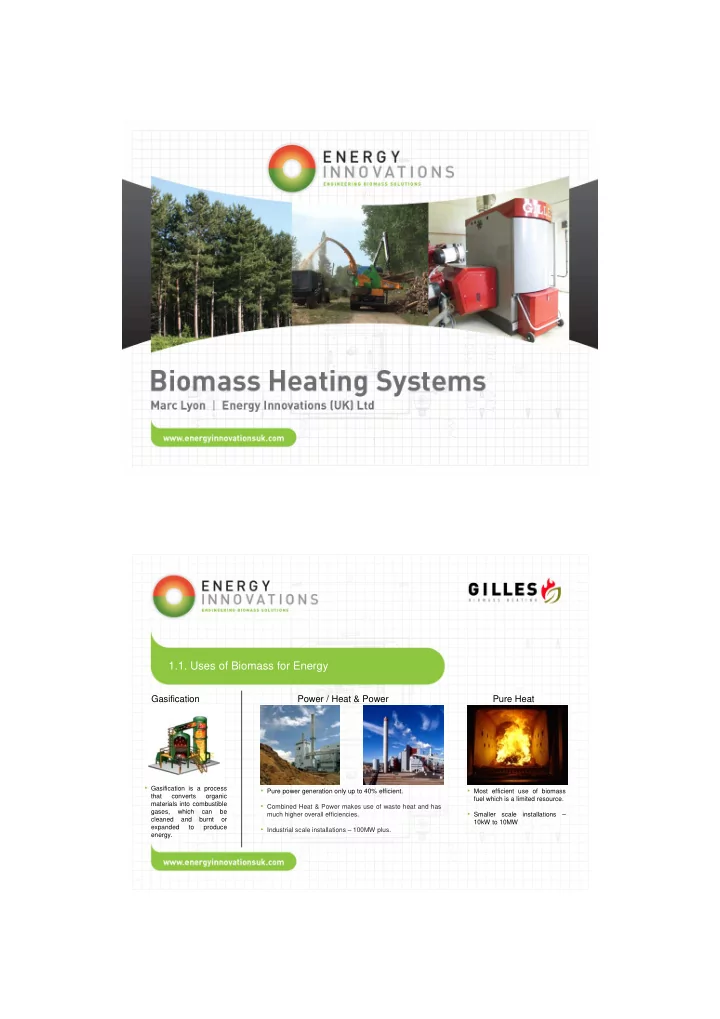
1.1. Uses of Biomass for Energy Gasification Power / Heat & Power Pure Heat Gasification is a process Pure power generation only up to 40% efficient. Most efficient use of biomass that converts organic fuel which is a limited


slide-1
SLIDE 1

1.1. Uses of Biomass for Energy

Gasification Power / Heat & Power Pure Heat

  • Gasification is a process

that converts

  • rganic

materials into combustible gases, which can be cleaned and burnt

  • r

expanded to produce energy.

  • Pure power generation only up to 40% efficient.
  • Combined Heat & Power makes use of waste heat and has

much higher overall efficiencies.

  • Industrial scale installations – 100MW plus.
  • Most efficient use of biomass

fuel which is a limited resource.

  • Smaller scale installations –

10kW to 10MW

slide-2
SLIDE 2

Biomass for Heat

  • Most effective use of biomass
  • Smaller scale installations 10kW – 10MW

Biomass Fuels for Heat in the UK

  • Logs
  • Least processed fuel
  • No boiler automation
  • Wood Chips
  • Least processed fuel for

automated systems

  • Cheap but bulky fuel
  • 1T = 4-5m3 @ 30%

moisture

  • 1000 litre oil = 3 Tonne

chip = 12m3 chip

  • Wood Pellets
  • More processed fuel
  • Very convenient;

compact; good handling characteristics.

  • 1T = 1.4m3
  • 1000 litre oil = 2.25

Tonne pellet = 3.15m3 pellet

  • Wheat Grains
  • Food vs. fuel debate
  • Bad combustion

characteristics

  • Acidic emissions

shorten life of system and compromise green credentials.

  • Other Residues
  • Specific Cases
  • One off large scale

projects

  • Combustion not

necessarily best solution.

  • Anaerobic Digestion?
slide-3
SLIDE 3

4.0. Fuel Costs used in this Presentation

Heating Oil 60 pence per litre 10.8 kWh/litre 5.09 p/kWh Wood Pellet (bagged) 225 £ per tonne 4.7 MWh/T 4.79 p/kWh Wood Pellet (blown >5T) 200 £ per tonne 4.7 MWh/T 4.25 p/kWh Wood Pellet (bulk tipped) 160 £ per tonne 4.7 MWh/T 3.40 p/kWh Wood Chip (small scale specialist delivery) 110 £ per tonne 3.5 MWh/T 3.14 p/kWh Wood Chip (tractor and trailer delivery) 90 £ per tonne 3.5 MWh/T 2.57 p/kWh Wood Chip (bulk delivery) 80 £ per tonne 3.5 MWh/T 2.28 p/kWh Wood Chip (own production) 50 £ per tonne 3.5 MWh/T 1.43 p/kWh p/kWh Energy Cost Cost (as charged) kWh/unit Calorific Value

Biomass Heating - Why

Environmental Reasons Cost Savings Government Incentive

  • Nearly carbon neutral

process

  • Therefore ~100% carbon
  • ffset vs. fossil fuel.
  • Use of own resources – in

house process

  • Running costs can be as low as ⅓ of

an oil system

  • Capital cost must be considered –

can be high but well specified / well designed systems will pay back quickly

  • Renewable Heat Incentive
  • Similar to FIT for renewable electricity
  • Scheme Implementation November 2011
  • Tariff Rates:
  • 0 – 200kW – 8.3 pence p/kWh on Tier 1.
  • 2.1 pence p/kWh on Tier 2.
  • 200 – 1000kW – 5.1 pence p/kWh Tier 1.
  • 2.1 pence p/kWh on Tier 2.
  • >1MW - 1.0 pence p/kWh.
slide-4
SLIDE 4

Biomass Heating - Why

Non-Domestic Payment Example GILLES HPK-RA 550kW Woodchip Boiler Actual Peak load = 25% x 8,760 hours per annum = 2190 hours. Total kWh per annum = 2190 x 550kW = 1,204,500kWh Tier 1 = 1314 x 550kW = 722,700kWh Tier 1 annual RHI Payment = 722,700kWh x 5.1 pence = £36,857.70 Tier 2 annual RHI Payment = 1,204,500kWh – 722,700kWh = 481,800kWh x 2.1 pence = £10,117.80 Total annual RHI Payment = £36857.70 + £10,117.80 = £46,975.50

Biomass - Where

  • Small Rural
  • <30kW – Pellet boiler

with day hopper.

  • 30-50kW – Pellet Boiler

with bulk store hopper.

  • RHI will be v. important.
  • Medium to Large Rural

(+ rural district)

  • 50 – 150kW – woodchip

boiler

  • Local or own fuel source

important

  • These are solid,

economically viable biomass jobs.

  • Payback times 5 – 7

years

  • Large Commercial
  • 150 – 2000kW
  • Commercially specified

and procured construction projects

  • Sometimes only 10%

renewables obligation is addressed

  • Large, central heat load

so ideal for biomass projects if properly specified / designed / installed

  • Community Heating
  • 150 – 5000kW
  • Ranges from 2 or 3

houses to hundreds of houses

  • Excellent application for

biomass as proven in Europe.

  • Large schemes starting

to be specified for UK new build.

  • Urban / Suburban
  • Space constraints lead

to difficult, potentially expensive projects

  • Not ideal for Biomass
  • District Heating?
slide-5
SLIDE 5

Biomass - When

Now!

  • High fossil fuel costs, set to rise
  • Where self sufficiency / fuel security can be achieved. Rural projects with own fuel source
  • Renewable Heat Incentive
  • boilers from 0.15 – 6MW example shown here is 0.36MW
  • suitable for woodchips, pellets, sawdust, shavings,

bark and much more

  • fully automatic ignition, ash removal and pneumatic

heat exchanger cleaning

  • integrated exhaust ash removal cyclones
  • under fed static furnace.

Gilles HPKI-K Industrial Heating Plant

slide-6
SLIDE 6

Gilles HPKI-K Industrial Heating Plant

Flue Dust Removal Cyclones Under Feed Stoker Pneumatic Heat Exchanger Cleaning Automatic Ash Removal Secondary Air Flow Primary Air Flow

A push floor system for use with larger industrial boilers A hinged arm sweep collector in a 22 cubic metre hopper for woodchip Cell wheel

Gilles Fuel Transfer Equipment

slide-7
SLIDE 7

12.0. Heat Metering Solutions

  • Ultrasonic heat meters can be used to

determine kWh throughput used for billing purposes and RHI payment calculation

  • Heat Meter positioning carefully controlled

within RHI regulations

  • Plant Room schematic and an independent

report must be supplied during accreditation process with regards to heat meter positioning

  • Once we have an idea of the required boiler size, the next thing is to identify the fuel strategy. This

will dictate a number of factors including fuel store size, location and configuration.

  • Consider proximity to buildings and pipe runs.
  • Flues and chimneys – can have a bearing on boiler location.

Chimney Heights / LAQM / Planning

  • At this stage, once costs have been identified, we will look at system feasibility, payback periods

and CO2 savings.

Energy Innovations Approach to a Biomass Project Where do we start? – Site Survey…

slide-8
SLIDE 8

Fuel Stores - An existing building

This must have good eaves height to allow trailers / fork lifts to tip. An above ground storage hopper is suitable for a high-tipped delivery

  • r loading with a fork-lift or front end loader.

Fuel Stores - Above Ground Storage

slide-9
SLIDE 9

Fuel Stores – Below Ground Storage

…usually seen as a last resort.

Fuel Stores - Blown Deliveries

slide-10
SLIDE 10

If site constraints are such that blown deliveries are the only option, then it is most likely that the project will be more suited to wood pellet than woodchip.

Blown deliveries Project stage - Design

  • In House CAD
  • In House Mechanical Design
  • Takes a project from concept to

installation

slide-11
SLIDE 11

Energy Innovations is able to undertake installation of district heating pipe work through the use of its specialist equipment and trained staff.

Project stage - Installation (District Heating) Project stage - Boiler system installation

  • all of our boiler positioning, assembly and commissioning is carried
  • ut “in house” by our own engineers
  • pipe fitting / plumbing is generally sub-contracted.
slide-12
SLIDE 12

Project stage - System Commissioning

  • experienced in-house electrical and boiler commissioning engineers
  • PC-based graphical interface to all system parameters (a key commissioning tool)
  • integrated overall commissioning strategy facilitated by a close partnership with Gilles.

Support from Energy Innovations

All Systems incorporate remote access link for monitoring and remote maintenance. Ongoing service and maintenance throughout system life. Advice and support on fuel and fuel suppliers.

slide-13
SLIDE 13
  • Boiler: Gilles HPKI-K 900
  • Heat Output: 900kW
  • Fuel: G50, W30 Woodchip to ÖNORM M 7133

sourced from the estate

  • Fuel Storage: Converted, disused grain store
  • Fuel Delivery Method: Timber chipped and stored onsite

Onsite handling with Tele-handler

  • Annual Heat Load: 1,577MWh
  • Annual Fuel Requirement: 563T
  • Annual Fuel Cost (yr.1): £22,526(@ £40/T) – 1.14p/kWh
  • CO2 saving (vs. heating oil): 512T

5.1. Example System: 900kW Woodchip District Heating 13.2. Snape Maltings - 550kW Woodchip Boiler complete with Hydraulic Walking-Floor

  • Boiler: Gilles HPKI-K 550
  • Heat Output: 550kW
  • Fuel: G50, W30 Woodchip to ÖNORM M 7133

sourced from the farm

  • Fuel Storage: 150 m3 underground bunker
  • Fuel Delivery Method: Flexible direct tipped options incl.

100m3 walking floor lorry

  • Annual Heat Load: 964MWh
  • Annual Fuel Requirement: 334T
  • Annual Fuel Cost (yr.1): £24,090.00 (@ £70/T) – 2.0p/kWh
  • CO2 saving (vs. heating oil): 313T/annum
slide-14
SLIDE 14
  • Modern wood-fuel boilers offer excellent clean, green, practical, carbon neutral heating.
  • Wood chip systems can offer huge financial savings as well as making use of local fuel

supplies, sometimes justifying improved woodland management.

  • District heating should be considered where a number of properties can be supplied

with heat from one central boiler.

  • Government support makes the economics of these systems very attractive.

Conclusions