~~~1}1 )A Animal Risk of Produced Water Barium Sulfate TDS - - PDF document

1 1
SMART_READER_LITE
LIVE PREVIEW

~~~1}1 )A Animal Risk of Produced Water Barium Sulfate TDS - - PDF document

~~~1}1 )A Animal Risk of Produced Water Barium Sulfate TDS (mg/L) (mg/L) (mg/L) Surface Discharges in Wyoming None Current 3,000 5,000 Limit: Penny Hunter Geomega 0.2 500 2,000 Proposed Limit: January 17, 2007 Note: Suffate Is


slide-1
SLIDE 1

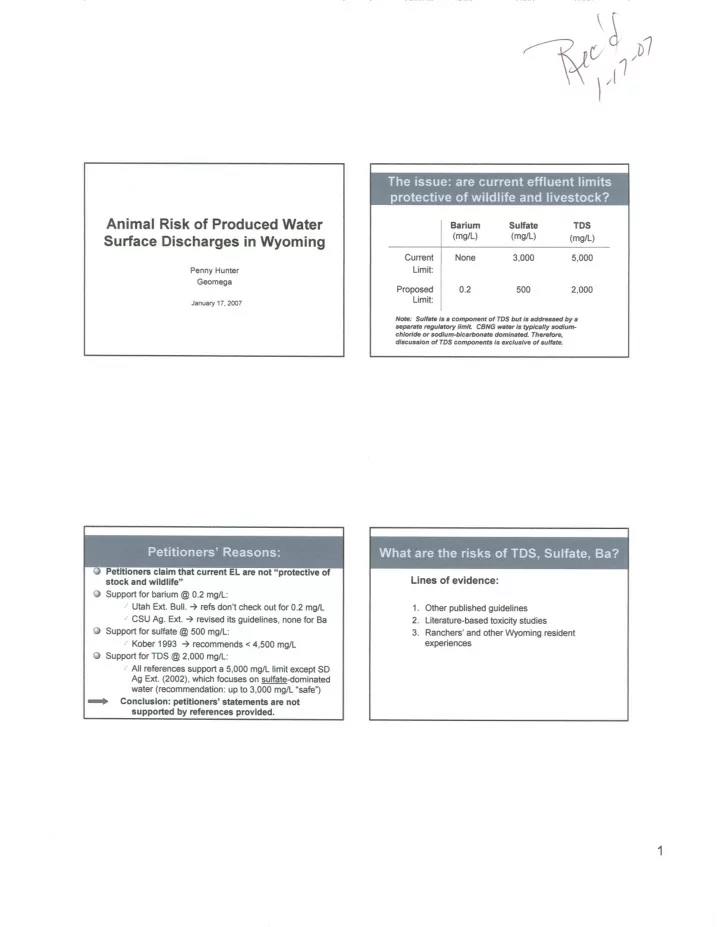
Animal Risk of Produced Water Surface Discharges in Wyoming

Penny Hunter Geomega

January 17, 2007

Petitioners claim that current EL are not "protective

  • f

stock and wildlife" Support for barium @ 0.2 mg/L:

/ UtahExt.Bull.-7 refsdon'tcheckoutfor 0.2mg/L / CSUAg. Ext.-7 reviseditsguidelines,nonefor Ba

Supportfor sulfate@ 500 mg/L:

/ Kober1993 -7 recommends

< 4,500mglL Supportfor TDS@ 2,000mglL:

/ All referencessupporta 5,000mg/Llimit except SD

Ag Ext. (2002), which focuses on sulfate-dominated water (recommendation: up to 3,000 mg/L.safe") Conclusion: petitioners' statements are not supported by references provided.

~~~1}1

)A

Note: Suffate Is a component

  • f TDS but Is addressed

by a separate regulatory limit CBNG water Is typically sodium- chloride or sodium-bicarbonate

  • dominated. Therefore,

discussion

  • f TDS components

is exclusive of sulfate.

Lines of evidence:

  • 1. Other published guidelines

2. Literature-based toxicity studies

  • 3. Ranchers' and other Wyoming resident

experiences

1

Barium Sulfate TDS (mg/L) (mg/L) (mg/L) Current None 3,000 5,000 Limit: Proposed 0.2 500 2,000 Limit:

slide-2
SLIDE 2

Barium: / 5 - 300 mg/L livestock WQ guideline (Canada)

/ 20-100 ppm livestock (NRC 1980, 2005)

Sulfate:

/ 1,000- 3,000mg/LlivestockWQ (Canada)

/ 2,500 mg/L feedlotted cattle (NRC 2005)

I;) TDS:

/ 5,000 -15,000

mg/L livestock (EPA 1976)

/ 5,000 mg/L livestock (NRC 1974)

II"'" Existing guidelines

are supportive of current limits, but do not support proposed changes to limits.

"lowest coneen",",on derived 10<each .scepto. ,hown. "N/A Not applioab~. No 'o~oity stud;e, ex'" to< "'.. type 01 "oepto.

:J!

c Q. ..

~

NOAEL LOAEL Dose

~

1

1;) Wyoming conditions differ from toxicity studies

8.

/ JohnsonandPatterson(2004)

~

I;) Adaptation I inc'd tolerance can occur w/o long-term .!! adverse effects

f

/ NRC (1974), Spafford (1941), Ballantyne (1957)

I;) Toxicity study limitations (NOAEL vs LOAEL) ,II'" Ranchers in Bighom and Powder River basins weigh in

/

Thanks to:Flitners, McCarty, Patterson, Shepperson, Schiaf,

Mikie,and others

2

Nonruminant Ruminant Ruminant Waterfowl mammal (growing (aduit steer) (mallard) (rodent) heifer) Barium

I

100 13 N/A- 360 (mgIL)* Sulfate

I

5,070* 5,100 3,010 4,590 (mglL) TDS 7,460 7,800 N/A- 5,680 (mgIL)

..,

SUOllllfted

.

"'-11<:

Geomebic

mean

RiskMoreLikely

""" ;;

. - ---

slide-3
SLIDE 3

Q No adverse effects on livestock (cattle, sheep, horses) that drank water containing:

/

Sulfates S 3,100 mglL

/ TDSS5,390mgIL

Q Adverse effects apparent when exposed to: / Sulfates" 4,000 mglL

/

TDS" 7,000mglL Loch Katrine

/ No adverse effects on

wildlife at Loch Katrine from produced water

contributions of 5,000 m

TDS and 2,050 mg/L sulfate (Ramirez,USFWS 2002) Q Ranchers'

  • bservations

/

Wildlife observed utilizing produced water

sources in greater densities than natural sources, withoutadverse effects. Experiencesinthe fieldare supportiveofcurrent

limits, but do not support proposed changes to limits. G Flitners: 7-year weaning rate averages as good or better on land wI produced water (2,700 mg/L S04, 5,000 mg/L TDS)

  • Mr. McCarty: No adverse

effects on land wI produced water (3,100 S04; 5,390 TDS); body condition, mortality, weaning rateslweights, breeding rate

G Meike,SChlaf,Shepperson: No adverse effects

Letters- Garland, Grabbert, Mantle, Pattison, Shultz, Wilsons, Baird, McCarty, F.OAL, etc.

3 Benchmark/Limit Barium Sulfate TDS mg/L mglL mg/L Recommended 13 3,010 5,600 benchmark: Current effluent None 3,000 5,000 limit: Petition proposed 0.2 500 2,000 limit:

slide-4
SLIDE 4

~ Letters of beneficial use by Wyoming residents

/

Cattle,sheepherdslargely maintained byproduced watersourcesin

areas of Bighorn and Powder River basins; / Increased capacity for irrigated crop and pasturelands attributed to produced water sources; / Wildhorse populations supported in Bighornbasin(F.OAL). ~ Use attainability analyses1

/

Salt Creek discharges support >4,500head of cattle and 3,300 head of sheep;

/ Cottonwood Creek discharges support 2/3rds of all crop production in the area; / Wildlife; game species abundant in discharge areas - supports tourism;

/

loch Katrine enhanced byproduced watersupports

sensitivelthreatened species.

1GeneR.Goo'oe 2005. RETEC 2004. SWWRC et aI. 2002

Effects

  • f reduced

exploration and development: Lost tax and export revenue to counties

/

Hot Springs County (HamiltonDome)= $28.7 million(1997 dollars);

/

Natrona County (S. Casper Creek) =$3 million(2002 dollars).

~ Lostjobs

/

Hot Springs (Hamilton Dome) = 136 jobs, $4.1 million annual labor;

/

Natrona & Johnson counties (Sail Creek fields) = $4.6 million ann. labor.

~ Lost contributions to social programs

/

Hot Springs (HamiltonCome) =$1.4 millionfor schools, etc

/

Natrona &Johnson counties (Salt Creek fields)= $2.9 millionproperty and severance tax.

.5ffect~ofeli minated pr9ciuce.ci.\~~ter )"X,/S,,',:;SUrface-d isc ~a1~.C'.,j'b~{11~lllf~~~~.fl

Q Cottonwood Creek: 15 - 20% loss of cattle ($2 million) Q Dry Creek: 30 - 50% loss of cattle (-$0.6 million) Q Salt Creek: 20 - 40% loss of cattle ($0.6 - 1.1 million) Q Hot Springs County - loss of cattle results in: / $3.3 million total economic output, / $645,000 annual labor income / 8% loss of pasture I) Additional costs to ranchers to develop alt water sources Q lost revenue from tourism, hunting, fishing Q lost access to federal funding for loch Katrine

Geomega's analysis shows that current WDEQ effluent limits Dose no measurable adverse effect to the health and well-being of domestic livestock and wildlife. and there would be no incremental reduction in wildlife

  • r livestock iniurv if limits were changed to

the Detitioners' reguested limits. In addition, associated social and economic imDacts of reduced water discharges and/or reduced exploration and development ~ould be harmful to Wvomina residents.

4

slide-5
SLIDE 5

References

_.c.V..J."""""""'_UM""". 1997.

  • "'-''''''''''''LNootod<.
  • ""'U"'.'"
  • Foot_"'''''''.
  • .

EE1""."" Con. J.Comp. Mod. V<L sa.2''''''"257. CCR"'.1987 ","'T"''''''''~-'"""",~_CouoOI

"'R__-----

GoMR.-"'_'~.. HAF. "" 2005. Uoe_-"'"...,.,Spido, "'"' -~.""""._. F_"Y".

  • ,~,P,S,,"'H.H._.

2004. E_oh"-'I''''M~''''~of~H~"''""m,,,,''''._.

  • ""'"'"."'. Soc.""'.Sd.55251.

"""".JA_"' "",_,.39-<2.F_'993.

NRe. 1914. __T""''''''''''''''W_'''''''''-

  • _"'_W_.D.C.

_R..-CouoOI.

NRe. 1980. _T_"'_-

  • _"'''''''''.W_D.C.

_R..-

CouoOI. NRe.2005 ,T__of_. N.".,,,""""my"'''''"'''''. W_. D.C. N_.IR_I<hC~""'. No""~. P.2002. 0;'"""""''''''''''M dO",""... ioto ,.w,om;"". U.S.

  • Wild..

SeN'"Coot,,,,,,,,", No"". R6I71=. """""'. WY. ,,",.

RETEe.2004 Uoe__.'" "' R'" N"",""

  • --

"""".

_. _'0

SD,..."'2OO2. T"" """,,,,,,,,,,,,,,,--,,,,,,,,,,,,,,,,,,,,,,,-

"'"''''"''''"'''.......

_.W..1"'.""'_"""'-"--_J.Dop._.S._""~

9IW<RC"..2OO2 ,ComponyUH_- _20. """W"'_R- eo.pomtioo. W""""""""'T_.I~.-

  • _Com_"C.

us EPA. 197..""'''' """".. WO,"'. """" ofWotM H..."~ M""'''. W"",...~. D.C. J..,.

5