
SLIDE 1
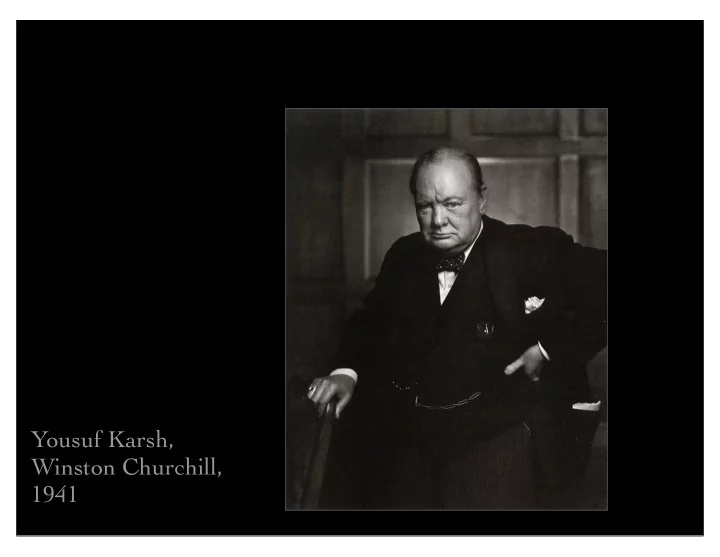
Yousuf Karsh, Winston Churchill, 1941 Yousuf Karsh, Audrey - - PowerPoint PPT Presentation
Yousuf Karsh, Winston Churchill, 1941 Yousuf Karsh, Audrey Hepburn 1956 Yousuf Karsh, Peter Lorre, 1946 Photography in available light ! challenging ! worthwhile ! requires patience and luck ! always carry your camera 11 ! Marc Levoy
! Marc Levoy
! challenging ! worthwhile ! requires patience and luck ! always carry your camera
11
Avedon working outdoors
! Marc Levoy
19
floodlight zebra board lights with diffusers spotlight with reflective umbrella strobe spotlight
(Kodak)
! Marc Levoy
21
soft box film view camera with digital light meter polaroid preview pictures 1970’s haircut
(Kodak)
! Marc Levoy
22
(London)
! Marc Levoy
23
(London)
! Marc Levoy
! main light on side towards camera - broadens narrow faces ! main light on side of face away from camera - most common ! main light directly in front of face - glamour lighting
24
! Marc Levoy
! broad lighting is sometimes called Rembrandt lighting
25
Rembrandt van Rijn, Self Portrait, 1660
(Varis)
! Marc Levoy
! 8:1 means 3 f/stops (3 doublings) ! think about the mood you want to convey ! the color of the key and fill lights can be different...
26
(London)
! Marc Levoy
29
(Kodak)
photographed by D.W. Mellor diffused spotlight diffuse reflector
! Marc Levoy
! darkfield lighting ! took all day to set up
30
(Varis)
! Marc Levoy
31
2-second exposure to show dusk outdoors note lighting in 2nd room
(Kodak)
! Marc Levoy
32
photographed by Richard Fukuhara
(Kodak)
! Marc Levoy
33
(Hunter)
! Marc Levoy
35
! Marc Levoy
[Belhumeur CVPR 1997]
! changing the depth of an object is equivalent to changing
36
! Marc Levoy
37
photographed by Fil Hunter
(London)
! Marc Levoy
! freezing the action ! fill-flash ! flash-plus-ambient ! flash as a fill light ! ways to avoid using flash
39
! Marc Levoy
! shorten exposure, then add flash ! could instead use HDR, but that requires multiple shots
42
exposed for foreground exposed for background exposed for background, with fill flash
(London)
! Marc Levoy
! use flash, and lengthen exposure ! avoids isolating the foreground from its background
43
standard flash exposure 1/4 second with flash
(Ang)
! Marc Levoy
! golden hour sun + off-camera fill flash
(Canon 5D Mark II, Speedlite 580EX, orange gel)
44
as cameras get more sensitive, flash is less frequently needed when the scene is dark, but it’s still useful for changing the light balance or color
! Marc Levoy
!
key flash (on right side of scene) with orange gel & umbrella + fill flash (extreme left side of scene) with no gel or diffuser + background flash (pointed at back wall) with blue gel
45
(Linda Cicero)
! Marc Levoy
48
direct flash,
direct flash,
bounce flash, from above bounce flash, from the side
(London)
! Marc Levoy
49
1880: flash powder
powdered magnesium + potassium chlorate + antimony sulfide
(Race Gentry)
1927: flashbulbs
aluminum foil in oxygen, later tungsten or zirconium filament coated in explosive primer paste
1960s: flashcubes
! Marc Levoy
! battery charges up a capacitor (dangerous when disassembled!) ! high-voltage trigger ionizes the gas inside the tube, reducing its
! the capacitor discharges through the ionized gas, heating it to a
50
Canon 580EX
(wikipedia)
! Marc Levoy
(Canon E-TTL or Nikon iTTL, including Nikon D40)
! on shutter half-press, focus under ambient light
! on shutter press, fire weak preflash and record on flash sensor ! compute some combination of aperture, flash duration, and ISO
autofocusing, shooting mode, etc.
! flip up mirror, open shutter, and fire flash ! drawbacks
people to blink, especially if using 2nd curtain sync
54
! Marc Levoy
! broad spectrum, approximates daylight (6500°K, i.e. D65) ! if mixed with ambient tungsten light, flash will look blue if WB
57
(graphics.cornell.edu)
! Marc Levoy
! flash exposure lock (FEL) ! flash exposure compensation (FEC) ! flash exposure bracketing (FEB) ! strobe modes ! speciality flashes, like ring flash ! wireless master-slave
! check out http://photonotes.org/articles/eos-flash/index2.html
58
! Marc Levoy
! power falls as distance squared
! in-camera flash is too close to lens
! red-eye
! shutter speed must be low enough that shutter is completely open
!
don’t shoot perpendicularly into glass
59
! Marc Levoy
! flash can be used to freeze the action, as fill-flash for bright
! to avoid the deer-in-the-headlights look of on-camera flash
! to adjust flash intensity, change its pulse duration; to adjust the
! flash intensity is specified by a guide number
60
! Marc Levoy
! Andrew Adams
!
Stone, M., A Field Guide to Digital Color, A.K. Peters, 2003.
!
Reinhard et al., High Dynamic Range Imaging, Elsevier, 2006.
!
Minnaert, M.G.J., Light and Color in the Outdoors, Springer-Verlag, 1993.
!
Hunter, F., Fuqua, P., Light Science and Magic (2nd ed.), Focal Press, 1997.
!
Tanser and Kleiner, Gardner’s Art Through the Ages (10th ed.), Harcourt Brace, 1996.
!
London, Stone, and Upton, Photography (6th & 9th editions), Prentice Hall, 2008.
!
Ang, T., Digital Photography (2nd ed.), DK Publishing, 2007.
!
LoSapio, A., Professional Photographic Illustration, Eastman Kodak, 1989.
!
Story, Derrick, Digital Photography Hacks, O’Reilly, 2004.
!
Varis, L, Skin, Wiley, 2006.
!
Nissen, H.J., Damerow, P., Englund, R.K., Archaic Bookkeeping, University of Chicago Press, 1994.
!
for a great tutorial on off-camera flash lighting, see http://strobist.blogspot.com
63