
SLIDE 1
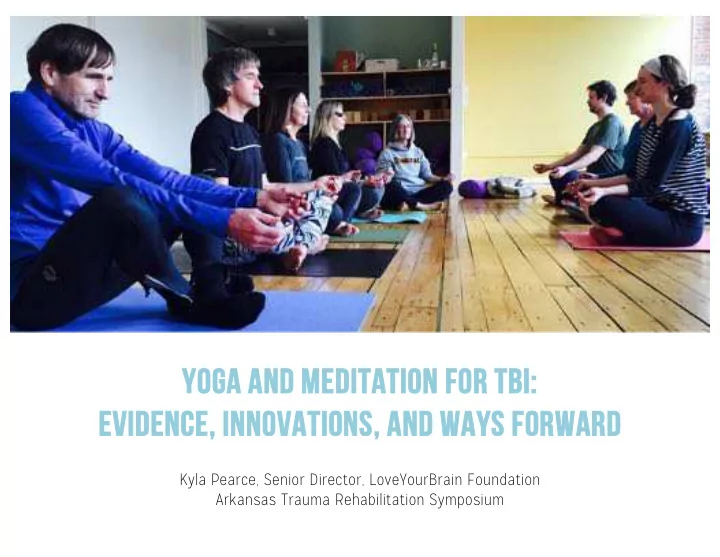
Yog Yoga and nd meditation
- n for
- r TBI
BI: evi eviden ence, e, innova vations, and ways fo forw rward rd
Kyla Pearce, Senior Director, LoveYourBrain Foundation Arkansas Trauma Rehabilitation Symposium
Yog Yoga and nd meditation on for or TBI BI: evi eviden ence, - - PowerPoint PPT Presentation
Yog Yoga and nd meditation on for or TBI BI: evi eviden ence, e, innova vations, and ways fo forw rward rd Kyla Pearce, Senior Director, LoveYourBrain Foundation Arkansas Trauma Rehabilitation Symposium Disclosure Statement Dr. Kyla
Kyla Pearce, Senior Director, LoveYourBrain Foundation Arkansas Trauma Rehabilitation Symposium
program for the LoveYourBrain Foundation. She has no industry relationships to disclose.
1. Be able to define what yoga is and its unique features
1. Be able to define what yoga is and its unique features 2. Understand the evidence-based benefits of yoga and meditation for TBI rehabilitation
1. Be able to define what yoga is and its unique features 2. Understand the evidence-based benefits of yoga and meditation for TBI rehabilitation 3. Understand techniques for adapting yoga and meditation for TBI
1. Be able to define what yoga is and its unique features 2. Understand the evidence-based benefits of yoga and meditation for TBI rehabilitation 3. Understand techniques for adapting yoga and meditation for TBI 4. Learn about free TBI-friendly yoga and meditation resources and how people can access them
Hathayoga.net
physical movement (asana)
physical movement (asana) breathing exercises (pranayama)
physical movement (asana) breathing exercises (pranayama) meditation (pratyahara, dharana, dhyana)
physical movement (asana) breathing exercises (pranayama) meditation (pratyahara, dharana, dhyana) moral observations (yamas and niyamas)
physical movement (asana) breathing exercises (pranayama) meditation (pratyahara, dharana, dhyana) moral observations (yamas and niyamas) complete wellbeing (samadhi)
Con Confide dence Fe Fear An Anger Joy Joy
A D D R E S S E S T H E W H O L E P E R S O N
Bi Bio-ps psycho-soc social-sp spiritual Mod Model Pan Pancha Ko Kosha Model
Hasenkamp, et al. Mind wandering and attention during focused meditation: A fine-grained temporal analysis of fluctuating cognitive states. NeuroImage. 2012; 59(1)750-760.
Six-week program designed to build community and foster resilience for people with TBI and caregivers
Affiliate program
Introduce yoga-based tools early post-injury
based program
Expand upon benefits of yoga in community setting
integration
Sustain community connection and healing through yoga
2,103 people with TBI and caregivers served 4,800 people engaged through outreach 199 programs / 1,194 classes / 10,000 attendances 771 yoga teachers and clinicians trained
Ease of participation Belonging Sustaining community connection Physical health Self-regulation Self-efficacy Resilience
TBI-specific scales assess changes from baseline to after participating in the program
ü Quality of Life (44.9 (SD=17.6) to 54.6 (SD=17.6), p<0.001)
ü Resilience (45.1 (SD=2.8) to 46.4 (SD=2.8), p=0.0004) ü Positive affect (48.8 (SD=2.0) to 50.3 (Sd=2.9), p<0.001) ü Cognition (34.4 (Sd=1.9) to 35.9 (SD=1.8), p<0.001)
improve balance, address spasticity and neck pain
improve balance, address spasticity and neck pain
improve balance, address spasticity and neck pain
improve balance, address spasticity and neck pain
nervous system, and manage negative thoughts
improve balance, address spasticity and neck pain
nervous system, and manage negative thoughts
community and resilience
þ Able to move without assistance (no wheelchair, cane) þ Open to participating in a group discussion þ Able to follow instructions and regulate intense emotions þ Can commit to attending all 6 classes (first class mandatory) þ Are younger than 71 years of age We welcome people with post-concussion syndrome, mild to moderate TBI, and severe TBI, if they meet above criteria.
Table 1. Participant characteristics Age (mean) 44 years Sex (% female) 70% TBI severity (%) Mild 35% Moderate 28% Severe 37% Symptoms and comorbidities (%) Light sensitivity 40% Post-concussion syndrome 24% Weaknesses on one side of the body 19% Seizures 7% PTSD or post-traumatic stress 14%
Diverse benefits contribute to more positive sense of self
Promotes adjustment by focusing on potential for positive change Diverse benefits contribute to more positive sense of self
Resilience associated with community integration and quality of life Promotes adjustment by focusing on potential for positive change Diverse benefits contribute to more positive sense of self
Together, we believe we can change the culture around brain injury healing and support through yoga and meditation. Contact Kyla Pearce, Senior Director kyla@loveyourbrain.com
Cole MA, et al., Simultaneous Treatment of Neurocognitive and Psychiatric Symptoms in Veterans with Post-Traumatic Stress Disorder and History of Mild Traumatic Brain Injury: A Pilot Study of Mindfulness-Based Stress Reduction. Mil Med 2015; 180(9):956-63. Azulay J, et al. A pilot study examining the effect of mindfulness-based stress reduction on symptoms of chronic mild traumatic brain injury/post concussive syndrome. Head Trauma Rehabil, 2013; 28(4):323-31. Schmid AA, Miller KK, Van Puymbroeck M, Schalk N. Feasibility and results of a case study of yoga to improve physical functioning in people with chronic traumatic brain injury. Disabil Rehabil. 2015:1-7. Silverthorne C, Khalsa SB, Gueth R, DeAvilla N, Pansini J. Respiratory, physical, and psychological benefits of breath-focused yoga for adults with severe traumatic brain injury (TBI): a brief pilot study report. Int J Yoga Therap. 2012(22):47-51. Johansson B, et al. Mindfulness-based stress reduction (MBSR) improves long-term mental fatigue after stroke or traumatic brain injury. Brain Injury. 2012;26(13-14):1621-8. Donnelly K, et al. The feasibility and impact of a yoga pilot programme on the quality-of-life of adults with acquired brain
Donnelly K, Goldberg S, Fournier D. A qualitative study of LoveYourBrain Yoga: a group-based yoga with psychoeducation intervention to facilitate community integration for people with traumatic brain injury and their caregivers. Disability and
Steven Southwick and Dennis Charney. Resilience: The Science of Mastering Life’s Greatest Challenges. 2012. Wells RE, Phillips RS, Schachter SC, McCarthy EP. Complementary and Alternative Medicine Use among U.S. Adults with Common Neurological Conditions. J Neurol. 2010;257(11):1822-31. Grace JJ et al. Post-traumatic growth following acquired brain injury: a systematic review and meta-analysis. Front Psychol 2015 Aug 14;6:1162. doi: 10.3389/fpsyg.2015.01162. eCollection 2015.