x agent with these beliefs and these My preferences preferences - - PowerPoint PPT Presentation

x
SMART_READER_LITE
LIVE PREVIEW

x agent with these beliefs and these My preferences preferences - - PowerPoint PPT Presentation

Rational Decision Theory I believe I am in The choice(s) that it thus and such a would be rationally Decision and Game Theory Decision and Game Theory circumstance. permissible for any x agent with these beliefs and these My preferences


slide-1
SLIDE 1

1

Decision and Game Theory Decision and Game Theory

Justin C. Fisher

Southern Methodist University Dept of Philosophy

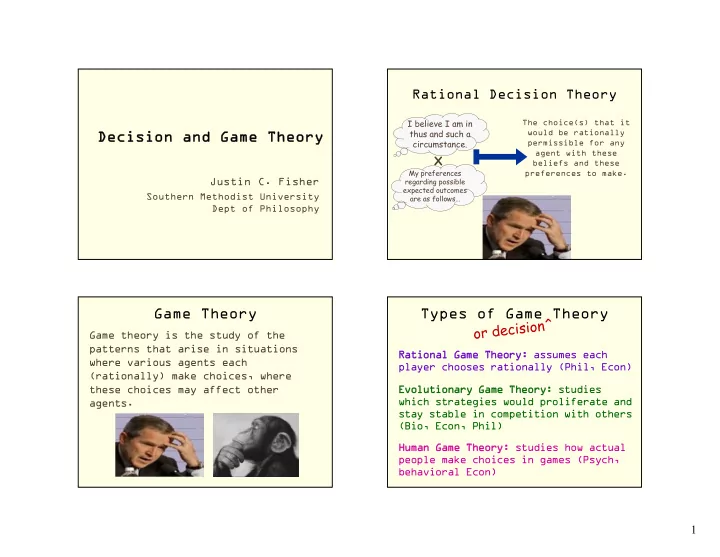
Rational Decision Theory

I believe I am in thus and such a circumstance.

My preferences regarding possible expected outcomes are as follows…

The choice(s) that it would be rationally permissible for any agent with these beliefs and these preferences to make.

x

Game Theory

Game theory is the study of the patterns that arise in situations where various agents each (rationally) make choices, where these choices may affect other agents.

Types of Game Theory

Rational Game Theory: Rational Game Theory: assumes each player chooses rationally (Phil, Econ) Evolutionary Evolutionary Game Theory: Game Theory: studies which strategies would proliferate and stay stable in competition with others (Bio, Econ, Phil) Human Game Theory: Human Game Theory: studies how actual people make choices in games (Psych, behavioral Econ)

slide-2
SLIDE 2

2

Significance of our ‘Irrationality’?

  • There may be different notions of

rationality.

  • If game theory makes predictions

based on the assumption that we’re rational in a way that we aren’t, then it will make bad predictions.

  • 1. If I put my O up top, I will win.
  • 2. If I don’t, I will lose.
  • 3. I prefer winning to losing.
  • 4. So I should put my O up top.

If you’re certain that a particular choice will have the best available consequences, you should make that choice. Decision Making in cases of Certainty

  • 1. I don’t know how X will choose.
  • 2. If I put my O to the left, I might

win, lose, or tie.

  • 3. If I put my O in bottom middle,

I can’t win but can force a tie.

  • 4. I prefer win > tie > lose.
  • 5. So, …?

A “risk-tolerant” approach would accept the risk in hopes of getting a win. “Maximin” maximizes the worst-case scenario: better to force a tie than risk a loss. (“risk averse”)

Decision Making without Probabilities

Best in a harsh environment that will exploit any weakness. E.g., “zero sum” game vs smart well‐informed opponent. Best in safe environment where much can be gained and little lost.

Scenario 1: Get $1000 for sure.

  • A. Get extra $500 for sure.
  • B. 50% extra $1000, 50% gain 0

Scenario 2: Get $2000 for sure.

  • C. Lose $500 of that for sure.
  • D. 50% lose $500, 50% lose nothing.

But these two scenarios are exactly the same!!! Whatever’s rational in one must be rational in the other. Be wary when people frame things in terms of gains/losses – redescribe the other way too.

Warning: People reason strangely about risks

Subjects are averse to taking risks just for gains. Subjects are often willing to take risks to avoid losses.

slide-3
SLIDE 3

3

Computing the expected value of a choice

1. List the different possible ways the world might be. 2. Estimate how probable each possibility is. 3. Estimate how valuabe each possibility would be. 4. Multiply the probability of each possibility times its value. 5. Add up all those products  That’s the expected value.

Suppose you can flip a coin. You’ll win $24 if it flips heads, but you’ll lose $36 if it flips tails. Should you? 1/2 (chance you’ll lose) x -$36 + 1/2 (chance you’ll win ) x +$24

  • =
  • $6

“expected value”

Maximize Expected Value

Suppose you can flip a coin. You’ll win $24 if it flips heads, but you’ll lose $36 if it flips tails. Should you? 1/2 (chance you’ll lose) x -$36 + 1/2 (chance you’ll win ) x +$24

  • =
  • $6

You have prudential reason to perform whichever available option has the highest expected value.

“expected value”

Probabilities and payoffs both matter.

Suppose you can flip a coin. You’ll win $24 if it flips heads, but you’ll lose $36 if it flips tails. Should you? The coin is weighted: it flips Heads 2/3 of the time. 1/3 (chance you’ll lose) x -$36 + 2/3 (chance you’ll win ) x +$24

  • = +$4

If the payoff is small, the probability of winning has to be really high for it to be a good gamble.

“expected value”

High Payoffs with Low Probability

Suppose you can pay $1 to win $1,000,000 if the ace

  • f hearts is randomly drawn from a deck of cards.

51/52 (chance you’ll lose) x -$1 + 1/52 (chance you’ll win ) x $1,000

  • = $18

If the potential payoff is high enough, it can be a good gamble even if you’re very unlikely to win.

“expected value”

slide-4
SLIDE 4

4

Prisoners’ Dilemma

Coope

  • opera

rate te with o ith other priso risone ner Defec efect Coope

  • opera

rate te with o ith other priso risone ner 1 ye 1 year 1 ye 1 year Free! ree! 5 y years ears Defec efect 5 y years ears Free! ree! 3 y years ears 3 y years ears

Causal Dominance

Coope

  • opera

rate te with o ith other priso risone ner Defec efect Coope

  • opera

rate te with o ith other priso risone ner 1 ye 1 year 1 ye 1 year Free! ree! 5 y years ears Defec efect 5 y years ears Free! ree! 3 y years ears 3 y years ears

Prisoners’ Dilemma

Coope

  • opera

rate te with o ith other priso risone ner Defec efect Coope

  • opera

rate te with o ith other priso risone ner 1 ye 1 year 1 ye 1 year Free! ree! 5 y years ears Defec efect 5 y years ears Free! ree! 3 y years ears 3 y years ears

But…

  • If only they had both cooperated,

they both would have been better

  • ff!
  • Who’s more rational – the

defectors who are thrown away for years, or the cooperators who get

  • ff lightly?
slide-5
SLIDE 5

5

A trick…

  • In framing the last comparison, I

assumed that both prisoners will end up choosing the same.

  • This assumption isn’t justified

in the simplest description of the problem.

  • But this assumption would be

justified if you knew both prisoners would decide in roughly the same ways.

Rational Prisoners’ Dilemma

  • Suppose that, in addition to

knowing all the standard stuff, the prisoners both know that they are both rational.

  • Does this knowledge change what

choices they ought to make (or what choices norms of rationality will lead them to make)?

Psychologically Similar PD

  • Suppose that, in addition to

knowing all the standard stuff, the prisoners both know that they have been paired with each other because they are psychologically similar.

  • Does this knowledge change what

choices they ought to make (or what choices norms of rationality will lead them to make)?

Rational PD

Coope

  • opera

rate te with o ith other priso risone ner Defec efect Coope

  • opera

rate te with o ith other priso risone ner 1 ye 1 year 1 ye 1 year Free! ree! 5 y years ears Defec efect 5 y years ears Free! ree! 3 y years ears 3 y years ears

slide-6
SLIDE 6

6

Hofstadter’s Argument

  • We’re both rational.
  • Whatever norms of rationality dictate

to me, they’ll also dictate to you.

  • So we’ll both choose the same thing.
  • If we both choose C we’ll each get -1.
  • If we both choose D we’ll each get -3.
  • Rational people would get -1 rather

than -3.

  • So we’ll rationally choose C.

How many iterations?

Single-shot Single-shot – the full impact of your choice is captured in the matrix above. No one will remember what you did and further reward or punish you for it. Iterated Iterated – there’s a good chance you’ll be paired off against this partner again, and what you do this time may affect how he/she treats you later on. Some Strategies for Iterated PD’s

All-C ll-C – – Always cooperate. All-D ll-D – Always defect. Tit-f it-for

  • r-T
  • Tat

at – – Always cooperate, except defect once in response to defection. Tit-f it-for

  • r-T
  • Two

wo-Tats – – Always cooperate, except defect once in response to being defected against twice in a row.

Axelrod’s Keys to Success in Iterated PD’s

Nicen icenes ess – s – Start by cooperating. Provo rovoca cabi bili lity - don’t keep cooperating with someone who will abuse you. Forgi

  • rgivi

ving ngne ness – – If the other player will repent for a mistake, you’re better off going back to mutual cooperation with them. Clari larity ty – – Don’t try to be too fancy, or you’ll make other players suspicious and lose the chance for cooperation.