World War II Group Presentation 1. Create a group Google Slides - - PDF document

world war ii group presentation
SMART_READER_LITE
LIVE PREVIEW

World War II Group Presentation 1. Create a group Google Slides - - PDF document

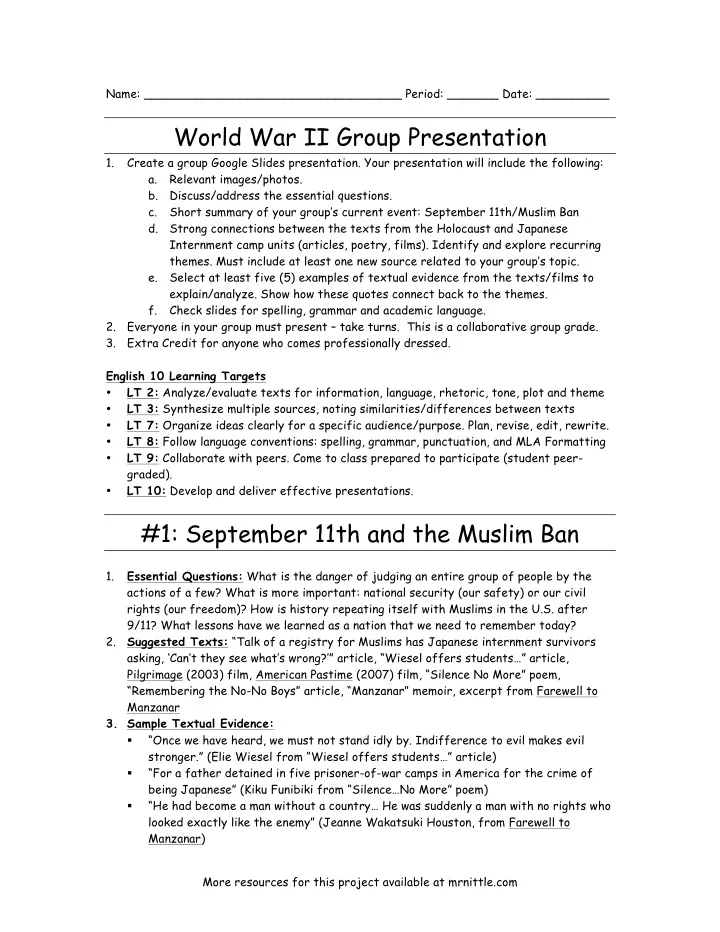
Name: ___________________________________ Period: _______ Date: __________ World War II Group Presentation 1. Create a group Google Slides presentation. Your presentation will include the following: a. Relevant images/photos. b. Discuss/address


slide-1
SLIDE 1

More resources for this project available at mrnittle.com Name: ___________________________________ Period: _______ Date: __________

World War II Group Presentation

1. Create a group Google Slides presentation. Your presentation will include the following:

  • a. Relevant images/photos.
  • b. Discuss/address the essential questions.
  • c. Short summary of your group’s current event: September 11th/Muslim Ban
  • d. Strong connections between the texts from the Holocaust and Japanese

Internment camp units (articles, poetry, films). Identify and explore recurring

  • themes. Must include at least one new source related to your group’s topic.
  • e. Select at least five (5) examples of textual evidence from the texts/films to

explain/analyze. Show how these quotes connect back to the themes.

  • f. Check slides for spelling, grammar and academic language.
  • 2. Everyone in your group must present – take turns. This is a collaborative group grade.
  • 3. Extra Credit for anyone who comes professionally dressed.

English 10 Learning Targets

  • LT 2: Analyze/evaluate texts for information, language, rhetoric, tone, plot and theme
  • LT 3: Synthesize multiple sources, noting similarities/differences between texts
  • LT 7: Organize ideas clearly for a specific audience/purpose. Plan, revise, edit, rewrite.
  • LT 8: Follow language conventions: spelling, grammar, punctuation, and MLA Formatting
  • LT 9: Collaborate with peers. Come to class prepared to participate (student peer-

graded).

  • LT 10: Develop and deliver effective presentations.

#1: September 11th and the Muslim Ban

1. Essential Questions: What is the danger of judging an entire group of people by the actions of a few? What is more important: national security (our safety) or our civil rights (our freedom)? How is history repeating itself with Muslims in the U.S. after 9/11? What lessons have we learned as a nation that we need to remember today?

  • 2. Suggested Texts: “Talk of a registry for Muslims has Japanese internment survivors

asking, ‘Can’t they see what’s wrong?’” article, “Wiesel offers students…” article, Pilgrimage (2003) film, American Pastime (2007) film, “Silence No More” poem, “Remembering the No-No Boys” article, “Manzanar” memoir, excerpt from Farewell to Manzanar

  • 3. Sample Textual Evidence:

§ “Once we have heard, we must not stand idly by. Indifference to evil makes evil stronger.” (Elie Wiesel from “Wiesel offers students…” article) § “For a father detained in five prisoner-of-war camps in America for the crime of being Japanese” (Kiku Funibiki from “Silence…No More” poem) § “He had become a man without a country… He was suddenly a man with no rights who looked exactly like the enemy” (Jeanne Wakatsuki Houston, from Farewell to Manzanar)

slide-2
SLIDE 2

More resources for this project available at mrnittle.com Name: ___________________________________ Period: _______ Date: __________

World War II Group Presentation

1. Create a group Google Slides presentation. Your presentation will include the following:

  • a. Relevant images/photos.
  • b. Discuss/address the essential questions.
  • c. Short summary of your group’s current event: religious terrorism
  • d. Strong connections between the texts from the Holocaust and Japanese

Internment camp units (articles, poetry, films). Identify and explore recurring

  • themes. Must include at least one new source related to your group’s topic.
  • e. Select at least five (5) examples of textual evidence from the texts/films to

explain/analyze. Show how these quotes connect back to the themes.

  • f. Check slides for spelling, grammar and academic language.
  • 2. Everyone in your group must present – take turns. This is a collaborative group grade.
  • 3. Extra Credit for anyone who comes professionally dressed.

English 10 Learning Targets

  • LT 2: Analyze/evaluate texts for information, language, rhetoric, tone, plot and theme
  • LT 3: Synthesize multiple sources, noting similarities/differences between texts
  • LT 7: Organize ideas clearly for a specific audience/purpose. Plan, revise, edit, rewrite.
  • LT 8: Follow language conventions: spelling, grammar, punctuation, and MLA Formatting
  • LT 9: Collaborate with peers. Come to class prepared to participate (student peer-

graded).

  • LT 10: Develop and deliver effective presentations.

#2: Religious Terrorism: Attacks on Houses of Worship

1. Essential Questions: We say “Remember the Holocaust” and “Never again,” but why are religious groups still being attacked today? What causes prejudice and discrimination? How can we prevent future terrorist acts on religious groups? What lessons have we learned as a nation that we need to remember today?

  • 2. Suggested Texts: “Security experts say houses of worship vulnerable to attacks,”

article, Night, “First they came for the Jews” poem, “Tale of a Sprinter,” Oprah Winfrey interview, “Proudly bearing elders’ scars” article, “A Night at the Garden” (2018) film, “Creed of a Holocaust survivor” poem

  • 3. Sample Textual Evidence:

§ “First they came for the Jews / and I did not speak out / because I was not a Jew” (Martin Niemoller, “First they came…” poem) § “There is no running, from the Holocaust” (Sudeep Pagedar, “Tale of a Sprinter” poem) § “And killing of man, is like killing of God” (Alexander Kimel, “Creed…” poem)

slide-3
SLIDE 3

More resources for this project available at mrnittle.com Name: ___________________________________ Period: _______ Date: __________

World War II Group Presentation

1. Create a group Google Slides presentation. Your presentation will include the following:

  • a. Relevant images/photos.
  • b. Discuss/address the essential questions.
  • c. Short summary of your group’s current event: immigration family separation
  • d. Strong connections between the texts from the Holocaust and Japanese

Internment camp units (articles, poetry, films). Identify and explore recurring

  • themes. Must include at least one new source related to your group’s topic.
  • e. Select at least five (5) examples of textual evidence from the texts/films to

explain/analyze. Show how these quotes connect back to the themes.

  • f. Check slides for spelling, grammar and academic language.
  • 2. Everyone in your group must present – take turns. This is a collaborative group grade.
  • 3. Extra Credit for anyone who comes professionally dressed.

English 10 Learning Targets

  • LT 2: Analyze/evaluate texts for information, language, rhetoric, tone, plot and theme
  • LT 3: Synthesize multiple sources, noting similarities/differences between texts
  • LT 7: Organize ideas clearly for a specific audience/purpose. Plan, revise, edit, rewrite.
  • LT 8: Follow language conventions: spelling, grammar, punctuation, and MLA Formatting
  • LT 9: Collaborate with peers. Come to class prepared to participate (student peer-

graded).

  • LT 10: Develop and deliver effective presentations.

#3: Immigration Detainment/Family Separation

1. Essential Questions: How does family separation affect an individual? How do families rely on one another for survival during traumatic experiences? What lessons have we learned as a nation that we need to remember today?

  • 2. Suggested Texts: “Is it fair to call the US’s migrant child detention centers

‘concentration camps?’” (Quartz) article, “Holocaust” poem, Night, “Silence No More” poem, American Pastime (2007) film, Farewell to Manzanar excerpt, “Manzanar” memoir

  • 3. Sample Textual Evidence:

§ “We were ripped from the arms of our parents… We were nothing more than children… We had dreams, then we had no hope.” (Barbara Sonek from “Holocaust” poem) § “I myself didn’t cry about Papa…until the next time I saw him, almost a year later” (Jeanne Wakatsuki Houston, Farewell to Manzanar) § “Men to the left! Women to the right! Eight simple, short words… Yet that was the moment when I left my mother” (Elie Wiesel, Night)

slide-4
SLIDE 4

More resources for this project available at mrnittle.com Name: ___________________________________ Period: _______ Date: __________

World War II Group Presentation

1. Create a group Google Slides presentation. Your presentation will include the following:

  • a. Relevant images/photos.
  • b. Discuss/address the essential questions.
  • c. Short summary of your group’s current event: Genocides since the Holocaust
  • d. Strong connections between the texts from the Holocaust and Japanese

Internment camp units (articles, poetry, films). Identify and explore recurring

  • themes. Must include at least one new source related to your group’s topic.
  • e. Select at least five (5) examples of textual evidence from the texts/films to

explain/analyze. Show how these quotes connect back to the themes.

  • f. Check slides for spelling, grammar and academic language.
  • 2. Everyone in your group must present – take turns. This is a collaborative group grade.
  • 3. Extra Credit for anyone who comes professionally dressed.

English 10 Learning Targets

  • LT 2: Analyze/evaluate texts for information, language, rhetoric, tone, plot and theme
  • LT 3: Synthesize multiple sources, noting similarities/differences between texts
  • LT 7: Organize ideas clearly for a specific audience/purpose. Plan, revise, edit, rewrite.
  • LT 8: Follow language conventions: spelling, grammar, punctuation, and MLA Formatting
  • LT 9: Collaborate with peers. Come to class prepared to participate (student peer-

graded).

  • LT 10: Develop and deliver effective presentations.

#4: “Never Forget”: Genocides since the Holocaust

1. Essential Questions: We say “Remember the Holocaust” and “Never again,” but there have been several genocides since the end of World War II: Cambodia, Rwanda, Bosnia and Darfur. How should we educate students about this history? What lessons have we learned as a nation that we need to remember today?

  • 2. Suggested Texts: “Four genocides we should also remember on Holocaust Memorial

Day,” Night, “Silence No More” poem, “Creed of a Holocaust Survivor” poem, “Proudly bearing elders’ scars,” Oprah Winfrey interview, “Pilgrimage” film

  • 3. Sample Textual Evidence:

§ “Whoever listens to a witness becomes a witness” (Elie Wiesel from “Wiesel offers students” article” § “Silence no more... no more” (Kiku Funabiki, “Silence no more” poem) § “Despite the massacres in Rwanda, the cleansing in Bosnia, / The folly of Muslim fanatics, and the cruelty of Pot Pol. In the love and compassion of the Creator, I do believe” (Alexander Kimel, from “Creed of a Holocaust Survivor”)

slide-5
SLIDE 5

More resources for this project available at mrnittle.com Name: ___________________________________ Period: _______ Date: __________

World War II Group Presentation

  • 4. Create a group Google Slides presentation. Your presentation will include the following:
  • a. Relevant images/photos.
  • b. Discuss/address the essential questions.
  • c. Short summary of your group’s current event: Chinese internment camps
  • d. Strong connections between the texts from the Holocaust and Japanese

Internment camp units (articles, poetry, films). Identify and explore recurring

  • themes. Must include at least one new source related to your group’s topic.
  • e. Select at least five (5) examples of textual evidence from the texts/films to

explain/analyze. Show how these quotes connect back to the themes.

  • f. Check slides for spelling, grammar and academic language.
  • 5. Everyone in your group must present – take turns. This is a collaborative group grade.
  • 6. Extra Credit for anyone who comes professionally dressed.

English 10 Learning Targets

  • LT 2: Analyze/evaluate texts for information, language, rhetoric, tone, plot and theme
  • LT 3: Synthesize multiple sources, noting similarities/differences between texts
  • LT 7: Organize ideas clearly for a specific audience/purpose. Plan, revise, edit, rewrite.
  • LT 8: Follow language conventions: spelling, grammar, punctuation, and MLA Formatting
  • LT 9: Collaborate with peers. Come to class prepared to participate (student peer-

graded).

  • LT 10: Develop and deliver effective presentations.

#5: Chinese Internment Camps for Uighur Minority

1. Essential Questions: Today in China, up to 3 million Muslims are locked up in internment camps: how should we as Americans respond? When should our country stand up to injustice in other countries? What lessons have we learned as a nation that we need to remember today?

  • 2. Suggested Texts: “China putting minority Muslims in ‘concentration camps,’ U.S. says”

article, “Silence No More” poem, “Wiesel offers students…” article, Holocaust Poems, American Pastime (2007), Night, “Pilgrimage” (2003)

  • 3. Sample Textual Evidence:

§ “Once we have heard, we must not stand idly by. Indifference to evil makes evil stronger” (Elie Wiesel from “Wiesel offers students…” article) § “Silence, no more… no more” (Kiku Funabiki poem, “Silence no more”) § “First they came for the Jews / and I did not speak out / because I was not a Jew” (Martin Niemoller, “First they came…” poem)