
SLIDE 1
3
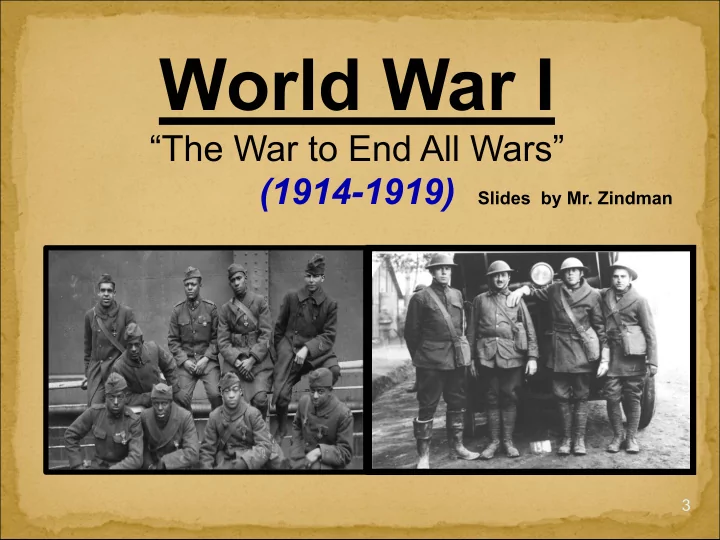
World War I The War to End All Wars (1914-1919) Slides by Mr. - - PowerPoint PPT Presentation
World War I The War to End All Wars (1914-1919) Slides by Mr. Zindman 3 NEW YORK STATE STANDARD World War I 8.4 WORLD WAR I : Various diplomatic, economic, and ideological factors contributed to the United States decision to enter World
3
4
NEW YORK STATE STANDARD
World War I
8.4 WORLD WAR I : Various diplomatic, economic, and ideological factors contributed to the United States decision to enter World War I. Involvement in the war significantly altered the lives of Americans.
(Standards: 1, 2, 4; Themes: SOC, GOV, ECO, TECH)
8.4a European militarism, the alliance system, imperialism, and nationalism were all factors that contributed to the start of World War I. 8.4b International, economic, and military developments swayed opinion in favor of the United States siding with the Allies and entering World War I. Domestic responses to World War I limited civil liberties within the United States.
United States entry into the war.
involvement in the war.
including the Espionage Act (1917) and the Sedition Act (1918). 8.4c New military technologies changed military strategy in World War I and resulted in an unprecedented number of casualties.
including trench warfare, chemical weapons, machine guns, and aircraft. 8.4d Following extensive political debate, the United States refused to ratify the Treaty of Versailles. The United States then sought to return to prewar policies by focusing on domestic rather than international matters.
Senate refused to support the Treaty of Versailles, focusing on opposition to the League of Nations.
5
ESSENTIAL QUESTIONS:
Fourteen Points? ENDURING UNDERSTANDINGS:
solve world wide problems.
they can not help themselves. I CAN STATEMENTS:
I can explain the causes of WWI. I can explain how propaganda helped ”fuel” WWI. I can spell out what restrictions Americans faced during WWI. I can describe the new weapon technology used in WWI. I can give details on why the Fourteen Points and League of Nations failed.
LANGUAGE OBJECTIVE:
1.To determine the topic and supporting details from an informational text. 2.To determine the central idea from an informational text 3.To make an inference using supporting evidence from a text.
6
______________________________________________________________ ______________________________________________________________ ______________________________________________________________
______________________________________________________________ ______________________________________________________________ ______________________________________________________________
______________________________________________________________ ______________________________________________________________ ______________________________________________________________
______________________________________________________________ ______________________________________________________________ ______________________________________________________________
______________________________________________________________ ______________________________________________________________ ______________________________________________________________
7
In 1914 Europe exploded into war. Extreme feelings of
nationalism, or pride in one’s nation, fueled the tension
between countries. European nationalists demanded freedom and self-government. Imperialism fueled rivalries between powerful nations to take over less powerful countries. Between 1870 and 1914, Britain, France, Germany, Italy, and Russia scrambled to take
I can explain the causes of WWI. I can explain how propaganda helped ”fuel” WWI. I can spell
used in WWI. I can give details on why the Fourteen Points and League of Nations failed.
8
Another source of war was tensions in Europe over militarism, the policy of building up strong armed forces to prepare for the war. Super powers built up their military forces and made formed alliances with other
with Austria-Hungry and Italy. France responded by a hooking themselves up with Russia and Britain in the Triple Entente.
I can explain the causes of WWI. I can explain how propaganda helped ”fuel” WWI. I can spell
used in WWI. I can give details on why the Fourteen Points and League of Nations failed.
9
In June 1914, the new crisis struck and helped contribute to the start of World War I. The Archduke Franz Ferdinand, heir to the throne in Austria-Hungary , and his family were shot by a terrorist
next day, Russia ordered its forces to mobilize, or prepare for war. Germany, called on Russia to cancel the order to prepare for war. When they received no reply from Russia, Germany declared war on
I can explain the causes of WWI. I can explain how propaganda helped ”fuel”
Americans faced during WWI. I can describe the new weapon technology used in WWI. I can give details on why the Fourteen Points and League of Nations failed.
10
In World War I countries started taking sides, the Central and Allied Powers. The Central Powers- Germany, Austria-Hungary, and the Ottoman
Allied Powers- France, Britain, and Russia. In time, twenty one
Both sides dug in, creating a maze of trenches protected by mines and barbed wire. Soldiers spent weeks in these muddy rat- infested holes in the ground.
I can explain the causes of WWI. I can explain how propaganda helped ”fuel” WWI. I can spell out what restrictions Americans faced during WWI. I can describe the new weapon technology used in WWI. I can give details on why the Fourteen Points and League of Nations failed.
11
Europe and Asia choose sides.
I can explain the causes of WWI. I can explain how propaganda helped ”fuel” WWI. I can spell out what restrictions Americans faced during WWI. I can describe the new weapon technology used in WWI. I can give details on why the Fourteen Points and League of Nations failed.
12
Weapons used in World War I
The machine gun, dominated the World War I
choice for the infantry soldiers.
I can explain the causes of WWI. I can explain how propaganda helped ”fuel” WWI. I can spell out what restrictions Americans faced during WWI. I can describe the new weapon technology used in WWI. I can give details on why the Fourteen Points and League of Nations failed.
13
In trench warfare opposing armed forces attack, counterattack, and defend from relatively permanent systems of trenches dug into the ground. The
warfare is resorted to when the superior firepower of the defense compels the opposing forces to “dig in” so extensively as to sacrifice their mobility in order to gain protection.
Trench Warfare
I can explain the causes of WWI. I can explain how propaganda helped ”fuel” WWI. I can spell out what restrictions Americans faced during WWI. I can describe the new weapon technology used in WWI. I can give details on why the Fourteen Points and League of Nations failed.
14
Three substances were responsible for most chemical-weapons injuries and deaths during World War I: chlorine, phosgene, and mustard gas. ... Although the Germans were the first to use phosgene on the battlefield, it became the primary chemical weapon of the Allies. Chemical weapons caused choking, blindness, skin blisters, and sometimes death! Today world leaders in the United Nations react seriously to the use of chemical weapons!
I can explain the causes of WWI. I can explain how propaganda helped ”fuel” WWI. I can spell out what restrictions Americans faced during WWI. I can describe the new weapon technology used in WWI. I can give details on why the Fourteen Points and League of Nations failed.
15
Aircraft in World War I
The aircraft played a pivotal role for all sides of World War 1 when the conflict began in 1914. ... As the situation on the ground slowed to become Trench Warfare, it would fall to the men in the skies to provide a breakthrough and ultimately force air superiority on the
I can explain the causes of WWI. I can explain how propaganda helped ”fuel” WWI. I can spell out what restrictions Americans faced during WWI. I can describe the new weapon technology used in
the Fourteen Points and League
16
One of the War Heroes of the Germans was “The Red Baron.”
I can explain the causes of WWI. I can explain how propaganda helped ”fuel” WWI. I can spell out what restrictions Americans faced during WWI. I can describe the new weapon technology used in WWI. I can give details on why the Fourteen Points and League of Nations failed.
17
When war broke out in Europe, the United States was determined to avoid being dragged into the conflict. The government adopted an
Americans “to be neutral in fact as well as in name.” Public
The war had several immediate effects on the United States. The economy boomed. American farmers and manufactures rush to fill
I can explain the causes of WWI. I can explain how propaganda helped ”fuel” WWI. I can spell
used in WWI. I can give details on why the Fourteen Points and League of Nations failed.
18
Both sides waged a propaganda war in the United States. Propaganda is a spreading of ideas and helped cause or hurt an imposing cause. World War I propaganda was used to convince Americans that we needed to go to war! Each side (Germany and the U.S.A.) pictured each other as savage beasts who killed innocent civilians. To enforce a blockade of trade Germany used a new powerful weapon –a fleet of submarines known as U –boats. German U- boats attacked a ship data entered or left British ports.
propaganda U –boats.
I can explain the causes of WWI. I can explain how propaganda helped ”fuel” WWI. I can spell out what restrictions Americans faced during WWI. I can describe the new weapon technology used in WWI. I can give details on why the Fourteen Points and League of Nations failed.
19
Examples of World War I Propaganda
I can explain the causes of WWI. I can explain how propaganda helped ”fuel” WWI. I can spell
used in WWI. I can give details on why the Fourteen Points and League of Nations failed.
20
I can explain the causes of WWI. I can explain how propaganda helped ”fuel” WWI. I can spell out what restrictions Americans faced during WWI. I can describe the new weapon technology used in WWI. I can give details on why the Fourteen Points and League of Nations failed.
21
On May 7, 1915, a German submarine torpedoed the Lusitania, a British passenger ship, off the coast of Ireland. The Germans claimed the Lusitania was carrying weapons secretly. Nearly 1,200 people died, including 120 Americans. Wilson called the sinking of the ship murder on the high seas. Germany did not want to risk war with the United States so if they agreed to stop attacking neutral ships without warning.
Lusitania
I can explain the causes of WWI. I can explain how propaganda helped ”fuel” WWI. I can spell out what restrictions Americans faced during WWI. I can describe the new weapon technology used in WWI. I can give details on why the Fourteen Points and League of Nations failed.
22
The outbreak of war in Europe horrified American auto maker Henry Ford. Ford sailed to Europe to try to bring the warring powers to the peace table. As Christmas past, the war went on. A President Wilson tried to bring both sides to peace talks. He believed that the United States, as a neutral country, could lead the warring nations to a fair peace. The President built a stronger navy and army because he thought the United States to be drawn into the war.
I can explain the causes of WWI. I can explain how propaganda helped ”fuel” WWI. I can spell out what restrictions Americans faced during WWI. I can describe the new weapon technology used in WWI. I can give details on why the Fourteen Points and League of Nations failed.
23
People who tried to stir up wars were called warmongers. In January, 1917, and Wilson issued what proved to be his final plea for peace, but it was too late. Germany has already decided to use submarine warfare. In February, Wilson learned that Arthur Zimmermann had sent a secret note to the German minister in Mexico. The Zimmermann Telegram instructed the minister two tell Mexico to attack the United
attack the United States. In return, Germany would help Mexico regain the territory is lost to the United
United States into the war. In addition, German submarines sank several American merchant ships.
I can explain the causes of WWI. I can explain how propaganda helped ”fuel” WWI. I can spell out what restrictions Americans faced during WWI. I can describe the new weapon technology used in WWI. I can give details on why the Fourteen Points and League of Nations failed.
24
When the war in Europe began in 1914, Russian revolutionaries called for democracy in Russia. The revolutionaries stared the Russian Revolution. President Wilson welcomed the Russian Revolution. The Russians had to pull out of the war to handle the Russian revolution. Wilson was elected as President because he promised to keep the US out of the war. On April 2, and President Wilson went before Congress to asked for a declaration of
Americans into the deadliest war the world hasn’t yet seen. Signing the Declaration of War
I can explain the causes of WWI. I can explain how propaganda helped ”fuel” WWI. I can spell
used in WWI. I can give details on why the Fourteen Points and League of Nations failed.
25
The day after Congress declared war, George M. Cohan wrote a new song, “Over There.” The two swept the nation. On May 18, Congress passed the Selective Service Act. And it acquired all young men from the age 21 to 30 to register for the military draft. A draft is a law requiring people of certain age to serve in the
the armed forces.
I can explain the causes of WWI. I can explain how propaganda helped ”fuel” WWI. I can spell out what restrictions Americans faced during WWI. I can describe the new weapon technology used in WWI. I can give details on why the Fourteen Points and League of Nations failed.
26
I can explain the causes of
propaganda helped ”fuel”
restrictions Americans faced during WWI. I can describe the new weapon technology used in WWI. I can give details on why the Fourteen Points and League of Nations failed.
27
Congress Passes the Espionage Act of 1917 and Sedition Act of 1918
The purpose of the Espionage Act was to prohibit interference with military
enemies during wartime or to promote insubordination in the military.
authority to prohibit the mailing of newspapers and magazines. The law also threatened individuals convicted of obstructing the draft (military recruitment) with $10,000 fines and 20 years in jail.
law with the Sedition Act of 1918. Its purpose was to make it illegal to write or speak anything critical of American involvement in the war.
abusive language" about the Constitution, the government, the American uniform, or the US flag.
The Supreme Court of the US ruled in the case, Schenck vs. US, that free speech can be restricted and limited if it creates a clear and present danger to the US (as in times of war)
I can explain the causes of WWI. I can explain how propaganda helped ”fuel” WWI. I can spell out what restrictions Americans faced during WWI. I can describe the new weapon technology used in WWI. I can give details on why the Fourteen Points and League of Nations failed.
28
While men drilled for combat, women served as radio operators, clerks and stenographers. People got caught up in the wars spirit. For many African Americans and immigrants, the army offered several firsts. It was the first exposure to military authority and discipline. About 25% were illiterate, that is, unable to read or write. Racism was still evident in America’s army. African Americans rallied behind the war. In an effort, W.E.B. Du Bois voiced the effect World War I had on the African Diaspora and the failure of treating African soldiers equally.
I can explain the causes of WWI. I can explain how propaganda helped ”fuel” WWI. I can spell out what restrictions Americans faced during WWI. I can describe the new weapon technology used in WWI. I can give details on why the Fourteen Points and League of Nations failed.
29
States are recognized its economy to produce food, arms, and other goods needed to fight the war. A huge bureaucracy emerged to manage the war effort. A bureaucracy is a system of managing government through departments run by appointed officials. Wilson chose Herbert Hoover to head Food
job was to boost food
to feed his troops and help Allies.
bureaucracy Herbert Hoover
I can explain the causes of WWI. I can explain how propaganda helped ”fuel” WWI. I can spell out what restrictions Americans faced during WWI. I can describe the new weapon technology used in WWI. I can give details on why the Fourteen Points and League of Nations failed.
30
Americans on the home front united behind the war effort. Movie stars, such as Charlie Chaplin and Mary Pickford, helped sell Liberty Bonds. By buying bonds, American citizens were lending money to the government to pay for the war. As men join the armed forces, women stepped into their jobs. Women received better pay in war industries than they had in peacetime. Still, they earned less than men they replaced. Some women drove trolley cars and delivered the mail. By performing well in jobs once reserved for men, women helped change the view that they were fit only four “women’s work.” Indeed German prejudice spread throughout the United States.
I can explain the causes of WWI. I can explain how propaganda helped ”fuel” WWI. I can spell out what restrictions Americans faced during
technology used in WWI. I can give details on why the Fourteen Points and League of Nations failed.
31
I can explain the causes of WWI. I can explain how propaganda helped ”fuel” WWI. I can spell out what restrictions Americans faced during WWI. I can describe the new weapon technology used in WWI. I can give details on why the Fourteen Points and League of Nations failed.
32
Describe this picture.
I can explain the causes of WWI. I can explain how propaganda helped ”fuel” WWI. I can spell out what restrictions Americans faced during WWI. I can describe the new weapon technology used in WWI. I can give details on why the Fourteen Points and League of Nations failed.
33
Some Americans opposed the war. Among them were progressives such as Jane Adams. Many of these critics were pacifists, people who refuse to fight in any war because they believe the war is evil. Antiwar feelings rose with the socialist believers. A socialist believes that the people as a whole rather than the private individuals should on all property and share the profits from all businesses.
Why is this a pacifist sign? Jane Adams
I can explain the causes of WWI. I can explain how propaganda helped ”fuel” WWI. I can spell out what restrictions Americans faced during WWI. I can describe the new weapon technology used in WWI. I can give details on why the Fourteen Points and League of Nations failed.
34
The United States would send more than 2 million soldiers to
took time. The first the troops had to be trained and then
300,000 American troops and reached France. The first American troops reached France on June, 1917. The Allies had lost millions of
were exhausted and ill. Many civilians in Britain and France were near starvation.
3.Americans in Battle
I can explain the causes of WWI. I can explain how propaganda helped ”fuel” WWI. I can spell out what restrictions Americans faced during WWI. I can describe the new weapon technology used in WWI. I can give details on why the Fourteen Points and League of Nations failed.
35
To make matters worse, Russia withdrew from the war. A group known as the Bolsheviks seized power from the government. Under the leadership
1800’s. Marks had predicted that the workers around the world would unite to overthrow the ruling class. After the workers revolted, they would divide the private property and set up a classless society. Lenin was determined to lead such a revolution in Russia. In March 1918, Russia and Germany signed the Treaty of Best-Litovsk. Karl Marx V.I. Lenin Treaty of Best-Litovsk
I can explain the causes of WWI. I can explain how propaganda helped ”fuel” WWI. I can spell out what restrictions Americans faced during WWI. I can describe the new weapon technology used in WWI. I can give details on why the Fourteen Points and League of Nations failed.
36
By June, 1917 American troops were reaching France in record numbers. American troops dressed in green were called the “doughboys” by British troops. General John Pershing commanded the American army. Pershing agreed to let some Americans fight with the British and
American to fight with the French army was a 369th United States
became known as the Harlem Hell
allowed few African Americans to train for combat, the French respected the bravery of African American soldiers and were glad to fight side by side with them.
General John Pershing
Harlem Hell Fighters
A Veteran of the Harlem Hell Fighters I can explain the causes of WWI. I can explain how propaganda helped ”fuel” WWI. I can spell out what restrictions Americans faced during WWI. I can describe the new weapon technology used in WWI. I can give details on why the Fourteen Points and League of Nations failed.
37
In June, 1918, American troops plunged into the first major battle of the war in Belleau Wood. This battle raged on for three weeks. It was called the Battle of Belleau Wood. In September, German generals told the Kaiser, or German ruler, that the war could not be one. An armistice or an agreement to stop fighting, was then set up. President Wilson’s set up two conditions for armistice. First, Germany must accept his plan for peace. Second, the German emperor must abdicate, that is, give up power.
Belleau Wood, France
Battle of Belleau Wood
I can explain the causes of WWI. I can explain how propaganda helped ”fuel” WWI. I can spell out what restrictions Americans faced during WWI. I can describe the new weapon technology used in WWI. I can give details on why the Fourteen Points and League of Nations failed.
38
On November 9, the German emperor was forced to resign. He ran away to Holland, and Germany became a Republic. The new German leaders agreed to the armistice terms. Between eight million and nine million people died in the battles of the war. Germany’s loan for the war was close to 2 million men. Much of northern France lay in ruins. Million Germans were near
The German Emperor German Soldiers
I can explain the causes of WWI. I can explain how propaganda helped ”fuel” WWI. I can spell out what restrictions Americans faced during WWI. I can describe the new weapon technology used in WWI. I can give details on why the Fourteen Points and League of Nations failed.
39
Then to complicate matters worse, a new disaster struck! A terrible influenza epidemic spread around the world. An epidemic is a rapid spread of a contagious disease among large numbers of people. Between 1918 and 1919, more than half a million Americans died in the flu epidemic.
The flu epidemic
I can explain the causes of WWI. I can explain how propaganda helped ”fuel” WWI. I can spell out what restrictions Americans faced during WWI. I can describe the new weapon technology used in WWI. I can give details on why the Fourteen Points and League of Nations failed.
40
President Wilson Visited Paris, London, Milan, and Rome to work on a peace plan now that Germany
Wilson outlined his peace plan called the Fourteen Points. His plan was meant to prevent international problems from causing another war. The first point of his agreement called for an end to secret
freedom of the seas, free trade and a limit on arms. He also supported the principle of self-determination, that is for the right of national groups to their own territory and forms of government.
President Wilson
I can explain the causes of WWI. I can explain how propaganda helped ”fuel” WWI. I can spell out what restrictions Americans faced during WWI. I can describe the new weapon technology used in WWI. I can give details on why the Fourteen Points and League of Nations failed.
41
The fourteenth point was the most important. It called for a “general association of nations,” or League of Nations League of Nations. Its job was to protect the independence
rejected the Treaty of Versailles based primarily on
ratify the treaty or join the League of Nations. The League infringed on the power and authority of the United States.
I can explain the causes of WWI. I can explain how propaganda helped ”fuel” WWI. I can spell
used in WWI. I can give details on why the Fourteen Points and League of Nations failed.
42
President Wilson convinced the allies to accept this proposal, but many countries were only concerned with their own interests. The diplomats from the more than 30 nations met in Paris and Versailles, France. Key issues were decided by The Big Four- Woodrow Wilson of the United States, Davis Lloyd George of Britain, Georges Clemenceau of France and Vittorio Orlando of Italy. Woodrow Wilson urged the nations to “have peace without victory.” Instead the counties had their own aims.
League of Nations
I can explain the causes of WWI. I can explain how propaganda helped ”fuel” WWI. I can spell
used in WWI. I can give details on why the Fourteen Points and League of Nations failed.
43
The other allies called for Germany to pay reparations, or cash payments for the losses, they had suffered during the war. The allies were also determined to stop Germany from building up its military again. By June 1919, the Treaty of Versailles was ready. Under the Treaty of Versailles Germany had to take complete blame for the war. Germany had to pay 300 billion dollars in reparations. The treaty limited the size of the German military. The United States focused on domestic policies rather than international issues after the war.
Versailles
I can explain the causes of WWI. I can explain how propaganda helped ”fuel” WWI. I can spell
used in WWI. I can give details on why the Fourteen Points and League of Nations failed.
44
I can explain the causes of WWI. I can explain how propaganda helped ”fuel” WWI. I can spell out what restrictions Americans faced during WWI. I can describe the new weapon technology used in WWI. I can give details on why the Fourteen Points and League of Nations failed.
45
The treaty provided for several nations to be formed. They included the counties of Poland, Czechoslovakia and Yugoslavia. They were created from the land once owned by Germany. When President Wilson returned home he had to convince Americans to support the treaty. Most German –Americans thought the terms of the treaty was too harsh. Many Americans were Isolationists because they wanted the United States to stay out of world affairs. Critics such as, Henry Cabot Lodge, accepted the idea of a League of Nations, but he called for changes in the provisions of the league. He did not like the fact that members of the league had to protect countries that were threatened. He felt this provision would bring us into future European wars.
Henry Cabot Lodge
I can explain the causes of WWI. I can explain how propaganda helped ”fuel” WWI. I can spell
used in WWI. I can give details on why the Fourteen Points and League of Nations failed.
46
As a result of the pressure from this provision, President Wilson suffered a stroke in November
America join the League of Nations due many opponents in the United States. Eventually, the League of Nations would set the foundation for the United Nations.
I can explain the causes of WWI. I can explain how propaganda helped ”fuel” WWI. I can spell
used in WWI. I can give details on why the Fourteen Points and League of Nations failed.
47
______________________________________________________________ ______________________________________________________________ ______________________________________________________________
______________________________________________________________ ______________________________________________________________ ______________________________________________________________
______________________________________________________________ ______________________________________________________________ ______________________________________________________________
______________________________________________________________ ______________________________________________________________ ______________________________________________________________
______________________________________________________________ ______________________________________________________________ ______________________________________________________________
48
I can explain the causes of WWI. I can explain how propaganda helped ”fuel” WWI. I can spell
used in WWI. I can give details on why the Fourteen Points and League of Nations failed.