Workshop Overview Support Medicaid Managed Care Services The New - - PDF document

workshop overview
SMART_READER_LITE
LIVE PREVIEW

Workshop Overview Support Medicaid Managed Care Services The New - - PDF document

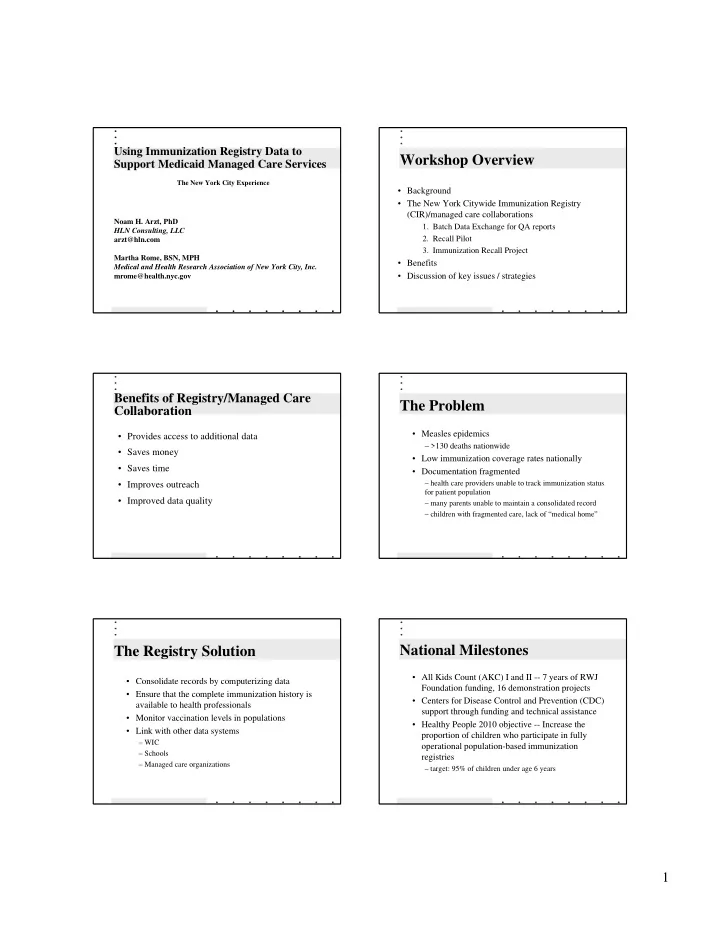
Using Immunization Registry Data to Workshop Overview Support Medicaid Managed Care Services The New York City Experience Background The New York Citywide Immunization Registry (CIR)/managed care collaborations Noam H. Arzt, PhD 1.


slide-1
SLIDE 1

1

Using Immunization Registry Data to Support Medicaid Managed Care Services

The New York City Experience

Noam H. Arzt, PhD HLN Consulting, LLC arzt@hln.com Martha Rome, BSN, MPH Medical and Health Research Association of New York City, Inc. mrome@health.nyc.gov

Workshop Overview

  • Background
  • The New York Citywide Immunization Registry

(CIR)/managed care collaborations

  • 1. Batch Data Exchange for QA reports
  • 2. Recall Pilot
  • 3. Immunization Recall Project
  • Benefits
  • Discussion of key issues / strategies

Benefits of Registry/Managed Care Collaboration

  • Provides access to additional data
  • Saves money
  • Saves time
  • Improves outreach
  • Improved data quality

The Problem

  • Measles epidemics

– >130 deaths nationwide

  • Low immunization coverage rates nationally
  • Documentation fragmented

– health care providers unable to track immunization status for patient population – many parents unable to maintain a consolidated record – children with fragmented care, lack of “medical home”

The Registry Solution

  • Consolidate records by computerizing data
  • Ensure that the complete immunization history is

available to health professionals

  • Monitor vaccination levels in populations
  • Link with other data systems

– WIC – Schools – Managed care organizations

National Milestones

  • All Kids Count (AKC) I and II -- 7 years of RWJ

Foundation funding, 16 demonstration projects

  • Centers for Disease Control and Prevention (CDC)

support through funding and technical assistance

  • Healthy People 2010 objective -- Increase the

proportion of children who participate in fully

  • perational population-based immunization

registries

– target: 95% of children under age 6 years

slide-2
SLIDE 2

2

CDC Functional Standards

  • Enable providers to retrieve information from the

registry on all vaccination encounters at the time of encounter

  • Automatically determine the vaccination(s) needed

when a person seeks vaccination based on ACIP recommendations

  • Consolidate vaccination records from multiple

providers, using duplication and edit checking procedures to optimize accuracy and completeness

National Challenges

  • On-going funding
  • Data quality - matching and merging records
  • Data completeness
  • Private provider participation

– technology barriers

– time constraints – lack of incentives

Moving Forward

  • All Kids Count (AKC) III

– integrated data systems – continued development of a national registry vision

  • American Immunization Registry Association

(AIRA)

– national membership organization – advocates for the support of registry development – promotes and facilitates information exchange

  • Health Care Financing Administration (HCFA)

funding for registries

Overview -- NYC

  • 125,000 births annually
  • 1,200 pediatric provider sites

–104 public

–1,083 private

  • 30 managed care organizations serving NYC

children

–18 serve Medicaid patients

slide-3
SLIDE 3

3

New York Citywide Immunization Registry

  • Citywide Immunization Registry (CIR) contains

1.9 million records, 10 million immunizations

  • Reporting immunizations is mandated by City

Health Code

  • Reporting options:

– paper, electronic and on-line

  • Web-based Intranet application

– child-by-child look-up – designed for immunization screening and printout

CIR Access/Use of Data

  • Providers -- on-line or via telephone

– child by child look-up – print-outs – recommendations for immunizations due

  • Parents -- written application

– parent brochure

– paper application – record faxed or mailed to parent

CIR / MCO Collaborations

  • 1. Batch Data Exchange to supplement chart review

data for NYS QA measures

  • 2. Recall Pilot

– 3 MCOs – ~ 950 children – recall letters sent to families

  • 3. Immunization Recall Project

– all 18 NYC Medicaid managed care plans

slide-4
SLIDE 4

4

Batch Data Exchange

  • Managed care plans provide lists of enrolled

children in sample for NYS QA

  • Automated and manual matching of records
  • CIR provides immunization records in flat file

format

  • 10 Plans sought CIR data in 2000
  • Plans able to raise scores by 5% or more with
  • ut-of-plan immunizations

Recall Pilot

  • A collaborative pilot to recall of children in

need of immunizations using registry/managed care plan combined data

– 3 Plans -- voluntary participation – N= ~ 950 children – recall letters sent for all children not UTD

Objectives

  • To pilot recall of children in need of

immunizations using registry/managed care combined data

  • To improve CIR data quality
  • To design and develop an automated process to

create recall letters using the CIR immunization forecasting algorithm

Process

File from MCO

  • r Provider

Smart Search De-duplication De-dup Reports Verification Report CIR File to MCO

  • r

Provider Letters and Labels Recall Generator Verification Recall Generator Recall Output PowerBuilder CIR Update File

Process (continued)

  • File de-duplicated using Smart Search
  • Report of immunizations (Verification Report) in

the CIR created by Recall Generator

  • Managed care plan personnel review report,

correct and add immunizations from medical record

Process (continued)

  • Report returned to DOH, data updated in CIR
  • For children not UTD, past immunizations and

immunizations currently due are automatically generated for a file or paper printout

  • Letters or file sent to the managed care plan
  • Plans or DOH mail recall letters to members
slide-5
SLIDE 5

5

Confidentiality

  • Plans identify children per NYC Health Code

regulations

  • Plans identify PCP and family address

– Office of Vital Statistics does not allow release of address from birth records

  • Strict matching algorithms and manual review

guarantee that records returned are the same children

  • No demographic information released

Process (continued)

Products

  • Smart Search: Visual Basic client that

accesses CIR database

  • Recall Generator: Visual Basic product

that accesses file generated by Smart Search

Process (continued)

Smart Search Parameters

Process (continued)

Smart Search Options

Process (continued)

Smart Search Record Review

Process (continued)

Recall Generator Parameters

slide-6
SLIDE 6

6

Process (continued)

Recall Generator Options

Process (continued)

Verification Report

Process

Letter Generation

Pilot Results

  • MCO #1

– CIR contained 899 immunizations for 130 children – 329 immunizations added on 72 children from medical record review

  • MCO #2

– CIR contained 2,191 immunizations for 411children – 3,725 immunizations added on 338 children from medical record review

  • MCO #3

– CIR contained 3,454 immunizations for 354 children – 1,707 immunizations added on 256 children from medical record review

Results (continued)

  • Average of 53% not up-to-date

– 4th DTaP – Varicella – intervals not accepted

  • Letters sent in July/August 2000
  • Preliminary results from CIR
  • Need more in-depth follow-up

– evaluation – outreach

Immunization Recall Project

  • A collaborative effort between the NYC

Department of Health Citywide Immunization Registry, the Division of Health Care Access, Medicaid Managed Care Plans, and Primary Care Providers (PCPs)

  • Builds on the Recall Pilot -- all Medicaid managed

care plans, ongoing

slide-7
SLIDE 7

7

Objectives

  • To identify and recall all 2-year-old children in

NYC enrolled in Medicaid managed care not up- to-date on immunizations

  • To improve immunization coverage of 2-year-
  • ld children at risk for vaccine preventable

disease in NYC

  • To increase completeness of CIR records

Methods

  • Submission received from 18 Medicaid managed

care plans in NYC

  • Each file contains demographic data of all

currently enrolled children born in 1998 and primary care provider (PCP)

  • Files size: Total=17,871 children, range of 65-

3100, average file size ~1000

Methods

Phase I: Data Processing

  • Data matched against CIR, multiple/fragmented

records merged – ~90% of children’s records found in CIR

  • Immunization record generated for each child (and

UTD status calculated)

  • Commissioner of DOH contacting each PCP by

letter

  • Each child’s record sent to their PCP for verification

Methods

Phase II: PCP Verification

  • PCPs verify immunization records and report

additional immunizations to the CIR

  • Each child’s record is updated manually
  • Customized recall letters generated for children not

UTD

  • Recall letters sent to families
  • MCOs informed of children not UTD
  • MCOs to undertake further outreach/recall activities

Progress to Date

  • All 18 files received and data cleaned
  • Phase I: Data Processing

– all files processed – children’s records sent to PCPs – time frame 6 weeks for turnaround

  • Phase II: PCP Verification and Recall

– in process – estimated time 6-8 weeks

Challenges

  • Understand competing priorities for Plans
  • Determine if recall should continue to be a

centralized function

  • Medical chart and registry data is needed
  • Need for more record review at the provider level
slide-8
SLIDE 8

8

Conclusions

  • Potential for multiple benefits is high

– data in the CIR more complete and useful – PCP incentive to participate in registries increases – health plans can use registry data to improve ability to outreach to children in need of services – health plans can use registries to save costs and improve efficiency – regular recall should improve immunization coverage