
SLIDE 1
Justin Albert
- Univ. of
Victoria TRIUMF Workshop
- n LHC Results
- Dec. 14, 2011
Victoria Dec. 14, 2011 ATLAS CMS TRIUMF Workshop on LHC Results - - PowerPoint PPT Presentation
Justin Albert TRIUMF Workshop on LHC Results Univ. of Victoria Dec. 14, 2011 ATLAS CMS TRIUMF Workshop on LHC Results TRIUMF Workshop on LHC Results TRIUMF Workshop on LHC Results CMS ATLAS approximate 125 GeV TRIUMF Workshop on LHC
Justin Albert
Victoria TRIUMF Workshop
TRIUMF Workshop
ATLAS CMS
TRIUMF Workshop
TRIUMF Workshop
TRIUMF Workshop
ATLAS approximate CMS
125 GeV
! Under the hypothesis that the peaks at ~125 GeV are the signal
from the decay of more than one different particle), we would like to know this particle’s:
1) Spin, CP, and effective couplings to each decay channel 2) and are these consistent with expectations from a SM Higgs, (in addition, of course, to its exact mass).
TRIUMF Workshop
! Since it appears to decay to !!, we know that it cannot be spin 1, and we also know that it cannot be a fermion => ! it must be spin 0 or 2
! Spin 2 (for example, a Randall-Sundrum graviton) is certainly still a conceivable possibility. In most such models, such particles also would decay to dileptons with a significant branching fraction – this certainly cannot be the case here (there are no bumps in dilepton mass spectra at this mass). But there is no fundamental reason for a tensor particle not to be fermiophobic. ! We need to exclude spin 2 experimentally.
TRIUMF Workshop
! What do we know about its CP? ! Not much. Since it decays to two photons (and because it has even spin), its C-parity must be +1 if C happens to be conserved in the decay – but we don’t know its parity. Must be measured experimentally as well.
! So far, the effective couplings of our possible particle appear consistent with an SM Higgs, but obviously be need quite a bit more data before effective couplings can be measured with any level of precision.
TRIUMF Workshop
god particle dog particle
TRIUMF Workshop
! With sufficient data, we can do an angular analysis of the 4 leptons from the ZZ* decays, and thus obtain info on spin and CP. ! Once we have data in VBF channels, angular analysis of the jets (+ Higgs) can also give us information. (And analogously for tt “H” channels.) ! Associated production channels (also, once we have data in them) can also help us exclude spin 2. ! The jet properties in “H” ! bb and “H” ! !! (again, once we have data in these channels) may also give some information.
TRIUMF Workshop
! And additionally, ratios of observed yields of the signal channels, and even limits, can also all contribute information on spin and CP. ! Information from these sources on Higgs spin and CP is coupled to and correlated with information on Higgs couplings and mass, as well as with other (less interesting) parameters. ! Need a system for combining all information into a global fit for Higgs spin and CP (as well as couplings)… ! Two general ways to do this: a) Directly fit actual events (that pass signal selection for the various Higgs decays) into an event-by-event global fit for Higgs properties. b) Combine already-experimentally-fitted information (constraints on spin, CP, and couplings, perhaps all as functions of Higgs mass) into world-average fits. ! Both are necessary. Let’s start with b)
TRIUMF Workshop
TRIUMF Workshop
! Based on De Rujula et
1001.5300 (extend to additional Higgs decay modes) -- thanks to Adam Ritz & Heather Logan for discussions: ! General spin 0 “Higgs” coupling to two vectors or two fermions: ! Spin 1: ! Spin 2+:
X X
Measured rates (or limits on rates):
gg -> H ZZ 1 qqH ZZ 2 gg -> H WW 3 qqH WW 4 ttH WW 5 gg -> H gam gam 6 qqH gam gam 7 ttH gam gam 8 WH gam gam 9 ZH gam gam 10 qqH tau tau 11 ttH b bbar 12 WH b bbar 13 qqH b bbar 14 qqH gamma b bbar 15 gg -> H Z gam 16 Angular variables
(see hep-ph/9602226): a_1, a_2, b_1, b_2, b_3, b_4 In those same modes: modified Gunion-He parameters (replacing the momentum of the antitop with the momentum of the reconstructed Higgs in the lab frame): a_1', a_2', b_1', b_2', b_3', b_4' In modes 2, 4, 7, 11, 14, 15 (VBF modes): delta_phijj (the azimuthal angle between the two tagging jets, see hep-ph/0105325) And the other phase space variable. [ In modes 1 and 2 (H -> ZZ): the phi & theta decay angles In modes 3, 4, 5 (H -> WW): the angle between the leptons (in the lab frame) In mode 15: the phase space variables In modes 2, 4, 5: angular correlations between the decay angles and the angles of the tagging jets? Decay width
decay (this is certain to be just an upper limit if we have an SM Higgs -- nevertheless, an upper limit gives information and potential constraints). Indirect Higgs information:
TRIUMF Workshop
Eric Ouellette
TRIUMF Workshop
Eric Ouellette
(Plehn, Rainwater, & Zeppenfeld, hep-ph/0105325)
TRIUMF Workshop
Mike Jarrett
TRIUMF Workshop
Mike Jarrett
TRIUMF Workshop
100 fb-1
SM expectation CP odd “Higgs” CP-violating “Higgs” Anomalous additional CP-even coupling “Higgs”
Mike Jarrett
TRIUMF Workshop
! Use best-fit values (with uncertainties) for other SM parameters. ! 21 parameter fit ! New package added to Gfitter. ! BUT FIRST!
1) Before one can really utilize a package like Gfitter, one needs to do an experimental fit for signal and background in the individual modes, etc., to fit for the physical constraints that can then be used in the Gfitter fit. 2) Gfitter does not (and can not) do an experimental fit for those physical constraints. 3) An event-by-event experimental fit, combining all the individual modes, can in principle provide a lot more information than first fitting for constraints, then doing a separate fit to combine those constraints.
⇒ Need to start with an event-by-event experimental fit, with signal and background in each mode, for Higgs properties…
TRIUMF Workshop
mH = 140 GeV
P -3.23959e-03 1.69670e-02 Q -2.54996e-03 5.13866e-03 X 9.99992e-01 3.42836e-04 Y -1.28825e-04 1.99217e-04 Z -3.44592e-05 2.91768e-04 mH 1.47996e+02 9.31544e+00
Parameter fitted value uncertainty
! RooFit-based fit to fully general PDF (as per the DLPRS paper). ! 1000 events (just signal, and just one decay mode, so far…). ! Fit for BSM parameters Y, Z, P, Q (as well as mH).
TRIUMF Workshop
mH = 120 GeV mH = 140 GeV mH = 180 GeV
P 9.90131e-03 1.87854e-02 Q -3.86540e-03 7.73411e-03 X 1.01477e+00 3.16450e-02 Y 3.46769e-02 2.35162e-02 Z 6.13751e-03 4.62983e-03 mH 1.69751e+02 1.21697e+01 P -9.74820e-03 1.54537e-02 Q -9.97596e-03 1.19311e-02 X 9.81234e-01 5.04382e-03 Y -2.37644e-03 1.14924e-02 Z 2.96249e-03 1.35229e-02 mH 1.21754e+02 8.66554e+00 P -3.23959e-03 1.69670e-02 Q -2.54996e-03 5.13866e-03 X 9.99992e-01 3.42836e-04 Y -1.28825e-04 1.99217e-04 Z -3.44592e-05 2.91768e-04 mH 1.47996e+02 9.31544e+00
Parameter fitted value uncertainty Parameter fitted value uncertainty Parameter fitted value uncertainty
TRIUMF Workshop
! We already know a few things about this “Higgs,” assuming it’s not a fluctuation: it must be spin 0 or 2, and – so far… – the couplings are consistent with SM expectation. ! Other properties will need a little more time, but note that although individual Higgs decay modes require large amounts
available info will start seeing results much sooner. ! Begun global Higgs properties fit, both event-by-event, as well as in the Gfitter framework – but urgently need help from / collaboration with theorists!
! Thanks so far to Heather Logan and Adam Ritz for much helpful advice!
! With your (theorists’) help, we should have much more info on the properties of our “possible Higgs” very soon.
TRIUMF Workshop
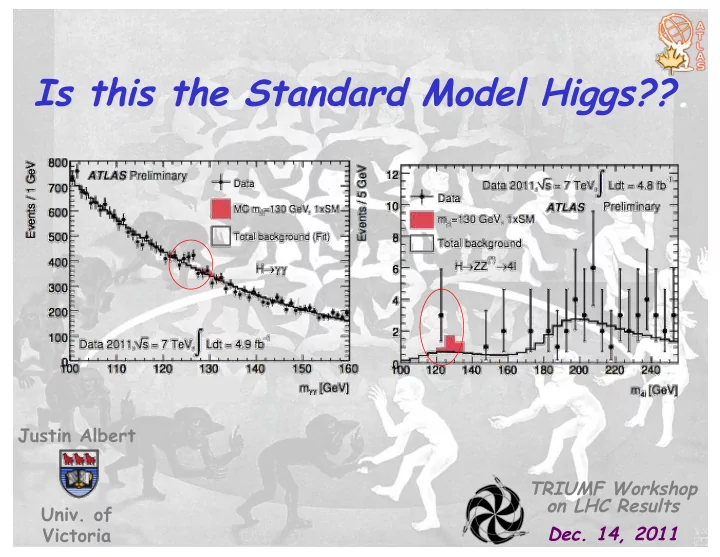
! Before look-elsewhere-effect is considered, we have:
! "" channel: ATLAS: 2.7" signal, (2.0 ± 0.8) x SM @ (126 ± 2) GeV CMS: 2.3" signal, (1.8 ± 0.8) x SM @ (123 ± 3) GeV ! 4! channel: ATLAS: 2.0" signal, (1.5 ± 1.1) x SM @ (124 ± 2) GeV CMS: 0.7" signal, (0.5 ± 0.7) x SM @ (125 ± 6) GeV
! 2ℓ2" channel: ATLAS:
1.8" signal, (2.1 ± 1.6) x SM @ (120 ± 15) GeV CMS: 1.0" signal, (0.7 ± 0.7) x SM @ (126 ± 2) GeV #
! After LEE is considered, we have
! ATLAS combined: 2.3" signal, (1.5 ± 0.6) x SM @ (125 ± 2) GeV ! CMS combined: 1.9" signal, (1.2 ± 0.6) x SM @ (122 ± 3) GeV
! Could there be two separate bumps (at 119 and 125 GeV)?
July 7, 2008
TRIUMF Workshop
God particle Dog particle?