Vaccinations anywhere in this presentation? The exemption rates. - - PowerPoint PPT Presentation

vaccinations
SMART_READER_LITE
LIVE PREVIEW

Vaccinations anywhere in this presentation? The exemption rates. - - PowerPoint PPT Presentation

Only 2.9% to 3.2% of WA K-12 Students use any type exemption- Medical, Personal, and Religious combined- to be less than all injections in any School This presentation is attempting to Attendance Recommended Vaccine Series. The majority of


slide-1
SLIDE 1

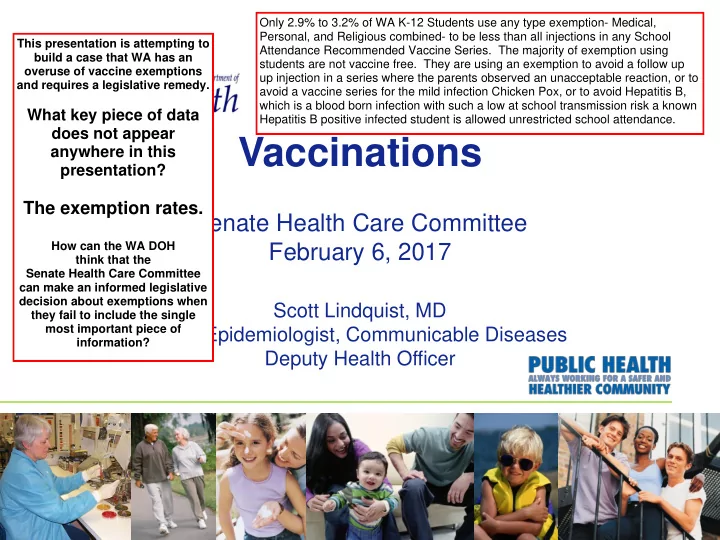
Vaccinations

Senate Health Care Committee February 6, 2017

Scott Lindquist, MD State Epidemiologist, Communicable Diseases Deputy Health Officer

Only 2.9% to 3.2% of WA K-12 Students use any type exemption- Medical, Personal, and Religious combined- to be less than all injections in any School Attendance Recommended Vaccine Series. The majority of exemption using students are not vaccine free. They are using an exemption to avoid a follow up up injection in a series where the parents observed an unacceptable reaction, or to avoid a vaccine series for the mild infection Chicken Pox, or to avoid Hepatitis B, which is a blood born infection with such a low at school transmission risk a known Hepatitis B positive infected student is allowed unrestricted school attendance. This presentation is attempting to build a case that WA has an

  • veruse of vaccine exemptions

and requires a legislative remedy.

What key piece of data does not appear anywhere in this presentation?

The exemption rates.

How can the WA DOH think that the Senate Health Care Committee can make an informed legislative decision about exemptions when they fail to include the single most important piece of information?

slide-2
SLIDE 2

2

Vaccines Save Lives

  • Vaccines given in the first 20 years of the Vaccines for

Children program (1994 – 2014) will prevent

 322 million illnesses  21 million hospitalizations  732,000 deaths over the course of their lifetimes

  • And will save

 $295 billion in direct costs  $1.38 trillion in total societal costs

If the purpose of this presentation is to build a case to eliminate certain vaccine exemptions, this page is irrelevant due to the small fraction of students who use an exemption to avoid all injections. Parents are not using exemptions out of ignorance or in defiance of these assertions of benefit. The fact that most exemption use is for selective vaccination for children who receive(d) vaccinations is the evidence they support(ed) these assertions. Most are using an exemption because they have personal experience with an unacceptable vaccine reaction(s). The real question for considering legislation to eliminate vaccine exemptions is: "Should a student's failure to have every

  • ne of the 17 injections required for K-12

enrollment force them to forfeit a Free and Appropriate Public Education?"

All of these numbers are projected estimates and are very contestable, but because WA has 97% voluntary vaccine compliance this is not necessary.

slide-3
SLIDE 3

The Power of Vaccines

100 200 300 400 500 600 700 800 1920 1925 1930 1935 1940 1945 1950 1955 1960 1965 1970 1975 1980 1985 1990 1995 2000 2005 2010 2015

Rate

Year

Mumps in n Washington 192 1920-2015

1967: Mumps Vaccine

* Cases per 100,000 population.

Mumps Mortality- 1920-1982 52 Total over 62 Years

Average .82 annually Peak 7 in 1930 3 mortality 1926 & 1931 0, 1, or 2 mortality 1932 onward 30 of the 62 years had 0 Mortality Peak Year 1964 21,496 cases reported 0 Mortality 1942 12,367 cases 0 Mortality 1973 1,949 cases 1 mortality 1974 2,284 cases 1 mortality 1979 261 cases 1 mortality Mumps mortality is typically due to "co-morbidities", i.e. other health factors rather than Mumps being directly

  • fatal. This is evidenced by the stable

mortality rate in relation to the case number rate fluctuations year to year. Morbidity refers to an incidence of ill health in a population. Mortality refers to the incidence of death or the number of deaths in a population. It is not an absolute that every infection with a high morbidity but low mortality requires suppression.

There is growing evidence that mild pediatric infections may confer some benefits to the child. Studies imply that Mumps infection is protective against Adult ovarian cancer. Measles virus is being researched as a cancer treatment. The idea that an infection could have a beneficial effect was not considered when the vaccines were developed.

High Morbidity Low Mortality Only 3% of WA K-12 students use an exemption of any type- Medical, Personal, & Religious combined- to be less than 2 injections of MMR = 97% compliance

slide-4
SLIDE 4

4

Without Vaccines, Everyone is Vulnerable

NY Times graphic

A Measles Outbreak

slide-5
SLIDE 5

5

High Vaccination Rates Protect the Community

Community Immunity (Herd Immunity)

WA K-12 School System has 97% compliance with vaccine requirements. WA has already achieved "Herd Immunity"

slide-6
SLIDE 6

6

Vaccinated People May Still Get Sick

Example: mumps vaccine is 88% effective

Unvaccinated/Vulnerable Vaccinated/Vulnerable Protected Protected

Only 3% of WA K-12 Students use an exemption to be less than 2 injections of Measles, Mumps and Rubella, MMR. Of the 3% 2/3 have 1 injection. In 100 WA K-12 students 1 have 0 MMR, 2 have 1 MMR, 97 have 2 MMR (or in process). Because vaccination fails 12% for Mumps protection 12 of the 97 students are "Vaccinated/Vulnerable"

100 WA Students 12 Students Susceptible

(12% of 97 Vaccinated)

85 Students

(88% of 97 Vaccinated)

2 Students 1 Dose

78% protected*

1 Student 0 Dose Susceptible

*MMR vaccine prevents most, but not all, cases

  • f mumps and complications caused by the dis-
  • ease. Two doses of the vaccine are 88% (range:

66 to 95%) effective at protecting against mumps;

  • ne dose is 78% (range: 49% to 92%) effective.

https://www.cdc.gov/mumps/outbreaks.html

3 Students Use Exemption

This corrected chart shows that due to the low, 88% efficacy of the Mumps vaccine the "Vaccinated/Vulnerable" students represent a much larger potential infection pool than the students using an exemption to be less than 2 MMR injections. Excluding exempt students from school has a minimal impact on transmission of this infection. Outbreaks occur in "100%" groups. 97 Students Complete 2 injections MMR

slide-7
SLIDE 7

The Power of Vaccines in Perspective

What is not shown in this chart is the shifting of infection incidence from the young ages where Mumps is extremely well tolerated to the post-pubertal outbreaks common today. This is due to the vaccine’s waning effectiveness, estimated to be 10 to 15 years. The combination of 82% initial efficacy, declining protection, and historical 10 year cycles are the cause of the recent outbreaks, which are unrelated to vaccination rates. WA has had no drop in MMR vaccination. It appears we may be headed for a 10 year booster.

10 year cycle CDC Chart National Mumps outbreak tracking https://www.cdc.gov/mumps/outbreaks.html

slide-8
SLIDE 8

Vaccine Recommendations and School Requirements

Spokane Outbreak Analysis

Every WA student is required to have a Certifi- cate of Immunization S tatus- CIS

  • to attend
  • school. If they don’t have one at enrollment

they must provide one within 30 days or be sus-

  • pended. Doesn’t this make it highly unlikely

that any of the “vaccination status unknown” cases are school age? There are 56 cases age 20-59. This group is the least likely to be able to document vaccination status to the health de- partment’s satisfaction. There are only 4 unvaccinated cases across 28 schools. From a simple logistical standpoint, how could 4 unvaccinated students be responsible for this

  • utbreak? Isn’t the only rational, scientific

conclusion here is that the vaccinated are in- fecting each other? This is supported by the fact that the CDC concedes that 12% of MMR recipients are never protected from Mumps by vaccination, and the vaccine wears off in 10-15 years (note the 94 cases in age 10 to age 19). There are 4 + times more vaccinated susceptible than children who are exempt. The “vaccinated susceptible” vastly outnumber the voluntary exempt. https:/ / www.cdc.gov/ mumps/ outbreaks.html How is excluding exempt students going to stop an outbreak when most of the susceptible students are still at school?

slide-9
SLIDE 9

9

Immunization Rates: Childhood

19 – 35 month olds with all recommended vaccines

GOAL: 80%

This Chart Does Not Measure WA K-12 School Required Vaccines.

97%

97% of WA K-12 Students DO NOT use an exemption for any vaccine series and are complete or in process

This chart is measuring children who are not in school, not subject to vaccine rules, (unless in a state licensed facility), for completing all vaccines in a series that are not K-12 School Attendance Requirements, by certain age milestones.

This is not a WA K-12 Vaccination Graph.

This is the actual K-12 Report. 96.8% to 97.1% of students do not use an exemption for any vaccine series. They are "complete",

  • r in process for their

vaccine series.

Why is this chart in a presentation about WA K-12 Vaccination and Exemption?

slide-10
SLIDE 10

10

Immunization Rates: Teens

Cancer prevention with full series of HPV vaccine

GOAL: 80%

HPV is not a School Required Vaccine, therefore is not subject to exemption. HPV is a sexually transmitted infection with no "at school" infection risk. What is this chart doing in a presentation that is supposed to be about legislation regarding School Vaccines & Exemptions?

slide-11
SLIDE 11

11

Foundation of Washington’s Immunization Program

Universal Childhood Vaccine Program

 All children are provided all recommended vaccines at NO COST  Washington Vaccine Association  Federal Vaccines for Children Program

Immunization Information System

 Vaccine ordering and management  Shows providers which vaccines a person is due for  Helps keep track of vaccines given, regardless of where you get healthcare

Working fine as illustrated by WA 97% compliance

slide-12
SLIDE 12

12

Essential Partners

Vaccine Advisory Committee

 State healthcare provider associations  Local health jurisdictions and tribal health  Health Care Authority  Office of the Superintendent of Public Instruction

Local Health Jurisdictions

 Assist providers with vaccine ordering and management  Provide guidance on improving immunization rates  Front line for disease outbreaks

State Board of Health

 Sets policy and writes rules

Working fine as illustrated by WA 97% compliance

slide-13
SLIDE 13

13

Essential Partners

Health care providers of all types

 Administer needed vaccines

Community organizations

 Immunization Action Coalition of Washington  WithinReach  VaxNorthwest

slide-14
SLIDE 14

14

New Initiative: School Module

Funded by the legislature Partnership with OSPI Will make it easier for:

 Parents (no need to hand-copy records for school)  School nurses (will show which children are complete)  School administrators (no need to file reports with DOH)  DOH (real-time school immunization data)

Why is there a need for this with 97% compliance? What problem is being remedied?

slide-15
SLIDE 15

15

Contact

Office of Immunization and Child Profile

Michele Roberts, Director Michele.Roberts@doh.wa.gov 360-236-3568

slide-16
SLIDE 16

Sierra Rotakhina, MPH Washington State Board of Health

slide-17
SLIDE 17

Child care and school entry requires proof of one of the following:

Full immunization Working toward full immunization Exemption

slide-18
SLIDE 18

Medical Religious Philosophical or Personal

slide-19
SLIDE 19

Measles Mumps Rubella Tetanus Diphtheria Whooping Cough Haemophilus influenzae type B Hepatitis B Pneumococcal Varicella Polio

slide-20
SLIDE 20

Nine Criteria

Vaccine Effectiveness Disease Burden Implementation

slide-21
SLIDE 21

Sierra rra Rotakh akhina, ina, MPH PH Health Policy Advisor Washington State Board of Health PO Box 47990, Olympia, WA 98504-7990 OFFICE: (360) 236-4106 | FAX: 236-4088 sierra.rotakhina@sboh.wa.gov

slide-22
SLIDE 22

22

SUPPLEMENTAL SLIDES

The speakers during the work session made it sound as if parents are hallucinating vaccine reactions. Here are 2 VAERS reports.

slide-23
SLIDE 23

23

“ALTERNATIVE” SCHEDULES

  • The recommended schedule is based on the earliest a

child can receive protection

  • Delaying vaccination leaves a child vulnerable to disease
  • There are no negative effects on a child’s health from

following the recommended schedule

  • Many vaccines are available in combinations to reduce

the number of shots needed

  • Providers already have latitude to give vaccines at the

time they feel is right for a child

Contestable Claim

The 2013 IOM (Institute Of Medicine) Childhood Immunization Schedule and Safety: Stakeholder Concerns, Scientific Evidence, and Future Studies: “Providers are encouraged to explain to parents how each new vaccine is extensively tested when it is approved for inclusion in the recommended immunization schedule. However, when providers are asked if the entire immunization schedule has been tested to determine if it is the best possible schedule, meaning that it offers the most benefits and the fewest risks, they have very few data on which to base their response.” “Although the committee identified several studies that reviewed the

  • utcomes of studies of cumulative immunizations, adjuvants, and

preservatives (see Chapter 5), the committee generally found a paucity of information, scientific or otherwise, that addressed the risk

  • f adverse events in association with the complete recommended

immunization schedule, even though an extensive literature base about individual vaccines and combination immunizations exists.” https://www.ncbi.nlm.nih.gov/books/NBK206949/

slide-24
SLIDE 24

School Year 2011-2012 2012-2013 2013-2014 2014-2015 2015-2016 Number of reports received 1,934 2,430 2,327 2,447 2,493 % Kinder- gartners complete 85% 86% 83% 83% 85% % Kinder- gartners OOC 9% 8% 10% 11% 8.6%

WA School Immunization Data

Kindergarten is the incorrect age to measure vaccination rates. WA school requirements, enrollment age, and report close date conflict with the CDC age 4 to age 6 administration window for 4 of the 16 WA school required vaccine injections- the 4th Polio, 5th DTaP, 2nd MMR, & 2nd Chicken Pox. WA enrolls children who are age 5 by the first day of school. Young Kinders who are still in process of aging into their final injections are classed as "Out of Compliance" and "Conditional". They are not exempt or "unvaccinated". By 1st grade when all the kids are 6 years old the Complete rates are 95% plus. "Complete" are the Kindergartners who have all 16 injections properly documented before the report deadline on November 1 of that year. It does not include injections received during the year. The Personal Exemption rate is only 3.3%. 100%- 3.3% = 96.7%. Rates below 96.7% are unrelated to exemption use. Students who are missing an injection or documentation are OOC "Out of Compliance" - not unvaccinated. Start of the year Kindergartner complete rates by vaccine series are DTaP 91%, MMR 90.9%, Polio 89.8%, Hep B 92.6%, Chicken Pox 89.3%. By 1st grade as the students turn 6 years these rates increase to 95%. OOC is "Out of Compliance", young kindergartners still in process of getting their final doses. This is Kindergarten only, not K-12- See actual WA DOH Screen Capture below. This is the actual K-12 Report. 96.8% to 97.1% of students do not use an exemption for any vaccine series. They are "complete",

  • r in process.
slide-25
SLIDE 25

25

Immunization Rates: Teens

with all recommended vaccines

Vaccine WA US

Whooping Cough 85.3 86.4 Meningococcal 75.4 81.3 3 doses of HPV - Girls 45.1 41.9 3 doses of HPV - Boys 28.0 28.1

These are not WA School Attendance Required Vaccines

Only 2.9% of WA K-12 students use an exemption for Whooping Cough. This number looks low because 6th graders have a 6th TDaP due during the year and some are still in process at report close. 95% have the first 5 DTaP injections. The Documented Complete Rates for WA 6th grade are 94.5% for Chicken Pox to 96.2% for MMR. Pertussis / Whooping Cough only measures low because of a booster due in 6th grade and the report closes early in the year.

slide-26
SLIDE 26

26

How DOH Promotes Immunization

  • Using evidence-based information
  • Explaining the benefits and risks honestly
  • Child Profile: a health promotion system

reaching 500,000 families with kids aged birth to six years

  • Public campaigns on flu, whooping cough and

HPV

  • Reminder programs for families
  • Media alerts and interviews

Working fine as illustrated by WA 97% compliance

slide-27
SLIDE 27

27

Performance Measurement

Included in Governor’s Results Washington measures Childhood immunizations in age 19 – 35 months CDC Publishes national kindergarten immunization rates National Immunization Survey Childhood and adolescent immunization rates National Quality Forum Common measures sets (HCA, Accountable Care Networks, Health Plans)

This is a telephone survey of children not in school for vaccines not required for K-12. Kindergarten children are too young to measure properly, and these rates are transitory. Final dose timing overlapping the K enrollment age, the early report close date and (in this presentation) using

  • nly the "complete" for all

16 of 16 injections misrepresents actual and final coverage. This is a telephone survey , includes vaccines not re- quired for WA K-12 and is unneeded as WA DOH tracks every student.

slide-28
SLIDE 28
slide-29
SLIDE 29

Three Components

Framework Assumptions Process

slide-30
SLIDE 30

Va Vacc ccin ine e re requiremen irements s for r ch chil ild d ca care re and/or

  • r

school

  • l entry

y are justif tifiabl iable e when en wit ithout ut them: m:

An individual’s decision could place others’ health in jeopardy The state’s economic interests could be threatened The state’s duty to educate children could be compromised

How does Hepatitis B meet this criteria? How would HPV? When reviewing WA States 1920-1962 Historical Rates the annual mortality for all of the the infections on the school attendance required schedule was less than zero long before school attendance rules were enacted, and in several cases before a vaccine was developed. In those cases how can excluding children from a State Constitutionally Guaranteed Education be "justifiable"?

slide-31
SLIDE 31

Some kind of process exists to opt out of immunization requirements by children attending either child care centers and school Vaccine(s) containing the antigen are accessible and cost is not a barrier

slide-32
SLIDE 32

Possible Board action TAG Recommendation Convene Technical Advisory Group (TAG)

Public Health Primary Care Epidemiology Medical Ethics Others

Initial Internal Review

slide-33
SLIDE 33

Recommended by ACIP Effective Cost effective from a societal perspective Safe with acceptable level of side effects

How can anyone other than a parent decide what is an Acceptable Side Effect?

Vaccination is a medical intervention which is NOT therapeutic or designed to treat an existing illness or condition

A parent's primary responsibility is to their own child. Exemption insures they have the ultimate, final decision. Efficacy, durability, and porousness is not perfect for any vaccine and varies greatly. This organization has had several questionable ethics reviews over their Conflict of Interest policies re: members who make money from vaccines voting on vaccines to be included in the recommended schedule. US House of Representatives

https://www.gpo.gov/fdsys/pkg/CHRG- 106hhrg73042/html/CHRG- 106hhrg73042.htm

Office of the Inspector General

https://oig.hhs.gov/oei/reports/oei-04-07- 00260.pdf

slide-34
SLIDE 34

Prevents disease(s) with significant morbidity and/or mortality Reduces the risk of person-to-person transmission

The risk of person to person, at school transmission of Hepatitis B is so low that a known Hepatitis B positive infected student is allowed unrestricted, medically confidential attendance. If a Hepatitis B infected child is not dangerous to other students, then how could a non-infected child who is simply missing the vaccine be a threat? What is Hepatitis B doing in the WA K-12 School Attendance requirements? Why does this presentation contain charts for HPV, a sexually transmitted infection with no at school exposure risk, which is not, and should never be, a school requirement?

slide-35
SLIDE 35

Acceptable to medical community and public Administrative burdens of delivery and tracking vaccine is reasonable Burden of compliance is reasonable for the parent/caregiver

Only a parent can make this decision for their child.