Workshop Goal Commu munity Grant nt Program gram Goal: Prepare - - PDF document

workshop goal
SMART_READER_LITE
LIVE PREVIEW

Workshop Goal Commu munity Grant nt Program gram Goal: Prepare - - PDF document

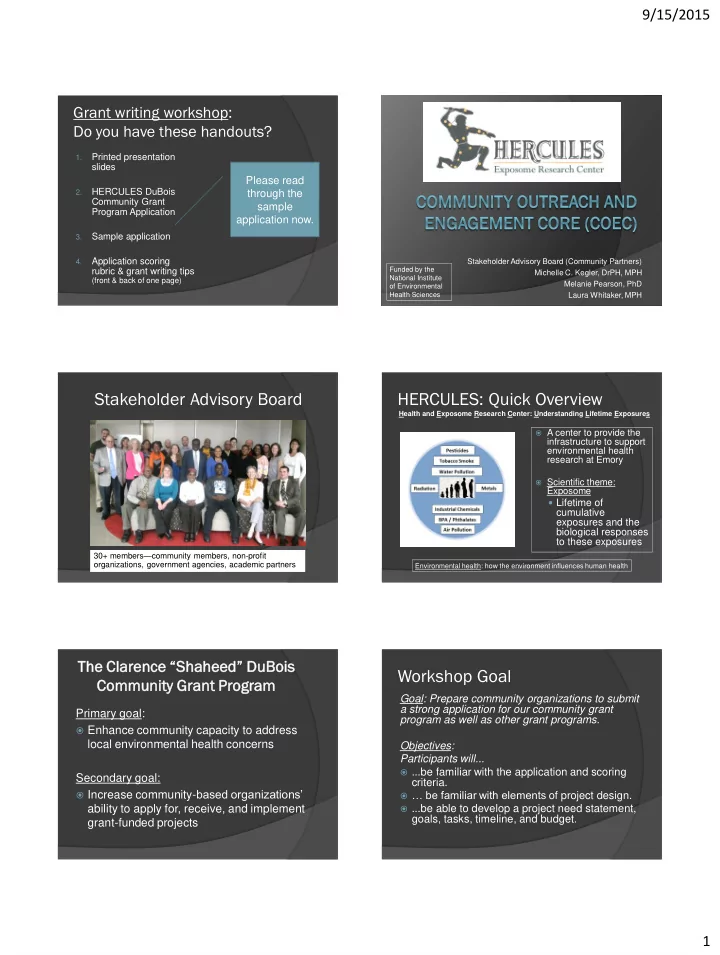
9/15/2015 Grant writing workshop: Do you have these handouts? Printed presentation 1. slides Please read HERCULES DuBois 2. through the Community Grant sample Program Application application now. Sample application 3. Application


slide-1
SLIDE 1

9/15/2015 1 Grant writing workshop: Do you have these handouts?

1.

Printed presentation slides

2.

HERCULES DuBois Community Grant Program Application

3.

Sample application

4.

Application scoring rubric & grant writing tips

(front & back of one page)

Please read through the sample application now.

Stakeholder Advisory Board (Community Partners) Michelle C. Kegler, DrPH, MPH Melanie Pearson, PhD Laura Whitaker, MPH

Funded by the National Institute

  • f Environmental

Health Sciences

Stakeholder Advisory Board

30+ members—community members, non-profit

  • rganizations, government agencies, academic partners

HERCULES: Quick Overview

 A center to provide the

infrastructure to support environmental health research at Emory

 Scientific theme:

Exposome  Lifetime of

cumulative exposures and the biological responses to these exposures

Health and Exposome Research Center: Understanding Lifetime Exposures Environmental health: how the environment influences human health

The Clarence “Shaheed” DuBois Commu munity Grant nt Program gram

Primary goal:

 Enhance community capacity to address

local environmental health concerns Secondary goal:

 Increase community-based organizations’

ability to apply for, receive, and implement grant-funded projects

Workshop Goal

Goal: Prepare community organizations to submit a strong application for our community grant program as well as other grant programs. Objectives: Participants will...

 ...be familiar with the application and scoring

criteria.

 … be familiar with elements of project design.  ...be able to develop a project need statement,

goals, tasks, timeline, and budget.

slide-2
SLIDE 2

9/15/2015 2

Workshop Approach

1.

Proceed step-by- step through the application

2.

Assisted work session with

  • pportunity for

feedback on individual proposal ideas

Question 1: Need Statement

 In other words…

“Why are you applying for this grant?”

  • 1. Projects must address a community need.

Briefly describe the community your project will serve, identify the specific need, and explain how the project will meet the identified community need. (Word limit: 300)

Question 1: Need Statement

“Describe the community your project will serve”

a.

Define your targeted community.

i.

can be a group of people living in the same place (geographical definition) or

ii.

having a particular characteristic in common (e.g., African American women of child-bearing age)

iii.

“students at Factory Elementary School” b.

Describe the conditions in the community.

i.

“buses and cars idle for 45 minutes at school” c.

Describe problems the conditions in the community have caused.

i.

“25% of children have presented respiratory symptoms throughout the past 3 years”

Question 1: Need Statement

“identify the specific need”

a.

State need specifically

i.

“Need to reduce children's exposure to bus and car emissions”

Image from http://www.nj.gov/dep/stopthesoot/sts-schools.htm

Question 1: Need Statement

“explain how the project will meet the identified community need”

a.

Describe how your project will address the problems the conditions have caused.

i.

“implement 1) a policy to have bus drivers turn off bus engines and 2) create flyers to encourage parents to turn off automobile engines”

Image from http://www.afdc.energy.gov/vehicles/images/noidlezone.jpg

Going from Question 1 to Question 2:

Project goals and objectives

What do you want to accomplish with this grant?

 Goals: the ultimate outcome

  • f the project

 “Reduce air pollution around the school & improve student’s health.”  Objectives: specific

actions/outcomes that support the help meet the goal

 “Drivers turn off buses when parked.”  IMPORTANT: Goals &

  • bjectives should directly

relate to the need statement.

Image from http://cdn2.hubspot.net

slide-3
SLIDE 3

9/15/2015 3

Question 2: Project Plan

 In other words…

“How will you accomplish your goals?”

  • 2. How will this project be conducted in your

community? Provide a detailed plan. Describe proposed activities and events. For example, describe how you will promote or publicize activities to get people to participate. Also discuss any barriers you foresee and how you will address them. (Word limit: 500)

Question 2: Project Plan

 Determine Tasks and

Events

 Determine Resources  Staff/volunteer  Supplies  Costs  Develop Timeline  Determine when each task/event is happening

Skip to Question 3: Timeline

DATE ACTIVITY January 2015 February 2015 March 2015 April 2015 May 2015 June 2015 July 2015 August 2015 September 2015 October 2015 November 2015 December 2015 January 2015

Question 3: Timeline

DATE ACTIVITY January 2015 Create official subcommittee February 2015 Training dates and idle reduction policy finalized March 2015 Driver training curriculum written April 2015 Training begins; classes begin art projects May 2015 School ends; training continues June 2015 Driver break room decorated July 2015 Driver appreciation celebration August 2015 Idle Reduction Policy implemented as school starts September 2015 Reportback at PTA meeting October 2015 Hear feedback from teachers and students November 2015 Spot checks by Ms. Krishna continue December 2015 PTA reviews and reports on progress January 2015 PTA presents project outcomes to Emory HERCULES

Skip to Question 5: Budget

 Determine what you

need for each task and event

 Over the grant

amount of $2500?

 Any other resources?

○ Supply donations,

volunteer time, in- kind donations?

○ Include in budget

 Adjust project plans

Image from http://www.topfloortech.com

Question 5: Budget

ITEM AMOUNT TOTAL $2500.00

slide-4
SLIDE 4

9/15/2015 4

Question 5: Budget

ITEM AMOUNT 20 bus drivers’ stipend for training $1000.00 Driver appreciation lunch $400.00 Driver training materials $100.00 Stipend to trainer $100.00 Awareness materials for students and teachers $150.00 Materials to furnish driver room $500.00 Materials for art projects $250.00 Coffee and tea PTA donations Driver break room and training venue Provided by school

  • Ms. Krishna’s work time

Provided by school PTA work time Volunteer Additional art materials Parent donations TOTAL $2500.00

Return to Question 2: Project Plan

 In other words…

“How will you accomplish your goals?”

  • 2. How will this project be conducted in your

community? Provide a detailed plan. Describe proposed activities and events. For example, describe how you will promote or publicize activities to get people to participate. Also discuss any barriers you foresee and how you will address them. (Word limit: 500)

Question 2 – Any Barriers?

 Did you realize any

challenges while planning your project?

 How will these be

addressed?

 “bus drivers are

resistant to leaving their buses "un- manned"

Return to Question 4: Describing your organization

 In other words…

“Why should your organization be awarded this grant?”

4.What is your organization’s past experience in addressing related community concerns? Or: What led your organization to identify the stated environmental health concern and what steps if any you have taken to address it? (Word limit: 200)

Question 4: Describing your organization

 Convince reviewers

that your

  • rganization has the

capacity, experience, qualifications, & past record to conduct the project.

 Organization’s

mission, goals, and priorities

 Project coordinator’s

resume.

 Support letters from

partners = increase capacity.

Strong applications s – see “tips” handout

 Be honest about the

capacity of your

  • rganization – don’t over

promise.

 Explain any omissions,

rather than “hope that no

  • ne will notice.”

 What is not said in an

application can hurt more than what is said.

 If it is not written in the

application, it does not exist for the purpose of the review.

22

slide-5
SLIDE 5

9/15/2015 5

Program basics

 Five awards, up to $2500  Organization must be not-for-profit under Section

501c(3)

 Fiscal agents are acceptable  Must serve or reside in 10-county region  Must address an environmental factor that is

perceived to cause harm to humans (directly)

 Final applications are reviewed and scored by

Stakeholder Advisory Board members

Application process

 Can complete as a PDF fillable form, save, and

email file to us. Please rename the file with your organization name and date.

 Suggest draft in Word, then cut and paste into form  If need to print and mail OK.  Handwritten applications accepted. Word limits apply.  Remember to include project coordinator’s

resume!!!

Questions??

Funding Process

 Half of the grant funds will be awarded at the

start of the grant

 Invoice and other paperwork required.  Grantee must invoice for the second half of

funds when needed.

 Plan to keep all invoices/receipts of expenses

– all expenses will need to be reported

 Government funds – federal rules apply

Expectat ations

  • ns for Awa

wardees

 Complete tax forms ASAP – in order to be in Emory system

for the award start date.

 Participate in a planning meeting with Stakeholder Board.  Provide quarterly brief updates.  documentation of activities and milestones  Participate in an end of year presentation.  Participate in 30-minute feedback phone call.

19

Important Dates

 September 15, 2015: Intent to Apply Due

(by email or phone)

 October 1, 2015: Application due (postmark by)  Receipt confirmation will be by email or phone.  Mid-December: Notification of awards  January 15, 2016: Project start date  For more information, please contact:

Laura Whitaker at 404-712-8761 or laura.whitaker@emory.edu