Workplace Pregnancy-Related Accommodations: Navigating Evolving - - PowerPoint PPT Presentation

workplace pregnancy related accommodations navigating
SMART_READER_LITE
LIVE PREVIEW

Workplace Pregnancy-Related Accommodations: Navigating Evolving - - PowerPoint PPT Presentation

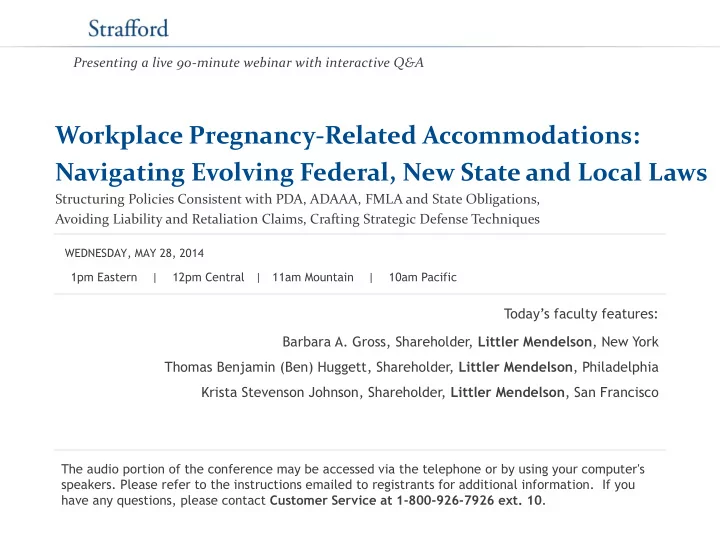
Presenting a live 90-minute webinar with interactive Q&A Workplace Pregnancy-Related Accommodations: Navigating Evolving Federal, New State and Local Laws Structuring Policies Consistent with PDA, ADAAA, FMLA and State Obligations, Avoiding


slide-1
SLIDE 1

Workplace Pregnancy-Related Accommodations: Navigating Evolving Federal, New State and Local Laws

Structuring Policies Consistent with PDA, ADAAA, FMLA and State Obligations, Avoiding Liability and Retaliation Claims, Crafting Strategic Defense Techniques Today’s faculty features:

1pm Eastern | 12pm Central | 11am Mountain | 10am Pacific

The audio portion of the conference may be accessed via the telephone or by using your computer's

  • speakers. Please refer to the instructions emailed to registrants for additional information. If you

have any questions, please contact Customer Service at 1-800-926-7926 ext. 10.

WEDNESDAY, MAY 28, 2014

Presenting a live 90-minute webinar with interactive Q&A Barbara A. Gross, Shareholder, Littler Mendelson, New York Thomas Benjamin (Ben) Huggett, Shareholder, Littler Mendelson, Philadelphia Krista Stevenson Johnson, Shareholder, Littler Mendelson, San Francisco

slide-2
SLIDE 2

Sound Quality If you are listening via your computer speakers, please note that the quality

  • f your sound will vary depending on the speed and quality of your internet

connection. If the sound quality is not satisfactory, you may listen via the phone: dial 1-888-601-3873 and enter your PIN when prompted. Otherwise, please send us a chat or e-mail sound@straffordpub.com immediately so we can address the problem. If you dialed in and have any difficulties during the call, press *0 for assistance. Viewing Quality To maximize your screen, press the F11 key on your keyboard. To exit full screen, press the F11 key again.

FOR LIVE EVENT ONLY

slide-3
SLIDE 3

For CLE purposes, please let us know how many people are listening at your location by completing each of the following steps:

  • In the chat box, type (1) your company name and (2) the number of

attendees at your location

  • Click the word balloon button to send

FOR LIVE EVENT ONLY

slide-4
SLIDE 4

Workplace Pregnancy-Related Accommodations: Navigating Evolving Federal, New State and Local Laws

PRESENTED BY:

  • Barbara Gross, Littler Mendelson, P.C., New York City
  • Ben Huggett, Littler Mendelson, P.C., Philadelphia
  • Krista Stevenson Johnson, Littler Mendelson, P.C., San Francisco
slide-5
SLIDE 5

Agenda

  • Federal laws regarding pregnancy accommodation
  • PDA
  • ADA
  • FMLA
  • Extended protections for pregnancy disability leave

and other accommodations for pregnancy in various states and cities

  • Extended medical leave under federal and state

disability laws

  • Accommodations for Nursing Mothers

5

slide-6
SLIDE 6

Pregnancy Discrimination Act (PDA)

  • Congress enacted the federal Pregnancy

Discrimination Act of 1978 (PDA), amending Title VII of the Civil Rights Act of 1964 (Title VII) to make clear that discrimination "on the basis of pregnancy, childbirth, or related medical conditions" is a form of unlawful sex discrimination (42

  • USC. § 2000e(k)).

6

slide-7
SLIDE 7

PDA

  • The PDA primarily prohibits

discrimination on the basis of pregnancy as a medical condition, specifically establishing that "women affected by pregnancy, childbirth, or related medical conditions shall be treated the same for all employment-related purposes, including receipt of benefits under fringe benefit programs, as other persons not so affected but similar in their ability or inability to work" (42 USC.§ 2000e(k)).

7

slide-8
SLIDE 8

PDA

  • The EEOC, which is charged with

enforcing the PDA, has issued regulations that further define the nondiscrimination obligation. The regulations prohibit employers from singling out pregnancy related conditions for special procedures when determining an employee's ability to work (29 C.FR. pt. 7604, App. Q&A-6).

8

slide-9
SLIDE 9

ADA vs. PDA

  • Unlike the ADA, which has a specific provision

requiring reasonable accommodation of disability, the PDA does not have a provision requiring reasonable accommodation of pregnancy.

  • Courts interpreting the PDA have disagreed on

whether and how employers must accommodate employees who, though not necessarily disabled, are limited in their ability to work as a result of pregnancy.

9

slide-10
SLIDE 10

ADA AND TEMPORARY DISABILTIES

  • The ADA, as amended by the ADAAA

amendments in 2008, and the EEOC’s 2011 regulations, provides that temporary disabilities, including temporary disabilities during pregnancy, may be covered disabilities that are subject to the reasonable accommodation requirement.

  • In Summers v. Altarum Inst., Corp., the Fourth

Circuit held in January 2014 that a temporary disability may be covered by the ADA.

10

slide-11
SLIDE 11

The Family and Medical Leave Act

  • f 1993 (FMLA)
  • Applies to companies with 50 or more employees, within 75 miles
  • Employed one year/1250 hours
  • Provides 12 workweeks of unpaid, job-protected leave to eligible employees in connection with:
  • The birth of a child (or placement of a child through adoption or foster care).
  • An employee's own serious health condition (including incapacity due to pregnancy and

childbirth). The care of a sick child, parent or spouse. (29 USC.§ 2672(a)(7).)

  • Provides leave for both new fathers and mothers following the birth of a child (29 C.F.R. pt. 825).
  • Employers must continue to provide medical benefits during leave to employees on FMLA leave
  • With some exceptions, must reinstate employees at the end of their leave to the same or a

substantially similar job.

  • FMLA regulations provide for intermittent leave for prenatal care and severe morning sickness

(even where less than 3 days and no health care provider is seen).

11

slide-12
SLIDE 12

EEOC AND PREGNANCY ACCOMMODATION

  • The EEOC announced in its three-

year strategic enforcement plan in 2013 that it would prioritize issues related to accommodating pregnancy-related limitations under the Americans with Disabilities Act Amendments (ADAAA) and Pregnancy Discrimination Act.

12

slide-13
SLIDE 13

EEOC AND PREGNANCY ACCOMMODATION

  • EEOC regulations provide if employee is unable to perform job

functions of her job due to pregnancy, her employer must treat her the same as it treats "other temporarily disabled employees."

  • For example, employers can provide for:
  • Modified tasks,
  • Alternative assignments,
  • Disability leave or leave without pay. (29 C.F.R. pt.

7604, App. Q&A-5.) *EEOC Regulations provide that temporary disabilities (e.g., gestational diabetes or preeclampsia) may be disabilities under the ADA.

13

slide-14
SLIDE 14

The Supreme Court and Pregnancy Accommodation

  • Supreme Court is currently considering petition

for cert. in Young v. United Parcel Service, Inc. (707 F.3d 437 (4th Cir. 2013), petition for cert. filed, 81 U.S.L.W 3602 (U.S. Apr. 8, 2013) (No. 12- 1226)

  • Fourth Circuit held that neutral policy that did

not provide for light duty for pregnant employee’s lifting restrictions did not violate the ADA (pre-ADAAA amendments) or PDA.

  • Plaintiff’s petition argues conflict with decisions

in the Sixth and Tenth Circuits.

14

slide-15
SLIDE 15

STATE AND LOCAL PREGNANCY DISCRIMINATION AND ACCOMMODATION DEVELOPMENTS

  • CURRENTLY THERE ARE TWELVE

STATES AND TWO CITIES THAT HAVE ENACTED LAWS REGARDING PREGNANCY ACCOMMODATIONS.

15

slide-16
SLIDE 16

Reasonable Accommodation Upon Advice

  • f Physician

California

– Broad requirement to accommodate employees for conditions related to pregnancy, childbirth or a related medical condition upon the advice

  • f her physician.

– Prohibits retaliation for exercising rights under the law. – Applies to employers with 5 or more employees and protects workers regardless of tenure and number of hours worked. – Employers must provide reasonable advance notice of these rights to employees.

Texas and West Virginia have laws with similar provisions.

16

slide-17
SLIDE 17

California Pregnancy Disability Leave Regulations

  • Protection for employees “affected by” and

“disabled by” pregnancy

  • Virtually unconditional duty to provide

accommodation to pregnant employees where medically “advisable”

17

slide-18
SLIDE 18

California Pregnancy Disability Leave Regulations

  • Accommodations can include:

– Transfer – Modification of work duties – Schedule modification – Lactation accommodation – Other accommodations

  • Employee “disabled by pregnancy” entitled to

Pregnancy Disability Leave

18

slide-19
SLIDE 19

California Pregnancy Disability Leave Regulations

  • 4 months generally equals 17 1/3 weeks or 693 hours
  • Must provide the same position or comparable

position on reinstatement date or within 60 calendar days

  • Must affirmatively notify employees about

comparable positions that become available

  • Potentially 7 months of leave and group health care

coverage under PDL and CFRA/FMLA

19

slide-20
SLIDE 20

State Laws Providing for Transfer

  • f Pregnant Employees
  • Illinois public employers must temporarily transfer a pregnant peace
  • fficer or fire fighter to a less strenuous or hazardous position if the

employee with the advice of her physician so requests, and if the transfer can be reasonably accommodated. 775 Ill. Comp. Stat. 5/2- 102(H) (2011).

  • Connecticut employers must make a reasonable effort to transfer a

pregnant employee to a temporary position if the employee’s current position could cause injury to her or to her fetus. Employers must inform employees by any reasonable means that the employee must give written notice of her pregnancy in order to be eligible for such a

  • transfer. Applies to employers with 3 or more employees. Conn. Gen.
  • Stat. § 46a-60(a)(7) (2011).

20

slide-21
SLIDE 21

State Laws Providing for Transfer

  • f Pregnant Employees
  • Louisiana employers must grant a temporary transfer to a pregnant

employee, upon her request and with the advice of her physician, to a less strenuous or hazardous position if she can be reasonably accommodated. The law applies to employers who employ 25 or more employees for 20 or more weeks per year and protects workers regardless of tenure and number of hours worked. La. Rev. Stat. § 23:342 (1997).

  • Alaska public employers are required to transfer a pregnant employee to a

position that is less strenuous or hazardous if the employee requests the transfer, is qualified for the position and the transfer is recommended by a licensed health care provider. Alaska Stat. § 39.20.520 (2013).

21

slide-22
SLIDE 22

Peggy Young v. UPS

  • The impetus behind Maryland’s 2013 amendment to its FEPA.
  • UPS, as do many employers, accommodates on-the-job injuries with light duty
  • assignments. However, UPS did not offer light duty assignments to any employee,

male or female, who had a medical condition unrelated to a work injury.

  • Young becomes pregnant, and she can no longer lift heavy items (an undisputed

essential function of her job).

  • Young asks for a light duty assignment – not to lift more than 10 pounds. UPS

denies this request, but allows her extended leave.

  • Subsequently, Young files a lawsuit and argued that the PDA requires employers

to provide pregnant employees light duty work if it provides similar work to other employees in other circumstances.

  • U.S. District Court for Maryland and Fourth Circuit disagreed. UPS’s policy was

lawful because it was: (1) gender neutral; and (2) employers are not required to provide light duty assignments to disabled employees under the ADA.

22

slide-23
SLIDE 23

State Laws Providing for Accommodation for Disability Related to Pregnancy

  • Maryland employers must explore means of reasonably

accommodating a disability caused or contributed to by pregnancy if employee requests a reasonable accommodation, unless it would impose an undue hardship. Examples include: changing an employee’s job duties; work hours; relocation; transferring the employee to a less strenuous position i.e., “light duty.” Employees are still required to engage in interactive process, which may include providing a certification from a health care provider. Notably, Employers must: (1) post information on these rights in a conspicuous location; and (2) include information on this law in any employee handbook.

  • Hawaii’s law has similar provisions.

23

slide-24
SLIDE 24

New Jersey Law Provides for Accommodation Based on Advice of Physician, But Does Not Require A Disability

  • Employers must provide reasonable accommodations to women affected

by pregnancy, childbirth, or related medical conditions, including recovery from child birth, when employee requests accommodation based on advice of her physician, unless employer can show undue

  • hardship. Reasonable accommodations include bathroom breaks, breaks

for increased water intake, periodic rest, assistance with manual labor, job restructuring or modified work schedules, and temporary transfers to less strenuous or hazardous work. N.J. Stat. Ann. § 10:5-12(s) (2013).

  • Information must be posted in places easily visible to all employees and
  • applicants. N.J. Admin. Code § 13:8-1.2 (2006).
  • The law applies to all employers. N.J. Stat. Ann. § 10:5-5 (2010).

24

slide-25
SLIDE 25

Accommodation for Healthy Pregnancies, No Physician Note Required

  • Philadelphia employers must provide reasonable accommodations for

needs related to pregnancy, childbirth or a related medical condition, provided the employee requests such accommodation it will not cause an undue hardship on the employer. – Reasonable accommodations include but are not limited to restroom breaks, periodic rest for those who stand for long periods of time, assistance with manual labor, leave for a period of disability arising from childbirth, reassignment to a vacant position, and job restructuring. – Employers must provide written notice to employees of these rights in the form of a posting. Philadelphia, Pa., Code § 9-1128. – Any employer who employs at least one non

  • relative. Philadelphia, Pa., Code § 9-1102(h) (2014).

25

slide-26
SLIDE 26

Accommodation for Healthy Pregnancies No Physician Note Required

  • New York City employers with four or more employees must provide

a reasonable accommodation to the needs of an employee for her pregnancy, childbirth or related medical condition so long as it does not cause an undue hardship on the employer.

  • Reasonable accommodations include bathroom breaks, leave for a

period of disability arising from childbirth, breaks to facilitate increased water intake, periodic rest for those who stand for long periods of time, and assistance with manual labor.

  • Employers must provide written notice to employees about these
  • rights. New York, N.Y., Int. No. 974-A (Oct. 2, 2013).

26

slide-27
SLIDE 27

Accommodation for Healthy Pregnancies No Physician Note Required

  • New York City Law amends the already very broad

New York City Human Rights Law, and provides pregnant employees with the same remedies available under that statute, including a possible award of back pay, front pay, punitive damages and attorneys’ fees in a private law suit.

  • While law does not apply outside of NYC, the New York

State Human Rights Law is already far broader than the ADA and covers much of what is provided for under the NYC law.

27

slide-28
SLIDE 28

Extended Medical Leave Under the Disability Laws – When is it Ever Enough?

slide-29
SLIDE 29

Applying Uniform Time Limits Violates the Disabilities Laws

  • It is a given that employers must: (1) comply FMLA if applicable; and (2)

follow their policies.

  • But doing both of these things is not enough!
  • Under the ADA, it is no longer lawful for employers to apply automatically

the time limits in company policies on medical leaves to employees with “disabilities.”

  • It does not matter if the limits in the policies are 4 months, 6 months or

even a year – employers cannot draw a firm line in the sand based on a specific leave limitation.

  • Instead, if an employee with a “disability” seeks extended leave beyond

FMLA or the time limit in company policy, employers are required under both the ADA and various state and local laws to engage in the “interactive” process and to grant extended leave if it is a “reasonable accommodation” for the disability that does not create an “undue hardship” for the employer.

29

slide-30
SLIDE 30

Policy Issues and Recommendations

  • Revise policies with specific limits on medical leaves of absence
  • Key is how you administer your policies: interactive process/communication,

flexibility and good judgment are critical

  • Communications/training for HR and managers – get the word out and take

control

  • Establish a good decision-making process
  • “Indefinite” leaves are generally not required, but when is

it ever enough? How do you draw the line on successive leave requests or an unduly long request? When can you replace or terminate the employee?

30

slide-31
SLIDE 31

“Be Interactive and Accommodate!”

slide-32
SLIDE 32

The “Interactive Process”

  • “Reasonable accommodation” for limitations resulting from

disabilities required by:

– ADA – Various state and local laws

  • Regulations under ADA: deciding if someone is disabled should

not require much analysis

  • Emphasize the importance of moving to interactive process to

determine if there is a “reasonable accommodation.”

32

slide-33
SLIDE 33

The “IP”: When is it Required?

  • If the employee with known disability requests accommodations;
  • If the employer becomes aware of the need for an accommodation through a

third party or by observation; or

  • If the employer becomes aware of the possible need for accommodation

because an employee with a disability has exhausted leave under the FMLA or state leave laws.

33

slide-34
SLIDE 34

The “IP”: What Does it Mean?

  • In consultation with the employee or applicant:

– identify / assess potential accommodations; – to determine if they will allow applicant/employee equal

  • pportunity in the application process and/or to perform the

essential functions of the job or equivalent benefits and privileges of employment compared to non-disabled employees.

  • Employer must consider employee preference, but may

choose another effective accommodation.

34

slide-35
SLIDE 35

Evidence of “Undue Hardship”

  • You need to have it.

– “The manager is really frustrated” doesn’t count. – Gather and evaluate evidence before you make a decision to deny leave or fill the employee’s job while

  • n leave; don’t try to do it after you’ve been sued:
  • How much will it cost you to replace the employee with a

temporary worker

  • How hard is it to find a qualified temporary worker
  • Quantify the harm that will arise from not having a

“regular” employee in the job

35

slide-36
SLIDE 36

Evidence of “Undue Hardship”

  • Courts want to see things spelled out.

– They are reluctant to grant summary judgment. – “It’s a question of fact for the jury.”

  • Carefully documenting the interactive process and

gathering the evidence of the impact of a prolonged leave on your business puts you in the best position to defend against a claim, and makes you less likely to get

  • ne.
  • Always consider granting leave, but filling the

employee’s position. Consider reinstatement if and when employee is released to return to work.

36

slide-37
SLIDE 37

States with Paid Leave Laws

  • New Jersey
  • California
  • Rhode Island
  • Some states and municipalities have enacted laws that are broader than the
  • FMLA. These laws, for example:

– Lower the threshold number of employees that triggers an employer's obligation to comply. – Expand the reasons for which an employee may take leave. – Importantly, under the FMLA, employers must provide employees the benefit of more generous state and local law. Therefore, it is critical that employers ensure they are aware not just of federal law, but also of applicable state and local laws.

37

slide-38
SLIDE 38

Expanded Definition of Disability

  • A number of states, including, California and

New York, for example, have much broader definitions of disability than the ADA, which may require accommodations for pregnant employees that would not be required under federal law.

38

slide-39
SLIDE 39

Avoiding Pregnancy Discrimination and Retaliation Claims

  • Revisit policies regularly to ensure that they are always up-to-date, including

accommodation, non-discrimination and FMLA policies.

  • Train managers on applicable laws and policies, as well as on their relevant roles

and responsibilities.

  • Appoint a person or persons to oversee employment policies and practices,

including administration of benefits and pregnancy-related leave and accommodation requests, and ensuring they are trained on the complex laws governing pregnancy, new parent leave and breastfeeding accommodation laws.

  • Thoroughly and promptly investigate all complaints of discrimination, retaliation

and failure to accommodate.

  • Consult legal counsel if questions arise concerning employees who are pregnant
  • r who are on or have recently returned from pregnancy or new child leave.

39

slide-40
SLIDE 40

Accommodations for Nursing Mothers

  • As part of the Patient Protection and Affordable Care Act (PPACA), Congress

amended Section 7 of the Fair Labor Standards Act of 1938 (FLSA) in 2010 to require employers to provide reasonable time and a private place for employees to express breast milk for nursing children.

  • Coverage is the same as under the FLSA, but provides a limited exception for

employers who both:

  • Employ fewer than 50 employees.
  • Can demonstrate that compliance with the provision would

impose an undue hardship.

40

slide-41
SLIDE 41

Accommodations for Nursing Mothers

  • the PPACA requires that employers provide "reasonable break time for an

employee to express breast milk for her nursing child for 1 year after the child's birth each time such employee has need to express the milk" (29 U.S.C. § 207(r)(1)(A).

  • Employers must also provide "a place, other than a bathroom, that is

shielded from view and free from intrusion from coworkers and the public, which may be used by an employee to express breast milk" (29 U.S.C. § 2D7(r)(1)(8)).

  • Various states have their own breastfeeding laws with provisions that vary

from the federal provision, e.g., NY law requires reasonable efforts to accommodate for 3 years.

41

slide-42
SLIDE 42

QUESTIONS AND ANSWERS

THANK YOU FOR JOINING US FOR TODAY

  • Barbara Gross, Littler Mendelson, New York City

212.471.4486 BGross@littler.com

  • Ben Huggett, Littler Mendelson, Philadelphia

267.402.3035 tbhuggett@littler.com

  • Krista Stevenson Johnson, Littler Mendelson, San Francisco

415-677-3164 kjohnson@littler.com

42