SLIDE 1
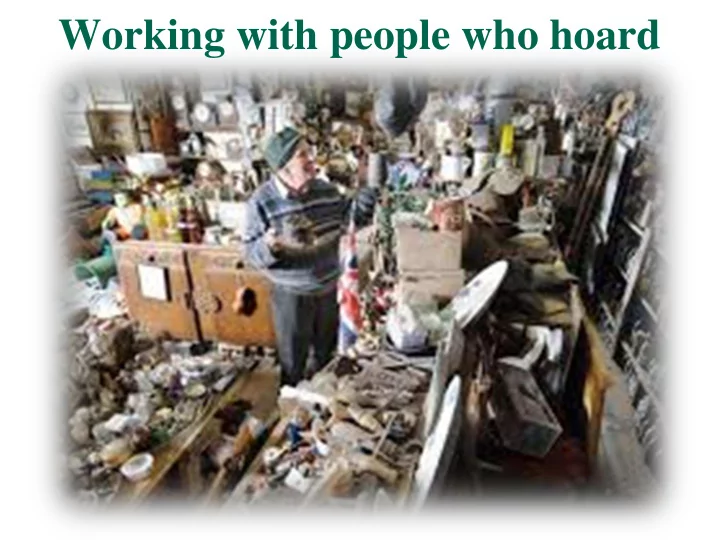
Working with people who hoard
SLIDE 2
SLIDE 3
SLIDE 4
SLIDE 5
SLIDE 6
How to talk to someone who is hoarding
Use judgmental language. Like anyone else, individuals with hoarding will not be receptive to negative comments about the state of their home or their character (e.g. “What a mess!” “What kind of person lives like this?”) Imagine your own response if someone came into your home and spoke in this manner, especially if you already felt ashamed.
SLIDE 7
Use words that devalue or negatively judge possessions. People who hoard are often aware that others do not view their possessions and homes as they do. They often react strongly to words that reference their possessions negatively, like “trash”, “garbage” and “junk”.
SLIDE 8
Let your non-verbal expression say what you’re thinking. Individuals with compulsive hoarding are likely to notice non-verbal messages that convey judgment, like frowns or grimaces. Make suggestions about the person’s belongings Even well-intentioned suggestions about discarding items are usually not well received by those with hoarding.
SLIDE 9 Try to persuade or argue with the person Efforts to persuade individuals to make a change in their home or behaviour often have the
- pposite effect – the person actually talks
themselves into keeping the items. Touch the person’s belongings without explicit permission Those who hoard often have strong feelings and beliefs about their possessions and often find it upsetting when another person touches their
- things. Anyone visiting the home of someone
with hoarding should only touch the person’s belongings if they have the person’s explicit permission.
SLIDE 10
Imagine yourself in the hoarding client’s shoes. How would you want others to talk to you to help you manage your anger, frustration, resentment, and embarrassment? Match the person’s language. Listen for the individual’s manner of referring to his/her possessions (e.g. “my things”, “my collections”) and use the same language (i.e. “your things”, “your collections”).
SLIDE 11 Use encouraging language.
- Use language that reduces defensiveness and increases
motivation to solve the problem (e.g. “I see that you have a pathway from your front door to your living room. That’s great that you’ve kept things out of the way so that you don’t slip or fall.
- I can see that you can walk through here pretty well by
turning sideways.
- The thing is that somebody else that might need to come
into your home, like a fire fighter or an emergency responder, would have a pretty difficult time getting through
- here. They have equipment they’re usually carrying and fire
fighters have protective clothes that are bulky. It’s important to have a pathway that is wide enough so that they could get through to help you or anyone else who needed it.
SLIDE 12 Highlight strengths. All people have strengths, positive aspects of themselves, their behaviour, or even their
- homes. A visitor’s ability to notice these
strengths helps forge a good relationship and paves the way for resolving the hoarding problem (e.g. “I see that you can easily access your bathroom sink and shower,” “What a beautiful painting!”, “I can see how much you care about your cat.”)
SLIDE 13
Focus the intervention initially on safety and organisation of possessions and later work on discarding. Discussion of the fate of the person’s possessions will be necessary at some point, but it is preferable for this discussion to follow work on safety and organisation.
SLIDE 14 CIR Ratings
With a show of hands how many people chose which rating on the CIR? We’ll have a brief discussion about why looking at:
Subjective nature of assessment
Personal standards Personal beliefs about cleanliness
SLIDE 15 Starting to consider change
Do not rush into action
- planning. Consider what the
person wants to do Support person to make one small change at a time – clear one small space Use a picture board – What would you like these shelves to look, what would you like this space to look like, what would you like this room to look like. Go through magazines and select images. Leave the picture board with the person.
SLIDE 16
SLIDE 17
SLIDE 18
Richard Wallace
SLIDE 19
SLIDE 20
Garden
SLIDE 21
Britain in Bloom
SLIDE 22
50 tonnes of rubbish removed from the garden
SLIDE 23
Help from friends – part of the community