
SLIDE 1
Working Together
- n Health and Safety
CPD WORKSHOP - LEGISLATION
Presented by High Hazard Unit - Extractives
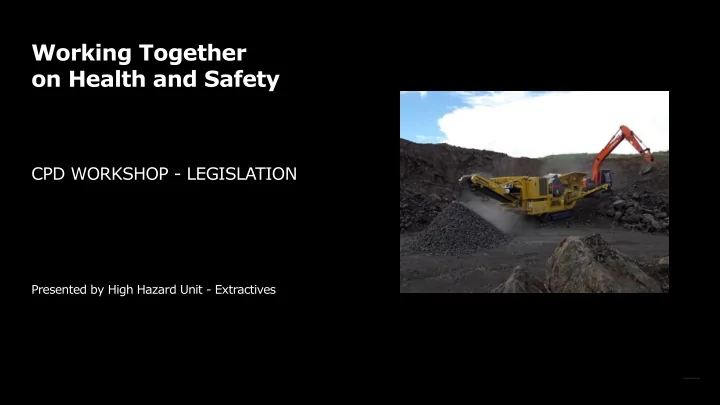
Working Together on Health and Safety CPD WORKSHOP - LEGISLATION - - PowerPoint PPT Presentation
Working Together on Health and Safety CPD WORKSHOP - LEGISLATION Presented by High Hazard Unit - Extractives Today well be covering: 1. WorkSafe update 2. Health and Safety Legislation 3. Notifiable Events 4. Regulations 5. Safe
Working Together
CPD WORKSHOP - LEGISLATION
Presented by High Hazard Unit - Extractives
Today we’ll be covering:
1. WorkSafe update 2. Health and Safety Legislation 3. Notifiable Events 4. Regulations 5. Safe Work Instruments & Guidance 6. Hazardous Substances 7. WorkSafe Website 8. Safe Plus 9. Board of Examiners
WORKSAFE NEW ZEALAND2
3
Health and Safety at Work Strategy
The Health and Safety at Work Strategy sets out the Government’s vision on improving health and safety at work across New Zealand over the next 10 years.
WORKSAFE NEW ZEALAND4
Be A Safe Guy
Our ‘be a safe guy’ campaign is focused on reducing workplace injuries and fatalities for young workers
WORKSAFE NEW ZEALAND5
Be A Safe Guy
WORKSAFE NEW ZEALAND6
WorkSafe Operations
High Hazard Unit Extractive Team
WORKSAFE NEW ZEALAND7
§ Mining § Quarrying § Tunnelling
Within our team we have Electrical, Mechanical, Geotechnical, Adult Education and Health & Safety Qualifications. Certificates of Competence for Site Senior Executive, Coal, Metalliferous, Mechanical and A Grade Quarry Managers. Work across teams – Energy Safety, Technical Services, Major Hazard Facilities, and General Assessment
8
The Legislative Framework
The Robens Model - Those that create the risk should manage it.
WORKSAFE NEW ZEALAND9
Details how What
What are your duties?
HSWA Primary duty of care Section 36 -A PCBU must ensure so far as is reasonably practicable the health and safety of workers and that other people are not put at risk by its work.
WORKSAFE NEW ZEALAND10
The primary duty of care includes providing & maintaining § A safe work environment § Safe plant and structures § Safe systems of work § Adequate facilities for welfare Providing information, training and supervision Monitoring health of workers and workplace conditions.
What you need to be aware of ?
HSWA Section 30 – Management of Risks
WORKSAFE NEW ZEALAND11
so far as is reasonably practicable and
eliminate risks to health and safety, to minimise those risks so far as is reasonably practicable.
Section 22 – Meaning of Reasonably Practicable
Practicable or Practical ? It’s not what you think that matters; what does the law say? ü Likelihood ü Degree of harm ü Knowledge ü Cost
So Far as is Reasonably Practicable
WORKSAFE NEW ZEALAND13
Meaning of reasonably practicable at a particular time, reasonably able to be done in relation to ensuring health and safety, taking into account and weighing up all relevant matters, including— (a) the likelihood of the hazard or the risk concerned occurring; and (b) the degree of harm that might result from the hazard or risk; and
14
Linkage to Risk Assessment
Knowledge
WORKSAFE NEW ZEALAND15
what the person concerned knows, or ought reasonably to know, about— (i) the hazard or risk; and (ii) ways of eliminating or minimising the risk; and (d) the availability and suitability of ways to eliminate
Cost
WORKSAFE NEW ZEALAND16
(e) after assessing the extent of the risk and the available ways of eliminating or minimising the risk, the cost associated with available ways of eliminating or minimising the risk, including whether the cost is grossly disproportionate to the risk.
17
HSWA & Notifiable Events
What is a Notifiable Event – Section 25
WORKSAFE NEW ZEALAND18
A notifiable event is any of the following events that arise from work:
Notifiable events trigger requirements to preserve the site, notify the regulator and keep records.
Section 23 Notifiable Injury or Illness
WORKSAFE NEW ZEALAND19
1. Admitted to hospital 2. A serious head injury 3. A serious eye injury, the loss of an eye or vision, object or substance entering the eye 4. A serious burn that requires intensive or critical care such as a compression garment or skin graft. 5. A spinal injury that requires injury to the vertebrae, including discs and spinal cord. Not back strain
6. Loss of a bodily function through electric shock or acute reaction to a substance used at work 7. Serious lacerations - deep cuts that cause muscle, tendon, nerve or blood vessel damage, or permanent impairment. 8. Skin separating from an underlying tissue (degloving or scalping) 9. Serious infection - micro-organisms
Section 24 Notifiable Incidents
WORKSAFE NEW ZEALAND20
HSWA Act, Section 24 The Health and Safety at Work Act 2015 (HSWA) requires that WorkSafe is notified if someone has been exposed to a serious and immediate risk of harm because of a workplace incident. WorkSafe website has a report that provides a high level summary of the types of incident that are being reported, where in the country they are occurring, and in what industries. MOQO Schedule 5 Injuries, illnesses, and incidents declared to be notifiable events under Act for Mining Operations.
What are Notifiable Incidents ?
WORKSAFE NEW ZEALAND21
(a) an escape, a spillage, or a leakage of a substance; or (b) an implosion, explosion, or fire; or (c) an escape of gas or steam; or (d) an escape of a pressurised substance; or (e) an electric shock; or (f) the fall or release from a height of any plant, substance, or thing; or (g) the collapse, overturning, failure, or malfunction of, or damage to, any plant that is required to be authorised for use in accordance with regulations; or (h) the collapse or partial collapse of a structure; or (i) the collapse or failure of an excavation or any shoring supporting an excavation; or (j) the inrush of water, mud, or gas in workings in an underground excavation or tunnel; or (k) the interruption of the main system of ventilation in an underground excavation or tunnel; or (l) a collision between 2 vessels, a vessel capsize, or the inrush of water into a vessel; or (m) any other incident declared by regulations to be a notifiable incident for the purposes of this section.
Notifiable Events – What to do
WORKSAFE NEW ZEALAND22
The PCBU who manages or controls the workplace must take all reasonable steps to ensure the site of a notifiable event is not disturbed until authorised by an Inspector (ie an Inspector gives permission for normal work to resume at the site of a notifiable event) Exceptions are if the disturbance is:
.
Notifiable Events – What to do
WORKSAFE NEW ZEALAND23
To ensure that the site is not disturbed:
should stay where they are
structures involved. Work can continue in other parts of the workplace.
Notifiable Events – what to do
WORKSAFE NEW ZEALAND24
The regulator must be notified by the fastest means possible given the circumstances. The person giving the notification must provide details about the notifiable event. If someone has been killed as a result of work, notify WorkSafe immediately by phone:
0800 030 040
call an Inspector if you need assistance.
Use the online Notification Tool.
Notifiable Events
Online Notification Tool
WORKSAFE NEW ZEALAND25
Notifiable Events
Online Notification Tool
WORKSAFE NEW ZEALAND26
Regulations
WORKSAFE NEW ZEALAND27
Regulations
WORKSAFE NEW ZEALAND28
Often deal with technical or administrative matters or where a higher level of prescription is required because of the level of risk. HSWA Regulations Expand on the duties found in HSWA. It is an offence to breach regulations. E.g.
How
Regulations And Risk Management
Mining Operations and Quarrying Operations (MOQO) Regulations
WORKSAFE NEW ZEALAND29
Regulation 13 – Manager of Mining Operation Regulation 14 – Manager of Quarrying operation Regulation 16 – Manager must hold certificate Regulation 54 – Risk Appraisal Regulation 55 – Risk Assessment Regulation 66 – Identify principal hazards and have principal hazard management plans in place Regulation 68 – Content of principal hazard management plan Review and audit requirements
Regulations And Risk Management
Mining Operations and Quarrying Operations (MOQO) Regulations
WORKSAFE NEW ZEALAND30 Part 4 prescribes the matters that must be considered in relation to principal hazards. i.e. provides a framework for expectations regarding the state of knowledge and controls for principal hazards e.g.
completed by a competent person
preparedness for a principal hazard
Regulations and Risk Management
General Risk and Workplace Management (GRWM) Regulations
WORKSAFE NEW ZEALAND31
Regulations And Risk Management
General Risk and Workplace Management (GRWM) Regulations
WORKSAFE NEW ZEALAND32
Regulations 4-8 specify Risk Management Processes to be followed
Regulations And Risk Management
Regulation 6 Hierarchy of control measures
WORKSAFE NEW ZEALAND33
34
Could insert slides here with visual examples of hierarchy of controls
35
2 Recapping
What have we covered so far?
WORKSAFE NEW ZEALAND36
ü Legislative Framework – The HSWA Act and Regulations ü So far as reasonably practicable ü Risk Management ü Regulations ü Notifiable Events – death, illness, injury or notifiable incident.
Regulations And Risk Management
General Risk and Workplace Management (GRWM) Regulations
WORKSAFE NEW ZEALAND37
associated with working under raised
38
This is still part of the HOW to achieve the Act.
Safe Work Instruments
Technical documents
WORKSAFE NEW ZEALAND39
Examples: Asbestos Hazardous Substances
Approved Codes
Practical guides to achieving standards required under HSWA and regulations
WORKSAFE NEW ZEALAND40
These are available on the WorkSafe Website. Examples: Emergency Preparedness Fire and Explosion Air Quality
Approved Codes of Practice
WORKSAFE NEW ZEALAND41
Guidance
Provides information on the legislation to assist duty holders with compliance
WORKSAFE NEW ZEALAND42
Includes:
help duty holders understand and apply their duties
Good Practice Guidelines
WORKSAFE NEW ZEALAND43
S2 – Planning for Excavation S3 – Planning for tips, ponds and voids S7 – Controlling Ground Instability in Excavations S8 – Tipping S9 – Water based mining S10 – Water or T ailings Storage
Guidance and Risk Management
WORKSAFE NEW ZEALAND44
45
46
Hazardous Substances
47
Hazardous Substances Toolbox
Hazardous Substances
WORKSAFE NEW ZEALAND48
What do you need to have ?
49
WorkSafe NZ Case Studies link
WORKSAFE NEW ZEALAND50
Case Studies
52
53
About SafePlus
SafePlus is a free health and safety improvement tool designed for small and medium-sized businesses.
WORKSAFE NEW ZEALAND54
performing.
About SafePlus
WORKSAFE NEW ZEALAND55
Summary of resources
WORKSAFE NEW ZEALAND56
ü Safe Plus ü Case Studies ü Hazardous Substances ü Safe Work Instruments & Guidance
New Zealand Mining Board of Examiners - BoE
Why was the BoE established?
WORKSAFE NEW ZEALAND58
Specific response to the Royal Commission into the Pike River Coal Mine Tragedy recommendation that the regulator should have a greater role in setting and assessing competencies WorkSafe was required to establish the BoE under clause 27 of Schedule 3, of the Health and Safety at Work Act 2015
BoE Board Members
WORKSAFE NEW ZEALAND59
What are the functions of the BoE?
Clause 28 of Schedule 3, of the Health and Safety at Work Act 2015 specify the functions of the BoE which are:
WORKSAFE NEW ZEALAND60
industry conferred on the BoE by regulations made under the Act.
What are the functions of the BoE?
The BoE’s Terms of Reference also require the Board to…
WORKSAFE NEW ZEALAND61
Certificates of Competence
The Health and Safety at Work(Mining Operations and Quarrying Operations) Regulations 2016, Part 2 Safety-critical roles and competency requirements, states the following safety critical roles require a certificate of competence:
WORKSAFE NEW ZEALAND62
specified in the certificate
Certificate of competence and continuing professional development requirements
development requirements are set out in gazette notices
63
B-grade quarry manager CoC requirements as set out in gazette notice and regulations
6402)
quarry for at least two years. At least nine months of the applicants experience must be
Experience is demonstrated in a logbook and approved by a logbook committee formed of BoE members
application process
* Note: NZQA record of achievement, first aid certificate, ID and Ministry of Justice criminal conviction check needs to be certified WORKSAFE NEW ZEALAND64 OR
Unit standard Title 8902 Prepare and implement safety plans for surface and benching operations 8905 Construct and maintain access roads within surface extraction sites 8909 Maintain working surfaces at surface extraction sites 8922 Conduct safety checks prior to requirement usage at extractives sites 16686 Conduct incident investigation at an extractives site 21153 Demonstrate and apply knowledge of dewatering, pump maintenance and cleaning settling ponds at extractives sites 21155 Review consent conditions and demonstrate knowledge of the use of water at surface extractives sites 21156 Plan, implement and describe surface extraction production to minimise environmental impacts 26856 Carry out the risk management processes at an extractives site 28742 or 7142 Explain the health and safety legislation and supporting documents, applicable to an extractives website or Demonstrate knowledge of application of regulatory requirements to manage an extractives website B-grade quarry manager CPD requirements as set out in gazette notice and regulations
requirements
WORKSAFE NEW ZEALAND65
CoC Hours required Competencies Learning B-grade quarry manager 5 year total: 60 hours 12 hours per year minimum Minimum of 8 hours over 5 years for each competency
safety systems
management
Formal: minimum of 8 hours per year Informal: up to a maximum of 4 hours per year
CPD Review Workshop Schedule
Submissions close 1 August and analysis completed 9 August.
WORKSAFE NEW ZEALAND66
30 May Dunedin 18 June Matamata 5 June Christchurch 19 June Whanganui 6 June Invercargill 20 June Napier 10 June Auckland 25 June Nelson 11 June Whangarei 26 June Greymouth
Oral exam
Once the applicant's application is considered complete and has been approved by a logbook committee the applicant will be required to attend an oral exam
WORKSAFE NEW ZEALAND67
and on the job through answering scenario based questions
When and where do the BoE meet?
WorkSafe New Zealand68
Every second month, generally at the WorkSafe offices in Wellington A newsletter is published on the website after each meeting
BoE Secretariat
It’s their job to help you! Contact them with any questions or queries on CoC’s, CPD or any other BoE matters on: Ph: 04 901 4980 Email: BoE_Secretariat@worksafe.govt.nz
WorkSafe New Zealand69
QUESTIONS?
WORKSAFE NEW ZEALAND70
Getting you home healthy and safe. That’s what we’re working for.
WORKSAFE NEW ZEALAND71