Women and men in the informal economy: A statistical picture - - PowerPoint PPT Presentation

women and men in the informal economy a statistical
SMART_READER_LITE
LIVE PREVIEW

Women and men in the informal economy: A statistical picture - - PowerPoint PPT Presentation

Women and men in the informal economy: A statistical picture Florence Bonnet, Vicky Leung and Juan Chacaltana Slide 1 Content An overview of the report in 4 questions Question 1 What is the size of the informal economy: global and regional

slide-1
SLIDE 1

Slide 1

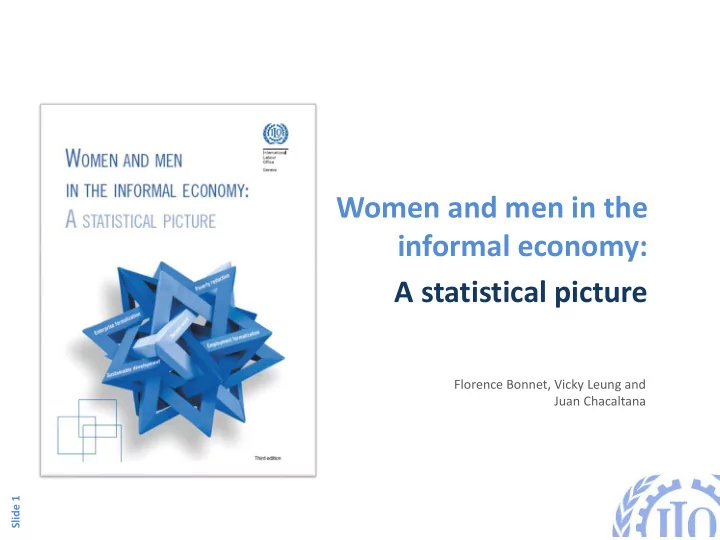
Women and men in the informal economy: A statistical picture

Florence Bonnet, Vicky Leung and Juan Chacaltana

slide-2
SLIDE 2

Slide 2

Content

An overview of the report in 4 questions

Question 1 What is the size of the informal economy: global and regional dimensions? Question 2 Who are the most exposed to informality? Who are the most represented among those in informal employment? Question 3 Are decent work deficits most pronounced in the informal economy? Question 4 What can we say about drivers of informality? Some first elements about a few of them…

Outline

slide-3
SLIDE 3

Slide 3

Question 1

What is the size of the informal economy: global and regional dimensions ?

slide-4
SLIDE 4

Slide 4

2 billion people — more than 60 per cent of the world’s employed population are in informal employment

World Developing Emerging Developed

Share of informal employment in total employment (including & excluding agriculture,

2016)

Source: ILO calculations based on household survey micro datasets: Women and in the informal economy: a statistical picture Note: based on 119 countries representing more than 90 per cent of the world’s working population. Missing values are estimated based

  • n sub-regional/ income groups averages.

Informal employment Formal employment

slide-5
SLIDE 5

Slide 5

The regional dimension of informality

Share of informal employment in total employment (%, 2016)

Source: ILO calculations based on household survey micro datasets (Women and in the informal economy: a statistical picture)

slide-6
SLIDE 6

Slide 6

Question 2

Who are the most exposed to informality? Who are the most represented among those in informal employment?

slide-7
SLIDE 7

Slide 7

The gender dimension of informality

Out of the two billion workers in informal employment, just more than 740 million are women 63.0 58.1 92.1

Developing

69.1 64.2 17.6 18.9

World Emerging Developed

  • 1. Informal employment is a greater source of

employment for men (63%) than for women (58%), but…

  • 2. … there actually more countries (55%) where

women are more exposed to informality than men and …

  • 3. … women are more exposed than men to informal

employment in sub-Saharan Africa, Latin America

  • r Southern Asia or more generally in low &

lower-middle income countries

  • 4. When women are in the informal economy, they

are more often found in the most vulnerable situations than their male counterparts

87.5

World Developed Emerging Developing

A proportion of contributing family workers more than three times higher among women in informal employment compared to men

Distribution of people in informal employment by employment status and sex (percentages, 2016)

slide-8
SLIDE 8

Slide 8

The self-employed are more exposed to informality … but employees are far from being exempted

Share of informal employment & composition by employment status (%, 2016)

Informal employment in the informal sector: 2/3 Informal employment in the formal sector: 27% Domestic workers informally employed in households: 5%

OAW: Own-account workers CFW: Contributing family workers

slide-9
SLIDE 9

Slide 9

The youth and older workers are the most likely to be in informal employment:

more than 3 out of 4 are informally employed

Source: ILO based on household surveys. Note: Global estimates based on 108 countries representing more than 85 per cent of total employment. Harmonized definition of informal employment.

The age profile of informality: share of informal employment along the life course (%)

by region by employment status

—— Total ——Employers ——Employees ——OAW

slide-10
SLIDE 10

Slide 10

Question 3

Are decent work deficits most pronounced in the informal economy?

R204 stresses the fact that decent work deficits are more pronounced in the informal economy, facts provide a confirmation

slide-11
SLIDE 11

Slide 11

Compared to permanent, full-time employment, non-standard forms of employment are significantly more likely to be informal, the worst situation being employees in “temporary part-time jobs”

Note: Global and regional estimates based on data for 96 countries representing over 78 per cent of the world employed population. Harmonized definition of informal employment and informal sector. Source: ILO calculation based on national labour force surveys or similar household survey data.

Share of informal employment and NSFEs (%, latest available year)

Among employees

slide-12
SLIDE 12

Slide 12

Question 4

What can we say about drivers

  • f informality?

Some first elements about a few of them…

slide-13
SLIDE 13

Slide 13

Higher levels of GDP per capita and growth are associated to lower levels of informality … but not strictly:

countries with similar levels of GDP per capita are presenting very different levels

  • f informality

Share of informal employment and level of GDP per capita

Note: The coefficient of determination R2=0.57. Source: ILO harmonized data on the share of informal employment in total employment and World Development Indicators 2017 for GDP per capita.

slide-14
SLIDE 14

Slide 14

The level of education of workers is not a guarantee but an important asset to access formal employment

Share of informal employment in total employment by level of education | World and main regions

Note: Global and regional estimates based on data for 107 countries representing 86 per cent of the world’s employed population.. Source: ILO calculation based on micro data.

Distribution of informal and formal employment by level of education (%)

slide-15
SLIDE 15

Slide 15

Poverty: a cause and a consequence of informality

Consequence: higher poverty rates among

workers in informal employment compared to workers in formal employment

A cause: the poor face higher rates

  • f informal employment ….

Source: ILO calculation based

  • n micro data
slide-16
SLIDE 16

Slide 16

Thank you