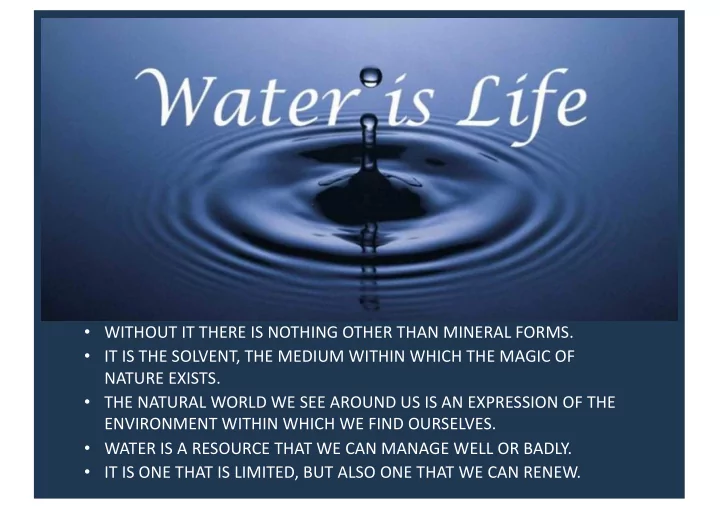
WITHOUT IT THERE IS NOTHING OTHER THAN MINERAL FORMS. IT IS THE - - PowerPoint PPT Presentation

without it there is nothing other than mineral forms it
SMART_READER_LITE
LIVE PREVIEW

WITHOUT IT THERE IS NOTHING OTHER THAN MINERAL FORMS. IT IS THE - - PowerPoint PPT Presentation

WITHOUT IT THERE IS NOTHING OTHER THAN MINERAL FORMS. IT IS THE SOLVENT, THE MEDIUM WITHIN WHICH THE MAGIC OF NATURE EXISTS. THE NATURAL WORLD WE SEE AROUND US IS AN EXPRESSION OF THE ENVIRONMENT WITHIN WHICH WE FIND OURSELVES.


slide-1
SLIDE 1
  • WITHOUT IT THERE IS NOTHING OTHER THAN MINERAL FORMS.
  • IT IS THE SOLVENT, THE MEDIUM WITHIN WHICH THE MAGIC OF

NATURE EXISTS.

  • THE NATURAL WORLD WE SEE AROUND US IS AN EXPRESSION OF THE

ENVIRONMENT WITHIN WHICH WE FIND OURSELVES.

  • WATER IS A RESOURCE THAT WE CAN MANAGE WELL OR BADLY.
  • IT IS ONE THAT IS LIMITED, BUT ALSO ONE THAT WE CAN RENEW.
slide-2
SLIDE 2
  • Increasing levels of CO2 in

the atmosphere will change the climate of the India

  • Climate change will surely

effect our water cycle

  • We are unsure how it will

effect our weather patterns, but it is expected to make

  • ur rainfall events more

intensive and perhaps more erratic.

  • However our best

understanding still comes from observing the world around us.

slide-3
SLIDE 3

The bioregion of Auroville

slide-4
SLIDE 4

Kaluveli watershed

754 sq. km 196 tanks 160 villages 3,50,000 People Kaluveli wetland is the single natural outlet of the watershed Watershed Area : 755 sq.km Number of tanks : 196

slide-5
SLIDE 5

Etang de Kaluvelly: 70 km2 Auroville Pondicherry Cuddalore

slide-6
SLIDE 6

Auroville The picture can't be displayed.

GEOLOGY

Lithology: 273 wells (CGWB, PWD, TWAD)

n Aquifers:

dune alluvium Cuddalore Kaddaperikuppam Vanur Ramanathapuram

n Aquitards: Manavalli clay

Ottay clay

slide-7
SLIDE 7
  • Over exploitation of water resources
  • Degradation of surface water structures
  • Erosion
  • Non Source Pollution
  • Solid waste
  • Wastewater
  • Major infrastructure development
  • Endemic plant species eradication

slide-8
SLIDE 8

CONTEXT

Since 1970, the number of bore wells increased exponentially => The water table level decreases drastically For example in the Vanur aquifer:

  • the water level is 60 m deeper than

30 years ago

  • the water level is below 0 msl

everywhere

1950 1952 1954 1956 1958 1960 1962 1964 1966 1968 1970 1972 1974 1976 1978 1980 1982 1984 1986 1988 1990 1992 1994 1996 1998 2000 2002 10 20 30 40 50 60 70 80 90 100 110 120 130 140

Évolution de l'extraction dans l'aquifère de Vanur depuis 1950

année volume extrait (Mm³/an)

Climate - semi-arid: PET > Rainfall ~ 9 months/year Efficient rainfall 3 months/year Rainfall: ~1300 mm/year with monsoons SW (Jul.-Sep., 40%) NE (Oct.-Dec., 60%) Tamil Nadu Available water resources volume -> 28 000 Mm³ Used water volume -> 32 000 Mm³ => A deficit of water already exists

slide-9
SLIDE 9

What is the ecologically appropriate vegetation of this area?

Tropical Dry Evergreen Forest: TDEF

slide-10
SLIDE 10
  • There are over 100 plants with relevant daily

uses

  • It is adapted to the local rainfall patterns
  • There are flowering and fruiting events

throughout the year – supporting native populations of pollinators

  • The permanent shade reduces ambient ground

temperatures around buildings

Using elements of the TDEF you can create a Vibrant, Dynamic and Ecologically balanced landscape

slide-11
SLIDE 11

Our Cultural Context

slide-12
SLIDE 12
slide-13
SLIDE 13
  • The water resources we have are limited.
  • Water is a renewable resource that can be managed

carefully.

  • We need to understand our local environment to

understand how we can manage our local water resource.

  • We can combine clues and hints from the natural vegetation

and from the traditional culture of our surroundings with new technological innovations to arrive at solutions.

  • The more energy we require to sustain ourselves, the less

sustainable the solutions we have arrived at.