Wirral Housing Needs Housing Requirements Workshop #1 - - PowerPoint PPT Presentation

wirral housing needs housing requirements workshop 1
SMART_READER_LITE
LIVE PREVIEW

Wirral Housing Needs Housing Requirements Workshop #1 - - PowerPoint PPT Presentation

Wirral Housing Needs Housing Requirements Workshop #1 Presentation by Colin Robinson 14 th October 2013 Wirral SHMA: Housing Needs Presentation Purpose of Todays Workshop The main objectives of todays workshop are: Understand


slide-1
SLIDE 1

Wirral SHMA: Housing Needs Presentation
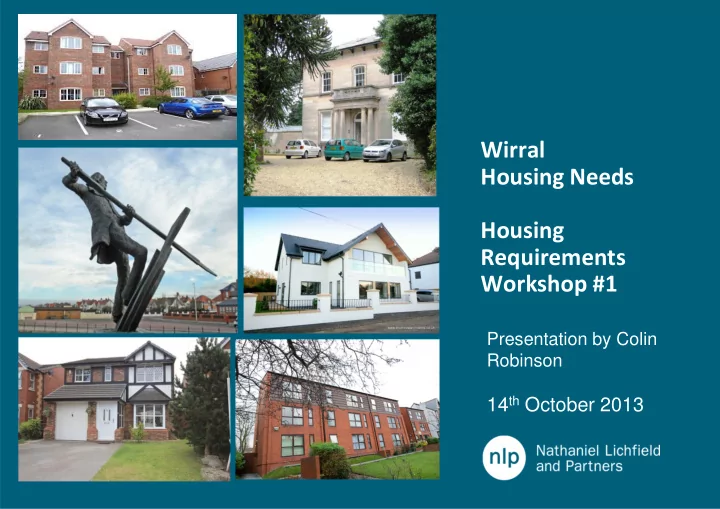
Wirral Housing Needs Housing Requirements Workshop #1

Presentation by Colin Robinson

14th October 2013

slide-2
SLIDE 2

Wirral SHMA: Housing Needs Presentation

Purpose of Today’s Workshop

The main objectives of today’s workshop are:

  • Understand the modeling process undertaken to date
  • Discuss the emerging findings of the housing

requirement work for the Wirral

  • Comment on the appropriateness/realism of the

housing demand scenarios Note: these findings are at an early stage and the figures will be subject to change

2

slide-3
SLIDE 3

Wirral SHMA: Housing Needs Presentation

3

Why do we need housing targets?

slide-4
SLIDE 4

Wirral SHMA: Housing Needs Presentation

Why do we need housing targets?

  • NPPF unashamedly pro-growth – LPAs should positively seek
  • pportunities to meet the full objectively assessed housing

and affordable dwelling requirements in their HMA [para 47]

  • Take account of market signals and set out a clear strategy

for allocating sufficient housing

  • Work with stakeholders to prepare a robust

evidence base assessing the need for all types

  • f households over the plan period
  • Failure to do so could lead to Local Plans being

found unsound at EiP and losing control of development in your area

slide-5
SLIDE 5

Wirral SHMA: Housing Needs Presentation

Current Situation

slide-6
SLIDE 6

Wirral SHMA: Housing Needs Presentation

Housing Challenges

Weak Demand

  • Wirral’s mean house prices in 2011

were c.£159,000. This is lower than the national average (£232,000), but higher than Merseyside (£139,000) and the North West (£152,000)

  • Vacancy levels are consistent with the

national average (4.5%) – relatively low levels of 2nd home ownership

  • Vacancy levels lower than Liverpool but

higher than the North West

£0 £50,000 £100,000 £150,000 £200,000 £250,000 Wirral Merseyside North West England

Mean House Price (Q2 2011)

slide-7
SLIDE 7

Wirral SHMA: Housing Needs Presentation

7

Economic Challenges

Aspirations for Growth

  • Wirral Waters
  • 18 million sq. ft. mixed use

development (retail, hotels, leisure, offices, and residential uses)

  • 20,000 or more new jobs
  • International Trade Centre
  • 2.5 million sq. ft. of commercial

floorspace

  • Wider Regeneration Proposals
slide-8
SLIDE 8

Wirral SHMA: Housing Needs Presentation

Indices of Multiple Deprivation

  • Parts of east Wirral are

within the Top 10% lowest ranked areas

  • Rural areas and west more

affluent – outside the top 50% lowest ranked areas

  • Wirral ranked 60th most

deprived out of 326 local authorities in 2010

8

slide-9
SLIDE 9

Wirral SHMA: Housing Needs Presentation

Wirral

Housing Delivery – 264 dpa (net of demolitions) RS requirement of 500 dpa – shortfall of 2,122 dwellings since 2003 (236 dpa)

2003/04 2004/05 2005/06 2006/07 2007/08 2008/09 2009/10 2010/11 2011/12 Gross Completions 655 521 511 763 820 599 340 272 268 Net Completions 443 102 220 506 564 224 200 97 22 100 200 300 400 500 600 700 800 900

slide-10
SLIDE 10

Wirral SHMA: Housing Needs Presentation

Housing Challenges

Affordable Housing Delivery

1996- 97 1997- 98 1998- 99 1999- 00 2000- 01 2001- 02 2002- 03 2003- 04 2004- 05 2005- 06 2006- 07 2007- 08 2008- 09 2009- 10 2010- 11 2011- 12 Wirral AH Completions 230 180 140 240 170 200 160 20 40 170 140 200 80 190 230 210 Wirral Housing Register 4949 6912 5725 6824 7861 10604 8795 8215 15524 13252 13912 15066 13770 19224 16232 21280 5000 10000 15000 20000 25000 50 100 150 200 250 300 Househodls on the Waiting List Affordable Houses Completed

slide-11
SLIDE 11

Wirral SHMA: Housing Needs Presentation

Demographic Challenges

slide-12
SLIDE 12

Wirral SHMA: Housing Needs Presentation

Demographic Challenges

Population Change

  • Wirral: Steady increase in households since 2007, from 134,000 to 140,500 in 2011
  • Latest 2011-based SNPP – population increasing from 320,000 in 2011 to 324,000 in

2021

slide-13
SLIDE 13

Wirral SHMA: Housing Needs Presentation

Demographic Challenges

1 2 3 4 5 6 7 8 1-4 5-9 10-14 15-19 20-24 25-29 30-34 35-39 40-44 45-49 50-54 55-59 60-64 65-69 70-74 75-79 80-84 85+ Proportion of Population

2011 Wirral Population Profile

North West Wirral

  • 14000
  • 9000
  • 4000

1000 6000 11000 0-4 5-9 10-14 15-19 20-24 25-29 30-34 35-39 40-44 45-49 50-54 55-59 60-64 65-69 70-74 75-79 80-84 85+

Wirral Demographic Profile

Females Males

slide-14
SLIDE 14

Wirral SHMA: Housing Needs Presentation

Demographic Challenges

High, and increasing Total Fertility Rate (TFR)

Births outnumbering deaths High levels of net out- migration countered by high levels of net in migration

1.50 1.60 1.70 1.80 1.90 2.00 2.10 2.20 2.30 198219841986198819901992199419961998200020022004200620082010 England and Wales Wirral

(Interim) ONS 2011 SNPP Wirral Births +39,500 Deaths

  • 34,500

Natural Change +5,100 Domestic Migration In +76,600 Domestic Migration Out

  • 73,000

International Migration In +8,900 International Migration Out

  • 11,600

Net Migration +900 Total +6,000

slide-15
SLIDE 15

Wirral SHMA: Housing Needs Presentation

Demand Forecasting

slide-16
SLIDE 16

Wirral SHMA: Housing Needs Presentation

Demand Forecasts

Considered a variety of scenarios over the Plan period to 2030

  • The PopGroup demographic modelling tool was used to project household, dwelling

and employment change over time

  • Widely used by Local Authorities and the Private Sector

Assumptions underpinning all modelled scenarios include:

  • Use of ONS 2010-based SNPP for TFRs, Standardised Mortality Rates (SMR)
  • Use of CLG 2011-based Household projections to derive headship rates to 2021,

2008-based household projections thereafter

  • Vacancy rate of 4.5% factored into model – kept constant
  • NOMIS modelled unemployment rate of 8.9% used for 2012 and gradually reduced

post 2019 to 7-yr average (7.6%)

  • Current commuting rate of around 1.3 in Wirral kept constant (i.e. net out-commuting)
slide-17
SLIDE 17

Wirral SHMA: Housing Needs Presentation

Approach

5 Key Demographic Scenarios modelled:

  • A. PopGroup Baseline: demographic shift based on current factors and recent trends

in the Borough (2011-SNPP, plus various headship sensitivities)

  • B. Natural Change: excludes all domestic/international migration
  • C. Zero Net Migration: migration included, but in/out migration rates equalised
  • D. Reduced Vacancy Rate: static vacancy rate of 3%, rather than 4.5%
  • E. Short term/long term migration trends: demographic shift based on updated

migration trends over the short term (past 5 years) and long term (past 10 years)

slide-18
SLIDE 18

Wirral SHMA: Housing Needs Presentation

Approach

Other scenarios: F. 2011-based CLG Household Projections: 335 growth in households annually 2011-21

  • G. Past Trends Job Growth: Wirral average job growth over past 10 yrs (-640)
  • H. Stable Job Growth: Zero net job growth between 2011 and 2030

I. Past delivery rates: 528 dpa gross (2003-2012), but 264 dpa allowing for demolitions

  • J. Regional Strategy requirements: 500 dpa

Other Economic Projections still to be modelled (i.e. new LEP labour force projections)

slide-19
SLIDE 19

Wirral SHMA: Housing Needs Presentation

Initial Findings

slide-20
SLIDE 20

Wirral SHMA: Housing Needs Presentation

Initial Findings

slide-21
SLIDE 21

Wirral SHMA: Housing Needs Presentation

Discussion

slide-22
SLIDE 22

Wirral SHMA: Housing Needs Presentation

Questions

  • Previously discussed a figure of around 500dpa for Wirral (2,470 dwellings 2011-30). Is this too high in the

light of updated demographic data?

  • General clustering around 400-700 dpa – how does this align with WBC’s economic aspirations?
  • How do we address the issue of backlog, or past under-delivery on RS 500 dpa target?
  • To what extent should the past take up rate of 264 dpa frame the requirement?
  • Stabilising job growth results in a very high housing requirement figure due to the ageing population – is

this an appropriate aspiration?

  • Latest 2011 household projections indicate a lower level of need (351 dpa) – to what extent should this

depress the dwelling requirements?

  • Could we reduce the high vacancy level over time, and hence the housing requirement?
  • Similarly, could we reduce the very high net out commuting rate over time, and hence the housing

requirement?

  • Will demolitions really decline, or will there always be an underlying level of stock rationalisation given poor

quality of many of the existing offer?

  • Do we need to meet the housing needs of adjacent Boroughs?
  • To what extent do we think that international migration rates will change in the HMA?
  • Is this sufficient to meet our social housing needs?