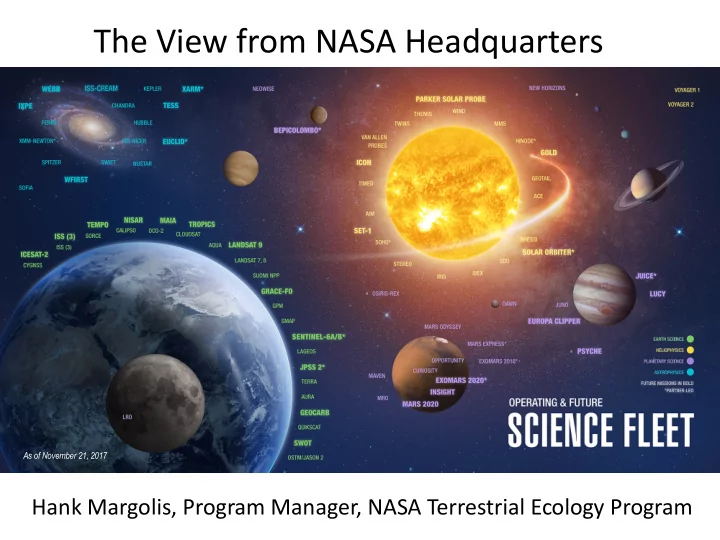
As of November 21, 2017
The View from NASA Headquarters As of November 21, 2017 Hank - - PowerPoint PPT Presentation
The View from NASA Headquarters As of November 21, 2017 Hank Margolis, Program Manager, NASA Terrestrial Ecology Program NASA Science Mission Directorate (SMD) Top-Level Goals Astrophysics: Discover the Secrets of the Universe Planetary
NASA Science Mission Directorate (SMD) Top-Level Goals
- Astrophysics: Discover the Secrets of the Universe
- Planetary Sciences: Searching for Life in the Solar
System and Beyond
- Earth Science and Heliophysics: Safeguarding and
Improving Life on Earth
(Pre)Formulation Implementation Primary Ops Extended Ops
ISS Instruments
LIS (2020), SAGE III (2020) TSIS-1 (2018), OCO-3 (2018), ECOSTRESS (2018), GEDI (2018) CLARREO-PF (2020)
InVEST/CubeSats
RAVAN (2016) IceCube (2017) MiRaTA (2017) HARP (2018) TEMPEST-D (2018) RainCube (2018) CubeRRT (2018) CIRiS (2018*) CSIM (2018)
* Target date, not yet manifested
NASA Earth Science Fleet
Missions: Present through 2023
Landsat 9 (2020) PACE (2022) NI-SAR (2021) SWOT (2021) TEMPO (2018) GRACE-FO (2) (2018) ICESat-2 (2018) CYGNSS (8) (2019) NISTAR, EPIC (DSCOVR / NOAA) (2019) QuikSCA T (2017) Landsat 7 (USGS) (~2022) Terra (>2021) Aqua (>2022) CloudSat (~2018) CALIPSO (>2022) Aura (>2022) SMAP (>2022) Suomi NPP (NOAA) (>2022) Landsat 8 (USGS) (>2022) GPM (>2022) OCO-2 (>2022) Sentinel-6A/B (2020, 2025) MAIA (~2021) GeoCARB (~2021) TROPICS (12) (~2021) SORCE, TCTE (NOAA) (2017) OSTM/Jason-2 (NOAA) (>2022)
JPSS-2 Instruments
RBI (2018), OMPS-Limb (2018)
01.18.18
Globally, 2017 was the second hottest year on record
The View From HQ
2017 was once again a busy year for the NASA Terrestrial Ecology Program Some TE Highlights
- ABoVE Airborne Campaign – a major investment from NASA
- Funded 15 new Carbon Research Program projects
- Terra-Aqua-SNPP solicitation
- New Investigator Program
- NESSF Graduate Fellowships
- Inter-Disciplinary Studies (IDS) – Methane, Carbon Partitioning, Ecology
at Land-Water Interfaces
- Preparations for Earth Venture Instrument 5 (EVI-5)
- Earth Venture Suborbital-3 is on the streets
- OCO-2 Science Team is under review
2017 Decadal Survey Recommendations
Address 35 key science/applications questions in six categories
- Coupling of Water and Energy Cycle
- Ecosystem Change
- Extending and Improving Weather and Air Quality Forecasts
- Sea Level Rise
- Reducing Climate Uncertainty
- Geological Hazards and Disasters
Recruiting a Program Scientist for the Terrestrial Ecology Program at NASA Headquarters
Serving on NASA Peer Review Panels is your obligation to NASA and to our scientific community.
- In economics, a free rider problem occurs when
people who benefit from resources do not “pay” for them, resulting in an under-provision of those resources.
- Situations subject to free-riding are characterized by
the inability of the market to exclude non-payers.
- Individuals in a community may reduce their
participation if they believe that other members of the community will free ride.
It is my intention that ABoVE be a nine- to ten-year research program.
- ABoVE continues to have a very high profile within NASA and across
the federal government and beyond (GCRP, IARPC, Arctic Ministerial)
As of November 21, 2017