
SLIDE 1
Wires Within Wires
A Minimal Model for Computational Bioelectronic Peptide Design
- R. A. Mansbach1
- A. L. Ferguson2
1Physics Department 2Materials Science Department
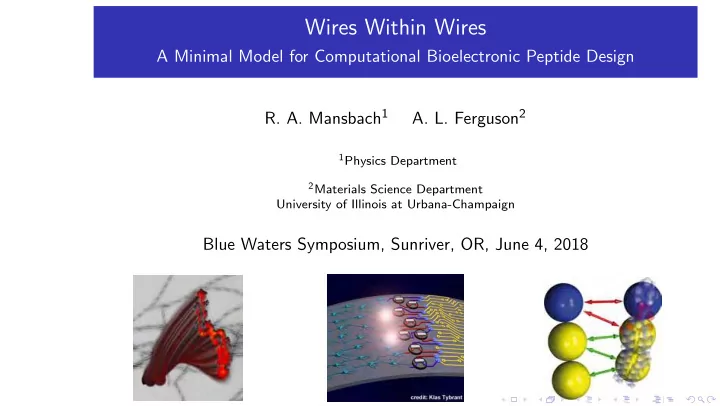
Wires Within Wires A Minimal Model for Computational Bioelectronic - - PowerPoint PPT Presentation
Wires Within Wires A Minimal Model for Computational Bioelectronic Peptide Design R. A. Mansbach 1 A. L. Ferguson 2 1 Physics Department 2 Materials Science Department University of Illinois at Urbana-Champaign Blue Waters Symposium, Sunriver,
1Physics Department 2Materials Science Department
Wires Within Wires Mansbach, Rachael Motivation Patchy Model Results Conclusions and Future Work
Wall, Brian D., et al. “Supramolecular Polymorphism: Tunable Electronic Interactions within π-Conjugated Peptide Nanostructures Dictated by Primary Amino Acid Sequence.” Langmuir30.20 (2014): 5946-5956. Galagan, Y.,& Andriessen, R. (2012). “Organic photovoltaics: technologies and manufacturing.” INTECH Open Access Publisher. topic-apple-watch-all.png?itok=OUtlCphV
2 / 15
Wires Within Wires Mansbach, Rachael Motivation Patchy Model Results Conclusions and Future Work
Wall, Brian D., et al. “Supramolecular Polymorphism: Tunable Electronic Interactions within π-Conjugated Peptide Nanostructures Dictated by Primary Amino Acid Sequence.” Langmuir30.20 (2014): 5946-5956. Galagan, Y.,& Andriessen, R. (2012). “Organic photovoltaics: technologies and manufacturing.” INTECH Open Access Publisher. topic-apple-watch-all.png?itok=OUtlCphV
2 / 15
Wires Within Wires Mansbach, Rachael Motivation Patchy Model Results Conclusions and Future Work
Wall, Brian D., et al. “Supramolecular Polymorphism: Tunable Electronic Interactions within π-Conjugated Peptide Nanostructures Dictated by Primary Amino Acid Sequence.” Langmuir30.20 (2014): 5946-5956. Galagan, Y.,& Andriessen, R. (2012). “Organic photovoltaics: technologies and manufacturing.” INTECH Open Access Publisher. topic-apple-watch-all.png?itok=OUtlCphV
2 / 15
Wires Within Wires Mansbach, Rachael Motivation Patchy Model Results Conclusions and Future Work
3 / 15
Wires Within Wires Mansbach, Rachael Motivation Patchy Model Results Conclusions and Future Work
3 / 15
Wires Within Wires Mansbach, Rachael Motivation Patchy Model Results Conclusions and Future Work
4 / 15
Wires Within Wires Mansbach, Rachael Motivation Patchy Model Results Conclusions and Future Work
4 / 15
Wires Within Wires Mansbach, Rachael Motivation Patchy Model Results Conclusions and Future Work
5 / 15
Wires Within Wires Mansbach, Rachael Motivation Patchy Model Results Conclusions and Future Work
Ardona, Herdeline Ann M., and John D. Tovar. “Energy transfer within responsive π-conjugated coassembled peptide-based nanostructures in aqueous environments.” Chemical Science 6.2 (2015): 1474-1484.
6 / 15
Wires Within Wires Mansbach, Rachael Motivation Patchy Model Results Conclusions and Future Work
7 / 15
Wires Within Wires Mansbach, Rachael Motivation Patchy Model Results Conclusions and Future Work
8 / 15
Wires Within Wires Mansbach, Rachael Motivation Patchy Model Results Conclusions and Future Work
9 / 15
Wires Within Wires Mansbach, Rachael Motivation Patchy Model Results Conclusions and Future Work
10 / 15
Wires Within Wires Mansbach, Rachael Motivation Patchy Model Results Conclusions and Future Work
11 / 15
Wires Within Wires Mansbach, Rachael Motivation Patchy Model Results Conclusions and Future Work
Brochu, Eric, Vlad M. Cora, and Nando De Freitas. “A tutorial on Bayesian optimization of expensive cost functions, with application to active user modeling and hierarchical reinforcement learning.” arXiv preprint arXiv:1012.2599 (2010).
12 / 15
Wires Within Wires Mansbach, Rachael Motivation Patchy Model Results Conclusions and Future Work
Brochu, Eric, Vlad M. Cora, and Nando De Freitas. “A tutorial on Bayesian optimization of expensive cost functions, with application to active user modeling and hierarchical reinforcement learning.” arXiv preprint arXiv:1012.2599 (2010).
12 / 15
Wires Within Wires Mansbach, Rachael Motivation Patchy Model Results Conclusions and Future Work
Brochu, Eric, Vlad M. Cora, and Nando De Freitas. “A tutorial on Bayesian optimization of expensive cost functions, with application to active user modeling and hierarchical reinforcement learning.” arXiv preprint arXiv:1012.2599 (2010).
12 / 15
Wires Within Wires Mansbach, Rachael Motivation Patchy Model Results Conclusions and Future Work
https://www.slideshare.net/sergejsgroskovs/ pragmatism-philosophy-of-science-lecture-slides
13 / 15
Wires Within Wires Mansbach, Rachael Motivation Patchy Model Results Conclusions and Future Work
https://www.slideshare.net/sergejsgroskovs/ pragmatism-philosophy-of-science-lecture-slides
13 / 15
Wires Within Wires Mansbach, Rachael Motivation Patchy Model Results Conclusions and Future Work
14 / 15
Wires Within Wires Mansbach, Rachael Motivation Patchy Model Results Conclusions and Future Work
*This research is part of the Blue Waters sustained-petascale computing project, which is supported by the National Science Foundation (awards OCI-0725070 and ACI-1238993) and the state of Illinois. Blue Waters is a joint effort of the University of Illinois at Urbana-Champaign and its National Center for Supercomputing Applications.
15 / 15
Wires Within Wires Mansbach, Rachael Choice of parameter space for sweep
Examples of single-parameter computations Additional data Ideal Gas Model
1 / 13
Wires Within Wires Mansbach, Rachael Choice of parameter space for sweep
Examples of single-parameter computations Additional data Ideal Gas Model
Cv
2 / 13
Wires Within Wires Mansbach, Rachael Choice of parameter space for sweep
Examples of single-parameter computations Additional data Ideal Gas Model
3 / 13
Wires Within Wires Mansbach, Rachael Choice of parameter space for sweep
Examples of single-parameter computations Additional data Ideal Gas Model
Main Text Backups 4 / 13
Wires Within Wires Mansbach, Rachael Choice of parameter space for sweep
Examples of single-parameter computations Additional data Ideal Gas Model
Main Text Backups 5 / 13
Wires Within Wires Mansbach, Rachael Choice of parameter space for sweep
Examples of single-parameter computations Additional data Ideal Gas Model
6 / 13
Wires Within Wires Mansbach, Rachael Choice of parameter space for sweep
Examples of single-parameter computations Additional data Ideal Gas Model
Main Text Backups 7 / 13
Wires Within Wires Mansbach, Rachael Choice of parameter space for sweep
Examples of single-parameter computations Additional data Ideal Gas Model
k nkgk,
Main Text Backups 8 / 13
Wires Within Wires Mansbach, Rachael Choice of parameter space for sweep
Examples of single-parameter computations Additional data Ideal Gas Model
Reference State N isolated monomers: ({n1 = N, ni = 0}, i > 1) Probability P({nk }) P(n1 = N) =
Λ3 k nk
nk e−β
k nk gk
Λ3 1N
N e−βNg1 (4) = e−β(
NN
k k 3 2 nk
e
5 2 (N− k nk ) k nnk k
Λ1 L 3(N−
k nk )
, (5) ln
P(n1 = N)
k
nk gk − Ng1 + 3 N −
nk ln Λ1 L
5 2 N −
nk +
3 2 nk ln k −
nk ln nk . (6) Main Text Backups 9 / 13
Wires Within Wires Mansbach, Rachael Choice of parameter space for sweep
Examples of single-parameter computations Additional data Ideal Gas Model
V
N
Main Text Backups 10 / 13
Wires Within Wires Mansbach, Rachael Choice of parameter space for sweep
Examples of single-parameter computations Additional data Ideal Gas Model
{fk }
fk ρΛ3
1
1
{fk }
1
Main Text Backups 11 / 13
Wires Within Wires Mansbach, Rachael Choice of parameter space for sweep
Examples of single-parameter computations Additional data Ideal Gas Model
Main Text Backups 12 / 13
Wires Within Wires Mansbach, Rachael Choice of parameter space for sweep
Examples of single-parameter computations Additional data Ideal Gas Model
Main Text Backups 13 / 13