The Probabilistic Method Week 4: The Basic Method Joshua Brody - - PowerPoint PPT Presentation

the probabilistic method
SMART_READER_LITE
LIVE PREVIEW

The Probabilistic Method Week 4: The Basic Method Joshua Brody - - PowerPoint PPT Presentation

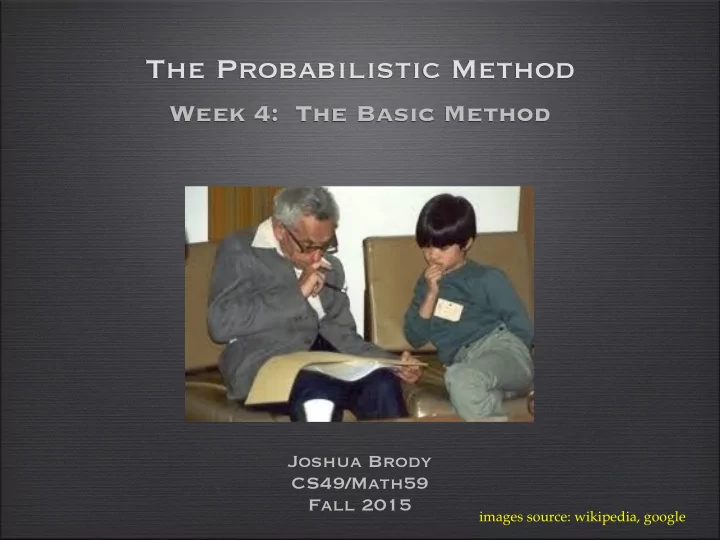
The Probabilistic Method Week 4: The Basic Method Joshua Brody CS49/Math59 Fall 2015 images source: wikipedia, google Clicker Question What does it mean for a tournament to have property S k ? (A) There is a set of k players that beat all


slide-1
SLIDE 1

The Probabilistic Method

Joshua Brody CS49/Math59 Fall 2015

Week 4: The Basic Method

images source: wikipedia, google
slide-2
SLIDE 2

Clicker Question

(A) There is a set of k players that beat all other players. (B) For any set of k players, there is one player that beats them all. (C) There is a set of k players that are all beaten by

  • ne player.

(D)For any set of k players, there is a player beaten by all of them

What does it mean for a tournament to have property Sk?

slide-3
SLIDE 3

Clicker Question

(A) There is a set of k players that beat all other players. (B) For any set of k players, there is one player that beats them all. (C) There is a set of k players that are all beaten by

  • ne player.

(D)For any set of k players, there is a player beaten by all of them

What does it mean for a tournament to have property Sk?

slide-4
SLIDE 4

Clicker Question

(A) A = {1, 2, 4, 6} (B) B = {17, 19, 35, 47, 101} (C) C = {-14, 22, 57, 71} (D)multiple answers correct (E) no answers correct

Which of the following sets are sum-free?

slide-5
SLIDE 5

Clicker Question

(A) A = {1, 2, 4, 6} (B) B = {17, 19, 35, 47, 101} (C) C = {-14, 22, 57, 71} (D)multiple answers correct (E) no answers correct

Which of the following sets are sum-free?

slide-6
SLIDE 6

Tournaments

Definition: A tournament on n players is an

  • rientation of Kn

(u,v) directed edge: “u beats v”

slide-7
SLIDE 7

Property Sk

Definition: T has property Sk if every set of k vertices there is another vertex that beats them all.

slide-8
SLIDE 8

Property Sk

Definition: T has property Sk if every set of k vertices there is another vertex that beats them all. Question: Are there always tournaments w/Sk?

slide-9
SLIDE 9

Tournaments with Sk

Theorem: If then there is a tournament

  • n n vertices with property Sk.

( )

n k

n-k

(1-2-k) < 1

slide-10
SLIDE 10

Tournaments with Sk

Theorem: If then there is a tournament

  • n n vertices with property Sk.

Proof:

  • Choose random tournament on n vertices.
  • each edge u → v or v →u independently w/prob 1/2.

( )

n k

n-k

(1-2-k) < 1

slide-11
SLIDE 11

Tournaments with Sk

Theorem: If then there is a tournament

  • n n vertices with property Sk.

Proof:

  • Choose random tournament on n vertices.
  • each edge u → v or v →u independently w/prob 1/2.
  • BADK: event set of vertices K not dominated by another vertex

( )

n k

n-k

(1-2-k) < 1

slide-12
SLIDE 12

Tournaments with Sk

Theorem: If then there is a tournament

  • n n vertices with property Sk.

Proof:

  • Choose random tournament on n vertices.
  • each edge u → v or v →u independently w/prob 1/2.
  • BADK: event set of vertices K not dominated by another vertex
  • BAD := ∪K BADK;
  • GOOD:= ¬BAD

( )

n k

n-k

(1-2-k) < 1

slide-13
SLIDE 13

Clicker Question

(A) 2-k (B) (1-2-k) (C) 2-k(n-k) (D)multiple answers possible (E) none of the above

What is the probability that a set of k vertices does not get dominated?

slide-14
SLIDE 14

Clicker Question

(A) 2-k (B) (1-2-k) (C) 2-k(n-k) (D)multiple answers possible (E) none of the above

What is the probability that a set of k vertices does not get dominated?

slide-15
SLIDE 15

Tournaments with Sk

Theorem: If then there is a tournament

  • n n vertices with property Sk.

( )

n k

n-k

(1-2-k) < 1

slide-16
SLIDE 16

Tournaments with Sk

Theorem: If then there is a tournament

  • n n vertices with property Sk.

Proof:

  • Choose random tournament on n vertices.
  • each edge u → v or v →u independently w/prob 1/2.
  • BADK: event set of vertices K not dominated by another vertex
  • BAD := ∪K BADK; GOOD:= ¬BAD

( )

n k

n-k

(1-2-k) < 1

slide-17
SLIDE 17

Tournaments with Sk

Theorem: If then there is a tournament

  • n n vertices with property Sk.

Proof:

  • Choose random tournament on n vertices.
  • each edge u → v or v →u independently w/prob 1/2.
  • BADK: event set of vertices K not dominated by another vertex
  • BAD := ∪K BADK; GOOD:= ¬BAD
  • Pr[BADk] =
  • # k vertex subsets:

( )

n k

n-k

(1-2-k) < 1

n-k

(1-2-k)

( )

n k

slide-18
SLIDE 18

Tournaments with Sk

Theorem: If then there is a tournament

  • n n vertices with property Sk.

Proof:

  • Choose random tournament on n vertices.
  • each edge u → v or v →u independently w/prob 1/2.
  • BADK: event set of vertices K not dominated by another vertex
  • BAD := ∪K BADK; GOOD:= ¬BAD
  • Pr[BADk] =
  • # k vertex subsets:

( )

n k

n-k

(1-2-k) < 1

n-k

(1-2-k)

( )

n k

union bound: Pr[BAD] ≤ ( )

n k

n-k

(1-2-k) < 1

slide-19
SLIDE 19

The Probabilistic Method