
SLIDE 1
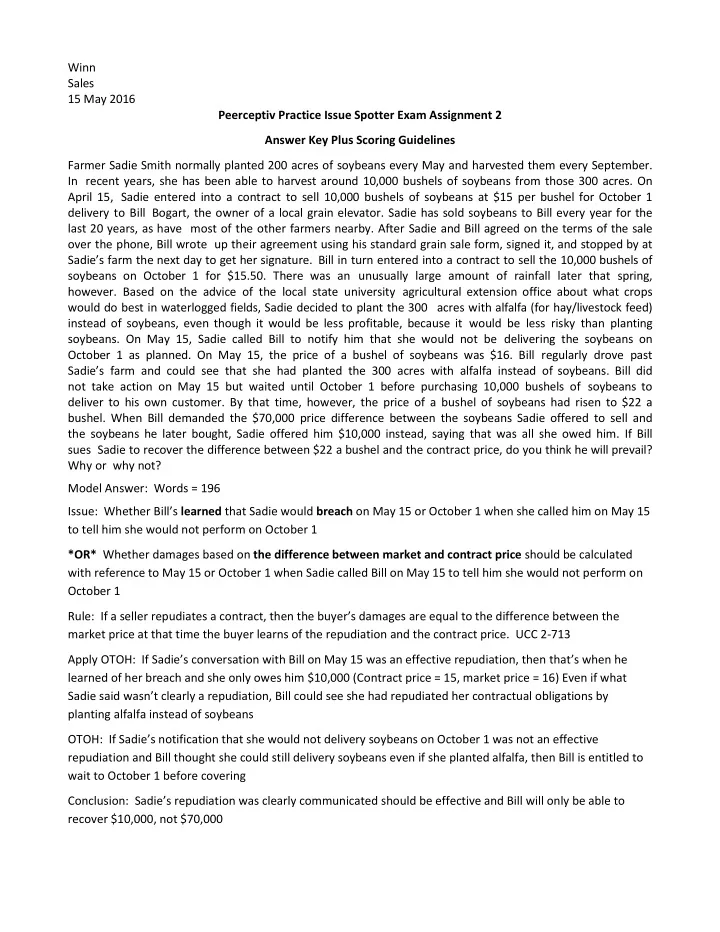
Winn Sales 15 May 2016 Peerceptiv Practice Issue Spotter Exam Assignment 2 Answer Key Plus Scoring Guidelines Farmer Sadie Smith normally planted 200 acres of soybeans every May and harvested them every September. In recent years, she has been able to harvest around 10,000 bushels of soybeans from those 300 acres. On April 15, Sadie entered into a contract to sell 10,000 bushels of soybeans at $15 per bushel for October 1 delivery to Bill Bogart, the owner of a local grain elevator. Sadie has sold soybeans to Bill every year for the last 20 years, as have most of the other farmers nearby. After Sadie and Bill agreed on the terms of the sale
- ver the phone, Bill wrote up their agreement using his standard grain sale form, signed it, and stopped by at
Sadie’s farm the next day to get her signature. Bill in turn entered into a contract to sell the 10,000 bushels of soybeans on October 1 for $15.50. There was an unusually large amount of rainfall later that spring,
- however. Based on the advice of the local state university agricultural extension office about what crops
would do best in waterlogged fields, Sadie decided to plant the 300 acres with alfalfa (for hay/livestock feed) instead of soybeans, even though it would be less profitable, because it would be less risky than planting
- soybeans. On May 15, Sadie called Bill to notify him that she would not be delivering the soybeans on
October 1 as planned. On May 15, the price of a bushel of soybeans was $16. Bill regularly drove past Sadie’s farm and could see that she had planted the 300 acres with alfalfa instead of soybeans. Bill did not take action on May 15 but waited until October 1 before purchasing 10,000 bushels of soybeans to deliver to his own customer. By that time, however, the price of a bushel of soybeans had risen to $22 a
- bushel. When Bill demanded the $70,000 price difference between the soybeans Sadie offered to sell and