
SLIDE 1
Winemaker inemaker of the Y
- f the Year 2015
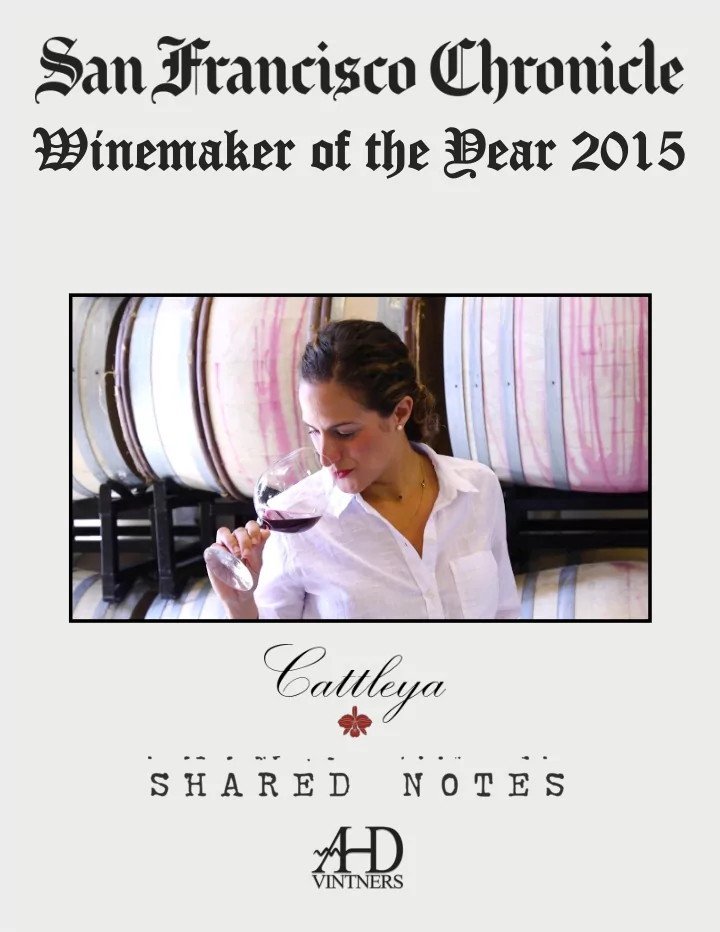
Winemaker inemaker of the Y of the Year 2015 ear 2015 Winemaker - - PDF document
Winemaker inemaker of the Y of the Year 2015 ear 2015 Winemaker inemaker of the Y of the Year 2015 ear 2015 BIBIANA GONZALEZ - RAVE ESTHER MOBLY December 3rd, 2015 What does it mean to name someone the winemaker of the year? The
What does it mean to name someone the “winemaker of the year”? The identity of a California winemaker has never been more complicated than it is in 2015. The dream of the estate is all but impossible for the nascent generation
working a day job while pouring your spare time into a fledgling personal project; buying 1-ton lots, piecemeal, because that’s all you can afford, from vineyards all over the state; custom-crushing or begging your employer to let you use their equipment. For more and more winemakers here, the goal is not to have just one project, but to consult for many. Bibiana González Rave, The Chronicle’s 2015 Winemaker of the Year, exemplifies this modern vintner. She is an accomplished winemaker, crafting outstanding wines that speak of their place, firmly rooted in the lessons she learned in French cellars while reveling in the wild freedom that California affords. And she represents what a California winemaker in 2015 can be. Which is a lot. Rave’s got a day job of sorts, at Wayfarer, owned by Napa-based Pahlmeyer — though she’s a consultant, not on payroll, “because that way I keep my freedom.” She’s got her own label, Cattleya, named for Colombia’s national flower, the orchid. With her husband, Jeff Pisoni, Rave makes Shared Notes, a highend line of Sauvignon Blanc. In an ambitious new move, she’s launching Alma de Cattleya, a value priced brand of California wines for distribution in Colombia. She is not pigeonholed to a single grape, nor confined to a single region. Her vineyards stretch as far north as Fort Ross and as far south as Monterey. She makes her wines not in an idyllic château, but in a Santa Rosa industrial park. She’s a mom. Or, if you prefer Jayson Pahlmeyer’s summary: “She’s a genius.” Rave came to California wine from both the likeliest and the least likely places: Bordeaux, France and Medellín, Colombia. Raised in Medellín in the days of Pablo Escobar’s de-facto reign (“Have you seen “Narcos”? That’s exactly what it was like!” she says, referencing the American television drama), the teenage Rave had never seen a vineyard when the notion that she would be a winemaker possessed her. ESTHER MOBLY December 3rd, 2015
“I just knew that I would make wine,” she shrugs, unable to explain. Her electrical engineer father and economist mother wanted their bright daughter to become the CEO of a big company. No one in Colombia drank wine. The drink of choice was the potent sugarcane and anise liquor aguardiente. After studying chemical engineering in Colombia, Rave went to France to study at universities in Bordeaux and Cognac. Meanwhile she worked a string of harvests, including at Bordeaux’s Château Haut-Brion, the Northern Rhône’s Domaine Michel & Stéphane Ogier and Burgundy’s Domaine Du Devevey — where she made a big impression on some of France’s most legendary vintners. “I rarely had such a curious intern,” says Jean Philippe Masclef, Haut-Brion maître du chai, or cellar master. Stéphane Ogier agrees: “I didn‘t want to take a worker that year, but I could feel immediately that Bibiana was special. In her wines now, you sense her passion.” France provided a rigorous training in the classics, but Rave knew that the path to success there would be long. “I’d work in France only if I could be the winemaker at Roumier,” she half-jokes, referring to the famous Burgundy domaine. “It takes 30 years to become an actual winemaker.” California offered “a chance to work with benchmark French varieties,” like Syrah, Pinot Noir and Sauvignon Blanc, but with total freedom to chart one’s own course. Here, you don’t have to inherit a domaine in order to be its winemaker. You’re not restricted to certain grape varieties (like Pinot Noir in Burgundy) or certain winemaking techniques. You’re not told by the government which sites are “grand cru.” In California there is the possibility, however remote for the young and the broke,
Before breaking out on her own, there were more years of hemisphere-hopping — three years in South Africa, harvests in California at Peay, Au Bon Climat, Qupé — and then, in 2009, a full-time winemaking gig at Sonoma’s Lynmar Estate. By the time Rave left Lynmar in 2011, she was ready to work for herself. She began consulting for Way- farer and launched Cattleya and Shared Notes. Rave is fully a French-style vigneron — a much-encompassing description of someone who is both grape grower and winemaker. “She is so connected to the vineyard,” says Anne Moller-Racke, who manages the Donum vineyard, from which Rave buys Pinot Noir for Cattleya. “That’s something a lot of people say, but for Bibiana it’s really true.” When she came on board as consulting winemaker at Wayfarer, Rave butted heads with the then-vineyard manager. She told the Pahlmeyers: My way or the highway. They let the vineyard
management, creating habitats for birds to eliminate pesticide use. “That vineyard is her baby,” Pahlmeyer says. In 2011, Rave married Jeff Pisoni — the California equivalent of marrying into a classed-growth legacy. She could have easily been subsumed by the Pisoni Vineyards business. Yet, though they make their wines in the same facility, she maintains total separation from her husband’s work — so much separation, in fact, that the couple decided to launch Shared Notes so that they could do something together. “There’s no sense of entitlement,” she says of her relationship with the Pisonis. Her brother-in-law Mark charges her for Soberanes Vineyard Syrah as he would charge anyone. When she realizes her ultimate dream
Not only is Rave at the forefront of a revolution in what it means to be a California winemaker — independent, multifaceted and resourceful, tied more to one’s own identity than to any pedigreed estate — but she is also leading a revolution in what California wine itself should be. Her radicalism is to reject polarization. Rave‘s wines exist in some liminal space between warm, generous California, land of the free, and the strictures of the Old World, with its time-proven traditions. This sensibility leaves Rave unswayed by the moving needle of winemaking fads. She listens only to her own inner compass. Among its Fort Ross-Seaview neighbors, the Wayfarer wines stand defiantly for the principle that rich, velvety wines can still be balanced. “Hirsch, Failla, Flowers have been so decisive on what they want the Sonoma Coast to be — so light,” she says. “But that’s not what Wayfarer gives us.” She can’t understand the current obsession with low alcohol levels. In France, she says, it was not discussed; alcohol is not on her mind when she makes harvest decisions. “I’m not a 13.5% winemaker,” she shrugs. “I don’t think you get aromatic compounds at veraison,” referring to the ever-earlier trend of pick dates that tends to render more austere, lower-alcohol wines. The Wayfarer and Cattleya Pinot Noirs, nevertheless, are elegant, refined and relentlessly floral — as with Burgundy, they have more finesse than power. Her Cattleya Syrah is meaty and angular, a California Côte- Rôtie. The Shared Notes Sauvignon Blancs include a stunning ode to the Haut-Brion Blanc, expansive and structured. The impatience with winemakers who seek to reinvent the wheel comes partly from Rave’s classical education, but also from her own personality. Just as she maintains complete autonomy from the Pisonis, so does she forge her own independent path stylistically.
Cattleya, which is named after the Colombia state flower, is Bibiana’s personal project and focuses primarily on single vineyard Pinot Noirs and Chardonnays, as well as a Syrah from the Santa Lucia Highlands. For the Chardonnays and Pinot Noirs, Rave pulls from two sites: Pratt and Donum Vineyards. The Pratt vineyard was developed in the early 1990’s by vineyard manager Jim Pratt and lies just to the north of Sebastopol, just south of the Green Valley AVA in the Russian River Valley. This is a sandy, loamy site that consist of rolling hillside parcels. The site sees the classic early morning fog, and high temperatures top out in the mid 70’s. Bibiana makes a Chardonnay from this site based all on the Wente clone. The Donum Vineyard is located to the east of Pratt Vineyard, in the Carneros AVA, and is planted with numerous clones of Pinot Noir and Chardonnay. Bibiana’s Donum Vineyard Pinot Noir is always a blend of Calera and Rutherford clones, and sees 40-50% whole clusters in the fermentation. The Syrah comes from the Soberanes Vineyard in the Santa Lucia Highlands, which is a younger, yet promising site managed by the Pisoni and Franscioni families. The philosophy here is simple: To produce unique wines of extreme purity, power, and finesse.
Cattleya Chardonnay Pratt Vineyard Russian River Valley 2016 (38 cases produced)
“A sensational effort that reminds me of a great Chassagne-Montrachet, the 2016 Pratt Vineyard comes from clone 15 and the old Wente clone, was harvested very late, and brought up all in new French oak. This awesome white boasts a stunning nose of caramelized citrus, toasted brioche, white flowers, and ripe orchid fruits. Deep, concentrated, yet with an overriding sense of purity and elegance, it has good acidity, building richness, and will knock your socks off over the next decade or more.” 97 Points
Cattleya Pinot Noir Cuvee Number One Russian River Valley 2016 (110 cases produced)
“From the cooler Green Valley portion of the Russian River (it’s all from Lakeview Vineyard), the 2016 Pinot Cuvee Number One comes from the Pommard and 115 clones and was brought up in a mix of new and used French oak. Beautiful red fruits, mulberries, flowers, and exotic spice notes, medium body, an elegant, yet rounded texture, and integrated acidity all emerge from the incredible Pinot Noir that has the class to drink nicely today, yet also evolve for a decade or more.” 95 Points
Cattleya Pinot Noir Donum Vineyard Carneros 2016 (46 cases produced)
“From the oldest vines in the vineyard, the 2016 Pinot Noir Donum Vineyard comes from a site in Carneros and spent 15 months in 65% new French oak. Beautiful black raspberry, sous bois, decayed flowers, and savory notes all flow to a medium to full-bodied, seamless Pinot Noir that has ripe tannin, a seamless texture, and a great, great finish. It’s another world-class effort from this estate that will compete with the best out there.”
97 Points
Cattleya Syrah Soberanes Vineyard Santa Lucia Highlands 2016 (65 cases produced)
“I think one of the best Syrahs coming out of California today is the Soberanes Vineyard from Bibiana. Sporting a vibrant purple color as well La Landonne-like notes of currants, bacon fat, white pepper, and cedar, the 2016 hits the palate with full-bodied richness, awesome purity of fruit, and a huge finish. More dry-aged beef and assorted meatiness develop with time in the glass, and while it was aged in 100% new French oak, it’s absorbed every trace
OTHER AVAILABLE WINES
Cattleya Chardonnay Pratt Vineyard Russian River Valley 2013 “14.5% alc., pH 3.38, TA 0.69, 101 cases. Pratt Vineyard is one of Sonoma County’s premier Chardonnay
vineyards, owned and farmed by Jim Pratt. The vineyard was planted in 2000, and this wine is sourced from 4 rows of clone 15 (Old Wente selection). Carefully hand sorted, gently pressed, native yeast fermented for 2 months, followed by 100% malolactic fermentation. Aged 15 months in 50% new French oak barrels. Moderately light golden yellow color and clear in the glass. Welcoming aromas of lemon pudding, pineapple and vanilla creme. Creamy and delicious on the palate, with flavors of pear, kiwi and grilled pineapple aug- mented by hints of butterscotch and nutty oak, offering impressive fruit expression, and sliding off the palate with aplomb at the finish. So beautifully composed, one is tempted to drink it all night. Reviewed February 5, 2016”
Cattleya Syrah Soberanes Vineyard Santa Lucia Highlands 2013
“ Wow, the 2013 Syrah Soberanes Vineyard is hold onto your hats good. Deep, inky, concentrated and impen- etrable, with a massive mid-palate, it has primordial notes of graphite, crushed rocks, burning embers and loads of black and blue fruits. I saw potential in this when I tasted it a few years ago, but wow! Forget bottles for 2-3 years and drink over the following decade or more. There’s 115 cases produced.
Cattleya Pinot Noir Cuvee Number One Russian River Valley 2014
14.2% alc., very limited, unreleased. Sourced from Lakeview Vineyard in the Green Valley of Russian River
Dark reddish purple color in the glass. Intoxicating aromas of black cherry, cassis and bark. Exceptionally refined in the mouth with a velvety texture, featuring mid weight flavors of black raspberry, blackberry and
A gregarious and toothsome wine that is meant to please. Score: 94. Reviewed February 5, 2016
Cattleya Chardonnay Russian River Valley 2015 “A new cuvee from Bibiana that’s released at a lower price point and made with the idea to be more ap-
proachable, the 200-case 2015 Russian River Valley Chardonnay comes from three different clones (4, 78 and 15), all from the Pratt Vineyard, and was brought up in 35% new French oak. While released at a lower price point, it offers a fabulous drinking experience and is a great introduction into the style of the estate. Stone fruits, apple blossom, toasted bread and hints of spice all give way to rich, textured, yet vibrant Chardonnay that’s one great drink”
96 Points 96 Points 94 Points 93 Points
Cattleya Chardonnay Pratt Vineyard Russian River Valley 2015 “Bottled in January, but not released until this September, the 2015 Chardonnay Pratt Vineyard is only from
clone 15 (which is an old Wente clone) and comes from just four rows in the vineyard. This is a very cool site and one of the last to be harvested. Native fermented and aged in 66% new French oak for 16 months, it has a sensational mix of richness and freshness, with lots of stone fruits, tangerine and green citrus aromas and flavors, beautiful concentration, high acidity and a great finish. Impressive, but unfortunately there’s
Cattleya Pinot Noir Cuvee Number One Russian River Valley 2015 “14.7% alc.,pH 3.52, TA 0.67, 143 cases. Spring release. Very limited production. sourced from Lakeview
Vineyard in the Green Valley of Russian River Valley. Pommard and 115 clones. Each clones fermented in its
clone aged separately in French oak barrels for 11 months. Moderate garnet color in the glass. Soaring aromas of Bing cherry raspberry, redwood grove and sous-bois. Intense on the attack with mouth filling flavors of black cherry and black raspberry fruits. A decadent, powerful wine that is yet demure in character with oodles of persuasive fruit goodness fueled by spirited acidity and backed by invisible tannins. The finish is exceptional long and endowed with uncommon generosity. I tasted this wine throughout a day’s time and it never wavered in its showy character. Wow! Score: 96. Reviewed November 12, 2017”
Cattleya Syrah Soberanes Vineyard Santa Lucia Highlands 2015
“The tiny production 2015 Syrah Soberanes Vineyard is a sensational Syrah that has complexity, elegance and
toasty oak and spice, it has an elegant, seamless style on the palate that’s already hard to resist. Reminding me of a silky Côte Rôtie from the southern end of the appellation, it needs 2-3 years of bottle age and will keep for a decade”
96 Points 96 Points 95 Points
VINEYARD NOTES The Pratt Vineyard is located in the Russian River Valley, a world renowned AVA in Sonoma County
rows of clone 15 were planted and are farmed carefully for Cattleya to produce the best clusters of Chardonnay grapes. Thanks to the intensity and complexity of fruit produced from this site, the Cattleya Chardonnay reflects the typicity and exceptional quality of white wines we can produce in Sonoma County from this finicky variety. WINEMAKING NOTES French Oak barrels, 100% which are new, were tenderly cared for throughout 16 months of aging. The harvest was on September 19th. The fruit was whole cluster pressed and the juice was cold settled overnight for barreling down the next day. The juice sat quietly in the barrel until the fermentation began several days later. By the end of the winter, all barrels had finished both native fermentation as well as malolactic fermentation. A very gentle racking occurred prior to bottling using argon gas.
Aging: 100% New Oak pH: 3.48 Alc: 14.2% TA: 6.1g/L Production: 38 cases
VINEYARD NOTES Cuvee Number One is a blend of two clones grown in the same vineyard. Lakeview Vineyard is located in the Green Valley AVA, a small very distinctive area inside the Russian River Valley AVA . I selected two clones from this vineyard as we developed our program for the Russian River AVA blend: 115 Dijon and Pommard. I love the way Pommard brings texture and mouth feel to a Pinot Noir blend while 115 enhances the intensity of the spicy and fruity aspect of the varietal. The vineyard is cane pruned with vertical shoot positioning, limited crop per vine, and a tremendous emphasis on optimal canopy management. WINEMAKING NOTES Each clone was fermented in it’s own small, stainless steal,
September 2nd 2016. There was a 5% whole cluster maceration inclusion on our Pommard fermenter. Fruit was destemmed 100% for our Dijon 115 clone. After a 10 day cold soak, fermentation began; punch downs were done daily throughout maceration. The wine fermented on the skins for 22 days, then was drained and barreled down for malolactic fermentation and aging. In 2016, each clone was aged in separate French oak barrels for 11 months. The wines are showing generous texture with soft tannins and a full bouquet of flavors. The fruit blend is 65% Pommard and 35% Dijon 115 with 20% new oak. We bottled on August 17th, 2017. pH: 3.52
VINEYARD NOTES Located in the coolest area of the Carneros-Sonoma coast AVA, this vineyard impresses by it’s history, the quality of the fruit produced and it’s importance in California Pinot Noir production. Once part of the traditional Buena Vista Carneros vineyard, the Donum estate was developed and planted in 1989-1990 under a different name. Anne Moller-Racke, viticulturist and vineyard manager, was the driving force of the development and planting of the 45 acre estate. Her passion for winegrowing and her deep knowledge of Pinot Noir in Carneros were essential reasons for me to initially approach her in 2012 to purchase fruit. WINEMAKING NOTES Roederer clone was harvested on September 26th. Fruit was destemmed. After a 10 day cold soaking, fermentation began and punch downs were done daily throughout maceration. The wine fermented on the skins for 16 days, then was drained and barreled down for malolactic fermentation and aging. After 11 months in 33% new oak, the wine was bottled unfined and unfiltered.
Aging: 33% New Oak pH: 3.63 Alc: 14.2% TA: 5.6 g/L Production: 56 cases
VINEYARD NOTES The Soberanes Vineyard is a site planted and farmed ex- clusively by the Pisoni and Franscioni families of the San- ta Lucia Highlands. Tradition and excellence are built in- to it’s name and practices. Named after Jose Maria Sober- anes, part of the famed Portala expedition of 1769, the vineyard is meticulously farmed and thrives in a cool cli- mate of fog and wind from Monterey Bay. The expres- sion of Syrah from this site is one of beauty and finesse. WINEMAKING NOTES The fruit was night harvested
soaking with 45% of whole cluster, the grapes began a native fermentation. Punch downs alternating with pump
fine balance of tannin, color and flavor extraction. After 25 days of fermentation, the wine was sent to barrel, over 70% new French oak having three to five years aging on the staves. Coopering details and toast levels are specifi- cally chosen for this single vineyard wine. Aging: 70% New Oak pH: 3.53 Alc: 14.2% TA: 7.3 g/L
Shared Notes is a celebration of Sauvignon Blanc, with the first two releases paying homage, separately, to the white wines of Bordeaux and the Loire Valley, with grapes sourced from the Russian River Valley. The Shared Notes releases are a project between Bibiana Gonzalez-Rave and husband Jeff Pisoni, which they started in 2012 so that they could spend more time together during harvest. Previously, during the grape harvest, Bibiana and Jeff were like the proverbial ships passing in the night. Early grape picks and late nights at the winery left them rarely crossing paths. Now, Bibiana and Jeff do cross paths—to discuss ideas and taste
likely with a glass in hand. Both had early desires of making wine, and spent most of their lives doing so. Bibiana learned how to make Sauvignon at Château Haut-Brion, and for this project they harvest at tiny yields, ferment at low temperatures, and age the wines in new barrels. These are unquestionably some of the top examples of Sauvignon and
CURRENT RELEASES
Shared Notes Les Pierres qui Decident Russian River Valley 2017
“The 2017 Sauvignon Blanc Les Pierres Qui Décident is made from 100% Sauvignon Blanc (all Musque clone), fermented in 100% new French oak and aged in puncheons for eight
paste, gooseberry and kiwi—this has tons of layers! Light to medium-bodied, it gives intense tropical and citrus flavors in the mouth, with very zippy acidity, pleasant texture and a long, mineral-driven finish. A serious Sauvignon Blanc. 78 cases produced. Shared Notes is a joint venture between husband and wife Bibiana González Rave and Jeff
I worked at Haut-Brion for my thesis," Rave says, " and Jeff worked at Peter Michael. So we both wanted to make an oak-fermented, French-inspired Sauvignon Blanc."
Shared Notes Lecons des Maitres Russian River Valley 2017
“Composed of 68% Sauvignon Blanc and 32% Sémillon, the 2017 Les Leçons des Maîtres
chopped herbs, pineapple, candle wax and white flowers. Light to medium-bodied with a waxy texture, it has loads of spicy tropical fruits and savory nuances lifted by zippy acidity, with a long, textured finish. Yum! “ 68 cases were made.
92+ Points 92 Points
Style: A blend inspired by the cellar masters of
Bordeaux and their dedication to Sauvignon Blanc and Semillon.
Variety: 68% Sauvignon Blanc (clone 1)
32% Semillon (clone 315)
AVA: Russian River Valley - Sonoma County Vineyard Source: Sauvignon Blanc from Kick
Ranch Semillon from Marino Vineyard
Harvest Date: Sauvignon Blanc- August 28th, 2017
Semillon– August 21st, 2017
Aging: 100% New French, Oak Barrel fermented
8 Months on the Lees No Malolactic Fermentation
Figures: pH of 3.03 / Alc 13.07% Bottled Date: June 28th, 2018
Heady aromas of white peach, tangerine, blood orange and citrus zest are all delicately complemented by notes of fresh acacia. Les leçons des maîtres embraces the palate with a textural richness courtesy of Semillon and the time it spent aging in barrel. The lengthy finish is redolent of peaches and honeysuckle, a perfect example of the beautiful marriage between racy Sauvignon Blanc and luscious Semillon. 68 cases 750 mL | 10 cases 1.5 L
Style: A Sauvignon Blanc inspired by the pure and
focused wines of the Loire Valley, where the rocks "decide" the style.
Variety: 100% Sauvignon Blanc (clone Musque) AVA: Russian River Valley - Sonoma County Vineyard Source: Kick Ranch 20%
Marino Vineyard 80%
Harvest Date: Kick Ranch - August 24th, 2017
Marino Vineyard – August 29th, 2017
Aging: 100% New French, Oak Barrel fermented
8 Months on the Lees No Malolactic Fermentation
Figures: pH of 3.02 / Alc 13.69% Bottled Date: June 28th, 2018
Enticing complexity meets dazzling linear acidity in the 2017 Les pierres qui décident. Crisp granny smith apple, zesty lemon, and mouthwatering lemon meringue pie give way to a hint of lightly toasted French oak to tease your
perfumed taste of bourgeon de cassis characteristic to this style of Sauvignon Blanc.
OTHER AVAILABLE WINES
Shared Notes Les Pierres qui Decident Russian River Valley 2015
“The 2015 Les Pierres qui Décident is bright, finely sculpted and loaded with Sauvignon Blanc energy. Citrus, sage, tomato leaf and green pear give the wine its translucent, chiseled personality. Crystalline and nuanced to the core, the 2015 is super-expressive. Hints of green pear, sage, mint and tomato leaf punctuate the finish. Les Pierres qui Décident is one of the most distinctive Sauvignon Blancs being made in California today. “
Shared Notes Lecons des Maitres Russian River Valley 2015
“The 2015 Les Pierres qui Décident is rich, sensual and inviting. Jasmine, white pepper and mint open up
through the middle. Drink this sensual, inviting white over the next few years. “
Shared Notes Les Pierres qui Decident Russian River Valley 2016 “The
2016 Les Pierres qui Décident, 100% Sauvignon Blanc, screams with varietal character. Lemon peel, mint, sage, tomato leaf, sea salt and herb notes are wonderfully alive in the glass. Crisp, dry and bracing, the 2016
94 Points 93 Points 93 Points